Something Worth Stealing
An old repair sketch leads Beech beneath the meeting hall, where an empty stone cradle reveals why the goblins came—and what their stolen prize could unlock.
In which Beech learns that some doors are better left closed, and that someone has been collecting keys.
Beech had never considered a drawing of a door to be a dangerous object.
A badly hung door could be dangerous. He had learned that at the age of thirteen, when his father had allowed him to fit the hinges on Widow Fenner's old coal shed. The door had fallen off before the paint was dry, narrowly missing the widow's foot and landing on her cabbage knife. She had been remarkably clear about where she thought the fault lay.
A drawing, on the other hand, was just lines on parchment. Nobody had ever been injured by a drawing, unless one counted the occasion on which Beech had submitted a bill to the village council and received a very sharp letter in return.
Yet now a scorched piece of his own handiwork lay on a plank between Nella and Merrick, and the three of them were treating it as if it might bite.
The sheepfold had settled into the uneasy quiet that came after a long, difficult day. Beyond the repaired canvas shelters, lookouts moved between the ash trees. Inside the stone store, Berta was tending Pellin's wounded leg. The lad had survived the arrow, but his skin was hot and his face too pale, and Beech could not get the memory of him collapsing in the mill doorway out of his head.
Nella traced the new lines on the back of the drawing without touching the blackened edge.
"Yours show the old yard entrance," she said. "These show something below it. But that isn't a cellar, is it?"
"Not one I ever built." Beech bent closer. "This is my mark for a beam. That's a hinge. Those three strokes mean I needed three bolts and only had two. I was hoping nobody would notice."
"And this square?"
"Not mine. Whoever drew it knew the measurements well enough to fit it beneath the hall wall, but they used a different scale."
Merrick leaned on his bad knee and frowned at the paper. "I hate it when a man builds something in a different scale. You turn up with a wheel that's the size of a dinner plate and he tells you the cart's perfectly sound."
"I don't think it's a cart," Beech said.
"That much I'd guessed."
At the end of the added passage was the same mark they had seen on the disciplined goblins: a white circle broken by a straight line. It was drawn neatly, almost ceremoniously, with none of the hurried strokes Beech recognised from his own work.
Nella folded her hands. "Someone knew the hall had a hidden room. They knew how to reach it. And the goblins knew where to go. We need more than a guess before we tell twenty-seven frightened people that there's something under their homes."
Beech would have preferred to tell them there was nothing under their homes except a disappointing amount of damp.
From the store came a muffled cry as Pellin's dressing was changed. All three fell silent. Nella looked towards the door, then back at the map.
"Whatever this is," she said, "we are not losing another person over a piece of paper."
Beech tucked his mother's frying pan closer beneath the bench. For once, he had no argument.
The next morning began with a complaint from Harl about missing cheese.
This was not unusual. Harl regarded the movement of food from one place to another without his express permission as a matter of national importance. On this occasion, the culprit proved to be Duchess, who had pushed her snout into a basket and eaten a rind, the corner of a loaf and part of a cloth napkin.
"She'll give herself a stomach ache," Harl said.
Widow Fenner regarded the enormous sow with satisfaction. "Nonsense. She's eaten your cooking before."
There were several moments of what might have been laughter. Then Berta emerged from the store, and everyone stopped.
"Pellin's resting," she said. "The bleeding hasn't started again. He's feverish, though, and I want clean water and fresh cloth kept ready. Nobody's to make him carry anything, however much he says he can."
Beech had been going to ask if the lad wanted some breakfast. He decided the question could wait.
Joss lay nearby beneath a folded blanket, his injured arm in a sling. Tilly sat beside him working knots into lengths of twine for the runners. She had invented three patterns to identify messages from the outer posts: one knot for a seen danger, two for a clear path just checked, and three for a request for help. Tam had protested that three was hardly enough. Tilly had replied that it was enough for people who intended to remember them.
Beech showed Joss the drawing.
The carter studied the scorched scrap for a long time. "That's the yard old Councillor Brant kept locked. Had a wall round it and a gate that opened crooked. I took a load of stone there once, years back."
"What sort of stone?" Beech asked.
"Big blocks. Not new cut. They'd dug them out of the ground behind the hall. Brant told me they were making the foundations safe."
"Did you see a cellar?"
"I saw a hole with timber over it and three council men telling me to put the blocks somewhere else. I wasn't paid to ask questions."
"You usually ask them anyway," Tilly observed.
"That's how I know what people owe me."
Beech was wondering what sort of hole required three council men to conceal it when Widow Fenner came to inspect what she called the spreading of nonsense. She heard Brant's name, looked at the drawing and made a small, disapproving sound.
"That yard wasn't always locked," she said. "Before you were born, Beech, the hall keeper used to air the old records there after a wet winter. There was a stone hatch under the rear steps, and my grandfather said you could hear water below when the brook was high."
"A drain?" Merrick asked.
"That's what they told us. But Brant had it sealed after the flood. I remember three workmen carrying a narrow iron chest down those steps before they put the stone cover back. The council said it belonged to the old workings and should stay there."
Beech straightened. "An iron box?"
"Chest, box, coffin for a particularly thin person. I wasn't measuring."
The ironbound chest the marked goblins had carried north had been narrow enough to hang between two poles. Beech looked at Nella, and she looked back.
"They left it underneath the hall?" he asked.
"Where else?" Widow Fenner replied. "Councils are remarkably good at keeping things in rooms nobody uses, behind doors nobody's allowed to open."
"And the key?"
She gave him a long look. "I have no idea. I wasn't on the council. They wouldn't have had me."
"I wonder why," Harl murmured.
The widow turned. Harl became very busy with his remaining cheese.
Nella decided they would make one careful visit to the meeting hall.
She did not describe it as an expedition. Beech suspected this was because expeditions tended to involve adventure, and Nella had formed a clear opinion of adventure after seeing what it did to Pellin's leg.
There would be three of them: Nella, Beech and Mara. Mara's brother kept a cooperage beside the old meeting-hall yard, and she had found the scorched parchment while retrieving the family's washing from that very spot the day before. She knew which rear walls could be passed unseen, and which paths had filled with fallen masonry. Fern would accompany them, but the dog was to remain close rather than range ahead where an arrow might find her.
Merrick would stay at the sheepfold with his knee and the mill knowledge nobody could replace. Darron would help the farmhands strengthen the stone store without lifting anything with his injured left arm. Harl would supervise food, watches and, to his considerable disgust, washing bowls.
"If the hall is occupied, we turn back," Nella told them. "If anyone spots us, we go straight to the orchard track. We aren't there to fight for a ruin."
"It's not entirely ruined," said Beech. "I helped put up the rear—"
"Beech."
"The orchard track. Understood."
He packed a heel of bread, his kitchen knife, a short chisel, a wooden mallet, and the amended drawing in his canvas bag. The carved wooden horse remained wrapped in cloth beside the paper, its little leg broken and one ear burned away. He had promised Elna that he would repair it for her niece, and every time he saw it he remembered another promise waiting to be kept.
He put on his separate walking boots, which had dried stiff by the sheepfold fire, and adjusted his torn brown cloak. His left wrist hurt when he tightened the buckle. The dented frying pan hung from his belt, more for familiarity than any expectation that it would solve the problem.
Nella watched him trying to keep the pan from striking his knife sheath.
"Do you need to bring that?"
"It's my mother's."
"I know whose it is."
"Then you know I can't leave it for Duchess."
Nella let the matter rest, though her expression suggested she had not conceded a thing.
Tilly handed them three short pieces of knotted twine, each with a different pattern. "If you send someone back with a warning, give them this. Don't just shout."
"I can remember one, two and three," Beech told her.
"Tam said that yesterday."
"A very fair point."
He put the twine in his pocket and followed the others downhill.
Briar Glen was quieter than it had been during the raid, but the silence made it feel less like home.
The smell of burned thatch lingered in the hedges. In the lane behind the bakery, rain had turned the ash into a dark paste that clung to Beech's soles. Someone had set a broken chair upright beside a wall, as though intending to come back for it, and the sight bothered him more than the wrecked roof beyond.
They avoided the mill approach where the archer had wounded Pellin. Beech knew the bowman too well: first the arrow through his sleeve in the flour-covered lane, then the night at Joss's stable, and finally the shot that had left Pellin feverish and unable to stand. Nella would not risk giving him another easy shot.
Instead, Mara guided them behind the eastern cottages and along the old drover's track. The fallen gate still lay where the villagers had shifted it during Operation Breakfast. A runner had checked the path earlier and found no raiders on it, but Nella reminded Beech that a report was not a promise.
They stopped behind the orchard wall. From there they could see the meeting hall's upper windows and the remains of the bell tower. The hall itself was not badly burned. Two adjoining houses had blackened rafters, but the hall roof remained intact except where falling masonry had torn a corner.
"They wanted it standing," Mara whispered.
Beech remembered the prisoner in the cattle pound saying, No fire in the hall. Go and make noise somewhere else. He had wanted it to be a lie. Looking at the untouched roof beside those ruined homes, he no longer thought it was.
A pair of ordinary goblins crossed the square, carrying a copper kettle and arguing about which of them had found it. They were followed at a distance by a third figure with a bow. He moved without hurrying, looking at the roofs and windows instead of the kettle.
Beech recognised the stillness with which the creature watched the windows. "The archer," he whispered.
Nella saw him. She drew them farther behind the orchard wall until the goblins passed. For several minutes they waited without speaking. Fern lay with her head low between her paws, as still as an old hunting dog carved above a hearth.
When Nella finally nodded, they went around Brant's locked yard by a narrow passage between two boundary walls. At the far end was the old service gate.
It stood closed, swollen by rain. Its hinges were hidden beneath patches of rust, and a fresh scrape in the stone showed where something heavy had been dragged through recently.
Beech knelt beside the latch.
"I worked on this gate with my father," he whispered. "Brant complained we'd put the hinges on the wrong side. My father told him he was looking at it from the wrong side."
"Can you open it?" Nella asked.
"Yes, if the latch hasn't rusted solid."
He slid the chisel beneath the upper keeper and worked it carefully. The gate gave a little but caught at the bottom. He stopped before forcing it; old wood made a louder sound when it broke than people ever expected. Instead he eased a wedge of loose stone from beneath the sill and lifted the gate against its sagging hinge.
It opened a hand's width. Then another.
Mara slipped through first, followed by Nella and Fern. Beech squeezed after them, careful of his cloak.
For once, nothing caught.
He thought this so remarkable that he nearly said so aloud.
Brant's yard was little more than a rectangle of weeds and wet stone. Two old benches leaned against the far wall. Beneath the rear steps of the meeting hall, a square patch of paving had been cleared recently, exposing a thick iron ring lying flat in a recessed stone slab.
Beech crouched beside it. He could see the marks of a crowbar in the joint.
"That's been lifted," he said. "Then set back."
"By the marked goblins?" Mara asked.
"Someone with a good lever and a poor opinion of the paving."
The slab was heavy, but it was designed to move. Beech found a small socket in its edge and fitted his chisel into it. Nella held the iron ring with both hands while Mara stood watch at the gate. Together they raised the slab just enough for Beech to slide a loose brick beneath the corner.
A breath of cold air rose from the darkness, smelling of wet stone and iron.
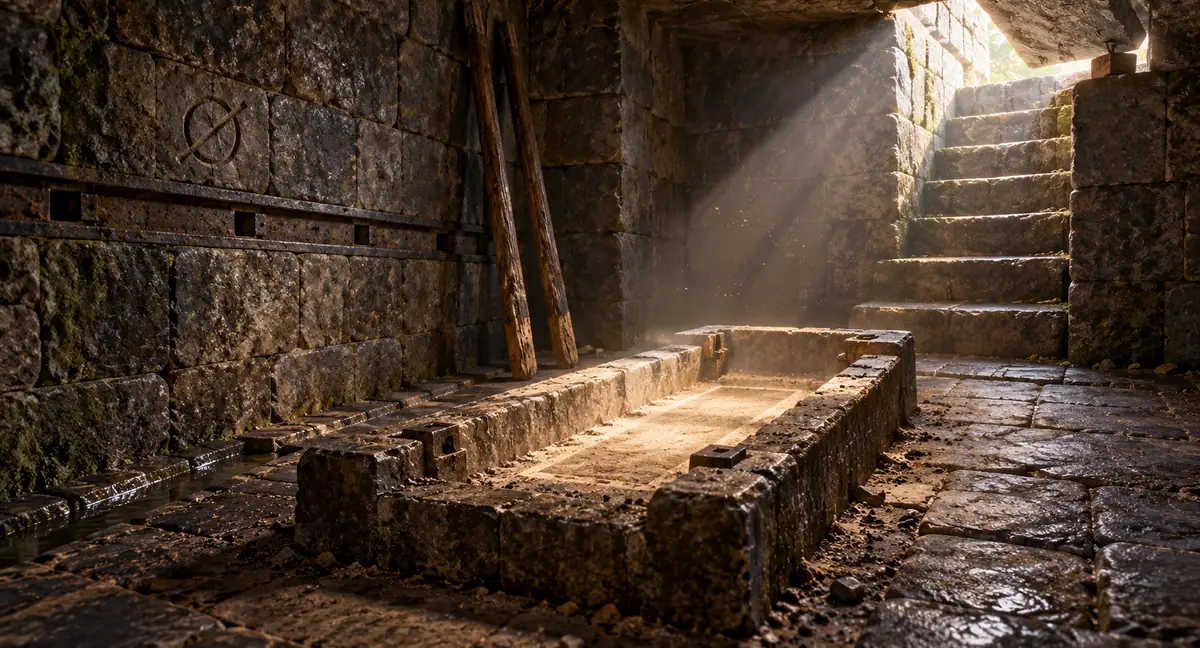
Below was a shallow flight of steps, cut squarely and carefully, with worn hollows where feet had once passed. Whatever Brant had called it, this was no drain. The lowest visible step turned beneath the hall foundations and vanished. Along the wall ran a narrow groove lined with old iron, and beside it was a symbol carved into the stone: a circle crossed by a single bar, its edge open where the stroke passed through.
Beech touched the carved stroke with one finger. It was the broken white ring.
"That's not a banner mark," he whispered. "It's a drawing of something."
Nella brought the charcoal-marked parchment close to the opening. The added line from the square beneath the hall ended at precisely that sign. Whoever had copied his old sketch had not invented the passage. They had mapped something real.
"We go only far enough to see what was taken," she said. "Mara keeps the yard. If she hears anyone, we come back at once."
Beech had been hoping to suggest remaining above ground, but the stairs seemed a poor place to discuss it. He followed Nella down, taking care with his sore wrist against the wall.
The passage ended after twenty paces in a low stone chamber. Their daylight came from a narrow shaft above the steps; it was just enough to show walls built of dark, close-fitted blocks that looked nothing like the rough foundations of the meeting hall. Water dripped somewhere beyond them. Beech could hear it travelling through a hidden channel beneath the floor.
At the chamber's centre stood an empty stone cradle, shaped to hold something long and narrow. Its surface was clean where a chest had rested, while the edges were furred with dust and old grit. Two timber poles lay against the wall, their ends newly scuffed.
"They carried it from here," Nella said.
Beech touched the cradle. The wood of the carrying poles was fresh; the stone beneath was old beyond guessing. Someone had gone to great trouble to remove a single object and had ignored everything else.
On the wall behind the cradle, a row of worn letters had been cut into a limestone strip. Their shapes were strange, but the words were in an older form of the common tongue. Beech's father had shown him similar lettering on an abandoned bridge north of the village, warning him never to confuse it with a builder's tally.
Beech brushed away the dust and read slowly.
"The North Winding Key ... laid here ... for the closing of the Underway."
He tried the middle words twice, but they were worn too deeply. Beneath the inscription was a carved diagram: two heavy doors at opposite ends of a passage cut through the hills. A round wheel and crossbar stood beside the northern door, beneath the words North Scar. The broken-ring symbol had been carved there too, not as decoration but as the outline of the wheel's fastening.
Nella leaned closer. "Underway?"
"An old road beneath the ground, I think." Beech traced the passage until a crack in the stone interrupted it. The southern end was marked Vale Mouth. Beside it, in smaller letters, was Lower Briar—the old name for the land on which the village stood. He pressed his fingertip to the southern mark and then looked up towards the stone ceiling and the meeting hall above it.
"This is the southern end," he said. "Or a room belonging to it, at least. The actual gate isn't this little hatch we came through."
"Where is it?" Nella asked.
Beech pointed out the iron groove running beneath the wall. It continued past the cradle and disappeared into solid masonry. "Further down, perhaps. Somewhere beyond that wall. I couldn't tell you how to reach it, let alone open it."
There was another mark scratched into the limestone, far newer than the inscription: the outline of a narrow chest beside a measurement in charcoal. The deliberate strokes matched the additions to Beech's repair drawing.
"Whoever made that map knew what to take," he said.
"A key," Nella answered. "Not treasure. A key to a road."
He looked at the empty cradle, remembering the families he had seen driven into the lanes by fire. Someone had wanted this old road badly enough to do that to Briar Glen.
A small scraping noise came from overhead.
Beech turned towards the stair.
For a moment he thought it was Mara moving their brick. Then came the click of iron striking stone and a voice speaking low in the common tongue.
"Someone's had the rear cover up," a voice said from the yard. "Look at the scrape on the stone."
Nella caught Beech's sleeve and pulled him behind a broad pier beside the cradle. Two sets of footsteps approached the open hatch; then came Mara's warning, a pebble dropping through the gap and striking the lower step. She was still at her post above.
"The winding key's gone north to North Scar," the first voice said. It was not the captain's coarse bellow. This speaker sounded precise and cold. "Why are we back here?"
"Because the master wants the other gate working," answered the second. "Vale Mouth. The southern end. The key can open North Scar all it likes, but if the road's blocked at this end, what's the use?"
In the darkness Beech followed the narrow iron groove with his eyes. It ran away from the chamber, deeper under the hall, towards the southern gate they had not yet seen.
"So test its lock and be done," said the first.
Iron struck iron above them, a careful tap followed by a heavier one. Whatever linkage the goblins were examining seemed to carry the sound through the old stonework. The concealed gate did not move.
Nella tightened her hold on Beech's sleeve. If the strangers came down, the stair was their only escape. Water ran through a hole in the far wall, but it was too narrow even for Beech, who was rapidly becoming an expert on squeezing through places best left to mice.
The footsteps edged towards the stair.
"Not with a hammer," the second voice warned. "The master said don't break the works. If North Scar opens and this lock stays shut, we've wasted the key."
"Then fetch a mason. I'm not spending another night among these farmers."
Beech heard a scuff of boots on the top step. He looked at Nella. She was already holding her crook across the narrow gap between the pier and the wall, ready to stop the first thing that came through.
Something moved above them. A small figure leaned into the shaft, blocking the daylight.
Fern gave a soft growl from the yard.
"What's that?" the figure asked.
A bark followed, sharp and sudden. Then the frantic skitter of paws on stone and Mara's voice, pitched as a frightened villager's, crying, "Help! Help! There's a beast in the orchard!"
The goblin at the hatch jerked upright.
"A beast?"
"A great one! With teeth!"
Beech closed his eyes. It was an appeal to precisely the sort of curiosity that got ordinary goblins into trouble. For a terrible moment he thought the two intruders would ignore her.
Then one said, "I want to see that."
"You are here to inspect the lock," the other replied.
"Could be the beast that ate the captain's men."
A pause followed. Then both sets of footsteps moved away from the hatch, accompanied by increasingly irritated orders and Fern's excellent imitation of an animal that had become personally offended by trespassers.
Nella waited until Mara tapped twice on the stone above. Only then did she let go of Beech's sleeve.
"Up," she whispered. "Now."
They climbed in silence. Beech reached the top just as a shout rose from the far end of the yard. Mara had drawn the intruders towards the orchard gate, where Fern was making herself visible for an instant at a time before vanishing behind the wall.
The goblins were not close, but Beech could see enough to frighten him: one wore a black cloth strip bearing the broken white ring. The other carried a short measuring rod and a hammer. They were not looters. They had come to inspect the mechanism.
Nella signalled. Mara ducked behind the gatepost and called Fern back. The four of them slipped through the service entrance and closed it as softly as they could.
Beech thought they were clear until his cloak snagged on the old lower hinge.
He stopped with one foot through the gap. His heart fell into his boots.
Nella caught the wool before he tugged. With a quick movement she lifted the hem free of the iron burr and pushed him out into the lane. They shut the gate behind them, then crouched behind the wall while the marked goblin called sharply to his companion.
"Forget the dog. Look at the hatch."
The three villagers and Fern retreated by the orchard path without waiting to hear what he found.
They did not run all the way to the sheepfold. Nella would not allow it. Running in the open field would advertise their position to any watcher on the mill road, and Beech had already learned what a patient goblin with a bow could do.
Instead they moved from hedge to hedge, stopping whenever a road or clearing came into view. By the time they reached the outer lookout, Beech's legs were aching with the effort of walking slowly when every part of him wanted to hurry.
Tam was waiting beneath an ash tree. He listened to Nella's report, counted the knots on her message cord, and sent a runner uphill. He did not touch his cracked horn.
"You're learning," Beech told him.
"I'm considering sounding it just to celebrate."
"Please don't."
At the sheepfold, Harl had gathered the villagers who could be spared from work or the sickroom. Darron remained seated with his injured arm supported. Merrick kept one hand on his bad knee. Berta had stepped outside long enough to hear the news but left the store door open so she could return to Pellin at once.
Beech laid the scorched drawing on the plank table and sketched the chamber beside it. His charcoal hand was steadier than it had been during Operation Breakfast, though he accidentally gave one of the stone doors the proportions of Harl's pantry.
"They took a narrow chest from below the hall," Nella said. "The writing calls what it held the North Winding Key."
Harl frowned at the charcoal. "They burned my tavern for something you wind up?"
"We don't know exactly what it does," Beech said. "But the carving shows an old road through the hills, with a gate at North Scar and another at Vale Mouth, below the meeting hall. This room is where the key was kept, not the gate itself."
"A road under Briar Glen?" Widow Fenner asked. "I'll be charging rent."
Merrick leaned over the drawing, taking the weight off his injured knee. "The northern passes are hard going even in good weather. A covered way that got carts through..."
"Or soldiers," Harl said. His smile had gone.
"If the passage is still clear," Nella added. "We haven't seen it. We only heard two goblins say their master wants the southern lock working before the key reaches the northern gate."
"Then we shut the southern door," Darron said. His wounded left arm rested in a sling; his good hand was clenched upon his knee.
"When we find it," Beech replied. "The hatch we used only leads to the old chamber. There's a heavier mechanism further below, and that archer is watching the square."
Harl looked towards the patched shelters. "So what do we do until we find it?"
Nella counted off their immediate needs: move the children above the old drover's track, keep runners between the sheepfold and the watch posts, and put a guard where the northern path could be seen without exposing anyone in the open field.
Tilly, listening beside her father's bedroll, raised her hand. "Why would they leave the north key at the south end?"
Beech regarded the empty rectangle he had drawn for the cradle. "Perhaps so a person who found one door couldn't open the other. My father would have liked that arrangement."
Elna stood at the edge of the gathering, her bandaged hands clasped in front of her. "Will they come back?"
The roof of her bakery was still a black shell. Beech could not promise her it would stay empty of enemies. "I think so," he said.
Harl went to tell the cooks they would need to move the food before nightfall.
Later, while Nella arranged another watch and Harl argued about how many blankets could be carried in one cart, Beech sat beside Pellin in the stone store.
The young cobbler was awake. His leg rested on folded cloth, and his face was still pale, but he had eaten a little broth. Berta had warned him that another arrow was not to be regarded as an invitation to show how brave he was.
"So," Pellin said, "did you find anything worth stealing?"
Beech rubbed at the charcoal still on his thumb. "A key to a door. There's another door where the key's gone, and the people with the key want both of them open."
Pellin stared at him. "That's a terrible explanation."
"It's been a complicated day."
"Did you bring back any flour?"
"No."
"Then it hasn't improved much since yesterday."
Beech smiled despite himself. He sat beside the lad until Berta came to change the dressing. Before leaving, he promised to make a low stool so Pellin could rest his leg more comfortably when the fever passed. Pellin told him not to put the hinges on backwards.
Outside, dusk had begun to gather. The people of Briar Glen were carrying water, mending shelters, checking their messages and making supper from stores that diminished a little more each day. They were tired, frightened and short of nearly everything. Yet nobody had given up.
Beech fetched two pieces of dry scrap wood and began whittling one with his kitchen knife. The little horse needed a leg and an ear; he could make both, even if there was no paint to hide the scorched side. Elna's niece had liked its mane best. He did not intend to spoil that.
He worked until a shadow fell across his hands.
Nella stood beside him. "You look thoughtful."
"I'm trying not to be. It causes trouble."
"And yet?"
He held up the small wooden leg, comparing it with the remaining three. The replacement ear lay beside his knee, no larger than a thumbnail.
"My father used to say that a door only does two things. It opens and it shuts. People make the business complicated because they can't agree when it ought to do which."
"Sounds like your father."
"If there's a door beneath the hall, somebody built it to shut. And if they've stolen the thing that opens it, there must be another way to keep it closed."
Nella looked towards the valley, where the roofs of Briar Glen showed dark against the evening haze.
"You want to go back."
"No," Beech said. "Not even slightly."
He fitted the leg into place and tested the balance. The horse stood, though one hoof was a fraction longer than the others. He pressed the new ear gently into its socket and turned the toy to make sure both would hold. The singed flank was beyond his skill to restore tonight.
"But I think we'll have to."
Down in the village, a faint metallic sound rang through the evening air. Not a bell. Not a hammer striking a smith's anvil. Three slow, deliberate blows, deep enough to carry across the fields.
Beech stopped working.
Nella was already on her feet.
After a pause came three more blows, measured and deliberate, from somewhere beneath the meeting hall.
Beech looked at the repaired wooden horse in his hands, then at the road leading home.
"I don't suppose," he said, "we can ask them to try a different door?"
End of Chapter Seven
The story continues.
Back to book contents