The Resistance of Briar Glen
Briar Glen's survivors organize supplies, shelters and lookouts, but a mission to the mill exposes the cost of their inexperience—and a clue to the raid's true purpose.
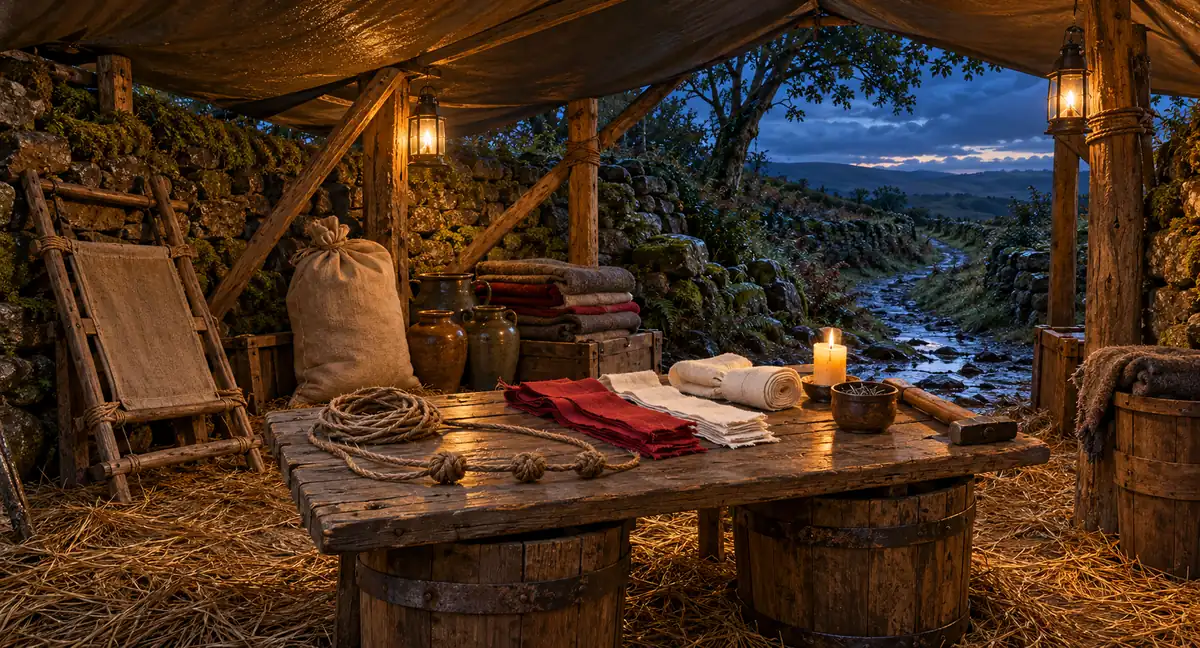
In which the village forms an army, discovers it has no soldiers, and makes do with what it has.
Beech found Nella trying to convince a wet piece of canvas to behave like a roof.
The canvas had other ambitions. It had filled with rainwater, sagged over the corner of the sheepfold, and deposited most of its contents down the back of Tam's neck. Tam had expressed his opinion of this in language sufficiently colourful to make two nearby sheep turn and look at him.
"Hold that corner," Nella told Beech, without looking round.
"I need to tell you something."
"Tell me while you hold it."
Beech took the rope. Nella drew the canvas tight, tied it round an ash trunk and stepped back. A little river of water ran off the edge and splashed Tam's boots instead of his collar.
"An improvement," Tam said bitterly.
"For all of us," Nella replied. "Now, Beech?"
He told her what Joss had seen: the marked goblins carrying a board, the way they had walked straight to the meeting hall, and the order to use the old entrance behind Councillor Brant's locked yard. He mentioned the charcoal sketch on stiff parchment he had once made for the hall keeper, showing the hinges and passages needing repair.
Nella listened without interrupting. Behind them, the rain pattered on stone and canvas. A child coughed in the shepherd's store, where the wounded were sleeping.
"Could they have had your drawing?" she asked at last.
"They could have had anybody's. The hall keeper was forever losing papers. He once filed a bill for roof slates under 'Livestock' because there was a picture of a crow on it."
"You didn't put anything valuable on yours?"
"Only doors, bolts, measurements. There was a rear entrance the council had stopped using, but half the village knew that existed." Beech rubbed his damp sleeve across his forehead. "I keep thinking I might have helped them without knowing it."
"Then we'll find out. Not tonight, and not by deciding someone's guilty because they owned a piece of charcoal." Nella looked towards the village, invisible beyond the rain. "First we keep these people alive. Tomorrow we organise."
"I thought we'd already organised. We had a plan."
"We had one plan. Now we've got twenty-seven people, a wounded blacksmith, almost no dry bedding, five armed prisoners, and a village full of things that can still go wrong."
Beech regarded the sagging canvas. "When you put it like that, it sounds rather a lot."
"It is. Get some sleep."
Beneath his borrowed blanket, boots tucked out of Duchess's reach, Beech dreamed of his broken front door and of all his unfinished repairs pursuing him down the mill road. He found the second dream more upsetting.
By morning the rain had passed, leaving the ridge cold, damp and brilliantly clear. Smoke still drifted from Briar Glen, though less than before. The stream shone silver beyond the mill, and the northern road lay empty as far as Tam could see.
Harl had called a meeting by standing on a feed trough and announcing that the people of Briar Glen must become a resistance.
"A what?" asked Widow Fenner.
"A resistance. A force of ordinary folk united against an invading enemy."
"We're already against them," she said. "I don't recall anyone voting in favour."
"That isn't the point."
"Then get to the point. I've got a pig to feed."
Harl spread his arms, nearly dislodging the borrowed coat that was much too small for him. "We must stand together! We must defend our homes! We must place ourselves under the command of—"
Beech, who had been attempting to scrape yesterday's stew from a bowl, looked up with a sudden chill of suspicion.
"—the man who has already led us to victory!"
Everyone turned towards him.
Beech held up the bowl. "This isn't a commander's implement."
"You don't have to command," Nella said. "You have to help us make the village usable again. Harl likes speeches. Let him have the speeches."
"I like decisions too," Harl objected.
"Then decide who's washing the bowls," said Elna.
That settled the opening ceremony.
They gathered around a plank laid across two buckets. Darron arrived with his wounded arm in a sling; Merrick brought a list of grain stores; Berta had counted the blankets, Elna the food, and Nella the people. It resembled an anxious village committee more than a military council.
There were twenty-seven villagers at the sheepfold, including the child Widow Fenner had found, and they had space for fewer than half beneath proper cover. More families might still be hiding below. Joss was feverish but alive; Tilly refused to leave his side except to fetch water. The five goblins in the cattle pound had not escaped, but nobody could promise how long the improvised gate brace would hold.
Beech listened until the problems became too numerous to remember, then asked for the slate.
He wrote three headings: PEOPLE. FOOD. ROADS.
"Is that the whole plan?" Harl asked.
"It's the part I can spell without assistance."
Nella took the chalk and added WARNING beneath them.
"That's the part that keeps the others possible," she said.
So they divided the work. Berta would organise bedding and the sickroom with Elna, whose burned hands needed rest but whose opinions did not. Darron would supervise repairs from a chair; he had already threatened to stand up and demonstrate if anyone struck a rivet incorrectly. Tam and two farmhands would watch the northern road, with orders to report what they saw rather than what they feared they had seen. Harl would keep the food counted and ready to move.
At this last instruction he looked offended. "I am a landlord, not a quartermaster."
"You count barrels for a living," Nella said.
"That's entirely different."
"You can start with sacks."
Merrick was to help open a safe route to the mill's remaining stores, while Beech and Nella would lead a small party down the drover's track. Nobody was to go looking for a fight. The object was flour, clean cloth, tools, and information about anyone still trapped in the village.
"What do we call ourselves?" Tam asked.
"Villagers," said Widow Fenner.
"The Defenders of Briar Glen," Harl suggested.
"The Association for the Recovery of Mislaid Property," said Beech.
"That'll look splendid on a banner," Darron muttered.
"We're not having a banner," Nella said. "A banner tells goblins exactly where to shoot."
Nobody objected.
Mara had brought a soot-streaked bundle back from her brother's cooperage near the meeting hall, where the family washing had been hanging when the raid began. She left it under the bench to sort later; even half-clean linen could be useful for bandages.
Tam wanted whistles for the lookouts, but the first demonstration brought both sheepdogs, followed by Duchess, who charged through the watch party in search of whatever had excited them. Nella pointed out that goblins had ears too. An army warned by a whistle would have just as much reason to listen as the people it was meant to protect.
Tilly had come outside to see what had upset the pig. "Dad uses cloth on his cart when he doesn't want to shout," she said. "Red means stop and white means go on. You can see them from the next bend."
"What if it rains?" Tam asked.
"Then they'll be wet," Tilly replied. "They'll still be red and white."
Berta found strips in her sewing bag. They agreed that a red strip at a watched corner meant danger, a white one meant the way ahead had been checked, and no strip meant nobody was watching. The distinction between checked and safe troubled Nella, but she needed to put eyes on the roads while there was daylight. Runners could carry the longer messages.
By late morning there were three posts along the ridge and orchard. A farmhand came panting back from the northern lookout with news of smoke beside an abandoned cart. Nella sent a second watcher to verify it rather than dispatching half the camp. The smoke came from damp hay; the suspicious figures beyond it turned out to be goats.
"If we were defending against goats," Tam said, "we'd be winning."
"We've still got Duchess," Beech replied. "I wouldn't say that too loudly."
At the cattle pound, guards reported the prisoners had spent the night arguing and scraping at the gate.
Beech's brace still held, though there were fresh marks around the hinge. Five hungry goblins sat in the muddy enclosure.
"They'll work that hinge again," Darron had warned before the party left. "You can lock a door or you can guard a door. With five blokes inside who know how to prise iron, you ought to do both."
Beech inspected the gate while Nella and Merrick waited out of spear range. He had brought a short iron strap and two bolts from Darron's stores, along with a spanner he was fairly sure belonged to him already. He fixed the strap over the lifting end of the hinge so the gate could no longer rise out of its socket.
A goblin peered through the gap. "Carpenter. You're making prison better."
"For me, certainly."
The goblin watched Beech tighten the bolt. "You got food?"
Merrick set down water and five pieces of bread, to be passed through the lower slot.
"Weapons first," Nella told them.
The goblin looked over its shoulder. A low argument began inside, broken by a shove and the sound of metal striking stone. At last three spears, a knife and a short hooked blade were pushed beneath the gate. Nella used Merrick's old grain rake to draw them clear, keeping her hands beyond reach. Beech checked the enclosure through the high viewing gap before permitting the bread through; he could not be certain the goblins had no other blades, but they would at least have fewer.
"There were others with you," Nella said. "The ones wearing a broken white ring. Who were they?"
The goblin with the bread answered too quickly. "Not ours."
"They were leading your captain."
"Captain follows money, doesn't he?"
A second goblin snapped something in its own language. The first fell silent and began chewing as though bread were a subject of urgent study.
Beech asked, "Why did you go to the meeting hall?"
"We didn't. Too much trouble."
"What trouble?"
"They said nobody in the hall. No fire in the hall. Go and make noise somewhere else." The goblin grinned, exposing a row of broken teeth. "We were good at that."
It sounded pleased with itself, which was more than Beech could manage. The meeting hall had been spared the worst of the burning while houses nearby were destroyed. That was no longer something he could dismiss as chance.
Nella wrote the words on a scrap of slate. She did not press the prisoners further. Hungry, frightened captives could tell lies as well as anyone, and the goblin beside the speaker had begun watching them with cold, attentive eyes.
On their way out, Beech secured the rear wicket on the mill-yard side and reminded the guards not to stand directly in front of the main gate.
"You think they'll charge it?" asked one.
"I think five people with nothing better to do can become very determined," he said. "I've seen what one man can do to a door when he wants his breakfast."
He remembered the goblin captain's axe striking his own oak door, and took little comfort from the comparison.
Their next task was to collect supplies from the mill's dry loft. Elna believed at least six sacks of flour had survived there, together with linen used for covering grain. They would be worth more to the refugees than a chest full of silver.
Beech travelled with Nella, Merrick, Mara and Pellin, the cobbler's young assistant. Fern padded beside them. Harl had volunteered until he learned the work involved carrying sacks, at which point he offered to supervise from the sheepfold.
White cloth marked the orchard turns. The village was quieter than the previous evening, which Beech disliked: silence let him imagine trouble everywhere.
They passed the blackened bakery. Its outer wall stood, but the roof beams had collapsed inward, and a sheet of rainwater lay across the floor among the ashes. Mara stopped at the sight of it. She had worked there and knew exactly which cupboard had held the day's flour and which corner Elna had kept warm for the apprentices.
"We'll build it again," Beech said.
"If we get home," Mara replied.
He nearly assured her they would. Then he remembered the arrow that had struck Joss's stable door, the fire they had been forced to abandon, and the empty spaces on Nella's list. He settled instead for putting a hand upon the charred wall as they passed.
Merrick led them into the mill. Though the lower channel still ran high, the loft was dry. Six sacks lay beneath canvas, with rope, linen and candles. They divided the flour into smaller loads.
Pellin, who had been unusually eager to prove himself, lifted more than he should. He staggered beneath a sack and nearly brought down a whole row of shelves.
"Carry half," Merrick told him.
"I can manage."
"So can a donkey. That's not an argument for putting a mill on its back."
Beech helped him divide the load. Outside, Fern growled.
Nella was already at the window. She raised two fingers. Two goblins were moving along the lower track, picking their way through the mud. A third stood on a dry bank with a bow, watching the mill rather than the road. The archer's posture was familiar to Beech: still, patient, and entirely unlike the spear-carriers who had fought over Joss's flour on his first escape.
"The bowman from the flour lane," he whispered. "He followed us into Joss's stable too."
Mara set down her sack. Merrick looked towards the narrow rear stairs, which opened onto the orchard route. They could withdraw without being seen if they moved now.
Pellin pointed to a fourth goblin circling towards the rear door.
"They've seen the white strips," Nella said. "Or they've seen someone use them."
Their new signal system was working against them.
There was no frantic dash for the bridge. The bowman had a clear view of the yard, and the rear path was no longer safe. Merrick shut the loft shutters while Nella sent Fern down the stairwell to warn anyone approaching from the orchard. Beech's first impulse was to block the door with sacks, but that would leave them trapped in a building full of food and dry timber.
He studied the mill machinery instead.
The grain hoist stood above a hatch in the loft floor, its rope still sound. Beside it, a sliding loading shutter ran in iron guides Beech had fitted himself. He remembered how abruptly it fell when the retaining peg came out.
"Merrick, can we get out through the lower grain hatch?"
"To the cart bay. Why?"
"There's a service door behind the wheel. The lower track's too wet for horses, but we can walk the stone coping above it."
Merrick gave him a doubtful look. "Five people carrying flour?"
"Not all of the flour."
That was the first painful decision. They had come for six sacks, and only now did Beech see how much more important it was to get everyone home than to win an argument with goblins over grain.
They lowered two small loads through the hatch. Mara descended next, then Pellin. Merrick followed with an effortful curse at his knee, while Nella watched the shutters. Beech stayed to secure the upper room and lower the last bag.
The first arrow came through a gap in the boards and struck the beam above his hand.
He ducked. Another thudded into the shutter. The bowman had taken position in the yard, while the other raiders hammered at the outer mill door. Beech could hear their voices, not shouting in confusion but calling positions to one another.
"Rear covered. There's a dog."
"Watch the wheel."
They knew the likely exits.
Beech crossed to the grain hoist, pulled the retaining peg from its notch and let the empty loading shutter fall into its iron runners. It came down with a heavy wooden bang, hiding him from the yard without endangering anybody outside. Then he climbed into the grain hatch and lowered himself by the rope, slipping the last few feet and landing badly on his sore wrist.
In the cart bay, Pellin was waiting with the two flour loads. The young man had found a loose plank beside the wheel housing and was levering it back into place.
"Leave it," Beech said. "We've got to go."
"It's holding the service door shut."
Beech looked. The plank had swollen and bowed against the jamb. A hinge had pulled half free of its post, leaving the door jammed at an angle. He had promised Merrick he would replace it before the spring rains.
Naturally.
Behind them, iron rang against the upper door. They had moments, not minutes. Beech slid his kitchen knife beneath the bent hinge strap, used the hammer end of the grain scoop as a lever, and eased the door clear enough for Merrick to pull it outward. The wood tore along its rotten grain. Fresh air, smelling of water and mud, washed over them.
"One at a time," Nella whispered.
Mara slipped out with the linen. Merrick followed. Pellin started next, hauling one of the flour bundles by its rope handles.
A sharp whistle sounded from the orchard.
One short blast.
Their own danger signal.
Pellin stopped on the threshold. For an instant everyone waited, uncertain whether the warning came from their lookout or from the goblins who had seen the signal strips.
Then an arrow struck the stone frame beside Pellin's head. Chips of mortar cut his cheek. He dropped the flour and staggered backwards, clutching his face.
A second arrow flew through the opening and struck his leg above the knee.
The young man collapsed, biting down on a cry that escaped him anyway.
Beech had no clever answer for what happened next. The service door opened onto a stretch of coping barely wide enough for one person. Pellin lay across the threshold, blood running down his trouser leg. Behind them the goblins had forced the upper door; their boots hammered on the stair.
Nella took hold of Pellin's shoulders. "Beech, his legs. Now."
They lifted him between them, keeping low beneath the stone lip of the millwheel housing. Fern snapped at a goblin that appeared in the bay above, buying them the few breaths they needed to reach the coping. Merrick, already outside, used his grain rake to hold the wounded boy's weight while Mara knelt farther along the bank with a strip of linen ready.
Beech heard the archer step closer on the other side of the wheel.
A loose sluice board rested beneath the turning wheel. He shoved it across the gap as a screen, braced against the coping stones. The next arrow struck the board instead of the people behind it.
"Go!" he called.
They went, carrying Pellin between them. Beech left the second flour bundle where it lay, half in the muddy water. He did not even look back for it.
They could not risk the orchard path, so they climbed beside the upper field wall, sheltering Pellin with mill canvas. Once a goblin's voice drifted up, and they lay behind a hedge until it passed.
Pellin tried to apologise for slowing them. Nella told him, firmly, that if he spent his breath on apologies she would find him something heavier to carry.
Beech kept one hand beneath the young man's injured knee and watched the blood soak through Mara's makeshift bandage. He knew how to stop a cabinet from wobbling and how to set a hinge square. He knew almost nothing about wounds, and the ignorance was worse than his aching shoulders.
When they reached the outer lookout, the red strip had been replaced by white. Beech tore it down.
"Who's watching this post?" he demanded.
A farmhand emerged from the hedge, startled by the anger in his voice. "I saw the goblins turn west. Thought it was clear."
"They hadn't turned west. One was waiting by the mill."
"I didn't know."
"Neither did we," Nella said, before Beech could say anything he would regret. She pointed to Pellin. "We need Berta. And clean water. Move."
They carried the wounded lad uphill, where the refugees were already making a place for him in the store. Berta examined the arrow and sent everyone who wasn't useful out of the doorway. Darron, pale with pain in his own arm, provided the small iron pincers and advice on how to keep a broken shaft from moving. Nella stayed; Beech did not.
Outside, Beech stared at his hands: flour on one, blood on the other.
Harl found him there. "You brought some linen. And candles. And a sack of flour."
"We left most of it behind."
"We'll manage."
"Pellin got hurt because we went for it."
Harl was silent for a moment. Then he said, "Pellin got hurt because a goblin shot him. Don't go handing the creature credit for a decision you didn't make."
"I put a white strip on that path. It showed us where to walk and told them where to wait."
"Then you've learned something."
"He's not a plank, Harl. I can't just cut another one."
The landlord looked towards the sickroom and, for once, had no ready answer.
By late afternoon Berta announced that the bleeding was controlled. Pellin would live if infection could be kept away and the leg rested. He was asking whether someone had remembered the flour.
Beech laughed once, shakily, and went to sit beside him.
"I didn't," he admitted.
"Merrick did," Pellin said. "It's in the store."
"One sack."
"Better than none."
Beech regarded the young cobbler's pale face. He had heard the same sensible answer from Nella and Harl and Merrick, and now from someone who had paid rather more for it than any of them.
"Next time," Beech said, "we do it differently."
Pellin managed a tired smile. "Next time you can carry the heavy end."
That evening they corrected the mistake before another runner could be led into an ambush. Cloth strips would mark only a post currently held, never promise an entire road was safe. Reports would travel with runners who could say what they had seen and when. Sitting beside Joss, Tilly proposed three knots for messages carried by runners: one for danger actually seen, two for a route just checked, three for help needed. The messenger would still have to say who had sent him. Tam proposed seven meanings; Tilly asked him to remember the first three before improving upon them.
Merrick moved bandages to the top of the supply list. Darron directed the making of a low carrying frame for the wounded. Harl measured the rescued flour into portions without complaint, while Beech and two farmhands braced the sheepfold's weakened roof supports. The dry space they made was barely enough for Pellin, Darron and the children, but blankets could now be laid where the rain would not reach them. No one suggested another mission that night.
Beech sat outside the stone store to clean his borrowed tools. He could hear Berta speaking quietly to Pellin and Tilly rehearsing her knots with a runner. They had brought home fewer supplies than they needed and one more wounded neighbour. Merrick approached with something he had been keeping back until the work was done.
The miller led him to the small fire by the outer wall and showed him a stiff scrap of parchment, creased across the middle and scorched at one edge. Mara had found it under a fallen roof slate by the hall's back wall when she salvaged that morning's washing. She had tucked it into the bundle without recognising the marks, then passed it to Merrick after sorting the clothes on her return from the mill.
"This belonged to your trade, I think," Merrick said.
Beech knelt beside him. The marks were faint, but familiar: a rectangle for the hall wall, two angled strokes for a hinge, and three short bars that represented an old crossbeam beneath the unused yard door. It was not a proper builder's plan. It was a quick working sketch, made for someone who had to mend a troublesome entrance without taking the whole thing apart.
"That's mine," Beech said. "I drew it for the hall keeper. Years ago."
"Sure?"
"I spelled 'lintel' wrong. Twice. Then I crossed it out and wrote 'big wood over door'."
Merrick looked at the scrap. Beneath the smoke stain, in a cramped hand, those words were still visible.
"A convincing signature," he said.
Beech smiled faintly. But when Merrick turned the parchment over, the smile vanished.
Someone had added lines to the back in a different hand, finer and more deliberate than his own. They showed the yard beyond the meeting hall, the old entrance behind the locked wall, and a square marked beneath the stone foundations. From that square a narrow line ran north, under the boundary of the hall itself. At its end was the symbol Beech had seen on the marked goblins' black cloth: a white ring, broken by a straight stroke.
"What is that?" Merrick asked.
"I don't know."
"A cellar?"
"The hall hasn't got a cellar." Beech remembered repairing the north wall when he was sixteen, his father standing beside him with a measuring rod. The foundations had been solid stone, as far as they could see. "At least, nobody told me it had."
Nella arrived in time to hear the last words. She studied the parchment in silence, then looked towards the darkening village.
"Who could have added this?"
"Anybody with the drawing," Beech said. "The council. A workman. Someone who found it in the hall."
"Or someone who knew the meeting hall better than we did."
Beech followed the added passage with one finger. The raiders had spared the hall, taken the ironbound chest, and obeyed a horn calling them north. Now he was looking at a way beneath the building, drawn on the back of work he had done years earlier.
"We should warn the lookouts to watch the hall," Nella said. "Quietly. The others can hear more once we know what we're dealing with."
Beech slipped the parchment into his shoulder bag beside the little wooden horse he had promised to mend for Elna's niece. He looked downhill at the crooked silhouette of the meeting hall, then at the last thin light in the windows of the sheepfold.
"Could we discuss it over a bowl of stew?" he asked.
Nella gave him a tired, almost unwilling smile. "Yes, Beech. We can tell them over stew."
End of Chapter Six
The story continues.
Back to book contents