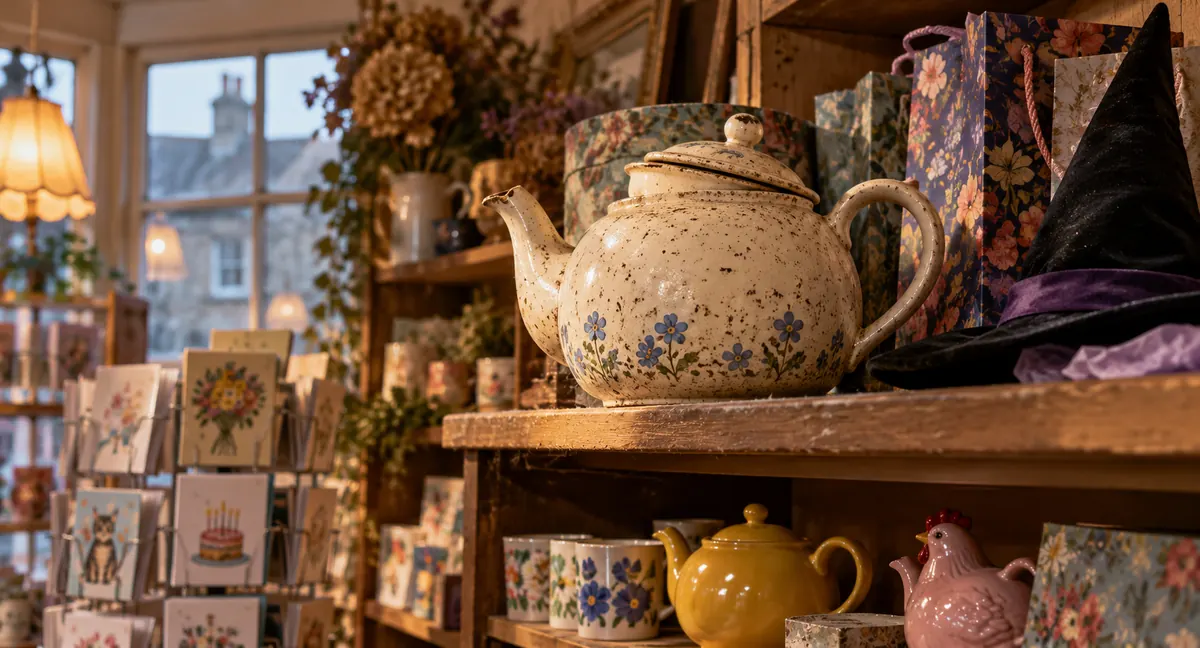
Feeding Time for Humans
At Lou's birthday dinner, Maddie brings a rescued teapot, a forgotten card and a tableful of imaginary company. Between cutlery concerts and a napkin sheep, the evening becomes something worth keeping.
Maddie is eleven minutes late, which is a personal best for the week. She arrives at The Bellflower with her scarf coming undone, one glove on, and a box under her arm that she has wrapped three times. The first attempt used too much tape. The second had a hedgehog facing the wrong way, which felt like a sign. The third has teapots on it, all facing what Maddie is fairly sure is the correct way.
The restaurant is loud in the way good restaurants are loud. Glasses clink, conversations overlap, the espresso machine hisses like a disappointed cat, and a man at the bar laughs at something that has clearly been funny for an hour. Candles burn in old wine bottles. The tablecloths are the colour of weak tea. Pendant lights hang low over the tables.
Lou is already there.
She sits by the window with her back straight and her coat folded over the chair beside her. Maddie can tell from the door that she has read the entire menu, possibly twice. A waiter is standing at her table with a notepad, and as Maddie weaves between the chairs she hears him say, "Ah, you're the seating plan lady. The Abbott dinner. We still talk about it in the kitchen."
"Oh," says Lou. "It was mostly a spreadsheet."
"Three tables moved, a vegetarian bumped to the front, and the boss's brother didn't end up next to his ex-wife. Nobody tells you how much work that is."
Then Lou sees Maddie, and something in her face opens bright and wide. "Mads! You're late."
"Eleven minutes. It's a record."
"She said you'd be late," the waiter tells Maddie, pulling out the chair opposite Lou. "Asked me to keep the seat facing the door."
"Lou said that?"
"Twice," says the waiter, and goes off to fetch the bread.
Maddie sits down and looks across at Lou, who is smoothing her napkin over her lap with tremendous care.
"Organised?" Maddie says. "Lou? She once put her house keys in the freezer and then asked the freezer where they'd gone."
"Not from where I'm sitting," says Lou, and picks up the salt cellar.
For a minute they are perfectly normal. They talk about the train, the sheep, and whether Maddie's colleague's new boyfriend is secretly a spy. Then Lou starts turning the salt cellar. It goes round once, twice, a slow revolution on the tablecloth. She lines it up with the edge of the table and turns it again. Maddie has been twisting her ring since she sat down, a thin silver band that has been on the same finger for three years and is now worn smooth on one side. She pushes it up, down, round.
She looks up. Lou is watching her hands.
"You're doing it too," Lou says.
"I'm not doing anything."
"You're doing the ring."
"You're doing the salt."
They both look at the table. Lou takes a sugar sachet from the little steel pot, folds it in half, then in half again, and rolls it between her fingers like she is making a very small cigar. Maddie reaches for the bread knife and taps the blade against her side plate. Lou picks up her fork and flicks the tines one after another, and the fork makes a sound like a tiny harp. Maddie answers with a spoon against the rim of her water glass. Ting. Lou answers with a ting of her own. Within a minute they are playing a rhythm on the table with cutlery, slow, then fast, then a flourish of spoons that rattles every glass in reach.
The woman in the green scarf at the next table turns round. She watches for a moment, raises one eyebrow, and returns to her conversation. The waiter arrives with a basket of focaccia.
"Would you like some rhythm with your bread?"
They both freeze, cutlery in mid-air. Then Lou laughs so suddenly she has to put her fork down.
"Sorry," Maddie says. "We've been doing that since we were nineteen."
"You've had some practice, then." He puts the basket down. "Can I get you anything else?"
"A recording contract?" Lou suggests.
The waiter smiles, then turns to another table where someone is holding up a menu.
When he has gone, Maddie takes two paper napkins from the little holder beside the bread basket. She folds the corners of one into a pointed hood, gives it two focaccia crumbs for eyes, and raises it above the table. It is a passable face.
"This is Gerald," she says, in a low, serious voice. "He's the salt. He has opinions about pepper."
Lou takes the pepper grinder, turns it upside down so the wooden head becomes a crown, and sets it in front of Maddie's napkin. "And I am the Duchess of Black Pepper," she says, in a voice somewhere between a headmistress and a bored swan. "I do not do small talk. I do not do breadsticks. And I do not share the candle."
"Gerald has been sharing the candle for years."
"Gerald is a fool."
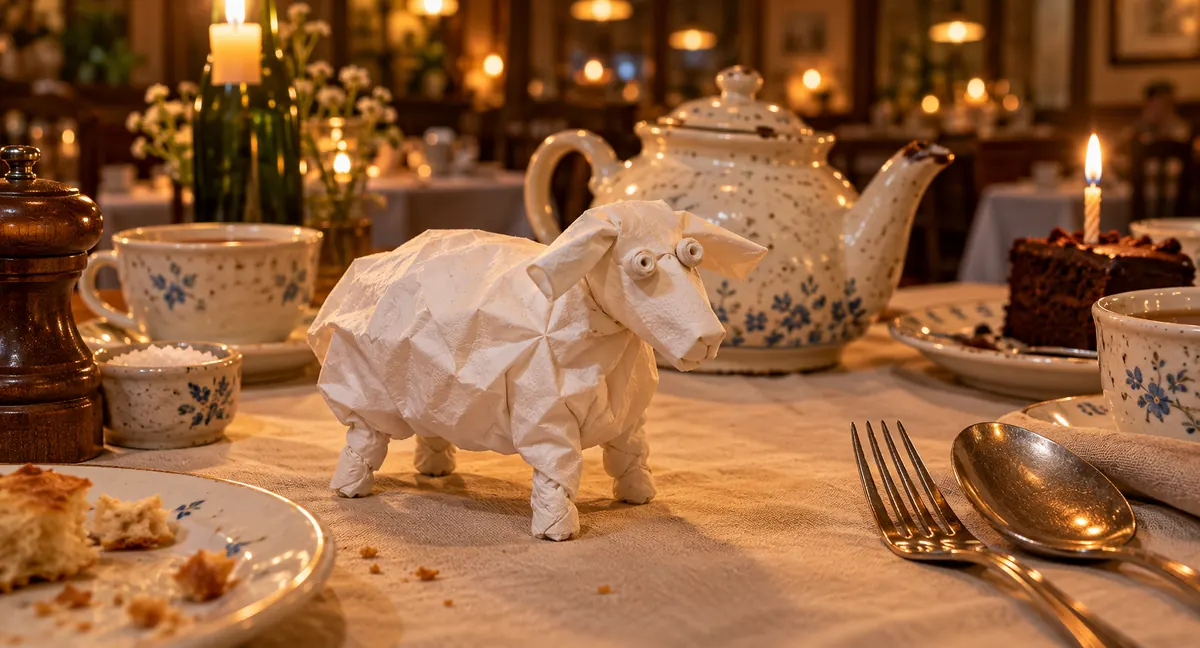
Lou folds another napkin into a lumpy sort of sheep, with twisted corners for legs and two tiny rolled-up pieces of napkin for eyes. "And this is Biscuit," she says. "He has been standing at the fence all afternoon, waiting for somebody to tell him something important."
Maddie had told her about the biscuit-coloured sheep on the platform. She had apparently told her rather thoroughly.
"Biscuit," says Gerald, in his most sincere salt voice, "is a sheep. Sheep do not get a seat at this table."
"Biscuit has a reservation," says the Duchess. "Under the name of the lady by the window."
Biscuit wobbles forward and addresses the bread basket. "Excuse me. Is anybody here feeding anybody?"
"Feeding time for humans!" Maddie announces, and a man at a nearby table coughs into his wineglass.
"Baaa," says Biscuit, with dignity.
"Right," says Maddie, when she can breathe again. "Before the food comes and you get distracted by the bread." She puts the box on the table between the salt and the candle. The teapot-patterned paper is folded neatly at the corners, the ends tucked and retucked, and there is a single smear of glue on the bow.
Lou stops moving.
It is the first time since she sat down that she has been completely still. Her hands rest on the tablecloth either side of the box, and she looks at it for a long time.
"You wrapped it," she says.
"Obviously I wrapped it."
"You wrapped it properly."
"Lou, open it before I start crying into the gnocchi."
She peels the tape off very slowly, one piece at a time, and folds each one over itself into a small square, then lines the squares up beside her plate. She does the same with the paper. Maddie wants to say just rip it, but she knows better. The tissue inside crackles. Lou lifts the lid, pushes the tissue aside, and goes quiet.
Then she lifts the teapot out with both hands.
It is cream, speckled brown, with the chip on the spout and the blue flowers rubbed half away round the base. Lou turns it slowly in the candlelight. She turns it so the chip faces away, then back again, and runs her thumb over the flowers the way you might stroke a cat that has decided, against its better judgement, to sit on your lap.
"It's got a face," she says.
"It doesn't have a face."
"It's got a face, Mads. Look at it. It's a bit cross."
"It's a bit cross because it's been on a top shelf since Easter."
Lou laughs. "You got me a teapot."
"I rescued you a teapot."
"From the top shelf."
"How did you know that?"
"You've told me four times." Lou gives her a small smile over the lid, and Maddie has the distinct impression that Lou has suspected what was in the box for days and has been enjoying not saying so.
She sets it down in the middle of the table, carefully, next to the candle.
"I didn't need rescuing, you know. I had a kettle. I had a jug. I had a mug with a bag in it that I'd only just got round to—"
"Left in until it was the colour of a conker."
"Left in until it was the colour of a conker," Lou agrees.
"I thought you'd like it," Maddie says.
"I do." Lou turns the teapot to look at the little blue flowers. "Very much."
"Even with the chip?"
"Especially. Saves me worrying I'll be the first to chip it."
For a moment they sit looking at it together. Then Lou picks up the Duchess. "Your Grace, the teapot has arrived, and it is cross."
Lou leans down and begins to dig through her bag. A receipt. A train timetable folded into eighths. One glove, the match to Maddie's. A phone charger, a packet of mints, an envelope from the bank she has clearly been carrying for weeks. Three pens, two of which don't work. Then the third, which does.
"You forgot the pen," she says, holding it up like a prize.
"How did you—"
"You texted me from outside the shop. Forgot pen. Then you sent a photograph of yourself looking like a sad potato."
Maddie takes the pen and the card from her bag. She thinks of the photograph she'd sent Lou of the lighthouse book, and of the message Lou had sent after reading it on the bus. Maddie had saved that message. She'd also laughed at it for several days.
After a long pause, she writes Cried on the bus. Worth it. Underneath she adds, Love, Mads.
She does not explain. Lou reads it upside down, makes a small noise that might be a laugh or might be something else, and tucks the card against the teapot as though they have always lived together.
Their main courses arrive, set down with a flourish. Lou's is a wild mushroom risotto, which she ordered with no parmesan, no butter and extra peas, and she had asked for the booking to note that, and she had said it twice. Maddie's is gnocchi with sage, which she chose because she is a risk-taker.
Lou picks up her spoon. Then she stops.
"Mads," she says, very quietly. "There's cheese on it."
"Is there?"
"There's a grating. There's a little grating." She is not looking up. Her hands are moving: the knife straightened, the fork straightened, the napkin folded into a square, then into a smaller square, then smaller again. Her thumb works at the edge of the cloth. The noise of the restaurant seems to climb around them, and Maddie watches Lou's lips move slightly and realises that she is counting.
"Lou."
"It's fine. It's fine. I said no cheese, I said it twice, and it's—" She stops. "It's fine."
"I'll get him."
"No, he's run off his feet. It's fine." The third fine is the wrong kind of calm, the kind that holds a cup at the very edge of the table.
Maddie picks up Biscuit, holds him close to Lou's sleeve so he is peering up at her, and in a small, wobbling voice Biscuit says, "Excuse me. Has anybody counted the peas?"
Lou makes a sound that is halfway between a laugh and the beginning of something else. "Mads."
"Biscuit has been counting. He has counted forty-one. He is very worried about the forty-second."
"There are forty-three."
"Biscuit is not going to be the one who tells you."
Lou's shoulders drop an inch. Her hands slow down. She picks up the napkin square and unfolds it, so that it is only a napkin again.
"Can we swap?"
"Yes."
"I'm sorry. It's just a lot of noise in here."
"You don't have to be sorry. Here." Maddie pushes the gnocchi across and takes the risotto. It is very good, and it has rather more cheese than she would have chosen, but she is not going to say that.
The waiter returns, sees the swap, and his face does a quick, anxious sum. "Is everything all right?"
"Yes," says Lou. "Thank you, honestly. It's just a bit of cheese." She smiles at him. It is the full organised smile, the one Maddie has seen across rooms and at parties and once through the window of a moving bus. "It's really fine."
"Of course," says the waiter. He glances towards another table where someone is trying to catch his eye. "Let me know if you need anything."
Maddie knows that smile. She's seen Lou use it a hundred times, at parties, in shops, with people who don't know her well enough to notice. It's the smile she puts on when everything is becoming a bit too much, the way you'd hold up a heavy box so a stranger can squeeze past.
They eat quietly for a while.
Maddie watches the candles burning in their bottles. One has melted almost entirely down one side, leaving a long ridge of wax that looks rather like a frozen waterfall. She wonders if candle wax has ever been used to make a waterfall. Probably not a very successful one.
Lou takes her time with the gnocchi. Occasionally she looks out of the window. Maddie doesn't ask anything.
After a while, Lou reaches across the table and straightens Biscuit, who has been lying on his side beside the bread basket.
"He's been very quiet," she says.
"He's digesting."
"He hasn't eaten anything."
"Neither have half the sheep in Britain. Nobody asks them."
Lou smiles. A proper one this time.
She picks up Biscuit and sits him beside her plate.
"Feeding time for humans," she says.
"Speak for yourself," says Maddie. "I'm a grazing animal."
Lou snorts into her water. Then, because the sheep has been left unattended, she sets him on the edge of Maddie's plate, where he tries to take a piece of gnocchi and is told off by Gerald. The Duchess weighs in on the matter of the candle. Maddie makes the salt and the pepper have a debate about whether gnocchi counts as bread. At the next table, someone asks for the mustard.
Over the next half hour they talk about everything. Lou's sister, who has started a bread-making class and now sends photographs of loaves with names. Maddie's brother, who has bought a canoe he cannot yet get into. The lighthouse book, which Lou maintains was entirely responsible for her crying on the bus. Maddie tells the story about the bollard for the fourth time, and Lou tells her it wasn't a bollard, it was a sign, and that the sign was clearly placed in the wrong place, and Maddie says that's exactly what a bollard is for, and they argue about it, very happily, until the waiter arrives with the dessert.
It is a slab of dark chocolate cake with a candle stuck in the top. Across the icing, in white, someone has written HAPPY BIRTHDAY LU.
"They've spelt it wrong," says Maddie.
"Lu," says Lou, delighted. "Like a biscuit." She looks at Biscuit, who is lying flat on the tablecloth where he has fallen. "Biscuit's my family."
The waiter lights the candle and begins to sing. A couple at a nearby table join in, slightly out of time. Around them the restaurant carries on: a chair scrapes, someone orders another glass of wine. Lou sits very still while they sing. Her eyes are bright. When they finish, she closes them, blows out the candle in one neat puff, and does not open them for a moment.
"Happy birthday, Lu," Maddie says softly.
"Don't call me that in front of the sheep."
Afterwards the waiter comes back with the bill, and at the bottom of the bill, in biro, someone has written Happy Birthday to the seating plan lady. Lou looks at it for a long moment. Then she folds it, very neatly, and puts it under the teapot.
"Would you like coffee? Tea?" the waiter asks, eyeing the teapot. "Or have you made other arrangements?"
"We've got a teapot," says Lou, lifting it so he can see the chip and the flowers and the cross little face. "Could we have some hot water?"
"Of course. Shall I give that a wash first?"
"Yes, please," says Lou. "Mind the lid. It likes to sit crooked."
He takes the teapot away and brings it back clean, with a jug of hot water and two cups. Lou fills it with serious concentration. She pops in a teabag, a teabag she has, to Maddie's amazement, remembered to bring. She pours the water in, sets the lid on slightly wrong, and then, without looking, straightens it. They wait. The steam rises. Lou pours two cups, far too strong, and gives one to Maddie, and holds the other up for Biscuit, who accepts it with grave politeness.
It is the best cup of tea Maddie has had in months. It's too strong and too hot, and it tastes faintly of cardboard and cake, and she drinks the whole thing.
"Thank you for the teapot," Lou says, looking at the cross little face on the table between them. "Even though I didn't need rescuing."
"I know you didn't."
"I know you know."
Outside, the street is wet and gold under the lamps, and the evening has finally gone quiet. Lou puts her coat on very slowly, one arm at a time, while Maddie carries the teapot in its box, the napkin sheep folded into her pocket. At the door, Lou stops and looks back at the table, where the candles have burned low in their bottles and the two plates have been cleared, and the restaurant is taking its breath before the next lot of humans come in to be fed.
"Biscuit didn't get any cake," Lou says.
"He's a sheep."
"That's hardly his fault."
Maddie considers this. It's a reasonable argument.
"I'll write him a letter of apology."
"Make it a proper one. He has standards."
Lou slips her arm through Maddie's. Maddie shifts the teapot box to her other side so she can lean against her, and they go out into the cold together.
Every ending is somewhere new.
Find your next story →