A Hero's Terrible Idea
Beech returns beneath the meeting hall with a carpenter's tools and a dangerous idea. Finding Vale Mouth is only the beginning; stopping its ancient lock may cost far more.
In which Beech discovers that the worst thing about having an idea is persuading other people to help with it.
Beech had always believed that a good night's sleep could improve almost any difficulty.
A stiff back, for instance. An argument about the price of timber. A particularly unpleasant birthday celebration that ended with a pig chasing you through a vegetable garden. All could be made rather less dreadful by going to bed and allowing the world to sort itself out until morning.
Unfortunately, the world beneath Briar Glen was not inclined to wait.
Three iron blows carried up from the valley. There was a pause, long enough for Beech to hope that the workmen had gone for their supper, and then three more.
Nella stood beside him outside the sheepfold, watching the dark outline of the meeting hall far below. The last of the daylight had gone, but the smoke from the damaged roofs still showed against the pale strip of western sky.
"Do you suppose they're building something?" Beech asked.
"I suppose they're hitting something," she said. "I wouldn't give them credit for anything more until we've seen it."
A runner came up from the lower lookout, bent with breathlessness. He handed over a length of twine marked with Tilly's three knots: help needed.
"Two of the marked ones at the hall," he told Nella. "And some ordinary raiders carrying timbers. The red-cloaked captain's been seen near the square. They've put a watch on the orchard lane."
"Anyone coming up the eastern road?"
"Not yet. But there was a horn from the north."
Nella sent him to the next post with instructions to remain concealed. Beech was left studying the dark valley and wishing, with increasing bitterness, that it contained nothing more troublesome than turnips.
"We can't keep going into the hall to see what they've done," he said. "They'll catch us sooner or later."
"Yes."
"And we can't stop the southern lock if we don't know where it is."
"Also yes."
"So perhaps," Beech said, "we should let them show us."
Nella turned towards him.
She had a way of becoming very still when he said something especially unwise. Beech had begun to recognise it as a warning, rather like a dog showing its teeth, except that Nella generally waited until after a person had made a fool of himself before she bit.
"Explain," she said.
Beech wished he hadn't begun.
Harl had laid a plank across two barrels and was calling it the council table. Nobody had asked him to, but nobody had the energy to stop him either. Merrick sat with his bad knee stretched out; Darron had his injured left arm in a sling. Elna set a shaded lamp on the ground, where its glow would not be seen from the valley.
Beech spread his amended repair sketch across the plank. Beside it he placed the smaller drawing of the chamber beneath the meeting hall.
"Brant's paving hatch leads down to the room where the chest was kept," he explained. "That's only a storeroom. But there's an iron groove in its wall, and the hammering travels along it. Something much larger is connected to the other end."
"The southern gate," Darron said.
"Maybe. The marked goblins know where to test the Vale Mouth lock. If we watch them working, perhaps we can find the gate itself."
"And then?" Harl asked.
"We come back with what we've seen. If it's anything like an ordinary door, Darron and I may be able to work out how to stop it."
"An ordinary door," Harl repeated. "Under a hill."
Beech ran a finger along the faded line connecting Vale Mouth to North Scar. "I didn't say it was one. The chest they took north may hold the winding key. If that gate opens and ours does too, this road might be usable again."
Elna stood very still beside the lamp. Her hands were still wrapped against the burns from the bakery. "There are people asleep in the store because they've nowhere else to go. Pellin hasn't lost his fever. How close could these things come to us?"
"I don't know," Beech admitted. "That's why I want to see it before they make it work."
Merrick leaned forward. "An iron groove might guide a bar. A wheel might lift it. Or the sound could be travelling through something we haven't imagined. Don't mistake a familiar noise for a familiar machine."
"And if it's dangerous to touch?" asked Darron.
"We won't touch it," Nella said. She drew the smaller sketch towards herself. "We watch. We learn which way the metal moves. Then we get out and speak to people who can think about it with both feet on solid ground. No hammering, no pulling, no wedges in the works. Even if it looks easy."
Beech glanced at his sketch. He had already begun wondering where a wedge might fit, and he knew Nella well enough to hear the warning beneath the words.
"Agreed," he said.
"If they find you, you leave at once," she added.
"Agreed," said Beech again, and this time he meant it.
Harl held out his hand for the parchment. "Good. Shall I record the decision?"
"You can make sure there's bread for the people who have to carry it out," Nella said.
Harl withdrew his hand. "A council with very unusual priorities."
Before dawn, he sat by the stone store carving a narrow oak wedge.
The work settled his hands. He cut along the grain, shaved away the splinters and made a shallow notch to take a cord if he needed to pull the wedge free. His left wrist ached when he pressed too hard, so he worked slowly. Beside him lay a second wedge, a chisel, his small mallet and the short length of stout cord Merrick had given him days earlier.
"What is it?" asked a small voice.
Elna's niece stood in the doorway, clutching a blanket around her shoulders. She had watched Beech work before, back when the bakery was whole and there were warm buns to be had in exchange for keeping sawdust off the counter.
"A very boring piece of wood," he told her. "Not worth getting out of bed for."
"It looks like a doorstop."
"That is an excellent description."
"Why are you making two?"
"Because I have a dreadful habit of losing things at important moments."
She accepted this as reasonable. Beech set the wedges aside and unwrapped the little wooden horse from his bag. Its replacement leg was slightly longer than the others and its new ear had come out rather pointed, but it stood unaided. A patch of dark scorching remained along its flank.
He offered it to her.
"I'm sorry it took so long."
She took the horse very carefully, turning it beneath the lamplight. Her thumb passed over the new ear. For a moment Beech feared she might cry, and he had no idea what he would say if she did.
"You gave it a different ear," she said.
"The old one was beyond repair. I can make another if—"
"I like this one. He looks as if he's listening."
She pressed the horse under her chin and slipped back inside before Beech could tell her that the new leg was held with a peg that must not be soaked in water.
Elna had watched from the other side of the doorway. She put her bandaged hand on the frame, not quite trusting it to bear her weight.
"Thank you," she said.
Beech gathered up his shavings. "He'll need a little paint when everything's settled."
"He can wait for paint."
For the first time since the bakery burned, Beech thought he might have made something Elna was glad to see.
Then Harl appeared carrying a parcel of bread and cheese and announced that he would be inspecting all departing bags to prevent the unreasonable hoarding of breakfast.
Beech hid the parcel behind his back.
"What parcel?" he asked.
Their party was small: Beech, Nella and Mara would go into Brant's yard, with Fern kept close until they reached the wall. Merrick would remain at the upper lookout, where he could advise if the old mill channels began to change. Harl and Tam were to keep the eastern route clear for the wounded and other refugees. There would be no grand diversion, no shouted charge and, at Nella's insistence, absolutely no improvised marching song.
Mara brought a cooper's measuring rule and a narrow lantern with a hood that could be closed. Her brother had used it to inspect barrels, though he had never expected it to be carried beneath a meeting hall older than anyone could remember.
"I told him I'd look after it," she said.
"We will," Beech promised.
"You said the same thing about my brother's ladder."
"That was an entirely different incident."
They entered the village along the drover's track while the sky was turning grey. The route still smelled of wet ash. A roof tile dropped somewhere in the distance, making Beech flinch, but the only movement near the orchard belonged to a pair of crows pecking at something in the mud.
Nella waited until Fern returned from the edge of the path. The dog had been trained to work sheep, not goblins, yet she knew the difference between staying close and running ahead. Beech suspected this made her the most sensible member of the party.
The meeting hall stood untouched by the main fires, as it had on their last visit. That had once seemed a piece of good fortune. Now the unburned roof bothered Beech more than the damage around it. Whoever organised the raid had wanted the hall left standing, even while families were driven from neighbouring cottages.
Two ordinary goblins were moving a bundle of lengths of timber through the square. They complained loudly about the weight, but a marked inspector followed at a distance and did not join their argument. He wore black cloth at his shoulder, with the broken-ring mark worked in white.
The marked man stopped, studied the hall door and pointed towards its north wall.
"More bracing there," he said. "The lower work isn't to take a blow from above."
Beech held his breath behind the garden wall.
The inspector was not trying to demolish the hall. He was trying to keep it standing while something beneath it moved.
When the group had passed, Mara led them through the cooperage passage and into Brant's rear yard. The service gate still hung low on its hinges. Beech eased it upward, opened it a hand's width and slipped inside after Nella. Mara took position beside the wall with Fern, where she could see the square through a gap in the stonework.
The great paving slab beneath the rear steps had been set back over the stair, but the marks of recent lifting remained. With their chisel and a small timber lever, Beech and Nella raised it just far enough to slip below. Mara lowered the slab until it rested almost closed on their hidden wooden spacer; from the yard it looked undisturbed unless someone examined the joint carefully.
The air beneath was cold enough to catch at Beech's throat. The stone stair led to the same chamber, with its empty cradle and the abandoned carrying poles. Daylight barely reached the floor. Mara passed down the hooded lantern, and Nella covered the opening above.
For a while there was only water dripping beyond the walls.
Then came an iron tap, faint but distinct, through the groove beside the cradle.
Beech knelt and placed a hand against the lining. He felt nothing. A second tap sounded, and somewhere deeper in the stone a dull vibration followed it.
"The blows carry along the metal," he whispered. "But they don't all come from the same place."
"How can you tell?" Nella asked.
"One of them sounds like a hammer against a bar. The next is something heavier answering."
He took the cooper's rule and laid its narrow edge against the groove, moving it along the wall while the taps continued. It was an imperfect tool for the job, but it transmitted a little of the tremor into his fingertips. Near the chamber's western corner the wood quivered with a low buzzing sound.
"There."
Nella closed the lantern hood until only a sliver of light remained. Behind the cradle was a block of stone discoloured by old water stains. A dark seam ran around three sides, nearly hidden beneath crusted lime. Someone had filled the joint long ago, but not as carefully as the rest of the masonry.
Beech recognised the work. Not the age of it, but the intention: a panel made to look permanent so that ordinary people would stop asking what lay behind it.
"There's an inspection opening," he said. "Or there was."
"Can it be opened quietly?"
"Quietly, perhaps. Quickly, almost certainly not."
Nella gave him a flat look.
"I know," Beech whispered. "You were hoping for both."
He worked the chisel into the seam and loosened the lime a little at a time. Small flakes fell against his sleeve. The slab was not a door in the ordinary sense; it turned on a pair of buried iron pins, and one had seized so badly that Beech feared his wrist would give way before it did. He changed hands and used the wooden mallet against the chisel's handle, barely tapping. The old joint shifted.
A finger of blackness opened behind the stone.
Beyond was a narrow inspection gallery, hardly wide enough for two people abreast. It ran downwards beside the iron-lined groove, descending towards a much larger space. Air moved through it, carrying the sharp smell of rust and something like damp slate.
From far below came a voice.
"Try the lifting rod again. Half a turn. No more."
Nella glanced back towards the stairs and the faint promise of daylight. They had heard the iron working, just as they'd hoped, but had yet to see what it moved.
"A look from the end," she whispered. "Then we're out."
Beech followed her onto the narrow gallery, keeping his hands clear of the ironwork.
The gallery descended from the storage chamber to a ledge overlooking Vale Mouth itself, the southern gate of the Underway. Brant's yard hatch had merely led them to the room above it; the true entrance to the road through the hills lay far below.
Vale Mouth did not look like a door.
At first Beech thought it was an enormous wall crossed by iron ribs. As the hooded lantern showed more of the space below, he made out a pair of stone-faced leaves meeting at a vertical seam, taller than any building in Briar Glen except the old bell tower. Heavy ironwork crossed them at several levels. A great wheel was fixed beside the left-hand leaf, its rim green-black with age, and from that wheel a thick rod rose into the masonry above.
The gallery overlooked a work floor several yards below. Four marked goblins stood around the wheel. One held a measuring rod; another carried a lamp; the third was guiding a lever beneath a hooked iron collar. The fourth watched without joining in, his dark cloth marked by the broken ring.
There was no sign of the ordinary raiders' usual quarrelling. These men were intent upon the machinery, speaking in short phrases and stopping whenever the metal resisted.
"Half a turn," said the watcher again.
The wheel moved a hand's breadth. Somewhere within the gate came a terrible groan, as if a mountain were shifting in its sleep. A length of iron beside the gallery rose a fraction, pulling through its guide.
Beech caught Nella's sleeve and pointed. The rod climbing past them was the same piece of iron whose vibrations he had followed from the storage chamber. It ran through a square collar fixed in the wall. If the rod moved far enough, something much lower down might be freed.
The goblin at the lever strained. The rod shivered, lifted again, and stopped with a jolt. The work floor echoed with a hammer blow.
"Still caught," said the watcher. "Find where it's biting. The master will not want an answer made of excuses."
Beech listened to the metal settle. He understood one small thing now, and it was enough to frighten him: the machinery was not dead. The goblins had persuaded part of it to move.
Nella motioned towards the passage. Their purpose had been to find the gate. They had done it. They could take what they knew back to Darron and Merrick and work out what, if anything, might be done.
Beech should have followed her. He even took one step.
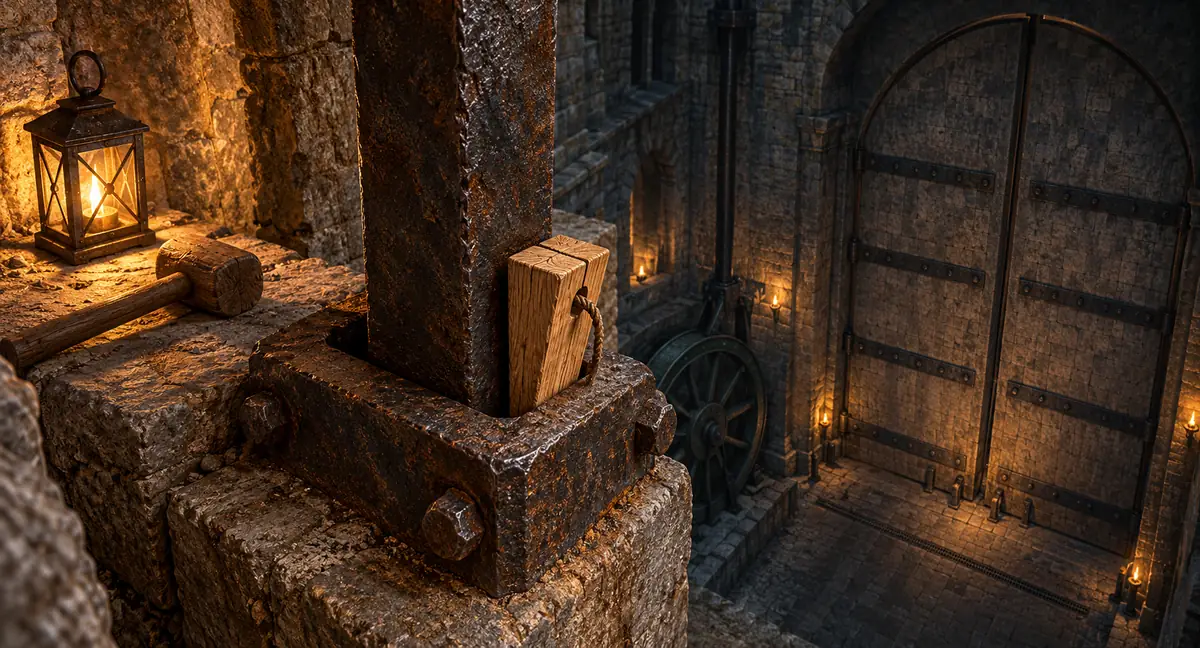
But the collar around the rising rod reminded him of the guide on the old grain hoist at the mill. When a hoist needed repairing, a carpenter could jam the lifting timber with a wedge to keep it from moving while a pin was replaced. Here the guide was iron, the rod far heavier, and the masonry older than any craft he understood. The gap beside the collar was still just wide enough for his prepared oak wedge.
He reached into his bag.
Nella caught his wrist. "You gave me your word."
"I know."
"Then put it away. We tell Merrick and Darron what we've seen."
Beech could hear the workmen below preparing for another turn. He imagined the children asleep in the stone store, Elna trying to hold a cup with her bandaged hands, and another troop of raiders arriving through a door beneath their homes. None of that told him what the ancient lock would do if he jammed it. Nella was right about that.
The watcher ordered the wheel turned. The iron rod shivered and began to rise.
Beech pulled free, crouched, and drove his wedge into the narrow gap between rod and guide. He struck it twice with his wooden mallet.
The rod descended onto the oak.
It stopped.
The wheel below shuddered and locked. The goblin on the lever staggered, almost losing his footing. A loud crack ran along the wedge's upper edge, but the oak remained jammed in the collar.
The groaning from the gate ceased.
For one breath the wheel stood still. Then Beech saw the split running through the oak, a pale line opening under the weight of the rod. He could not tell whether the obstruction would hold for an hour or for another heartbeat.
The goblin watcher looked up.
"Someone's in the gallery."
Nella's face was white with anger, but she did not waste a moment on it. "Move," she said.
Nella hauled Beech backwards by his cloak just as a lantern beam swept the passage. A short iron bolt struck the wall beside them and spun into the darkness.
"Out," she ordered.
They hurried towards the inspection opening. Behind them, goblins shouted to one another on the work floor. Footsteps rang along a stair that Beech had not seen, coming up from the other side of the chamber.
"The upper passage!" a voice called. "Don't let them reach the yard!"
Beech's left wrist gave a sharp stab when he caught himself against the wall. The frying pan bumped against his thigh. He wanted to stop and unfasten it, but every movement of the narrow corridor made the heavy thing strike the stone, and stopping would give the approaching goblins the time they needed.
At the inspection panel, Nella climbed through first. Beech passed her the lantern. He had just brought one leg over the threshold when the first goblin came around the bend behind him.
Not an ordinary raider with a stolen saucepan. A marked inspector, moving low and steady with a short blade in his hand.
"Stay there," the goblin said. "The master will pay for whoever knows that rod."
Beech's stomach seemed to drop through the floor.
The inspector did not rush. He advanced carefully, watching Beech's knife sheath and the iron pan. Behind him came a second set of boots.
Nella thrust her crook through the opening, forcing the goblin to halt or be struck across the knees. Beech backed into the service chamber, but the inspector caught the edge of his cloak and pulled.
The torn wool gave way with a sharp ripping sound. Beech fell against the cradle and knocked the old carrying poles to the floor. The goblin seized the crook, twisted it aside and stepped through the panel.
For a brief, dreadful moment he had Beech trapped between the cradle and the wall.
Then Nella swung the little lantern, not at the goblin but at the stone beneath his feet. Its hood snapped open. Light flared into his eyes. As he flinched, Beech drove the empty wooden carrying pole across the inspector's shins.
The goblin fell against the cradle. Nella shoved the heavy panel back towards its frame, and Beech wedged the second piece of oak into the lower edge to hold it closed.
It would not keep them out for long. He could hear the inspector swearing and striking the stone from the other side.
From above came Mara's warning: two pebbles on the stair, then a third. Danger seen. More than they had expected.
Beech and Nella took the steps two at a time. The slab overhead had moved; someone outside was tugging at it. Mara had her shoulder beneath the edge, fighting to keep it open against another force.
"Quickly!" she hissed.
Nella emerged first with Fern close behind. Beech passed up the lantern and his bag. Mara slung the bag over her shoulder while Nella took the lantern; then Beech dragged himself into the yard. Through the narrow passage beyond the service gate he could hear footsteps approaching from the square.
Mara pointed towards the orchard wall. "There's an archer on the cooperage roof. He saw me when I shifted the cover."
Beech needed no further description. He had met that archer's arrows before: in the flour-covered lane, at Joss's stable, and finally at the mill, where Pellin had fallen.
"We have to go another way," Nella said.
"There isn't one that avoids the square," Mara answered. "Not from this yard."
The archer's first arrow struck the service gate above their heads. The next hit lower, splitting the timber beside Beech's shoulder. He crouched behind the wall, breathless. This was not an enemy who intended to charge blindly into a trap.
A shout came from the orchard entrance. The red-cloaked goblin captain stepped through, his battered helmet freshly strapped and his axe held low. Two armed raiders came behind him, but he stopped them with a gesture. His gaze passed over Nella and Mara, then settled on Beech.
"You," he said.
There was no bellow about the pan. No foolish threat about bones. He simply looked pleased, in the unpleasant way of someone discovering a debt he had waited a long time to collect.
Nella guided Mara sideways towards the cooperage wall. Fern stood beside them with her hackles raised. The captain advanced a step, taking care to keep the archer's line of fire clear.
"The one who spoiled the bridge," he said. "And the pound. And now the lock."
Beech gripped the battered frying pan, but the captain's eyes barely flickered towards it.
"My employer has drawings of this place," the goblin continued. "He didn't say there'd be a carpenter making new problems faster than we could mend the old ones."
"I try to be useful," Beech replied. His voice sounded thin in the open yard.
The captain's mouth curled. "Then perhaps you can be useful to us."
Nella found Beech's hand with hers and squeezed once. Behind the captain the eastern lane was blocked by the two raiders. Above, the archer shifted position on the roof. They had not been killed because someone wanted answers. That might change as soon as the goblins discovered Beech was unwilling to give them.
Mara edged towards the cooperage gate, where a low stack of empty barrels stood against the wall. Beech saw her glance at the barrels and remembered that the ones at the bottom were missing their hoops. They had been awaiting repair since before Harl's birthday.
At last, an unfinished job that might help rather than hinder.
"Nella," he whispered, "the barrels."
Nella looked once and understood.
She seized the top barrel and heaved it sideways. Mara caught the next. The whole untidy stack collapsed across the narrow passage with a crash of dry staves and loose hoops. One raider was knocked to his knees; the other stumbled back, swearing. Fern darted through the gap by the wall, drawing the captain's eye for the length of a heartbeat.
"Run!" Nella shouted.
Mara scrambled over the low cooperage threshold and vanished into the side lane. Nella followed, ducking beneath the archer's next shot. Beech reached the gap behind her just as a cry from under the paving told him that the goblins below had broken through his wooden brace.
Beech stopped with one hand against the cooperage wall. If the inspector climbed into the yard while Nella and Mara crossed the exposed lane, the women would be caught between the captain's men and the archer on the roof.
Beech turned back towards the slab.
"Beech!" Nella cried.
He grabbed the broken length of barrel stave lying at his feet and thrust it beneath the slab's iron ring. The inspector heaved from underneath. Beech planted his walking boots on the wet stone and used the stave as a lever, forcing the heavy cover down against the goblin's upward push.
For several seconds they struggled. The stone lurched, settled, and caught on the lip of its frame. The goblin below shouted angrily. The lane beyond the wall filled with running feet—the sound of Nella and Mara getting clear.
Beech could have followed them then. He could have dropped the stave and made one last attempt at the gap.
The captain stepped between him and the gate.
An arrow struck the wall just beside Beech's ear.
"Don't," said the captain.
Beech released the stave.
It clattered across the paving. His mother’s frying pan hung at his hip, dented and entirely useless against the three weapons now pointed at him. He raised his empty hands.
Far beneath them, something struck iron twice, then stopped. He had seen no movement in the gate leaves before fleeing the gallery. The wedge in the upper guide might buy them a little time, though Beech could not guess how much.
The captain looked towards the hatch. His men were opening it from below. Then he turned back to Beech.
"Tell me about the thing you put in my master's lock."
Beech swallowed. His pulse was still hammering in his throat, and he could barely feel the fingers of his sore left hand. Through a gap in the wall he caught one last glimpse of Nella and Mara disappearing into the orchard trees with Fern beside them. Nella glanced back once. Beech lifted his hand, then lowered it as the trees swallowed her.
"A doorstop," he said.
The captain stared at him.
"You stopped an ancient gate with a doorstop?"
"A very good one," Beech replied. "Seasoned oak."
The captain regarded him for another long moment. Then he lowered his axe and gestured to the guards.
"Take him below. Carefully. The master wants to know who keeps shutting his doors."
The guards ushered him towards the hatch. Beech went carefully: his sore wrist shook, the stone steps were wet, and the captain was close enough behind to make an argument unwise. At the bottom of the stair he glanced back towards the bright square of daylight.
"I suppose," he murmured, "this means I'll miss lunch."
End of Chapter Eight
The story continues.
Back to book contents