Beech and the Morning After
After a thoroughly successful birthday celebration, Beech wants only breakfast and a quiet morning. Briar Glen has other plans—and his father’s sturdy oak door may be all that stands between them.
A tale of unfortunate celebrations, questionable decisions, and the importance of a sturdy front door.
Beech fell into bed with all the grace and dignity of a sack of turnips being thrown from a moving cart.
The bed creaked beneath him. One boot remained firmly attached to his left foot, while the other had disappeared somewhere between the front door and the bedroom. His trousers were damp, his shirt was stained with something that might once have been gravy, and there was a small twig lodged behind his right ear.
None of these things concerned him particularly.
What concerned him was the extraordinary effort required to stop the room from moving.
"Stay," he instructed the ceiling.
The ceiling, being constructed of oak beams and plaster, appeared willing to comply.
"Good."
He closed his eyes.
Then opened one again.
"Happy birthday, Harl," he whispered.
And promptly fell asleep.
It had, by almost any reasonable measure, been a very successful evening.
It had begun at the Lantern and Ladle, the largest and most respectable tavern in the village of Briar Glen. The establishment was owned by Harl Dobb, a broad-shouldered, red-faced fellow whose considerable belly had arrived at middle age several years before the rest of him.
Harl was celebrating his fifty-third birthday.
Or possibly his fifty-fourth.
There had been considerable disagreement over the matter, particularly from Harl's wife, who maintained that her husband had been fifty-three for at least three years.
Harl himself insisted that the exact number was unimportant, provided everyone continued buying him ale.
Beech had attended with the simple intention of enjoying a hearty meal, raising a mug to his good friend, and returning home at a sensible hour.
This intention had lasted until the second barrel was opened.
By the fourth barrel, Beech had volunteered to sing.
By the fifth, he had discovered that singing was considerably easier if one stood upon a table.
By the sixth, the table had expressed an entirely different opinion.
Fortunately, nobody had been seriously injured, although Old Merrick the miller had required assistance extracting his beard from a bowl of onion soup.
Beech remembered very little of the seventh barrel.
He did, however, remember the journey home.
Or parts of it.
There had been an incident involving a gate.
And a pig.
Possibly two pigs.
The trouble had begun when Beech, having bid an affectionate farewell to almost everyone in the tavern, including a coat stand he mistook for the village magistrate, stepped outside into the cool night air.
The moon hung above Briar Glen, large and silver, illuminating the cobbled streets and the thatched roofs of its sleeping cottages.
Beech had taken a deep breath.
The evening air smelled of damp earth, woodsmoke, and approaching rain.
"Beautiful," he had declared to nobody in particular.
Then he had stepped off the tavern's front porch and fallen into a barrel of rainwater.
This had been most unfortunate.
The barrel was not especially deep, but it was surprisingly narrow, and extracting himself required several minutes of concentrated effort accompanied by language that would have troubled a sailor.
Once free, Beech had attempted to make his way home by the shortest route.
Unfortunately, the shortest route required crossing Widow Fenner's vegetable garden.
Widow Fenner maintained a large and exceptionally ill-tempered sow called Duchess.
Duchess did not approve of visitors.
Particularly visitors who fell over her.
The resulting misunderstanding had ended with Beech scrambling over a stone wall, losing one of his stockings, and landing in a patch of nettles.
Duchess had remained on the other side of the wall, expressing her dissatisfaction at considerable volume.
Beech had apologised.
Duchess had declined to accept.
After that, he had followed what he believed to be the northern lane.
It was actually a drainage ditch.
Eventually, after mistaking a scarecrow for the night watchman, singing half a song about a maiden and a turnip, and becoming briefly convinced that the moon was following him, Beech had stumbled through his own garden gate.
He had paused beneath the old apple tree.
Something had sounded in the distance.
A hollow note, like a horn carried upon the wind.
Beech had listened for a moment.
Then he had hiccupped.
"Someone's still celebrating," he announced.
He had staggered inside, secured the heavy oak door, and made his way upstairs.
And that was how Beech, a perfectly ordinary fellow of thirty-seven years, came to be lying in bed with a twig behind his ear, a missing boot, and absolutely no knowledge of the events unfolding beyond his cottage walls.
It was probably the last truly peaceful moment he would enjoy for some considerable time.
Beech awoke to the sound of banging.
Not ordinary banging.
Ordinary banging was familiar to Beech.
He lived in a village, after all, and villages were places where people banged things with surprising enthusiasm. Blacksmiths banged iron. Carpenters banged wood. Farmers banged doors. Husbands banged their heads against low beams after their wives had warned them about those very beams for twenty years.
No, this was different.
This was a deep, irregular sort of banging.
A bang followed by a crash.
Then another bang.
Then what sounded suspiciously like someone dropping an entire kitchen down a flight of stairs.
Beech opened one eye.
The bedroom was dim.
A narrow shaft of daylight filtered through a gap between the wooden shutters, catching dust motes drifting lazily above the floorboards.
"Too early," he muttered.
He closed his eye.
Another crash echoed somewhere outside.
Then came a distant shout.
Beech pulled the blanket over his head.
"Some people," he grumbled, "have no consideration."
He attempted to return to sleep.
Unfortunately, his head had other ideas.
It throbbed.
Not gently.
It throbbed as though a tiny blacksmith had taken up residence behind his forehead and was attempting to repair a particularly stubborn horseshoe.
Beech groaned.
He rolled onto his side.
Something hard pressed into his ribs.
Reaching beneath himself, he discovered a wooden spoon.
He regarded it suspiciously.
He had no recollection of bringing a spoon to bed.
There was, he supposed, a perfectly reasonable explanation.
He simply could not imagine what it might be.
Placing the spoon on the bedside table, he slowly sat upright.
The room tilted.
"Ah."
He waited.
The room settled.
"Better."
He swung his legs over the edge of the bed and placed his feet upon the floor.
One foot was bare.
The other remained inside his boot.
Beech stared at it.
"Well, that's peculiar."
Removing the boot took considerably more effort than he felt appropriate for such a simple task.
When it finally came free, he placed it carefully beside the bed and sat motionless for several moments.
Outside, something shrieked.
It was a high, sharp sound, followed by a chorus of distant shouting.
Beech winced.
"Children."
He rubbed his forehead.
"Why do they have to be so loud?"
He had never understood children.
They seemed entirely too energetic, particularly before breakfast, and possessed an unreasonable enthusiasm for running, throwing objects, and asking questions.
Beech considered all three activities unnecessary before midday.
He rose cautiously.
His knees complained.
His back protested.
His head threatened to resign entirely.
For several seconds he stood beside the bed, taking stock of his situation.
He was alive.
He was indoors.
He had both legs.
These were encouraging developments.
His next discovery was less pleasing.
His trousers had dried during the night and were now sufficiently stiff to stand upright without his assistance.
He inspected the dark stains along one leg.
"Rainwater," he decided.
Then he noticed the smell.
"Possibly not."
He removed the trousers and dropped them into a basket reserved for washing.
After considering their condition, he moved the basket closer to the window.
A little fresh air, he reasoned, might improve matters.
Outside came another bang, followed by the unmistakable sound of breaking pottery.
Beech sighed.
"Youngsters."
He crossed the bedroom and retrieved a clean shirt from a wooden chest.
This proved unexpectedly difficult because someone had tied the sleeves of three shirts together.
Beech stared at the knot.
He had a vague memory of demonstrating a clever trick with knots to someone at the tavern.
Apparently, he had continued practising when he returned home.
"Very clever," he told himself bitterly.
Eventually, having dressed in a clean shirt, an old pair of breeches, and two socks that were almost certainly different colours, Beech made his way downstairs.
The little cottage greeted him with familiar smells.
Cold ashes from the hearth.
Dried herbs hanging above the kitchen shelves.
Old wood.
Soap.
And, faintly, the unmistakable aroma of yesterday's stew.
His home was modest but comfortable.
It consisted of a kitchen, a sitting room, a small pantry, and the bedroom upstairs. The walls were built of thick grey stone, the roof was thatched, and the floors were laid with broad planks of seasoned timber.
Beech had inherited the cottage from his father, along with a collection of woodworking tools, a respectable debt owed to the baker, and a stubborn conviction that most household problems could be solved with a hammer.
The finest feature of the cottage was its front door.
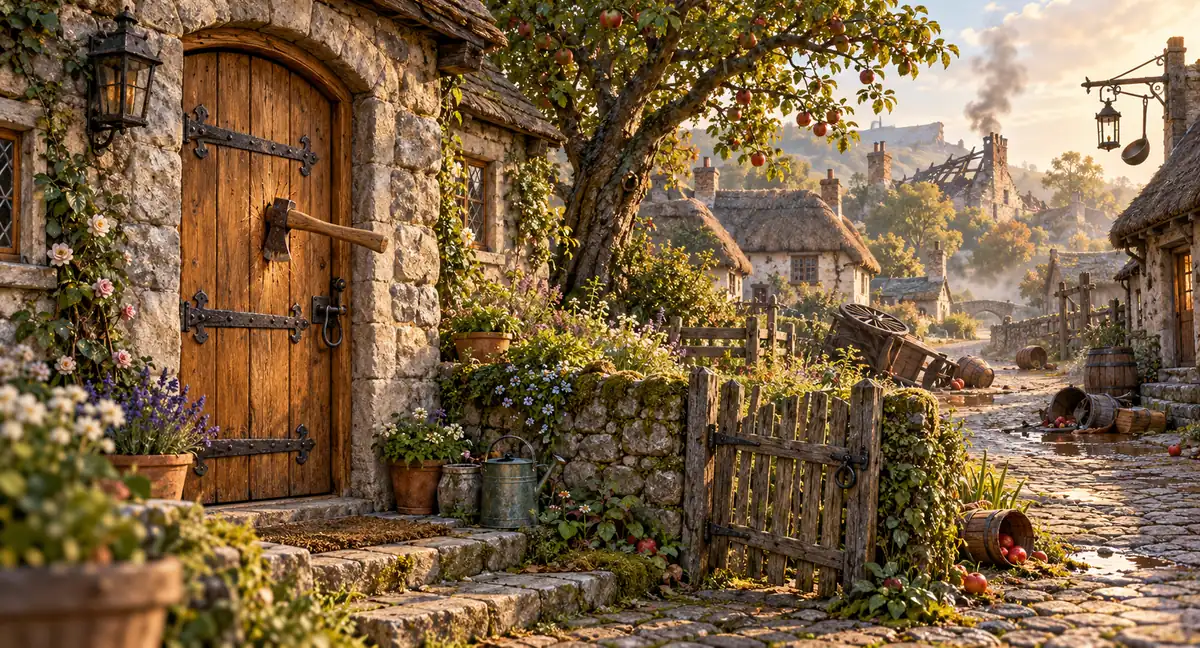
A great slab of seasoned oak, thick enough to impress a castle builder and heavy enough to discourage anyone with questionable intentions.
Beech's father had made it himself.
"A good door," the old man used to say, "is the difference between trouble outside and trouble inside."
Beech had never fully understood what his father meant.
But he had always appreciated the craftsmanship.
He passed the door on his way into the kitchen, running a hand along its smooth wooden surface.
"Morning," he murmured.
The door made no reply.
This was precisely the sort of behaviour Beech expected from a good door.
Beech was a man of routine.
He believed firmly that a proper morning should unfold in a particular order, regardless of the previous evening's festivities.
First, a drink of water.
Second, a fire.
Third, washing.
Fourth, breakfast.
Fifth, a leisurely consideration of the day's responsibilities.
And sixth, if absolutely necessary, actually performing some of those responsibilities.
He had developed this system over many years and saw little reason to improve upon it.
The first stage presented no difficulty.
A clay jug of water stood on the kitchen table beside a loaf of bread and a small piece of cheese.
Beech filled a wooden cup.
He drank it.
He filled it again.
He drank that too.
Then a third.
The water was cool and refreshing, although it did little to quieten the hammering inside his head.
"That'll teach me," he said.
He knew, with the certainty of long experience, that it probably would not.
From somewhere beyond the kitchen shutters came a tremendous clatter.
It sounded like a cart overturning.
Beech paused with his cup halfway to his mouth.
"That'll be Joss."
Joss was the village carter.
He had a remarkable talent for losing control of perfectly serviceable wagons, usually while explaining to passengers that he had never had an accident.
Beech waited for the inevitable stream of curses.
Instead, he heard several voices shouting at once.
There was a sharp metallic ringing, a crash, and then a strangely guttural cry.
Beech nodded knowingly.
"Definitely Joss."
He set down his cup and approached the hearth.
The ashes were cold.
A few blackened logs remained from the previous evening.
Beech knelt, gathered some dry kindling from a basket, and carefully arranged it beneath a small stack of firewood.
He reached for the tinderbox.
It was not there.
Beech frowned.
He checked the mantelpiece.
Nothing.
He inspected the shelf beside the chimney.
Still nothing.
He looked beneath the table.
He checked the bread basket.
He even examined the inside of his boots, though he could not have explained why.
Finally, he discovered the tinderbox inside the flour jar.
Beech regarded it for a long moment.
"I really must stop doing that."
He had never done it before.
But it seemed a good rule nonetheless.
After several attempts, a small flame caught the kindling.
Beech leaned forward and blew gently.
The flame flickered.
He blew again.
The flame grew.
A third, overenthusiastic breath sent a cloud of ash directly into his face.
Beech coughed violently.
His eyes watered.
He staggered backwards and struck his head against the edge of the kitchen table.
For several moments he remained crouched beside the hearth, considering the wisdom of getting out of bed at all.
Outside, a tremendous roar rose from somewhere near the village square.
It was followed by what sounded like several dozen people screaming.
Beech closed his eyes.
"Oh, for pity's sake."
The annual autumn fair was still weeks away.
Had Harl decided to continue his birthday celebrations into a second day?
It seemed entirely possible.
Indeed, after the quantity of ale consumed the previous evening, Beech wondered whether the celebrations might continue until someone ran out of money.
He stood and brushed the ash from his shirt.
The fire was burning nicely now.
At least something was going according to plan.
He filled a kettle from the water jug and placed it over the flames.
Then he turned his attention to washing.
A small basin sat upon a wooden stand in the corner of the kitchen, beneath a polished brass mirror.
Beech poured in some water and looked at his reflection.
He recoiled.
"Good grief."
The man staring back at him looked as though he had been dragged backwards through a hedge.
His hair stood in several directions.
One eye was bloodshot.
There was a purple bruise developing beneath his chin.
And something green was stuck to his cheek.
Beech leaned closer.
He picked at it.
A leaf came away between his fingers.
"Ah."
He examined the bruise.
He remembered falling into Widow Fenner's nettles.
He did not remember striking his chin.
Perhaps the scarecrow had hit him.
He had always thought the thing looked suspicious.
Beech dipped a cloth into the basin and began washing his face.
The cold water was unpleasant but effective.
He scrubbed at his cheeks, cleaned the dirt from around his ears, and attempted to flatten his hair with damp fingers.
This last effort was spectacularly unsuccessful.
A stubborn tuft above his left temple continued to point towards the ceiling.
Beech pressed it down.
It rose again.
He tried once more.
The tuft remained defiantly upright.
"Fine," he muttered. "Have it your way."
A sudden crash shook the window shutters.
Beech nearly dropped the basin.
He turned towards the sound.
Something rattled against the wall.
Then came a series of rapid impacts, as though handfuls of stones were being thrown against the cottage.
Beech stood very still.
"Rain?"
He listened.
Another impact struck the roof.
Then another.
A small shower of dust drifted from the ceiling.
Beech frowned.
"That's unusually heavy rain."
He approached the kitchen window.
The shutters were closed.
He reached towards the latch, then hesitated.
Daylight was already leaking through the gaps.
Opening the shutters would allow the full morning sun into the room.
And given the present condition of his head, this seemed an unnecessarily cruel thing to do.
Besides, if it was raining, there would be little to see.
He stepped away.
"Best leave it."
Breakfast was, in Beech's opinion, the most important meal of the day.
Lunch was a close second.
Supper was also extremely important.
Indeed, Beech struggled to identify a meal that was not important, although he did regard late-night eating with some suspicion, particularly when it involved cold sausages found in unfamiliar pockets.
This morning called for something substantial.
Porridge, he decided.
Porridge would settle his stomach.
Porridge would restore his strength.
Porridge would provide a solid foundation upon which he could rebuild the shattered remains of his dignity.
He fetched a small iron pot and set about preparing it.
Oats.
Water.
A little milk.
A pinch of salt.
He stirred carefully, humming a tune from the previous evening.
At least, he attempted to hum it.
The tune was difficult to remember, and he had only the vaguest recollection of its lyrics.
Something about a farmer's daughter.
A goose.
And a rather unfortunate incident involving a bishop.
He was halfway through the chorus when a horn sounded outside.
Beech stopped stirring.
The note was low and harsh, carrying across the village like the bellow of some enormous wounded beast.
It lasted several seconds before falling silent.
Beech waited.
Another horn answered it.
Then a third.
He scratched his head.
"Well, that's new."
Briar Glen had a village horn, of course.
It was kept in the watchman's hut beside the western gate.
Traditionally, it was sounded to announce the arrival of important visitors, warn of approaching storms, or summon the villagers when Old Merrick's goats escaped.
The horn outside sounded nothing like the village horn.
For one thing, it was much louder.
For another, it had a distinctly unpleasant quality, as though someone had attempted to blow a tune through the wrong end of a sick cow.
Beech returned to stirring.
"Probably practising."
He considered this explanation.
It seemed reasonable enough.
The village watchmen had never been particularly musical.
Indeed, Beech remembered that one of them, a cheerful fellow named Tam, had once attempted to play the flute and caused three dogs to flee the village.
Another horn sounded.
This time, much closer.
Beech grimaced.
"Well, he'll never get into the harvest band at that rate."
His porridge began to bubble.
He stirred it vigorously.
Outside, the shouting grew louder.
Beech could now distinguish individual voices, although not the words.
There were cries of alarm.
Angry bellows.
The sounds of people calling to one another.
Something heavy smashed into something else.
Then came a dreadful scraping noise, followed by an enormous crash.
Beech froze.
"That sounded expensive."
He considered the possibilities.
Perhaps Joss had overturned another cart.
Perhaps a tree had fallen.
Perhaps the villagers had decided to dismantle the old barn near the square.
He was still debating the matter when the village bell began ringing.
Beech looked up.
The bell hung in the little stone tower beside the meeting hall.
Every morning it rang six times to mark the beginning of the working day.
At midday it rang twelve times.
At sunset it rang again.
This morning, however, the bell appeared to have entirely abandoned its usual duties.
It rang once.
Then three times.
Then twice.
Then a furious succession of clangs so rapid that Beech briefly wondered whether a flock of angry pigeons had somehow become trapped inside the bell tower.
He stared towards the sound.
"Now what?"
The ringing stopped.
There was a distant wooden crack, a crash, and a deep reverberating clang.
Then silence.
Beech waited.
The bell did not ring again.
"Hmm."
He considered the matter.
"Probably broken."
This was irritating.
Beech relied upon the village bell to tell him when to begin work, when to stop for lunch, and when to return home.
Without it, the entire day might descend into confusion.
He made a mental note to complain to the village council.
Then he returned to breakfast.
The porridge was ready.
Beech spooned a generous helping into his favourite bowl.
He added a little honey, a handful of dried berries, and a dash of cream.
He carried the bowl to the table and sat down.
For the first time since waking, he felt genuinely hopeful.
He lifted his spoon.
A loud metallic clang came from outside.
Beech paused.
Another clang.
A scraping sound.
Then a tremendous crash.
He sighed and lowered the spoon.
"Honestly."
He stood, crossed the kitchen, and pushed a rolled cloth firmly into the narrow gap beneath the shutters.
It did very little to muffle the noise.
Still, he felt better for having done something.
He returned to the table.
The first mouthful of porridge was magnificent.
Warm.
Sweet.
Rich.
Beech closed his eyes and savoured it.
The second was even better.
By the fourth spoonful, he had almost forgotten his aching head.
By the sixth, he had begun considering the possibility that the day might turn out reasonably well after all.
Then came the smell.
Beech sniffed.
Something was burning.
He looked towards the hearth.
The fire crackled pleasantly.
Nothing unusual there.
He checked the porridge pot.
A little remained at the bottom, but it was not burning.
He sniffed again.
Smoke.
Not the comfortable smell of a cottage hearth, but the harsher scent of burning timber and thatch.
Beech frowned.
"Someone's overdone the bread."
Across the lane stood the bakery belonging to Mistress Elna, a formidable woman whose bread was excellent and whose temper was less so.
Mistress Elna had been baking in Briar Glen for nearly forty years.
In that time, Beech could not recall a single occasion when she had burned a loaf.
This seemed an impressive achievement, particularly considering her fondness for shouting at customers while simultaneously kneading dough.
He sniffed again.
The smell was stronger now.
"Must be trying something new."
He took another mouthful of porridge.
Outside came the sound of running feet.
Many running feet.
The voices were closer now.
A man shouted something.
A woman screamed.
Beech paused.
He listened.
Another voice yelled.
Then came a strange cackling sound, high and unpleasant, followed by the unmistakable crash of breaking glass.
Beech set down his spoon.
"That'll be the lads from the mill."
He shook his head.
"They've no respect for property."
He resumed eating.
A shadow passed across the narrow strip of daylight beneath the shutters.
Then another.
Then several in rapid succession.
Something struck the cottage wall with a hollow thunk.
Beech looked towards it.
He waited.
No further impact came.
"Apples," he decided.
There was an old apple tree in the garden.
It had dropped its fruit rather enthusiastically the previous autumn, although Beech could not recall it ever throwing apples sideways against the wall.
Perhaps the wind was particularly strong.
He made a note to inspect the tree later.
Assuming, of course, that he felt sufficiently recovered.
He was beginning to suspect that today might not be an ideal day for strenuous activity.
After breakfast came the important business of planning his responsibilities.
Beech fetched a small slate board from the shelf.
He used it to record the tasks he intended to perform each day.
The system was simple.
Anything written on the board should, ideally, be completed before supper.
Anything not completed could be transferred to the following day.
In this way Beech had successfully managed to postpone repairing the garden fence for almost eleven months.
He inspected yesterday's list.
Repair fence.
Collect nails from smithy.
Return borrowed ladder.
Buy onions.
Speak to Joss about wheelbarrow.
He considered the items.
The fence could wait.
The nails were not urgent.
The ladder belonged to Old Merrick, who had apparently forgotten lending it.
The onions were useful but not essential.
And speaking to Joss about the wheelbarrow would require Beech to remember precisely why he had borrowed it in the first place.
He took a piece of chalk.
At the top of the slate he wrote:
Recover.
He examined the word approvingly.
Then he added:
Eat something nice.
He considered adding a third item, but decided that two were quite sufficient under the circumstances.
The cottage shook.
Not violently, but enough to send a small wooden cup sliding across the shelf.
Beech caught it before it fell.
He looked towards the window.
"What on earth?"
There was another crash outside.
This time it was accompanied by a sound like thunder.
Beech glanced towards the ceiling.
The day had seemed bright enough when he woke.
Could a storm have rolled in?
It was possible.
The weather in Briar Glen was notoriously unpredictable.
A clear morning could become a torrential downpour before lunch, while an afternoon of rain might give way to glorious sunshine just as everyone finished complaining.
Beech had often suspected that the weather enjoyed listening.
He placed the cup back upon the shelf.
Another shout came from outside.
This one was close enough for him to make out the words.
"BACK! GET BACK!"
Beech frowned.
He recognised the voice.
It belonged to Darron the blacksmith.
A broad, powerful man who could bend iron bars with his hands and occasionally attempted to do so when people disagreed with him.
Beech had always liked Darron, despite his alarming enthusiasm for arm-wrestling.
"Must be moving something heavy," he decided.
He wondered whether the blacksmith needed assistance.
Then he remembered his aching back.
"Best not interfere."
He sat down again.
For several minutes he occupied himself by sharpening a small kitchen knife.
Beech found the activity soothing.
The gentle scrape of steel against stone helped distract him from the dreadful commotion outside.
He took care to maintain the angle of the blade.
His father had taught him that a well-sharpened knife was an essential household tool.
"A sharp knife cuts what you want," the old man used to say. "A blunt one cuts what it pleases."
Beech had always thought this rather wise.
He tested the edge against a piece of paper.
It sliced cleanly.
"Perfect."
Outside, somebody screamed.
Beech looked up.
He listened.
The scream ended abruptly.
There was a moment of silence.
Then a series of rapid footsteps passed the cottage.
Beech set down the knife.
For the first time that morning, a small feeling of unease stirred beneath his ribs.
Something was not quite right.
He could no longer pretend the noises were entirely ordinary.
Even allowing for Harl's birthday celebrations, Briar Glen seemed to be having an exceptionally disruptive morning.
He stood.
He took a step towards the front door.
Then stopped.
His eyes fell upon the kitchen table.
The porridge bowl was still sitting there.
Unwashed.
Beech frowned.
He disliked leaving things untidy.
Whatever was happening outside could surely wait until he had finished the washing-up.
He returned to the kitchen.
It took only a few minutes to clean the bowl, spoon, and cooking pot.
Beech worked methodically.
He scrubbed.
He rinsed.
He dried.
He stacked everything neatly upon the shelf.
Another horn sounded.
This one seemed almost directly outside.
The sound was followed by a chorus of harsh, guttural voices.
Beech stopped.
He tilted his head.
He could not make out the words.
It sounded like a group of very angry men attempting to gargle while arguing.
He frowned.
"Visitors?"
Briar Glen occasionally attracted travellers from the northern hills, where the people spoke with an accent so thick that even their own relatives sometimes required assistance understanding them.
Beech had once spent an entire afternoon talking to a northern trader before discovering that the man had been trying to sell him a sheep.
The memory still annoyed him.
He put the final plate away.
A tremendous impact struck something nearby.
The cottage windows rattled.
A clay jar fell from a shelf and shattered upon the floor.
Beech jumped.
"Oh, come on!"
He looked down at the broken pottery.
The jar had belonged to his mother.
It had survived thirty years, two house moves, a particularly severe winter, and an unfortunate incident involving a visiting cousin.
Now it lay in pieces.
Beech stared at the fragments.
His irritation began to outweigh his headache.
"Right."
He fetched a broom.
He swept the pieces into a small pile.
He gathered them carefully and placed them in a bucket.
Then he put the broom away.
He stood in the middle of the kitchen.
His hands rested upon his hips.
"This," he announced to the empty room, "is getting ridiculous."
Another scream echoed outside.
A crash followed.
Then the unmistakable sound of splintering wood.
Beech glanced towards the front door.
He had intended to spend the morning resting.
Perhaps enjoying a slice of bread with honey.
Perhaps taking a pleasant walk through the orchard later, if the weather improved.
He had certainly not planned on becoming involved in whatever foolishness had overtaken the village.
But enough was enough.
Someone needed to explain what was happening.
And someone, preferably Darron, needed to stop making so much noise.
Beech crossed the sitting room.
He stopped beside the coat stand.
His brown woollen cloak hung from one of its pegs.
His best walking boots sat beneath it.
He considered putting them on.
Then decided against it.
He was only going to step outside for a moment.
There was little point dressing for an expedition.
He did, however, retrieve his old woollen cap.
It was a battered green thing, stretched around the brim and decorated with a small feather.
Beech placed it upon his head.
The feather drooped.
He adjusted it.
It drooped again.
"Typical."
He straightened his shirt.
He brushed a little ash from his sleeve.
Then he approached the great oak door.
Outside, the sounds were growing closer.
Running feet.
Shouting.
A crash.
The harsh ringing of metal.
And something else.
Laughter.
Not ordinary laughter.
Not the cheerful laughter of friends sharing a joke.
This was a thin, cruel, shrieking sound, carrying a savage delight that made the hairs on Beech's arms rise.
He hesitated.
His hand rested upon the iron latch.
Perhaps, he thought, it would be wiser to remain indoors.
But the feeling passed.
After all, this was Briar Glen.
Nothing particularly dreadful ever happened in Briar Glen.
There had been a barn fire twelve years earlier.
And the unfortunate business with the travelling magician and the missing chickens.
And, of course, the great flood of twenty-six years ago, when half the village had been forced to spend three days sheltering in the meeting hall.
But these were exceptions.
Briar Glen was a peaceful place.
A good place.
A place where people knew their neighbours, looked after one another, and argued about the price of turnips with an enthusiasm usually reserved for matters of national importance.
Beech had lived there his entire life.
He had never known it to be otherwise.
He took a deep breath.
"Right then."
He lifted the latch.
Pulled back the heavy iron bolt.
And opened the door.
For one glorious, incomprehensible moment, Beech's mind simply refused to accept what his eyes were showing him.
The village was on fire.
Not all of it.
But quite enough to be thoroughly alarming.
Thick black smoke rose from the western end of Briar Glen, curling above the thatched rooftops and drifting across the morning sky.
The bakery was burning.
The meeting hall had lost half its roof.
The village bell tower stood crookedly beside a heap of fallen masonry.
The main street was littered with broken barrels, shattered carts, abandoned tools, and the scattered remains of market stalls.
A horse galloped past without a rider.
Behind it ran three men carrying pitchforks.
Behind them ran something small and green carrying a sword.
A woman emerged from a nearby cottage wielding a frying pan, struck the green creature squarely across the face, and disappeared back inside.
Beech blinked.
"What?"
An arrow hissed overhead.
It struck the wall beside his window.
Beech looked at it.
Then at the village.
Then back at the arrow.
Somewhere near the square, a large wagon overturned with a dreadful crash.
Several small, twisted figures leapt upon it, howling triumphantly.
Goblins.
Actual goblins.
Not the harmless little creatures of old children's tales, stealing turnips and frightening shepherds.
These were armed.
Armoured.
Filthy.
Their skin ranged from sickly grey to dark, mottled green. Their faces were long and sharp, with crooked teeth, yellow eyes, and pointed ears that protruded beneath battered iron helmets.
They swarmed through the village in dozens.
Perhaps hundreds.
Some carried rusty swords.
Others wielded spears, clubs, and wicked-looking axes.
Several had climbed onto the roofs and were tearing away handfuls of thatch.
One was enthusiastically attempting to set fire to a water trough.
Another had become trapped inside a barrel and was running blindly into things.
Beech recognised Harl Dobb near the tavern.
The landlord stood in the street wearing his nightshirt, a cooking pot upon his head, and wielding a large wooden mallet.
He was shouting furiously at three goblins who appeared to be attempting to steal his ale barrels.
Even at this distance, Beech could recognise the expression on Harl's face.
It was the same expression he wore whenever somebody asked for a drink on credit.
Beech stared.
His mouth opened.
No words came out.
A familiar pig thundered across the lane.
Duchess.
Widow Fenner's enormous sow charged between two burning carts, squealing furiously.
A goblin clung desperately to her back, facing the wrong direction, screaming as the animal carried him away.
Beech watched them disappear around the corner.
"Well," he whispered.
He had several questions.
An enormous number of questions, in fact.
He wondered why the village was burning.
He wondered where all the goblins had come from.
He wondered whether Harl's birthday celebrations had somehow got entirely out of hand.
Most importantly, he wondered whether he should shut the door.
Then he noticed movement.
Directly ahead, beyond his little garden gate, a goblin stood in the lane.
It was larger than most of the others, broad across the shoulders, with a flattened nose and a mouth full of jagged yellow teeth.
A crude iron helmet sat upon its head.
A tattered red cloak hung from one shoulder.
In its right hand it carried a broad, vicious-looking axe.
The goblin was shouting orders to a mob of smaller creatures behind it.
Then its yellow eyes settled upon Beech.
The shouting stopped.
For a heartbeat, the two stared at one another.
Beech stood in his doorway, wearing mismatched socks, an old woollen cap, and a shirt that was still slightly damp around the collar.
The goblin slowly raised its axe.
It grinned.
Beech swallowed.
"Morning," he offered.
The goblin roared.
It charged.
Behind it, a dozen others surged forward, screaming and waving their weapons.
Beech stared in horror.
The goblin vaulted the garden gate.
The axe rose above its head.
Beech stepped backwards.
"Oh," he said quietly.
The goblin lunged towards him.
Beech seized the heavy oak door with both hands.
He threw his weight against it.
The door slammed shut.
And a heartbeat later, the axe struck the oak with a tremendous—
THUD.
The story continues.
Back to book contents