Beech and the Art of Running Away
With goblins at his door, Beech flees through a village in flames. A furious sow, a runaway wagon and a rotten bridge teach him that escaping is only the beginning.
Chapter Two: In Which a Hero Is Born Entirely by Accident
The axe was stuck.
This was the first good thing to happen to Beech all morning, although he felt that calling it good might be rather generous. Its blade had bitten through the outer face of his oak front door and was now lodged beside the latch. On the other side, a goblin was attempting to pull it free with a series of grunts that grew steadily less dignified.
Beech stood in the sitting room with his back against the door. His heart thumped. His knees had taken up a curious trembling. His battered green cap had fallen over one eye.
There came a wrench, a yelp and a burst of laughter.
"You've hit yourself, captain!" cried a voice outside.
"I HAVE NOT!"
"There's blood on your nose!"
"THEN IT'S SOMEONE ELSE'S!"
Beech listened as several goblins argued over whose nose was bleeding. It was an encouraging sign, but he was not foolish enough to mistake an argument for safety. Through the split in the oak, he could see daylight and the glimmer of an axe edge. He could also hear more footsteps gathering on the porch.
"COME OUT, MAN!" bellowed the captain.
"Afraid I'm busy," Beech answered before thinking better of it.
"DOING WHAT?"
Beech looked around his comfortable sitting room, at the swept hearth and the little list of chores still standing on the kitchen shelf.
"Housework."
The captain roared and struck the door again, this time with something heavy enough to rattle the hinges. Beech considered the wisdom of discussing domestic obligations with an armed invader and decided he had exhausted the subject.
He remembered the back door.
It was an excellent invention, the back door. Beech had rarely appreciated it sufficiently. One could leave one's cottage without encountering people at the front, which until this moment had been chiefly useful when the baker called about unpaid bills.
First, however, he needed to dress properly.
His good walking boots stood beneath the coat stand, precisely where they belonged. They were not the unfortunate boots that had accompanied him home from Harl's birthday party; one of those had ended up in bed with him, and he had removed it upstairs that very morning. The walking pair were stout, dry and ready for considerably more walking than Beech usually considered reasonable.
He pulled them on, laced them tightly and rose. Something gave a small croak inside the right boot.
Beech sat down again, removed it and tipped out a frog.
For a moment they regarded each other in equal surprise. Then Beech carried the creature to a flowerpot by the kitchen window.
"You're going to have to explain that at a more convenient time," he told it.
He returned to his boot. Outside, the captain ordered someone to fetch a mallet. Beech put on his brown woollen cloak and gave the torn little feather on his cap a hopeful straightening. In the mirror he looked like a man going to a funeral by mistake, but at least he looked ready to go somewhere.
Next came provisions: a lump of bread, a wedge of cheese, two apples and two cold sausages wrapped in cloth. He put them in his canvas shoulder bag. His porridge could wait, provided the invaders left the kitchen alone.
Finally he needed a weapon. He considered the poker, rejected it for being awkward to carry, and took the sharp kitchen knife he had been so proud of honing earlier that morning. It fitted into an old leather carving-tool sheath at his belt. Beside the hearth hung his mother's black iron frying pan, heavy and seasoned by thirty years of breakfasts. Beech lifted it and gave it a tentative swing. The handle was firm. The pan had a good solid weight.
"I suppose," he said to the empty kitchen, "that will have to do."
The front door gave a noise like a tree cracking in frost.
Beech hurried to the back of the cottage, lifted the latch and pulled. The door didn't move. He pulled harder, putting a boot against the wall, while from the sitting room came an ominous splintering sound.
"THE HINGES!" shouted a goblin. "HIT THE HINGES!"
Beech gave the back door one final desperate tug, then recalled, with some embarrassment, that it opened outwards. He pushed. It flew wide and he almost fell face-first into his cabbages.
He recovered, took a breath of air tainted with smoke, and shut the door softly behind him.
That was when he saw the village rooftops beyond his garden fence.
From the front step he had glimpsed chaos. Here, away from the noise of the main street, he saw what it had done. The bakery roof was burning. One corner of the meeting hall had collapsed, leaving dark rafters thrusting into the morning. The bell tower leaned at an angle no bell tower had any business leaning. Smoke rolled eastwards in thick grey banks, and a man's voice was calling for help somewhere near the orchard lane.
Beech's hand tightened around the frying pan.
His front door broke open with a crash.
"HE'S GONE!" yelled a goblin.
"FIND THE FOOD!" yelled another.
There was an excited clatter from the kitchen, followed by a scream that suggested someone had discovered the hot kettle. Beech would normally have found this satisfying. Instead, he glanced once at his cottage and hurried towards the fence.
He had meant to repair it for nearly a year. Six weathered boards sagged beneath the apple tree, held upright largely by habit and a nail that had begun to give up hope. Beech stepped through the gap, caught his cloak on the nail and pulled. The fence came down with the long, appalled sigh of old timber.
So did Beech.
He landed amongst Widow Fenner's cabbages, where he lay for a moment considering whether the ground might be the safest place to remain.
"THERE HE IS!"
A goblin had appeared at the cottage's back door. It raised a short blade and shouted for the others.
Beech rolled upright and ran.
Widow Fenner's garden was a magnificent example of order. Its rows of turnips were straight, its cabbages enormous, its paths neatly raked. Beech tried to keep to the paths, less from courtesy than from a well-founded fear of the widow herself. Behind him, three goblins scrambled over the fallen fence with far less regard for the vegetables.
Duchess, the widow's enormous sow, was already loose. Beech had seen her charging about the village earlier, with a goblin clinging to her back. She had now returned to her familiar turnip beds, trailing a snapped leather strap and looking as though the whole morning had been an insult directed at her personally.
Beech saw the pig. The pig saw Beech. Neither was pleased.
"Morning, Duchess," he said, edging around her.
One goblin crashed through the cabbages and aimed a spear at him. The point tore a strip from his cloak and buried itself in the fence post where his chest had been a moment before. Beech stumbled away, suddenly cold beneath his shirt. Whatever ridiculous noise the creatures made, that spear would have killed him.
He raised the frying pan and struck it against the iron latch of Duchess's empty pen.
CLANG!
The sow leapt. Her ears flattened. For one alarming instant she fixed Beech with a glare that promised a painful reckoning. Then the goblin behind him screamed, "GET THE MAN!", and charged through the turnip bed.
Duchess decided that she had heard quite enough from goblins for one day.
She launched herself into the nearest one with the unstoppable indignation of a runaway beer barrel. The creature vanished into the turnips. Another tried to dodge and discovered that its companion had the same idea; together they collided with the side of the shed. The spearman dropped his weapon and climbed a tree, which seemed a wise decision until Duchess began uprooting the earth beneath it.
Beech watched, fascinated. He had only meant to make a noise.
"Well, there's a thing."
"BEECH!"
Widow Fenner stood in her doorway holding a rolling pin. She surveyed the crushed cabbages, the broken fence, the goblins and her furious sow. Then she looked at Beech with the expression she usually reserved for people who returned borrowed kitchenware without washing it.
"WHAT HAVE YOU DONE TO MY GARDEN?"
"There are goblins," he offered.
"I CAN SEE THAT!"
A goblin staggered up behind her. Without turning, the widow struck it backwards across the face with her rolling pin.
CLONK.
"And I can deal with them," she added. "What I can't deal with is you standing on my onions. RUN!"
Beech obeyed. He had known Widow Fenner his entire life, and while he was uncertain what a goblin could do to him, he had an excellent understanding of what she could do.
He slipped out of the side gate and into the lane behind the cottages. There he stopped so abruptly that his shoulder bag swung around and hit him in the stomach.
Five more goblins blocked the eastern end. They were stripping the harness from Joss's grain wagon, quarrelling over a sack they believed to contain silver. It contained flour. Beside the stable door, Joss himself lay against a water trough, clutching an arm dark with blood.
Beech forgot his fear for a moment. "Joss?"
Joss looked up. He was conscious, but his face had lost its usual ruddy colour.
"Don't come here," he said hoarsely. "One of them's got a bow."
An arrow struck the timber post beside Beech's head. He ducked behind a rain barrel, his earlier optimism draining away. One of the goblins was standing perfectly still at the far end of the lane, fitting a second arrow to its string. It had seen him. It was waiting for him to run into the open.
Beech's fingers found the edge of a stone propping the grain wagon's rear wheel. The wagon stood on the slope between the stable and the trough; Joss had left it with the brake rope partly frayed and a wooden chock beneath the wheel. Beech knew because he had been asked to replace the rope last week.
He had not yet got round to it.
It was not an admirable circumstance, but there was no time to regret it. He dropped to one knee, hooked the frying-pan handle behind the chock and heaved. The stone shifted. The wheel turned. The wagon lurched downhill.
Beech had intended to send it towards the goblins. He had not considered Joss, who was sitting beside the trough at the bottom.
"JOSS! ROLL AWAY!"
Joss looked from Beech to the gathering wagon, then flung himself sideways with an oath vigorous enough to suggest recovery was possible. The wagon struck the trough. Water exploded across the lane; the flour sack burst under a wheel, and the goblins disappeared in a cloud that turned immediately into white paste.
The archer still fired. His second arrow caught Beech's sleeve, pinning the cloth to the barrel. Beech yanked free, leaving a flap of his shirt behind. His green cap slipped off in the struggle and vanished into the spreading flour; there was no time to recover it. He scrambled towards Joss through the settling cloud.
"Can you stand?"
"If you stop making roads more dangerous," Joss muttered, using his good arm to grip the stable door.
Beech helped him up. The groom's little daughter, hidden inside the stable, pulled the door open just far enough for them to squeeze through. Beech pushed Joss into her arms and told her to bolt it from within.
"There's a back way to the orchard," he whispered. "Take it when the lane's clear. Go uphill, away from the smoke."
The girl nodded. Her face was frightened but steady.
Beech wanted very badly to stay and make sure they reached safety. Then the archer's voice sounded through the flour cloud, calling to its companions. He had no weapon long enough to face the goblin's bow, and if he remained, the creatures would find the stable.
So he fled, carrying the unhappy knowledge that he had almost killed Joss while trying to save him.
The mill road was open, but not empty. Goblins moved between the houses, hauling sacks and tools. A cottage window shattered near the baker's lane, and Beech saw a boy dart across the street with two smaller children pressed against him. Behind them came a goblin with a hooked blade. Before Beech could move, Darron the blacksmith emerged from a doorway and slammed his shoulder into the attacker. The children vanished into the adjoining yard. Darron held the doorway with a hammer in one hand, shouting for someone inside to bar the shutters.
Beech raised a hand. Darron saw him and waved him away urgently.
"EAST!" he shouted. "Get clear, Beech!"
Beech didn't argue. He had just learned the difference between an enemy who was funny and one who was harmless.
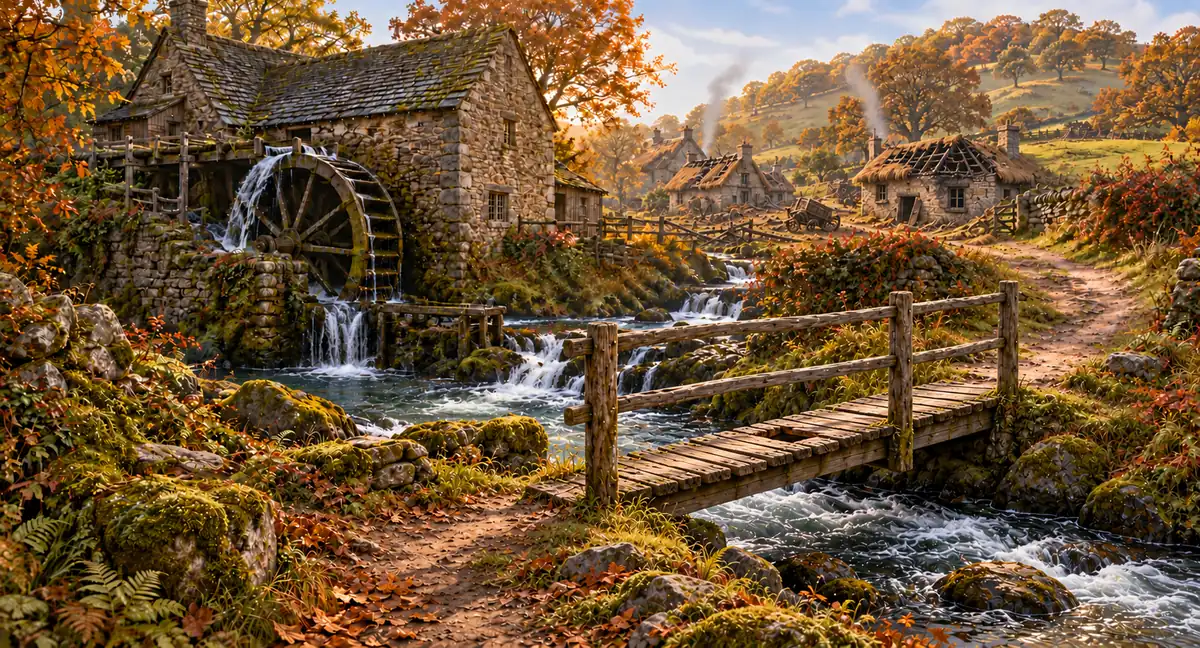
The old mill stood beside the eastern stream, its waterwheel creaking steadily. Beyond it, a narrow timber bridge led to the fields and rising woods. Beech stepped onto the bridge and felt the planks complain beneath his walking boots. He had been asked to mend it in spring. That seemed, in retrospect, an oversight.
A horn sounded from the road behind him, followed by a voice he recognised at once.
"THERE HE IS!"
The large goblin captain stood on the mill road, red cloak over one shoulder and broad axe in hand. Beech could see a swollen mark across his nose from the struggle at the cottage door. Around him gathered half a dozen goblins. One wore a black strip of cloth stitched with a white ring broken by a vertical line. Unlike the others, that one said nothing. It pointed towards the meeting hall, where another group was moving with purpose through the smoke, and the captain sent it away with a curt nod.
Beech might have wondered about that if the captain had not begun running at him.
He hurried to the far bank. The first two goblins hesitated at the bridge, but their captain shoved past them. Beech seized the long pole used to clear weed from the waterwheel and thrust it towards the oncoming creatures. One ducked. Another caught the pole and nearly pulled Beech into the stream.
The captain reached him at the end of the bridge. Its axe swept sideways. Beech threw up the frying pan without any thought except to avoid dying.
CLANG!
Pain ran from his wrist to his shoulder. The axe glanced away, leaving a deep dent in the pan's rim, and Beech staggered backwards. Before the captain could swing again, Beech swung the pan in a wild, frightened arc. It caught the goblin across the helmet with a sound like a kitchen bell struck by a mallet.
The captain reeled and planted one foot squarely on the centre plank.
The rotten timber gave way.
The goblin plunged into the cold millstream, taking a quantity of bridge with him. Beech heard a splash and saw the red cloak surface near the bank. The captain was alive. Worse, he caught hold of a root, dragged himself onto the mud and retrieved his axe from the shallows.
He looked up at Beech with a hatred that required no translation.
Beech decided this was the moment to leave.
He ran into the fields, over a low stone wall and up the rising path towards the woods. His cloak snagged once and he tore it free rather than stop. Behind him the captain marshalled his goblins into two groups: most turned back to the village at an urgent call from the north, while three were ordered to follow Beech.
Their shouts dwindled as the hill steepened. Beech finally stopped beneath an old oak, chest heaving, and looked back.
Briar Glen lay in the valley below. He could pick out the tavern, the mill, the ruined bell tower and the bakery's smoking roof. He thought of Harl with his wooden mallet; of Darron defending the children; of Joss, pale and bleeding against the stable; and of the girl who had helped drag her father indoors.
He was safe, or nearly so. They were not.
That was a deeply uncomfortable discovery for a man whose chief ambition that morning had been a second breakfast.
Beech could hardly go back with a kitchen knife and a battered frying pan. He was no warrior. He made tables, repaired shutters and occasionally carved little wooden animals for children at the market. His father had once told him that Beech could turn a perfectly good afternoon into a disaster just by trying to improve it.
Yet he knew Briar Glen. He knew its lanes and leaning walls; its stuck gates and missing steps. He knew precisely which repairs he had neglected, largely because there were so many of them.
He looked at the dent in his mother's pan and remembered the goblins in the millstream. He remembered Duchess, and the wagon, and Joss almost beneath its wheels. There were ways to fight without being a fighter, but next time he would have to be more careful about who else was in the way.
"I'll be back," he said towards the village.
After a moment he added, "Not immediately, obviously."
A plan would be required. A sword might help. And perhaps lunch. Heroes, he imagined, must be allowed lunch.
He found one of the sausages in his bag, brushed away a stray cabbage leaf and bit into it. The food steadied him enough to picture his return: the villagers cheering, Harl pouring ale, and someone else paying for it. Beech the Brave had a promising sound.
A branch cracked behind him.
Three goblins emerged from the lower trees. One had a swollen nose, another had lost a boot, and the third had found a bucket to wear on its head. Their captain had sent them over the hill.
"THERE!" shouted the first.
Beech stared at his unfinished sausage.
"Oh, come on. I've only just sat down."
They charged. He jammed the rest of the sausage into his mouth, gripped his pan and ran for the woods.
He intended to be the hero of Briar Glen. He simply hoped the beginning of his heroic career would allow him to survive the morning.
End of Chapter Two
The story continues.
Back to book contents