The Last Stand at Briar Glen
As Briar Glen's streets begin to split, Beech and the villagers race to get their neighbours out. His father's oak door may be their most useful defence.
In which the village refuses to fall down quietly, and Beech finds a better use for his front door.
The first house in Briar Glen to move was Mistress Elna's old flour store.
It did not move very far. A finger's width, perhaps, which would ordinarily have been too small a distance to interest anyone except a carpenter fitting a particularly awkward drawer. But houses were not generally expected to move at all, and the store accompanied its little journey with a long, miserable creak that could be heard from the eastern lane.
The runner who brought the news to the sheepfold described the noise as a dragon clearing its throat.
"And then the paving opened," the runner said. "There was water coming out. Mrs Grist's trapped in the lower cottages. And there are people at the cooperage calling for help."
Nella was already fastening her cloak. "How many?"
"I couldn't count. They were behind the smoke."
She turned to Harl. "Keep the wounded here. Move everyone else into the stone store or up beyond the sheepfold wall. If the northern road becomes unsafe, use the shepherd's track through the ash wood. Tam knows it."
"I know it too," Harl said.
"Then try not to argue with him about which way it goes."
Beech picked up his canvas bag from beside the spring. His left wrist was freshly wrapped and had begun to throb again. Berta had dressed the shallow arrow-graze high on that arm as well, and the torn sleeve tugged unpleasantly whenever he raised it; the rest of him seemed determined to remain attached for the moment. The bag held a small mallet, a measuring rule, some cord, and two scraps of bread. It did not hold his kitchen knife, which was somewhere under the meeting hall, or his mother's frying pan, which was sitting on the empty stone cradle that had once supported the stolen chest.
The absence of the pan left him feeling improperly dressed, even with his sturdy walking boots and patched cloak.
"I'm coming," he said.
Nella gave him a long look. This was not the sort of look with which she usually greeted cheerful volunteers.
"You told Darron what you saw under the hall? All of it?"
"Yes. The posts, the wet soil, the stone, the bit I didn't understand. Especially the bit I didn't understand."
"Good. We're getting people out, not going down to meddle with the gate. If I say we leave, we leave."
"Agreed."
"Even if you've thought of something clever."
"I can think of it while walking."
"Good," Nella said. "Then fetch your tools."
She called Fern to heel, sent Gorse to help the refugees on the upper track, and started downhill with Beech, Mara, and two villagers carrying blankets for anyone who could not walk. They had no shining armour, no battle standards, and nothing resembling a formal military command. Beech wondered whether proper armies were allowed to begin their great engagements with a woman reminding everyone to bring water.
If they were not, he thought, they probably should be.
The eastern approach to Briar Glen had changed since Beech's escape.
The orchard wall, never perfectly straight, had acquired a sharp bend. Several cottages stood with their doors open and possessions scattered outside, as though their owners had been interrupted in the middle of moving house. The distant square was hidden by smoke and drifting dust. Every so often a deep metallic moan rose from underneath it, making the birds burst out of the apple trees.
Nella stopped them behind the upper hedge. From here the ways out of the lower village could be seen clearly enough: the drover's track behind the cottages, narrow but sheltered; the lower lane past Beech's cottage, broad enough for a wagon; and the mill path, which was now cut off where broken paving and a flooded drainage ditch met near the old bridge.
"Mara, take the drover's track. Go house to house and bring people to the orchard turn. Don't send anyone into the main street."
Mara nodded. Her brother's cooperage lay farther down the lane, close to the meeting-hall yards, and she was already looking that way.
"And you?" she asked.
"I'll take the lower cottages with Beech. Fern stays with us."
Mara glanced at Beech's bandaged wrist. "Don't let him carry anything heavy."
"I heard that," Beech said.
"Good. Saves me repeating it."
They separated beneath the hedge. Beech followed Nella through a garden where broken jars lay among early cabbages and a washing line had been brought down by falling tiles. Across the lane, Mrs Grist's cottage leaned visibly towards the street.
Mrs Grist was a cobbler's widow with two grandchildren, both of whom Beech had seen chasing hoops through the village on ordinary afternoons. Now she stood at an upstairs window, holding a child in each arm while smoke drifted along the eaves below her.
"The door won't open!" she shouted. "The floor's gone crooked!"
Beech tried the front latch. The door was jammed hard against its frame, and the lintel had shifted just enough to pin the top corner. He put his shoulder to it, then stopped when he felt the frame shiver.
"Don't hit that again," Nella said.
"I wasn't going to. The wall's carrying weight it wasn't carrying yesterday."
"Can we get them out by the window?"
Beech looked at the height, then at the wooden rain barrel beneath the sill. He had once helped Mrs Grist put up a little awning there, chiefly because she refused to have her washing drenched every time the weather changed. Its supporting crosspiece was still sound, but the rest had torn loose.
"A ladder would be better," he said.
"We haven't got one."
"Then we're going to have to settle for something considerably less respectable."
He found an old door laid flat behind the cottage, probably waiting to become shelves. It was narrow but sound, with three stout battens across its back. With Nella at one end and Beech using his good arm at the other, they carried it to the rain barrel and leaned it from the ground towards the window, resting its upper edge against the awning's crosspiece.
"That's not a ladder," Nella observed.
"No. It's a door having a difficult morning."
He tied the bottom through the barrel stand to stop it sliding. Nella tested it with her foot and called up to Mrs Grist.
The first child came down sitting, guided by Nella from below and held by his grandmother at the window. The second began crying halfway, but Fern stood at the bottom with her tail wagging, which seemed to provide a far better reason to continue than anything Beech had said. Mrs Grist followed last, her skirt catching on a splinter. Beech reached up to free it, feeling his sore wrist protest as he stretched.
They were stepping away when the cottage's front lintel cracked.
A section of stone dropped into the empty room, followed by a shower of dust from the upstairs wall. Mrs Grist clutched both children. Dust filled the place where the children had been standing. Beech opened his mouth and found that no words came.
Nella did not waste time admiring the escape. She directed the family towards the hedge, put Fern beside them, and sent one of the blanket carriers ahead to guide them uphill.
"Take them up by the hedge," Nella told the blanket carrier. "We'll check the marked houses on our way to the orchard turn."
Three soot-streaked neighbours were already coming out of the candle-maker's shop when Nella and Beech passed. An elderly man had followed them with his hens in a basket and was attempting to explain why the birds ought to be counted as separate persons. Nella directed the group after Mrs Grist's family, then stopped when the old man asked whether hens could go on a stretcher.
"Not unless they're injured," she said.
He examined his basket anxiously, and they continued before he could make a claim.
They had almost reached the orchard turn when an arrow struck the trunk of the nearest apple tree.
Nella pushed the children behind a low stone wall. A second shaft struck the ground where the elderly man had been standing a heartbeat earlier, close enough to scatter gravel against his boots.
"Down!" she hissed.
Beech recognised the direction at once: the cooperage roof, beyond the bend in the lower lane. He could not see the bowman, but he knew the careful rhythm of those shots by now. In the flour-covered lane on the morning of his escape, this same goblin had pinned Beech's sleeve to a rain barrel. He had fired after Beech at the meeting hall too. Unlike most of the raiders, he did not waste arrows.
Nella peered over the wall once and withdrew before the next shaft arrived.
"The hedge shields the far end of the track," she said. "But nobody can cross this open bit while he's watching."
Beech looked at the space: twenty paces of lane, a low wall at each end, and a gap where an old fruit cart had been overturned during the raid. Above it, one roofline offered the archer a clear view.
"Could go through the cottages," he suggested.
"Not with the walls coming down."
He looked towards his own little house, farther east along the lane. The roof still stood. The front door, his father's great oak door, hung at an uncomfortable angle between cracked hinges. One panel bore the split made by the goblin captain's axe.
Beech had spent several days pretending he did not mind what had happened to that door. Now he was looking at it with quite different thoughts.
"I know where there's a bit of timber," he said.
Nella followed his gaze. "That's the heaviest door in Briar Glen."
"My father liked his work to last."
"Can it be moved?"
"With help. And a cart. And preferably without anyone shooting us."
Nella considered the garden path beside the cottage. It was sheltered from the roof by the remaining stone wall, and there was an old handcart just inside Beech's gate.
"You have five minutes," she said. "I'm sending the others by the hedge when it's ready."
"Five minutes?"
"Would you prefer three?"
The front door was nearly off its hinges already, which was one of the few conveniences the goblin captain had provided.
Beech and Harl—who had come down with a water party and refused to go back without an explanation—worked from the sheltered side of the doorway. Harl leaned his substantial shoulder into the timber while Beech knocked out the final hinge pin with his little mallet.
"I ought to charge that goblin for the repair," Beech said.
"Charge him double. He damaged the door while you were still in bed."
"Actually, I'd been up for some time. I was making porridge."
Harl grunted under the weight. "Of course you were. No wonder the village was unprepared."
The door came away with a heavy scrape. They lowered it onto the handcart, tied it in place, and pushed it back along the garden wall. From the front room Beech caught a glimpse of his broken furniture, the overturned table and the familiar hearth. His little slate still hung beside the kitchen shelf. Across it, in his own handwriting, were the words Recover and Eat something nice.
For a moment he wanted to go in and erase them.
Then another low groan passed through the ground, and he returned to the cart.
They pushed the door to the orchard turn. Nella had found two lengths of fence timber and laid them across the cart's sides to create a rough moving screen, with the oak door standing upright against the frame. Its thick middle boards offered protection against arrows from the roof; the split near the edge did not make it less useful as a shield, provided nobody stood directly behind the gap.
"Don't crowd it," Beech warned. "One at a time when we cross. Harl and I will push. Keep the children below the top."
Harl stared at him. "That is easily the least comfortable manner in which I've ever served drinks."
The next arrow struck the upper edge of the oak with a solid, satisfying knock.
Beech flinched, but the shaft did not come through.
"Good door," he whispered.
Nella waved the first family across behind the moving screen. Fern stayed low along the sheltered side, herding the children away from the opening. Another arrow hit the cart. Harl cursed. The elderly man with the hens asked whether it was safe to stand up, and received so decisive a reply from Nella that he stayed down for the next twenty paces.
The cart passed the exposed stretch with the refugees behind it and reached the orchard hedge. There, the lane narrowed between a fallen wall and the open drainage channel. Beneath the rumbling ground, water had begun to cut away the edge of the path.
The wheel sank.
Beech tried to pull the cart free. His left wrist gave a sharp warning. Harl took the weight, but the wheel merely spun in the mud.
"Leave it," Nella said from the hedge. "People first."
Beech wanted to argue that his father's door could still be saved. He could picture it back on repaired hinges after the war, solid and respectable as it had always been. The thought lasted exactly as long as it took him to see Mrs Grist lifting one of the children over the broken stones.
"Right," he said. "Help me get the door off."
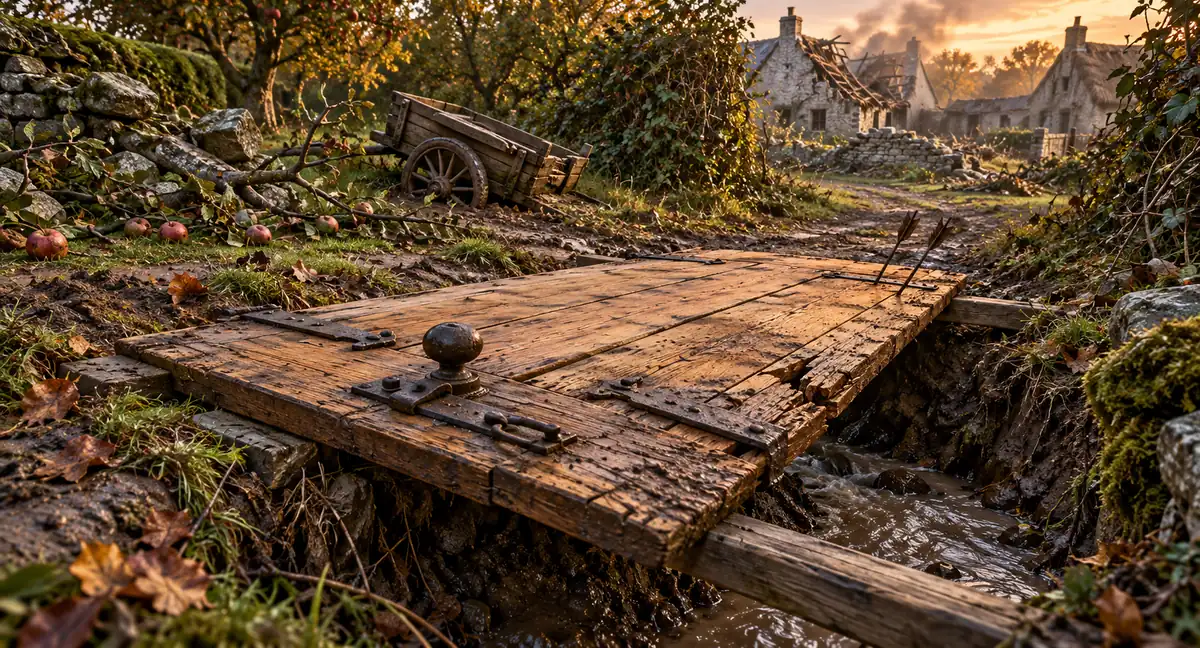
Together he and Harl lowered it across the narrow drainage cut. The sound timber on either bank supported its ends. It was only a shallow gap, but the water ran fast and the earth at the edge had become soft enough to collapse beneath a man's weight. Beech laid the two fence pieces under the door's outer edges and pressed down hard with his good arm. It held for his weight, though he took his foot off quickly.
"Cross singly," he told them. "Don't run."
Mrs Grist and the children went first, followed by the candle-maker's neighbours. The elderly man crossed next, carrying the hens like a magistrate protecting precious documents. The last bird objected to the arrangement and pecked his thumb, but even he did not stop to discuss it.
Harl crossed after them. Beech remained beside the door until Nella and Fern came along the protected side of the cart.
"Time," Nella said.
Beech looked once at the oak boards, their familiar grain smeared with mud and scarred by an arrow. His father had made them to keep the world outside. They were doing a much better job of helping people leave it behind.
He followed Nella across.
At the far side of the orchard they found Mara waiting with a face white beneath the soot.
"Four trapped at the cooperage," she said. "My brother and three neighbours. And six more down by the hall steps: a man pinned under a beam, his daughter and four neighbours who stayed to help him. Those are separate groups. None of them can reach the orchard turn."
Nella looked towards the village. Dust hung above the meeting hall, turning the late light a dirty gold. The distant archer had ceased firing; either the roof no longer gave him a useful angle or he was shifting to another post.
"The last families go uphill," Nella told Harl. "Tell Tam the lower lane is closed. Use Tilly's knots for help needed if anyone else comes out."
Harl looked at Beech. "You're coming back?"
"A little way."
"Of course you are."
He pushed the refugees towards the upper path without adding anything else. It was the first time Beech could remember Harl Dobb leaving a conversation without trying to have the last word.
Nella, Mara, and Beech took the sheltered route behind the cooperage sheds. The building itself had suffered badly in the raids: smashed hoops and split barrels lay in the yard, and the eastern wall leaned against a stack of staves. A narrow passage ran between it and the old rear gardens. Mara knew every turn, having carried tools and meals to her brother here since they were children.
They reached the corner just in time to hear a goblin voice.
"Nobody goes through. The marked officer says the passage stays clear for the timber."
Another voice answered, human and furious. "Those are our houses!"
Mara moved forward, but Nella caught her sleeve. Beyond the corner stood two ordinary raiders with spears. A broken gate barred the way. Behind it Mara's brother was helping an elderly neighbour stand while two others crouched near the cooperage wall.
Beech studied the gate. The iron bolt had been replaced with a stout length of timber driven through the hasp. He had fitted that very hasp six years earlier, after Mara's brother had complained that the old latch couldn't keep an inquisitive cow out of the cooperage.
"I know that gate," Beech whispered.
Mara gave him an incredulous look. "Is there a gate in Briar Glen you haven't fixed?"
"Several. It has proved extremely inconvenient."
The two goblins began arguing with the trapped neighbours. Beech slipped back along the wall and found the narrow access hole where the cooper stored ash poles beneath the eaves. It was too small for a grown man to pass through, but large enough for Fern, who needed little encouragement to investigate an unfamiliar space.
Nella signalled. The dog squeezed through, emerged behind the gate and began barking at the raiders from the wrong side. Both spun towards her.
Beech reached the hasp while they were distracted. He pushed his little measuring rule into the gap beneath the bar and lifted. It moved barely an inch. Mara seized the top rail, Nella took hold of the lower post, and between them they eased the timber clear of its slot.
The gate swung open.
One raider turned back and lunged with his spear. Beech dragged the gate into the line of the thrust. The spear struck the old oak upright and glanced aside. Nella pulled the nearest villager through, while Mara caught her brother and the others by the sleeves.
The goblin recovered his weapon at once. He was not foolish enough to thrust at the same piece of timber twice.
"Back!" Nella shouted.
They retreated down the side passage with the two raiders following. Beech dropped a loose cooper's stave behind them, not as a trap but to close the gap in the broken wall through which the raiders might cut across. The first goblin struck it aside. The second came through behind him, close enough that Beech could hear his armour scrape against the bricks.
They reached the orchard hedge just as a third arrow hissed from somewhere above the yard. It struck the packed earth beside Mara's brother. The bowman had moved.
Nella put Fern through the gap, then Mara and the villagers. Beech brought up the rear, holding the broken gate with his good shoulder long enough to obstruct the passage. The wood shook under a spear blow. He could feel the split spreading.
"Beech!" Nella called.
He let go and followed her into the hedge as the gate fell apart behind him.
They hurried as far as the bend beyond the bowman's view. Two of the blanket carriers met them there and took Mara's brother and the three neighbours up the sheltered orchard path. Mara counted each one passing the hedge, then turned back towards the meeting hall.
"Six at the lower steps," she said. "They won't have heard the signal."
Nella glanced at the dust rising beyond the cooperage. "One pass. All together. Then up to the bend. Darron's people are preparing a barrier there."
Beech followed without proposing a second expedition.
The lower steps were scarcely recognisable. A cottage doorway had collapsed across them, leaving a broad roof beam slanting onto the paving. A man lay with one leg caught beneath it, his daughter beside him clutching an empty bucket. Four neighbours stood in the shelter of the adjoining passage. None had abandoned him; none could lift the beam without bringing down the lintel it still partly supported.
Beech knelt beside the timber, keeping his wounded arm close to his side.
"Does the beam get heavier when you try to move your foot?" he asked.
The man nodded, jaw tight with pain.
"Then we won't pull you through it." Beech found a sound spot near the outer end and put a broad stone under it. While Mara and a neighbour braced the remaining doorway, he used his little mallet to tap a timber offcut into the gap. The beam rose hardly at all. On the fourth blow the stone settled, and Beech had to stop and pack the footing again.
From the square came a shout, followed by the thin metallic scrape that always preceded a deeper groan. The man's daughter put down her bucket and held the light steady. Beech tapped again.
This time the foot came free. Nella and two neighbours drew the man clear, while the others stripped a shutter from the abandoned shop beside the steps and laid a cloak across it. They carried him between them, his daughter keeping one hand on the stretcher's edge. Six people from the lower steps, exactly as Mara had counted. Beech walked behind them, watching the masonry and keeping the route clear.
The ground shivered as they reached the orchard slope. Water welled through the cracks behind them. Ahead, the track narrowed to a single cart's width between a high bank on the left and a broken orchard wall on the right. Beyond the bend lay the path towards the sheepfold.
Darron waited there with Tam, Harl and several villagers, a hay cart turned across the lane. His injured left arm was bound to his chest. He had been told to remain at the sheepfold, and had apparently interpreted that instruction as advice about where to send his good arm.
"How many?" he called.
"Four from the cooperage are already uphill," Mara said. "These are the six by the steps. All accounted for from the places we checked."
"And those from the drover's track?" asked Nella.
"Two parties still coming," Tam said. "They'll pass behind us by the orchard hedge. The last runner saw them leave the eastern cottages."
Nella sent the six lower-step residents through the hedge opening at the cart's uphill end. Two volunteers took charge of the shutter stretcher. The man was breathing hard but conscious. Beech watched his daughter follow, then took his place beside Darron. There was no time for another trip downhill. The voices behind the cooperage were getting closer.
The cart stood crosswise between the bank and the broken wall, with its near wheel braced against a stone step. The open end of the orchard hedge lay behind it on the uphill side, giving the villagers a way to leave without passing the goblins. Nothing about the arrangement looked military. It looked like Joss had parked badly while somebody unloaded potatoes.
"They'll push it over," Tam said.
"Not quickly," Beech answered. He showed him the locking peg beneath the near axle. "If that stays seated, they'll have to lift the whole cart. We've put the heavy stones below the rails, where the weight helps instead of just rolling about."
"And if they come over the bank?"
Nella pointed to the narrow goat track above the cart. "Darron, keep two with ash poles there. Fern can warn us, but she's not an army."
"She'd be offended to hear you say it," Beech murmured.
"She can be offended after everyone is safe."
Three villagers carried more stones from the fallen orchard wall. Harl fetched water for the two farmhands waiting at the barricade. He said little, which in Harl was both unsettling and useful. Darron tested the cart's movement with his good boot, then directed the last of the stones to the low rail.
The captain appeared at the bend with six shield-bearing raiders and several more behind. His red cloak was dusty, and one edge was dark with old blood. He stopped them before they reached spear range. Beside him the disciplined bowman studied the bank, the orchard wall, and the distance to the cart. He had moved down from the cooperage roof.
"You again," the captain called to Beech.
"I've lived here a long time," said Beech. "It's difficult to avoid me."
The captain surveyed the cart. His gaze paused upon the wheel, the bank and the gap in the hedge behind the defenders.
"My employer wants this lane clear. Move the cart, and the people behind it can go."
"They're going already," Nella said. "Your men are the only ones stopping them."
"I have five men in your cattle pound."
"Fed and alive. We'll discuss them when nobody's trying to kill the neighbours."
The bowman moved a few steps to gain an angle past the cart. Beech saw him bring up his bow, and knew there would be no leisurely discussion.
The captain raised one hand. "Advance."
The first arrows struck the cart high, sending splinters over the defenders' heads. Shielded goblins came on underneath them, crouching to drive their spearpoints between the lower rails. One farmhand was cut across the forearm before he could pull away; he fell backwards, white-faced, clutching the wound. Nella drew him under cover and pressed a cloth into his good hand.
"Hold that tight. Don't let go."
Beech dropped beside the near wheel and pressed his ear to the old axle as the cart shook. The rim gave a dry complaint. The iron band on the wheel had loosened, just as he had once warned Joss it might.
He looked up at Tam. "The near rim is going. If they get purchase beneath it, they'll roll us into the ditch."
"Can you fix it?"
"Not while somebody's attempting to put a spear through my ear."
The first raider hooked a chain over the cart's upper rail. Two companions seized it and began pulling in time. The frame rocked; a stone slipped from beneath the axle. The captain was making his men do what the villagers had feared: work together.
"Harl, the lower rail!" Beech shouted.
Harl thrust a timber stave through the frame, bracing it between the wheel and the stone bank, but the next pull bent the stave. The goblins heaved again. The cart lurched an inch down the slope. The captain did not waste another man attacking the rail. He ordered the chain tightened.
Above them Fern barked twice, sharp and urgent. Two raiders were climbing the goat track, using the assault below to draw the defenders' attention. Darron pointed with his sound arm, and two villagers with ash poles moved to block the climb. One pole broke against a shield. The raider behind it kept coming.
Nella left the wounded farmhand with a neighbour, bounded up the bank and took the remaining pole from the man who had lost his. She planted it crosswise at chest height. The raider pushed against it; loose stones slid under his boots, carrying him back into his companion. They retreated a pace but did not fall, and the moment they found firmer footing they advanced again.
"They'll get round!" shouted Tam.
"Not before the last families," Nella called. "Tell me when they're through!"
Beech saw the cart wheel rising against its brace. A second pull would tip it clear. He could try to hammer the loose band back into place, but his injured wrist made the idea absurd, and the raiders would not allow him the time.
Then he saw the peg.
He had spent the last ten minutes trying to keep the axle level. Perhaps that was the wrong thing to save. He called to Darron, who answered without taking his eyes off the bank.
"If I draw the locking peg, the near wheel will slip off the axle. The cart will drop against the stone step. They won't pull it aside, but neither will we. It's our last barrier."
Darron measured the slope with one glance. "And our way out?"
"Behind us, through the hedge. Provided nobody's still below."
Nella heard them and looked to the runner at the orchard opening. The boy waved one of Tilly's knotted cords and called, "Both parties are through! Last one's clear!"
"Do it," she said. "Then everyone comes back through the hedge. No one stays with the cart."
Beech fitted his little mallet against the stubborn peg, steadied his left wrist against his chest and struck with his good hand. The first blow loosened it. The second sent it out across the cobbles. At once the nearside wheel slipped outward. The cart dropped on its frame with a crash that made the chain leap from one goblin's grip, and the lower rail lodged hard against the stone step.
The raiders staggered, then recovered. The captain shouted for them to cut the chain and climb over the wreck. One had already scrambled onto the cart before Tam rammed his ash pole against the man's shield. The shield twisted aside; the goblin caught the pole, and both fought for it across the rails.
An arrow struck the wood between Tam's hands. He flinched but held on. Another raider thrust below the frame. Beech caught the spear shaft with the loose timber stave, forcing its point into the broken cart floor; a second thrust split the stave, leaving him holding two useless pieces. He dropped them and hauled Tam back by his collar just before the captain's axe struck the cart where his head had been.
"I remember that pan," the captain said through his teeth.
"So do I," Beech replied, breathless. "I'd appreciate having it back."
For a few desperate moments there was nothing clever to be done. The cart was collapsing and the goblins were too close. Harl helped the injured farmhand through the hedge while Mara waved the returning runners up the sheltered path. Nella shouted for Tam, Darron and Beech to follow.
The captain planted a boot on the broken upper rail. He could climb it now, though the jammed frame would prevent his men bringing shields through together. Beech saw him choose between pursuing one person and keeping the raiders in a fighting line. The captain ordered a withdrawal of two paces to reform. It cost him the chance to catch Beech at the rail.
Then the ground shook.
Not enough to fling an army into the air, but enough to break the mortar along the orchard wall. Down in the square a roof edge vanished behind grey dust, and the long metallic groan beneath Briar Glen rose into a violent grinding note. Every goblin on the lane looked back.
A marked messenger stumbled up from the square, shaking a strip of parchment. "The lower braces! We need more men beneath Vale Mouth. The master pays when the southern gate is ready!"
"You've had my men," the captain snapped. "One with a crushed leg, and more of them bleeding here for a road we haven't seen."
"Then clear the lane and bring timber!"
The captain looked at the broken cart that his men had been unable to pull aside, the upper goat track still held by villagers, and the hedge through which the last refugees had disappeared. There was nobody left for him to capture except a handful of defenders who were already withdrawing. Another tremor travelled along the bank, showering them with grit.
"Back to the square," he ordered. "Take the wounded. We aren't dying under this hill for somebody else's silver."
His raiders obeyed, shields still raised. The marked messenger shouted after them, but they did not turn. It was not peace; the captain could still order them against the village tomorrow. Today the barricade had held long enough.
Before turning back towards the square, the captain called across the ruined barricade. "Your five in the pound. I haven't forgotten."
"Neither have we," Nella called back.
The captain's eyes found Beech where he crouched beside the ruined cart. "And your pan, carpenter. It's still below the hall."
"I know," said Beech.
From the orchard opening Nella called once more. Beech followed Tam and Darron through the hedge without stopping to rescue any more of the cart, while the first loosened stones tumbled down onto its broken frame. The captain went back towards the square with his raiders. None had crossed the barricade before the last villagers were clear.
Night settled before the last of the rescued villagers reached the sheepfold.
Nobody called it a victory at first. There were too many people to count and too few dry blankets to spread. The farmhand with the spear wound needed stitching. The man from the lower steps had an injured ankle. Mrs Grist's grandchildren shivered beside a fire, too tired to cry. Harl organised hot water and bread while Widow Fenner sat in judgement over the distribution of turnips, allowing Duchess only the ones she declared unfit for human eating. Duchess disagreed with this arrangement and expressed herself at length.
Pellin, still feverish and unable to stand without help, insisted on seeing the newcomers. Berta sent him back to bed after he tried to take a water bucket from a child and nearly fell over. Elna watched the families gather in the stone store, her bandaged hands resting on her knees. Her niece sat beside her with the repaired wooden horse held tight against her chest.
Joss took a count of the escapees from the lower cottages, using Tilly's knotted cords to check the messages against the names brought back by the runners. His injured arm made the writing slow, but he refused to let anyone take the list from him until he was satisfied.
"All the houses we knew still had people," he told Nella at last. "We got them out. I can't promise there weren't others hiding."
Nella nodded. She did not ask him to promise what he could not know.
Beech sat on the wall with his bandaged wrist resting in his lap. His boots were covered in clay. His cloak smelled of smoke. There was a bruise on his shoulder from hauling the shutter stretcher, and somewhere along the way he had lost the last of the bread from his bag.
"You ought to eat," Nella told him.
"I was considering that."
"You're always considering that."
She handed him half a loaf wrapped in cloth. They sat together without speaking for a while, watching the firelight move across the sheepfold walls. Beyond the ridge the village was almost invisible, except where sparks rose from the smoking roofs.
"I did what you asked," Beech said eventually.
"You did."
"I didn't go below the hall."
"No."
"Even when it was making those awful noises."
"I noticed."
He pulled a piece of bread apart. It was hard and slightly burnt on one side, but he was grateful for it.
"I thought being a hero meant finding something dangerous and doing the bravest thing you could think of," he said.
Nella watched the children settling under blankets. "Sometimes it means carrying a door while somebody tells you to hurry up."
"I was very good at that part."
"You were tolerable."
Beech smiled. It felt unfamiliar but welcome.
Below them, the village made another distant grinding sound. They both looked towards it.
On the northern ridge, three points of light appeared among the trees. They were too steady and too far apart to be a wandering shepherd's lantern. A horn sounded once, low and measured. Another answered from somewhere nearer Briar Glen.
Tam came up from the lookout with his cracked horn still hanging uselessly at his side. "Not ours," he said. "There are riders on the north track. More than a handful. Can't tell who."
Nella rose. "Keep watching them. No one goes down without a runner knowing where they've gone."
From the valley came a shout carried thinly through the dark, followed by the iron groan of a mechanism under strain. Whatever the marked workers had done to Vale Mouth, it had not finished moving. Whether its ancient leaves had opened even a crack was still hidden beneath the hill.
Beech looked at the distant lights, then at the village where his house stood behind its missing door. "Do you suppose," he asked quietly, "we'll have to do all of that again tomorrow?"
Nella looked towards the northern track.
"Something worse, I expect."
Beech took another bite of bread.
"Well," he said. "I'd better have the other half, then."
End of Chapter Ten
The story continues.
Back to book contents