A Well-Deserved Breakfast
With the raiders gone, Briar Glen begins the harder work of recovery. Beech finally gets his breakfast—and discovers that peace brings a fresh list of promises to keep.
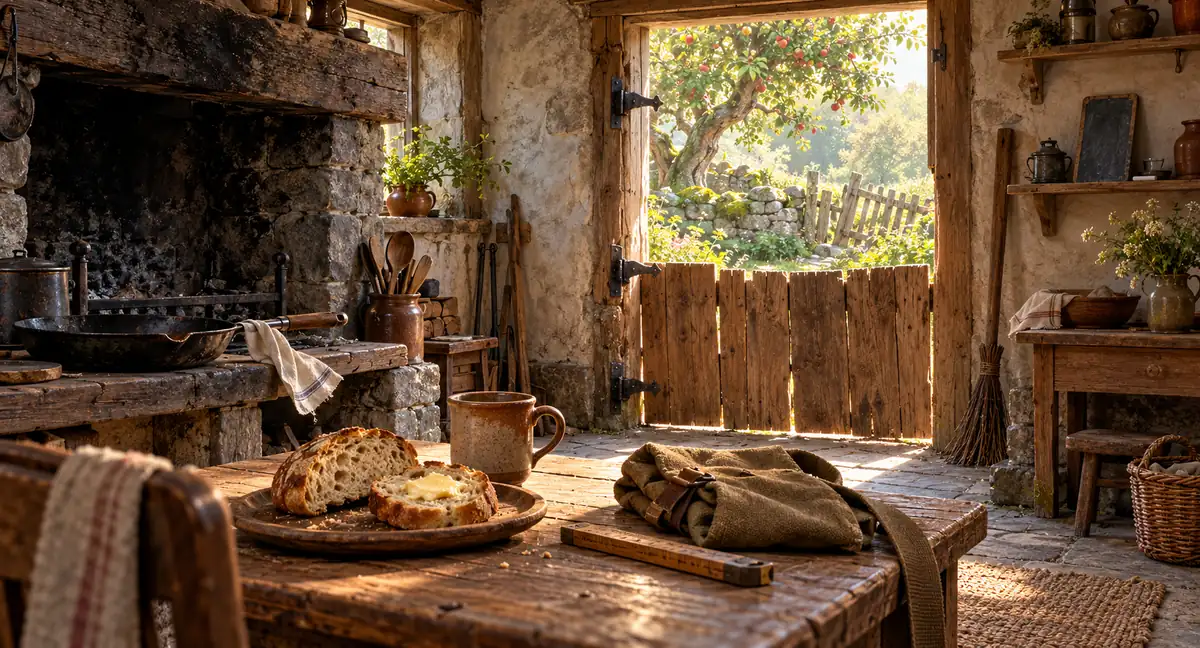
In which Beech attempts to enjoy a peaceful morning, only to discover how much work peace requires.
The first night without goblins was considerably noisier than Beech had expected.
He had pictured a profound silence, the sort found in a library after closing or a tavern just before opening. There might be an owl, perhaps the wind in the ash trees, and eventually somebody would have the kindness to bring him breakfast.
Instead, the eastern sheepfold was full of coughing, crying, snoring, arguments about blankets, and one very large pig that had learned to lift the lid of the turnip barrel with her snout.
“Duchess,” Widow Fenner said, “you put that down.”
The sow took a turnip and walked away with it.
Beech lay on a bed of straw beneath the patched canvas awning. His left wrist throbbed inside its bandage; the shallow arrow graze high on his arm caught against his sleeve whenever he moved. His mother's frying pan lay beside him, wrapped in clean cloth. He had washed it twice since getting it back from beneath the meeting hall. The dent was still there, and his father's old smoothing of the handle still fitted his hand perfectly.
From the cooking fire came Harl's voice, arguing with Tam about the number of supper bowls.
“There are twenty-eight,” Harl said.
“Twenty-seven. I counted.”
“You counted one twice.”
“How does a man count the same bowl twice?”
“By being Tam, apparently.”
A little later the voices subsided, and Beech heard a child breathing in quick, anxious gasps on the far side of the awning. It was one of Mrs Grist's grandchildren, a boy of seven or thereabouts, curled beneath a coat far too big for him.
“Can't sleep?” Beech whispered.
The boy shook his head. “Will the goblins come back?”
Beech looked through a fold in the canvas. A watch fire glowed beside the upper track. Beyond it, Briar Glen was a collection of dark rooflines, some lower than they should have been.
“I don't know,” he said. “But there are people watching the roads, and Nella knows what to do if she hears anything.”
“Does she?”
“She generally knows what to do when she hears something she doesn't like.”
This appeared to satisfy the boy. After a while his breathing steadied.
Beech remained awake, listening to the small noises of people who had survived and still had to sleep somewhere. He rested a hand on the pan's handle. It was an odd comfort, having something familiar and heavy beside him.
“Duchess!” called Widow Fenner from outside. “That was the last good turnip!”
Beech pulled his cloak over his face.
By morning Harl had produced a pot of porridge so watery that Beech suspected the oats had been shown to the water and then removed for safekeeping.
“There's been an invasion,” Harl reminded him as he handed over a bowl.
“I'm aware of that. I still think the porridge ought to be aware of it too.”
Harl scraped a spoonful of thicker oats from the side of the pot into Beech's helping, an act of generosity so precise that Beech did not insult the breakfast again.
Along the sheepfold wall Berta changed Pellin's dressing while the young cobbler explained that his leg was perfectly good for walking, provided nobody expected him to stand on it. Darron, his injured left arm supported, dictated a list of salvageable iron to an apprentice. Joss sat with his own arm in a sling and a slate of names across his knees. Tilly, surrounded by loops of her runner's cord, was checking who had gone along each safe path.
Elna's bandaged hands kept her from working the dough that Harl had managed to make from their dwindling flour. Instead, she showed her niece how to divide a crust among three smaller children. The little girl's repaired wooden horse stood beside her, its new pointed ear catching the sunlight above a scorched flank.
Nella arrived with Fern at her heel and a piece of charcoal in her hand. She had already checked the northern lookout.
“Four names still without a mark,” she told Joss. “Two from the western cottages, one from the old granary, and one who may have been out in the north fields when it began. We'll search the sound ground and call from the roads. Nobody goes into a building that's slipped.”
Beech put down his bowl. “I'll come.”
“Finish eating first.”
“It's hardly eating.”
“Then you won't take long.”
She drew the safe routes on a board, leaving a broad line across the lower village where the street had split. The meeting hall stood on that line, crooked and partially roofless, with its rear court barred by rubble. Nella gave Mara and Beech the upper western route. Tam and Mara's brother would check the sheds nearer the cooperage from the other side. The road below the hall was to remain empty.
Beech collected his mallet, measuring rule and cord from his canvas bag. His mother's pan stayed with Harl, who promised to keep it away from Duchess.
“She can't eat iron,” Beech said.
“I'd rather not be the one to discover she can.”
They passed Beech's father's great oak door where it lay across the orchard drainage channel. It had once been strong enough to withstand an axe without letting its owner into the cottage. Now muddy footprints marked the timber from one end to the other, and the channel ran cold beneath it. Beech tested the fence-wood supports with his boot.
“Needs another bearer under the middle,” he said. “It's sound today, but not for carts.”
“People first,” Nella answered. “We'll put the bridge on the repair list.”
“Whose list?”
“Yours, I imagine.”
Beech had a brief longing for the days when his most troublesome responsibility was a garden fence.
His cottage stood beyond the channel, the garden open where the fence had fallen during his escape. The front doorway was a dark rectangle with broken hinges protruding from the jamb. Sunlight shone on the old apple tree. Beech paused long enough to see that the house was still upright, then followed Nella and Mara westward.
They found the first two missing villagers in the loft of a charcoal store. An elderly couple had heard the fighting in the lower road and decided that if they came down, goblins would catch them. They had remained there ever since, rationing a kettle of water and an earthenware pot of pickled onions.
“We couldn't leave the onions,” the old woman explained as Mara helped her onto the ladder.
“Of course not,” Beech said.
“My mother made them.”
“Then I'm surprised you've not eaten them already.”
The old woman gave him a look so sharp that it brought Widow Fenner to mind. Beech decided he liked her.
Mara took the couple back along the upper route, moving slowly enough for the old man to manage the uneven stones. Nella scratched two names off the board.
At the granary, their luck ended. The doors stood open, grain had swollen across the floor and one gable wall leaned towards the lane. The missing worker's coat hung on a peg just inside. They called until their voices were hoarse but received no answer.
Beech could see a loosened joint above the door and a crack travelling down from the roof beam. He stayed outside. Nella marked the location and the danger on her board so that a properly supported search could be arranged later. The fourth name, the person from the north fields, remained uncertain.
For a long while they stood on the upper road looking towards the meeting hall. A portion of its rear wall had collapsed after the goblins withdrew. Beneath the paving lay Brant's old access stair, the empty chest cradle, the inspection gallery and, deeper still, Vale Mouth. The great gate had not been proved open or shut. Nobody was going to find out by wandering down with a lantern.
“Someone will have to look at it eventually,” Beech said.
“Someone who knows more about those stones than we do,” Nella replied. “Until then, the lower roads stay closed.”
Beech nodded. There was no argument worth making against a cracked building with people standing beside it.
On the way back along the safer eastern lane, he found Elna standing well clear of the fallen timbers outside her ruined bakery. The fire had destroyed the roof timbers and most of the shelves, but the great clay-lined oven still stood. Her hands were wrapped in linen, and she held them stiffly as she inspected its soot-darkened mouth.
“My father built that oven,” she told Beech. “Got the curve wrong the first time. Burned every loaf along the back until my mother refused to cook in it.”
“Did he correct it?”
“Eventually.”
Keeping outside the reach of the broken roof timbers, Beech crouched to look at the sill. “The rear wall ought to be checked before there's a fire in it. And you'll need a new mixing bench.”
“I'll tell you exactly where it goes.”
“I was afraid you might.”
She walked him through the positions of the old shelves, speaking with increasing authority until, for a few moments, the wrecked bakery felt like the place where villagers would soon be arguing about bread again. Beech marked the measurements on the back of his board.
“When will you do it?” Elna asked.
“After we get the houses closed against the weather.”
“That's a real promise?”
“Write it down, if you like.”
“With a date?”
“There's no need to become unreasonable.”
Pellin's uncle returned from the south at sunset, following the errand Nella had sent him on when the village first began to organise its resistance.
Tam saw the pony coming along the high road. Behind it rode six soldiers in dusty cloaks, followed by two pack animals carrying food, bandages and bedding. The pony's rider had to be helped down; the journey back from the king's southern garrison had been delayed by flooded crossings, and neither man nor animal had much strength remaining.
Pellin, sitting on the bench outside Berta's shelter, insisted on getting to his feet to greet his uncle. Berta made him sit again, and the reunion proceeded with both of them complaining about the other's judgement.
The officer commanding the soldiers was a grey-haired woman who listened before she spoke. Nella gave her Joss's list, the number of injured and a report of the goblins' withdrawal. Beech handed over his drawings of the temporary hauling frame and the damaged hall supports, carefully marking what he had actually seen and leaving the ancient workings below blank.
“The gate is called Vale Mouth,” he told her, “and we've found references to another entrance called North Scar. The people with the broken-ring mark wanted to open the route between them. There was a narrow ironbound chest taken north, but we never saw inside it.”
“The man who ordered the work?” the officer asked.
“A hooded human courier carried the orders,” Nella said. “Who sent him, we don't know.”
The officer examined the copied insignia and shook her head. “I don't know that sign. I'll put it in the report, along with the courier and the chest. The garrison can seek orders from people with knowledge of old roads. That will take time.”
“And the meeting hall?” asked Harl.
“No one goes underneath it. We'll watch both roads and keep people clear of the cracked streets. I've brought hands for the search, but I won't lose soldiers under a roof that's already falling.”
She assigned guards to the approaches and arranged for a report to ride south at first light, requesting masons, food and someone qualified to inspect the damaged foundations. An enquiry into the chest and the unknown employer would follow separately. Neither the officer nor anyone in Briar Glen claimed to know whether North Scar had been opened, or what the chest truly contained.
Beech found he was relieved to hear a person in uniform admit that she did not know something. It was a quality he thought could be encouraged in more professions.
The officer turned to Berta, who had been standing behind them. “Where are your worst cases?”
Berta showed her without wasting another word.
Harl watched the soldiers unload their sacks of meal, then rubbed his hands together.
“Tomorrow,” he announced, “we shall have a proper breakfast.”
“After the wounded have been seen,” Nella said.
“You have a remarkable talent for spoiling a celebration.”
“It's a gift.”
Beech slept until the sound of a ladle tapping a pot woke him.
For a moment he lay still, waiting for a horn or a crash from the valley. Neither came. The sheepfold smelled of warm bread, onions and the small amount of salt pork the soldiers had brought. Through the open canvas he saw Berta carrying a clean basin towards the sickroom, and a soldier struggling to persuade Duchess that the ration sacks did not belong to her.
Beech sat up, reached for his walking boots and checked them both for frogs. They were empty. He put them on, adjusted the bandage at his wrist and carried his mother's frying pan to Harl's outdoor hearth.
The surviving tavern stores and the soldiers' food had been combined into a modest breakfast. There were actual oats in the porridge, a little cheese and, thanks to the hens rescued from the village, a few eggs. Harl guarded them with the possessiveness of a man watching the last cask in his cellar.
“I'm told you're a hero now,” he said as Beech set the pan on the hearthstones. “Heroes shouldn't have to cook.”
“Then you're welcome to do it.”
Harl considered his other obligations. “You know how particular you are about eggs.”
Beech worked with his good hand. The pan was heavier than usual, and its dent made the butter gather towards one side. The first egg slid in that direction as soon as he cracked it, sending Beech on a small pursuit with a wooden spoon.
“It's seen some use,” Harl observed.
“So have I.”
When the white had set, Beech slipped the egg onto a piece of bread and carried it to Elna's niece. She sat with the repaired wooden horse beside her, its pointed ear tilted towards the cooking fire.
“Here,” he said. “Mind, it's hot.”
The child looked up. “Where's yours?”
“Still in its shell.”
She took the bread and began eating with the fierce attention of someone who hadn't had enough food for several days.
Harl had followed Beech and looked offended on principle. “You wait all this time for a proper egg and give the first one away.”
“She's smaller than me.”
“That has never stopped you having seconds.”
“No,” Beech agreed, “but I shall try to be patient until the second panful.”
By then Nella had arrived with two bowls of porridge. She passed one to Beech, who took a spoonful and found it thick with oats and sweetened with a little honey. He looked at Harl, and Harl held up a hand.
“Don't say anything. I already know it's excellent.”
Along the wall, Joss and Tilly shared their meal while examining the names on the slate. Two had been crossed off; the remaining two would be searched for again with help from the soldiers when the dangerous buildings could be supported. Pellin complained that Berta was making him eat sitting down, and Darron directed someone else's hammering from his stool. Merrick, with his troublesome knee stretched out, instructed Tam on the safe way to set the grain sacks. Tam objected on grounds nobody could discover.
Duchess was tethered to a stout post away from the food. Widow Fenner sat beside her with a bowl in her lap and a look that warned anyone against offering the sow a treat.
When Harl had finally eaten his own breakfast, he raised a mug and waited for the conversations to settle. He did not stand on a table; Beech considered that progress.
“To Briar Glen,” Harl said. “To the people who got us out, the people who fed us, and the people who told us when we were being fools.”
“That last one's me,” Widow Fenner announced.
“And to Beech,” Harl continued, “who has the strangest method of repairing a village I've ever seen.”
“Most of it was broken before I got there,” Beech said.
“Not every bit.”
Several people laughed. Harl raised the mug once more, towards Nella and the wounded and the children on the wall, then drank. Before anyone could propose a song, Elna asked who would help her salvage the oven stones when it was safe to return. By the time Harl found his answer, three people had volunteered and a fourth was arguing about where to put the timber.
Beech got his second egg. The yolk broke, the bread was darker than he preferred, and he ate every mouthful.
Nella sat beside him for a minute after the others had begun clearing the dishes.
“Darron wants measurements for some temporary doors,” she said. “And Elna has apparently decided your life belongs to her mixing bench.”
“I shall need another breakfast if this keeps up.”
“You can begin with your own door.”
Beech looked down the slope towards his cottage. “I thought I might go and fetch the slate. I left a list on it before all this began.”
“I can come with you. The upper route's been checked.”
“Are you supervising?”
“Preventing you from wandering into the Underway to repair something that hasn't asked you to.”
“I don't intend to go near it.”
“Good.” She stood and whistled softly to Fern. “Bring the pan. You've become difficult to recognise without it.”
By midmorning Beech was standing in his own kitchen.
The cottage's front entrance had a temporary board across its lower half to keep out animals; the place where his father's oak door had hung remained open above it. The door itself still served as a bridge below the orchard, now steadied by the bearer he and Darron had arranged the day before. The garden fence lay in pieces where Beech had fallen through it, and three shirts with their sleeves knotted together still hung over the washing basket.
Beech set his pan beside the cold hearth and found the little slate propped near the shelf.
Recover.
Eat something nice.
He smiled at the two lines. They had seemed ambitious enough when he'd written them, not long after tumbling out of bed with a dreadful headache.
He took the chalk from its ledge and wrote beneath them:
Make a new front door.
Help Elna with her bakery.
There was barely enough chalk left for another line. He thought about the goblin captain, the mark of the broken ring, and the ancient stone gate that nobody dared approach. Then he wrote:
Keep goblins out of Briar Glen.
He rubbed his aching wrist with his good hand and studied the list. The final item had, he thought, a discouraging lack of instructions.
Nella came in through the back door carrying two pieces of warm bread saved from the sheepfold breakfast. Fern stayed outside beneath the apple tree.
“I thought you'd be here,” she said.
“Making a list.”
“I see you've remembered the door.”
“Difficult to miss it.”
Nella looked around the kitchen. “I'll ask Darron to look at the entrance frame once he's able. Until then, no heavy work with that wrist. You can measure, and the rest of us can carry.”
Beech took the bread she offered. “You can be exceptionally unpleasant when you're being kind.”
“It's a gift.”
He broke off a piece and ate it slowly. Outside, a cart rattled along the upper lane. Somewhere near the orchard two villagers were arguing about whether an oak door could be called a bridge, and whether calling it one meant the carpenter was entitled to charge for another job.
“Before you make me do anything,” Beech said, “I should like to ask three things.”
Nella folded her arms. “Go on.”
“No goblins waiting in the garden?”
“None.”
“No one wants me to climb beneath the meeting hall?”
“Certainly not.”
“And no celebration requiring me to stand on a table?”
“Not while I'm here.”
Beech looked at the empty space where his front door had once been. A breeze moved through the opening, stirring the loose end of the cloth around his pan's handle. He had a great many things to do. Several of them might even be finished before winter.
Nella passed him his canvas bag. “Darron needs the orchard measurements before lunch.”
Beech looked at the bread in his hand, then at Nella.
He took another deliberate bite.
“After breakfast,” he said.
And for once, nobody argued.
End of Chapter Twelve
End of Book One — The Misadventures of Beech
The end of this book.
Back to book contents