Where the Water Remembers
On Crete, a botanist tracing polluted springs discovers a buried wartime structure—and an unexpected connection with the engineer helping her uncover what the mountain remembers.
The plants were dying uphill from the factory, which meant Jen had spent three weeks asking the wrong question.
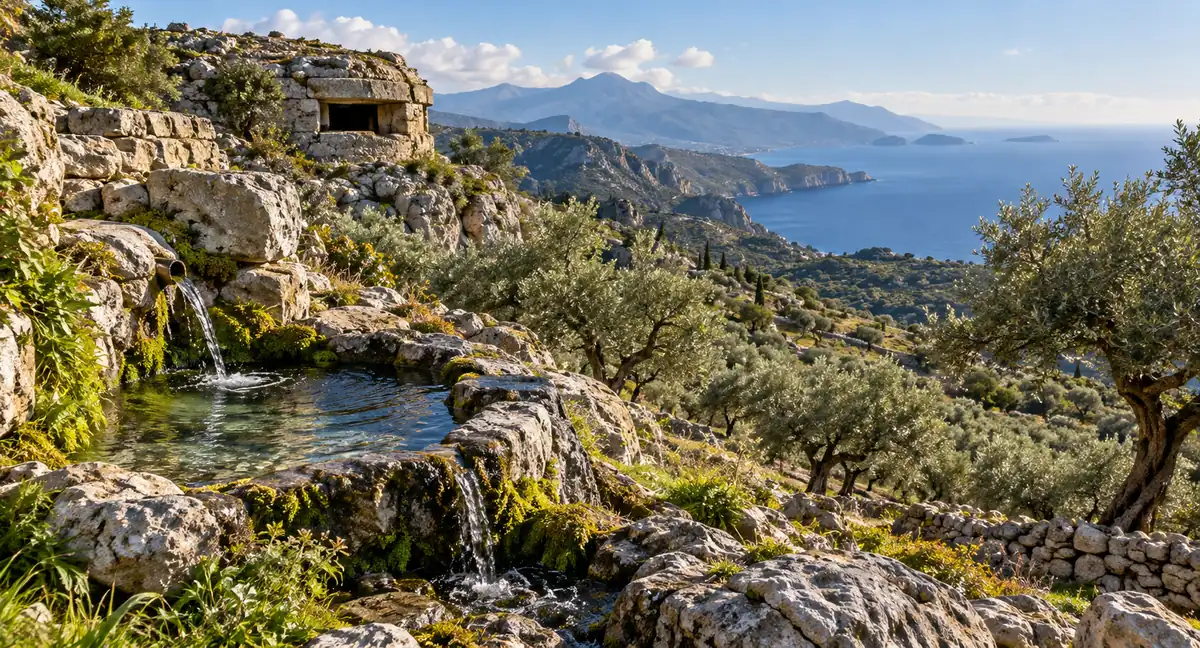
She crouched beside the spring with her notebook balanced on one knee. Below her, olive trees shivered silver in the morning wind. Beyond them stood the white sheds of an olive-processing cooperative, the obvious suspect in a study about industry and water.
But the yellowed water mint at her feet grew above its drainage basin.
“Please tell me that expression means lunch,” said Priya.
“It means we’re walking higher.”
Her three master’s students exchanged looks.
At twenty-seven, Priya had perfected the expression of a woman reconsidering postgraduate education. Mateo, twenty-nine, was already unfolding the map. Eleni, the eldest at thirty-one, unscrewed a sampling bottle.
“Same symptoms?” Eleni asked.
“Same damaged roots. Less damage on the dry bank.” Jen lifted a stem with her pencil. “Whatever’s hurting them is coming through the water.”
She had designed the Crete field course to teach careful observation before accusation. Now her own preliminary report linked the declining springs to agricultural processing.
Preliminary was a useful word. It did not make being wrong pleasant.
Above them, a stone clicked against stone.
A man in a faded blue shirt stood beside the broken wall that crossed the slope. He carried a survey pole and wore a white hard hat hooked to his rucksack.
“Don’t go past that fig tree,” he called.
Jen looked up. “Why?”
“The terrace collapsed last winter. The ground is hollow underneath.”
“That would have been an excellent opening sentence.”
He considered her.
“Yes,” he said. “It would.”
He came down by a route that avoided the wall, stepping lightly over loose limestone. He was perhaps forty, lean, dark-haired, with a face that seemed built for withholding judgement.
“I’m Nikos Vrysanellis. The municipality asked me to inspect the old water channels.”
“Jen Fenward. Botanist. These are my students.”
His gaze moved from the bottles to the spring.
“You’re investigating the cooperative.”
“We’re investigating the water.”
“Good distinction.”
“You sounded surprised.”
“People usually arrive with the answer printed on the van.”
Jen almost smiled.
He knelt on the dry side of the spring and pointed to a crack beneath a shelf of limestone.
“Your water comes from there. The channel below joins it later.”
“I know.”
His hand stopped.
“The mint told me,” she added.
This time his expression changed.
“How?”
She showed him the damaged plants, then the healthy stand beside the lower channel. He listened without interrupting.
When she finished, he moved his boot away from a small rosette he had been about to crush.
Jen noticed.
By noon, the spring had a barrier around it.
Jen had caught a faint petroleum smell while Eleni filled the final bottle. They stopped sampling, withdrew, and phoned the regional environmental office. The spring fed irrigation terraces and a public washing trough, not the village drinking supply, but Nikos called the municipal water manager anyway.
“People fill containers from places their grandparents trusted,” he said.
No one argued with closing access.
Under a plane tree in the village square, the students ate spinach pies while Jen phoned the laboratory in Chania. She requested expedited analysis, added upstream sampling points, and sent a correction to the university project lead.
Then she opened her preliminary report and stared at the sentence about industrial influence.
Nikos set a coffee beside her.
“I didn’t order that.”
“I know. You’ve been holding the menu upside down.”
She turned it over.
“How serious is the collapse above the spring?”
“I haven’t established that yet.”
“What do you do, exactly?”
“Civil engineering. Old structures, mostly. Bridges, retaining walls, things people remember only when they move.”
“Do you enjoy telling people their terrace is unsafe?”
“Only before breakfast.”
He took the opposite chair.
On his tablet was a survey of the hillside. The fig tree stood below a long, shallow depression. Jen enlarged the image.
“Was there a building here?”
“Possibly. The land register says rough grazing. There’s a concrete fragment in the collapse, but concrete has been arriving on this island for quite some time.”
“And the channel?”
“An irrigation branch. Abandoned when the electric pumps went in.”
Jen looked uphill. From the square, the slope appeared ordinary: olive trees, pale rock, a few dark cypresses.
“We have five days left,” she said. “I’d like to find where the contamination enters the spring system before we leave.”
“The rain may find it first.”
He showed her the forecast. A band of heavy weather was moving east across the Mediterranean.
“How long?”
“Perhaps three days.”
She stirred coffee she had forgotten to sweeten.
“Then we should stop discussing my upside-down menu.”
For the first time, he smiled properly.
It made concentrating fractionally harder.
The next morning’s laboratory call changed the field trip.
Petroleum hydrocarbons were present. The pattern suggested a weathered, heavier oil mixture; further analysis would take longer. It did not resemble the olive-processing waste they had expected.
The regional officer arranged a wider inspection. Jen moved her students out of the suspect spring area and gave them safe sampling stations downstream, working in pairs with the cooperative’s agricultural adviser.
“You’re disappointed,” she said as Mateo packed the bottles.
“We’ve discovered pollution from somewhere unexpected,” he replied. “I’m trying to look appropriately concerned.”
“Practise on the walk.”
Their enthusiasm steadied her. The course had not failed because the hypothesis had.
Nikos arrived with spare helmets and an old aerial photograph.
“My colleague found this in a planning file. There was a mechanical installation above the terraces in the seventies.”
On the photograph, a low roof sat beside a dirt track.
“A pump house?”
“Likely. Diesel pumps sometimes had separate tanks.”
That was their first promising lead.
They climbed in the early cool, with thyme catching at their trousers and the sea appearing between the hills in pieces of hard blue. Nikos carried the survey equipment. Jen carried plant quadrats, a hand lens, and enough labelled bags to suggest she intended to arrest the hillside.
“You always bring that many?” he asked.
“You always bring three measuring tapes?”
“One of mine is emotional support.”
The pump house stood without a roof. Rusted bolts marked where machinery had once been fixed. Behind it lay a rectangular concrete cradle.
Jen felt the quick pleasure of a hypothesis taking shape.
Then Nikos walked around the foundation twice.
“No.”
“What?”
“The tank sat here. Above ground.”
“It could still have leaked.”
“It could.”
He measured the slab’s fall while she examined the ground around it. There were no stressed plants below the tank cradle, and the soil they were authorised to sample showed no obvious oily residue.
More decisively, the surviving drain led west, into another gully.
They spent two hours tracing it through brambles to be certain.
At the bottom, Jen sat on a stone and pulled a thorn from her sleeve.
“A beautifully unhelpful pump house.”
“It has answered a question.”
“I prefer answers with forward momentum.”
“That’s because you’re thirty-six.”
She looked at him.
“Your university biography,” he said. “I checked who was asking me to climb a hill.”
“Should I have checked yours?”
“It would tell you I’m thirty-nine and once wrote eighteen pages about lime mortar.”
“Only eighteen?”
“There were illustrations.”
She laughed, surprising herself.
He handed her his water bottle while she searched for hers, then looked away while she drank. It was a small courtesy, without performance.
On the climb back, they stopped above the collapse.
From there, Jen could see a narrow crescent of unusually lush vegetation crossing the dry slope.
She took a photograph.
“Something?”
“Possibly another excellent way to waste two hours.”
“Then we should give it a name.”
They called it the Green Eyebrow.
It followed the hillside above the fig tree, a curved strip of rushes and water mint where neither belonged. Jen had noticed it on their first day, but assumed a leaking irrigation pipe.
Now she laid her photographs beside the old aerial image.
The vegetation crossed the old track. It also continued beyond the seventies pump house, toward a bare shelf of rock.
“Water is being held close to the surface here,” she said.
Nikos leaned over the table in the small guesthouse courtyard. Somewhere beyond the wall, someone was frying garlic. Their knees almost touched beneath the laptop.
“There could be a clay seam.”
“There could. But look at the shape.”
She had marked the plants on a current satellite image. The arc was too regular to be convincing geology.
He studied it, then opened his own survey.
“The retaining wall isn’t retaining anything.”
Jen turned toward him.
“Below the fig tree. I assumed the terrace behind it had eroded. But the wall curves with your plants, and its upper stones hide a poured-concrete edge.”
“A buried roof?”
“Possibly. Water could be collecting on it, then escaping at the margins.”
“Which means the collapse—”
“Could have opened a path through it.”
They sat quietly for a moment.
The guesthouse owner, Despina, brought them bread and a bowl of tomatoes without asking whether they had ordered dinner.
“You have the faces of people who will forget,” she said.
Nikos thanked her in Greek.
Jen tore the bread.
“Would a roof account for the pollution?”
“Only if something underneath contains oil.”
“A storage building.”
“Or a workshop. Or an old municipal tank.”
He did not reach for the dramatic answer. She liked that.
They searched digitised municipal records until the courtyard emptied. Most references concerned land boundaries. One plan showed a wartime access road, but the relevant sheet ended maddeningly short of their hillside.
Another file referred to a “former military installation” demolished in 1952. No drawing survived.
Jen rubbed her eyes.
“Lost building. Missing plan. Incomplete photograph.”
“An excellent foundation for eighteen pages.”
She glanced at him. He was smiling at the screen, sleeves rolled up, pencil tucked behind one ear.
She had been aware of his hands all evening.
That seemed inconvenient.
“Do you live here?” she asked.
“In Chania. My mother lives two villages over, which she considers essentially the same house.”
“And the work?”
“All over the island. You?”
“Bristol. For another six weeks.”
He turned from the laptop.
“My research centre is closing,” she said. “I have an offer in a consultancy. Good salary. Mostly reviewing reports other people write.”
“Do you want it?”
“I want to stop calculating whether I can afford to want something else.”
He nodded, without offering a sunny solution.
“Tonight,” he said, “you can probably afford another tomato.”
She took one.
After a while, his knee touched hers.
Neither moved immediately.
By the following afternoon, they had an answer worth taking seriously and several reasons not to trust it completely.
A local historical society provided access to occupation-era aerial images. Nothing was labelled. Jen and Nikos spent the morning matching terraces, using a chapel and a forked ravine as fixed points.
The road had been realigned. The old photograph had been taken at an angle. Twice they placed the suspected structure on the wrong slope.
Finally, Nikos corrected the perspective enough to compare it with his survey.
There was a long, low building where the Green Eyebrow now curved.
Beside it stood something that might have been a loading platform.
An inventory from a postwar clearance operation listed lubricating oil and heavy fuel containers in that district, but gave only a military grid reference covering several hectares. It established a possibility, not a location.
“Can we put ‘probably a wartime oil store’ in the report?” Jen asked.
“Probably.”
She gave him a look.
He returned it blandly.
Their more useful discovery came from a farming ledger Despina had persuaded her brother to retrieve. His father had recorded irrigation repairs with furious precision.
In 1968: Upper channel diverted around army roof. Always blocked. Do not send water there.
In 1981: New pipe complete. Leave old sluice shut.
No hidden treasure. No secret confession. Just decades of irritation with badly behaved water.
Jen read both entries again.
“The old irrigation branch didn’t supply the building,” she said.
Nikos pulled the survey closer.
“It went around it.”
“And the winter collapse could have dropped rubble into that bypass.”
He traced the contour with his finger. The abandoned channel approached the depression above the fig tree. From there, the ground fell directly toward the suspected roof.
Rainwater that once passed safely around the building might now pour into it.
Jen turned the aerial image upside down.
“What?”
“The plants.”
She brought up her field photographs. The worst damage occurred near the collapse, while older, woody growth farther along the curve remained healthy.
“A recent change,” she said. “The roof could have been holding water for years. But the contamination hasn’t been reaching the roots for that long.”
Nikos sat back.
“The winter storm broke the roof, blocked the bypass, and started washing through whatever was left inside.”
It was still a working explanation. But it accounted for the shape of the vegetation, the new damage, the collapse, and the polluted spring.
For the first time, they knew what evidence to seek next.
The disagreement came at the hillside.
Jen wanted to sample the fresh seep below the collapse. Nikos wanted a structural inspection before anyone approached the exposed edge.
“The seep is six metres downhill,” she said.
“The undermined ground may extend farther.”
“May.”
“Yes.”
She disliked the flatness of his voice. More irritatingly, she understood it.
“We need to establish the connection before the rain,” she said. “The regional team won’t commit equipment based on unhealthy mint.”
“They have the chemistry.”
“They have chemistry from below. They need the source.”
He took off his sunglasses.
“I can mark a safe approach after I’ve checked the ground. That will take an hour.”
“And if you can’t?”
“We use an extension sampler.”
“The bank is too steep.”
“Then we find a different method.”
Jen looked past him at the bright trickle beneath the stones. An hour felt absurdly expensive.
“My team loses access tomorrow afternoon,” she said. “Their flights are booked. The project budget is finished. I can’t keep extending this indefinitely.”
“I’m not asking you to.”
“You are asking me to wait.”
“Yes.”
Wind moved through the olive leaves.
She exhaled.
“All right. An hour. I’ll map the lower vegetation while you inspect.”
Something eased in his shoulders.
“Thank you.”
“I’m still annoyed.”
“I had gathered.”
He returned forty-seven minutes later with a marked route that stopped short of the seep and a sampling pole borrowed from the municipal water crew.
She looked at the pole.
“Emotional support?”
“Practical affection.”
The words hung between them.
He seemed to hear them a second after she did.
Jen took the pole.
“An underrated category.”
The sample was visibly oily.
They documented it, sealed it, and sent it away under the regional officer’s instructions. Then Nikos lowered a camera through the collapse from a stable position, keeping everyone back.
The screen showed broken concrete, a corroded steel vessel, and dark water against a wall.
No one suggested climbing inside.
The air down there might be dangerous. So was the roof.
Jen stared at the image.
After eighty years, the mountain had opened a cupboard nobody remembered owning.
The regional officer arrived before dusk with a hazardous-materials contractor and two municipal workers.
Her name was Sofia. She spoke briskly, took meticulous notes, and showed no interest in anyone’s preferred theory.
The camera inspection revealed two large vessels on concrete supports. One was visibly breached. The contractor’s equipment detected hydrocarbon vapours through the opening.
They widened the exclusion zone.
A stamped fitting, visible under the camera’s light, carried a manufacturing date from 1941. Taken with the aerial photograph and clearance inventory, it was enough to treat the site as an abandoned wartime fuel store while historians investigated its precise use.
Sofia made the distinction clear.
“We know what is leaking. We can establish who built it later.”
She authorised emergency containment downstream, continued closure of the affected water points, and mobilisation of a specialist removal team.
But the weather had accelerated.
The first heavy rain was due overnight.
A tanker could reach the lower track. It could not reach the buried structure until engineers assessed and widened the approach. Pumping from above would require equipment arriving the next morning.
“What can we stop tonight?” Sofia asked.
Nikos spread the survey over the bonnet of her vehicle.
“The clean runoff entering here. There’s an old bypass around the building.”
“The one that failed?”
“The lower section is blocked. Upstream, there’s a sluice that sends water into the branch. We close that and divert the storm flow into the main ravine.”
Sofia followed the contours.
“Can the ravine take it?”
“The main channel can. I need to inspect the spillway and its outfall.”
Jen pointed farther along the map.
“Not through this patch.”
Everyone looked at her.
“A spring-fed wetland. Small, but it supports the downstream water system through summer. If we send dirty water there, we spread the problem.”
“Would the bypass carry dirty water?” Sofia asked.
“Not if we intercept above the roof,” Nikos said. “But she’s right. The outfall needs to stay on this side of the ridge.”
He shifted his pencil line.
Their plan took shape through corrections. No single clever gesture would solve it. They needed barriers, clean-water diversion, contaminated-water recovery, and weeks of monitoring afterward.
Jen found that reassuring.
A real solution had people’s phone numbers written beside it.
They ate at ten, sitting on the guesthouse steps because the courtyard chairs had been stacked.
The students had finished uploading their data. Sofia’s crew had installed temporary collection barriers at accessible seep points. Nikos had confirmed that the main ravine was clear.
For the next few hours, there was nothing more useful to do.
Despina handed them warm cheese pies wrapped in paper.
“Eat before discussing more pipes.”
“We don’t only discuss pipes,” Jen said.
Despina looked unconvinced.
Nikos waited until the door shut.
“We discussed tomatoes.”
“And lime mortar.”
“A rich intellectual life.”
The village was quiet except for a scooter climbing somewhere beyond the square. Warm air moved down from the hills, carrying dust and wild herbs ahead of the weather.
Jen leaned back on her hands.
“I was unfair this afternoon.”
“You were under pressure.”
“That explains it. It doesn’t make you the correct target.”
He broke a corner from his pie.
“I could have explained the ground risk better.”
“You explained it perfectly. I disliked the explanation.”
His laugh was low and unexpected.
She wanted to hear it again.
“Why old structures?” she asked.
“My father repaired fishing boats. I liked the way he could look at something damaged and distinguish what was finished from what needed attention.”
“And you chose concrete.”
“A disappointment to everyone.”
“Does he still work?”
“He died four years ago.”
“I’m sorry.”
Nikos nodded.
“For a while, I said yes to every job. It was easier than going home to his tools.”
“What changed?”
“My sister asked whether he had raised a son or opened a branch office.”
Jen smiled gently.
“She sounds useful.”
“She knows this.”
He brushed crumbs from his fingers.
“Why plants?”
“Because they stay long enough to tell you what happened. Most of the time.”
“And the consultancy?”
She looked at the slice of sky above the opposite roof.
“I’m good at the fieldwork. I like being good at something that requires me to be outside. But I’m tired of treating uncertainty as a moral virtue.”
“It isn’t one.”
“No.”
“You don’t have to choose the least secure life to prove you love it.”
She turned toward him.
No encouragement to leap. No promise that the ground would appear.
Just room to make her own decision.
His shoulder was close enough that she could feel its warmth.
“I’m going to kiss you,” she said, “if that would be welcome.”
He set down the unfinished pie.
“Very.”
She touched his jaw first. He held still for that small moment, looking at her, before their mouths met.
The kiss began softly and changed when she moved closer. His hand settled at her waist; hers slipped into his hair. He tasted faintly of salt and pastry, which should not have been devastating and somehow was.
She drew back just far enough to breathe.
“You’re much less reserved like this.”
“There seemed to be sufficient evidence.”
She laughed against his mouth.
The second kiss was slower. When his thumb brushed the bare skin above her waistband, he paused, and she answered by drawing him closer.
They stayed on the steps until the first cool gust reached the village.
Then she rested her forehead against his.
“We have an early start.”
“Unfortunately, I respect your professional judgement.”
She kissed him once more for that.
At half past five, Jen woke to rain hitting the shutters.
By six, it sounded like gravel.
Her phone rang while she was pulling on her boots.
“The sluice won’t close,” Nikos said.
All the warmth of the previous night remained, but it moved aside for work.
“How far?”
“Halfway. There’s something under the gate. The crew tried clearing it before the flow rose.”
“Can you divert above it?”
“Limited space. We’re assessing.”
“I’m coming to the control point.”
“Use the east road. The lower ford is already closed.”
She left the students at the guesthouse with instructions to maintain the data log and coordinate incoming samples. Eleni took one look at her face and handed her a waterproof power bank.
“Try not to discover another century.”
Outside, gutters emptied across the cobbles.
The hillside had changed colour. Dry tracks were red streams. Water struck olive leaves so hard they flashed white.
At the control point, Sofia stood beneath a vehicle’s raised tailgate, speaking into a radio. A small excavator waited on the track, unable to cross a culvert whose edge had washed away.
Nikos met Jen at the barrier.
“The gate’s open about twenty centimetres. Enough to send a lot of water toward the roof.”
“And the temporary barriers?”
“Working. Nearly at their storage limit. The tanker is taking the first load now.”
Below them, the spring had turned the colour of weak tea.
Jen watched its surface catch a slick, iridescent shine.
Their elegant plan was becoming a series of containers that would fill.
Sofia ended her call.
“We need to reduce the inflow. The removal crew is forty minutes away, assuming the road stays open.”
Nikos showed Jen a photograph taken at the sluice.
A dark slab was jammed under the descending gate. The operating screw had bent when the municipal crew first tried closing it. Forcing it farther risked breaking the frame.
“No one goes into that channel,” he said.
Jen studied the photograph.
Something about the plants on the far bank bothered her.
Not the damaged mint. A dense tuft of sedge growing behind a squared stone.
She opened the photographs from their first survey.
“What is it?” Nikos asked.
“Give me a moment.”
The old channel divided beside the sluice. One branch led toward the buried store. The other, wider route ran to the ravine.
But in her earlier photograph, a line of moisture-loving plants continued straight through what they had taken for a stone retaining bank.
She enlarged it.
“There’s another opening.”
Nikos bent closer.
“Where?”
“Behind this growth. Look at the stones. Same height, flat top.”
“An overflow?”
“Maybe. The ledger said the upper channel was diverted around the army roof. We assumed that meant this branch.”
He was already pulling up the aerial overlay.
“And this wall predates the gate.”
They looked at each other.
The old bypass might not be the obvious channel at all.
They approached from the dry side, roped to a secure anchor where the bank narrowed, with a municipal worker keeping watch upstream.
Rain ran inside Jen’s collar. She ignored it.
Nikos probed behind the sedge with a pole, then cleared loose stems with a long-handled hook.
A rectangular opening emerged beneath a limestone lintel.
It had been packed with small stones and earth.
He crouched on the safe ledge and shone his torch along its edge.
“Deliberately blocked,” he said. “Probably when they installed the newer gate.”
“Does it go to the ravine?”
“I need to see the far side.”
They retreated uphill and walked around, losing precious minutes to thorn scrub and slippery rock.
Jen found the outlet first.
A clump of maidenhair fern hung from a shallow recess. Beneath it, a stone chute disappeared under brambles and emerged above the main ravine.
She had photographed those ferns two days earlier because they were unexpectedly healthy.
The old passage had carried a persistent trickle, enough to sustain them, too little to attract attention.
Now the plant records and the ledger told the same story.
Nikos checked the chute, its drop, the intact masonry. He took measurements and called Sofia.
“Original bypass. Clear downstream. We can reopen it from the dry side.”
“Will it take enough?”
He calculated on the waterproof pad against his thigh.
“Enough to lower the water at the stuck gate. Then the crew can isolate that branch.”
Sofia authorised the work.
They had tools. They had people. What they lacked was an excavator in the right place, so the municipal workers began by hand.
Jen helped carry cleared stones away from the bank. Nikos directed the sequence, leaving the last layer intact until everyone was out of the discharge path.
The channel behind it rose.
A worker called the depth every few minutes.
Jen’s arms shook from lifting. Mud sucked at her boots. Below the hill, the tanker sounded its horn as it moved clear for the next vehicle.
Then the upstream observer shouted.
A mat of branches had lodged against the half-open gate.
Water was backing up faster.
“We withdraw if it reaches the red mark,” Nikos said.
The mark was a handspan above the surface.
Jen looked at the remaining plug. Roots had knitted through it, binding the stones into a stubborn mass.
“Cut across the roots,” she said. “Don’t pull the whole clump. It’ll bring the bank.”
The worker changed tools.
A long root parted with a sound like cloth tearing.
The last stones loosened.
Everyone moved back except Nikos, who stood on the protected side with the long hook.
He looked to the upstream watcher, then Sofia.
She nodded.
He pulled.
For one suspended second, nothing happened.
Then brown water burst through the old opening.
It struck the stone chute, curled white, and rushed away toward the ravine.
Jen stood beside Nikos, close enough that their sleeves pressed together, watching for the thing neither wanted to see: a wall giving way, a new leak, the water choosing another route.
The masonry held.
At the sluice, the level stopped rising.
Then it fell.
Nobody cheered. There was still work to do.
But Nikos put his muddy hand against the back of Jen’s for one brief, deliberate moment.
She turned her palm and caught his fingers.
By noon, the branch toward the buried store was isolated.
By evening, the specialist crew had begun recovering oily water through hoses lowered from stable ground. The rain eased into a silver mist.
The spring remained closed. Nobody pretended one good day had made it clean.
Over the next two days, Jen and her students established permanent monitoring points. Sofia arranged continued sampling, and the municipality commissioned a full assessment of the buried structure before removal of the remaining contents.
The final inspection found that the collapsed roof had indeed admitted runoff into a breached tank and its surrounding sump. Oil-contaminated water had escaped through a damaged floor joint into the limestone fissures below.
The old store had survived underground long enough to become anonymous.
It had not become harmless.
Jen rewrote the field course report in the guesthouse courtyard. The cooperative’s manager read the summary, then went back to the paragraph that cleared the current works as the source of this incident.
“You will send this to everyone who received the first version?”
“Yes.”
“Good.”
He tapped the page.
“And keep testing our water.”
“Yes,” she said again.
His expression softened.
“Then we understand each other.”
The students left the next morning with muddy boots, revised dissertations, and very little respect for the phrase straightforward field trip.
Priya hugged Jen at the bus stop.
“For the record, this was considerably better than lunch.”
Mateo held up his phone. Their shared project folder had been renamed The Green Eyebrow Investigation.
“That is not going in your thesis,” Jen said.
Eleni looked past her.
Nikos stood beside his truck, pretending to be interested in a parking notice.
“Your lift’s here.”
“I can see that.”
“Yes,” Eleni said. “You’ve developed excellent observational skills.”
Jen stayed three extra days.
She paid for them herself, moved her flight, and spent the first morning working out what she could realistically offer the monitoring project.
Not an indefinite unpaid commitment. Not a grand declaration made under the influence of a handsome man and improved weather.
She proposed a funded seasonal survey shared between her university colleagues and a local environmental group. Field visits twice a year, remote supervision between them, and training for people who would still be there when visiting researchers went home.
Then she called the consultancy.
She asked about a four-day week and retaining independent field projects.
The answer was not immediately yes.
It was not no.
When she told Nikos, he was repairing a loose hinge on Despina’s courtyard gate.
“You’re negotiating.”
“I’ve heard adults do it.”
“Dangerous precedent.”
“Apparently I don’t have to decide my entire future by Friday.”
He tested the gate. It swung cleanly and stayed where he left it.
“Good.”
She leaned against the wall.
“I do need to decide something else.”
He set down the screwdriver.
“I’d like to keep seeing you. Deliberately. With actual plans, rather than the possibility of another environmental emergency.”
His expression, usually so measured, opened.
“I was going to ask whether you’d come back in November.”
“For the sampling?”
“For dinner. Sampling if you insist.”
“I might.”
“I anticipated that.”
She stepped closer.
“And you could come to Bristol.”
“I own a coat.”
“You’ll need a better one.”
He put his hands lightly at her waist.
“Are you always this encouraging?”
“Only when I’m serious.”
He kissed her then, in the courtyard with the repaired gate standing open and Despina loudly discovering something urgent to do inside.
On Jen’s last afternoon, they walked to the hillside.
The exclusion barriers remained around the buried store. Hoses lay neatly beside the access track. There were permits in weatherproof sleeves and fresh survey markers among the stones.
Below them, the spring ran clear to the eye.
Jen knew better than to confuse appearance with recovery.
She crouched beside her marked quadrat and photographed the mint. The damaged leaves would not turn green again. They would wait for new growth, collect more samples, follow what happened through the winter.
Nikos waited on the path.
“Anything?”
“Too early.”
He nodded.
She packed away the camera and joined him. From there, they could see the old bypass carrying a thin ribbon of clean water toward the ravine.
“I booked November,” she said.
“How many days?”
“Eight.”
His smile came slowly.
“That leaves time for dinner.”
“Possibly two.”
They started down toward the village, where the first kitchen lights were coming on beneath the plane trees. At the narrow turn, he offered his hand. Jen took it, and kept it long after the path grew wide enough for them to walk apart.
Every ending is somewhere new.
Find your next story →