What the Sea Kept
When Captain Kate hauls an ancient instrument from the waters off Turks and Caicos, protecting its secrets draws her toward a reserved marine conservator and a dangerous discovery.
The thing in Kate’s net had a human hand wrapped around it, until the deck light swung and the fingers became coral.
“Don’t touch it,” she said.
Her deckhand stopped reaching.
The object lay among yellowtail snapper and weed on the wet deck of Morrow, a dark bronze ring the width of a dinner plate. A crusted bar crossed its centre. Something that looked like a small arrow pointed toward Kate’s boots.
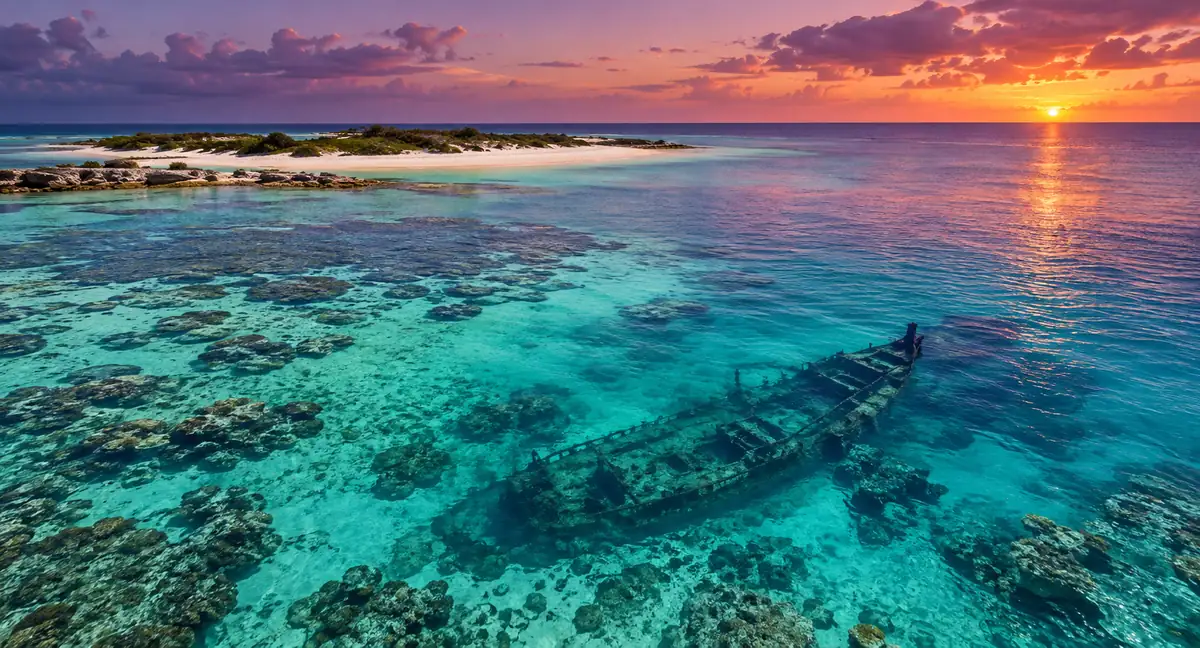
Beyond the stern, the wreck marker blinked against the last violet of evening. Three abandoned vessels lay beneath that water: two steel barges and a little coastal freighter, all sunk decades apart. Fish gathered around their bones.
Whatever this was, it belonged to something older.
“Worth anything?” Ellis asked.
“Probably worth not breaking.”
Kate knelt, keeping clear of the loose net hooks. Their final set had come back wrong: heavy, then suddenly light, with a length of rotten rope caught through the mesh.
She had thirty-six insulated boxes promised to a restaurant supplier in Providenciales and an export order connecting with tomorrow’s flight. Fuel had gone up again. Her starboard engine needed an injector.
Nevertheless, she fetched the clean fish tub.
Ellis watched her lower the object into seawater.
“That’s the expensive tub.”
“Then it should feel at home.”
At thirty-four, Kate owned a fleet of one, employed two people, and knew exactly how much trouble an unexpected object could afford to be.
She covered it with a wet towel anyway.
By nine the next morning, the fish had been delivered, the export paperwork corrected twice, and a stranger was standing beside her boat with a case that looked more expensive than her engine.
“You must be Captain Mereholt,” he said.
“Depends who sent you.”
“The museum. You emailed photographs.”
“You’re quick.”
“You said someone was considering cleaning it with vinegar.”
Kate glanced toward Ellis, who discovered something urgent inside the wheelhouse.
The stranger introduced himself as Adrian Grellan, a marine conservator working with a museum survey project on Grand Turk. He was thirty-eight, tall, dark-haired, and dressed for practical work rather than a photograph of it. A pale scar interrupted one eyebrow.
He asked permission before boarding.
That improved Kate’s opinion of him.
He opened the tub beneath the wheelhouse shade. For a moment his expression became completely still.
“Well?” she asked.
“I think you’ve caught a mariner’s astrolabe.”
“Does it count toward my quota?”
His mouth moved at one corner.
He crouched, examining without lifting it. “An instrument for measuring the sun or a star’s height above the horizon. This heavy, open design was intended for use aboard a moving ship.”
“How old?”
“If it is what it appears to be, perhaps four hundred years. But photographs aren’t enough, and neither is an excited man beside a bucket.”
“You admit you’re excited?”
“Professionally.”
She liked his voice: quiet, precise, with humour somewhere beneath it.
When he asked where it had come from, she brought out her plotter track and paper log. She had marked the beginning and end of the net set, the snag, and the moment the tension eased.
Adrian looked from the neat figures to her.
“You recorded the tension change?”
“I wanted to know where not to put an expensive net again.”
“This may help us find the wreck.”
“There are three wrecks.”
“Three that you know about.”
Outside, a trolley rattled along the dock. Someone shouted about missing ice. Kate watched a drop of water move slowly down the bronze ring.
“My mother spent forty years commanding merchant ships,” she said. “She used to say the sea never ran out of ways to make you feel underqualified.”
“Is she still at sea?”
“Retired to South Caicos. Supposedly. Last week she reorganised the ferry queue.”
This time he smiled properly.
Kate looked back into the tub.
“I’d like it in a museum.”
“That’s what I’d like too.”
Neither of them noticed the man on the dock until he spoke.
“Before anyone gets generous, you might want to establish whose property it is.”
Dane Routhmere ran a salvage company out of Providenciales. Kate knew him by his immaculate deck shoes and his habit of calling working captains “skipper.”
He had a tug and a crane barge near the western banks, clearing one of the steel wrecks under a removal contract.
“That came out of my work area,” he said.
Kate stood between him and the tub.
“It came out of my net.”
“Inside a permitted recovery site.”
“Then show me the boundary.”
Routhmere’s gaze passed over Adrian’s equipment.
“I’m trying to save everyone paperwork. We recover interesting pieces occasionally. There are collectors who pay well.”
“It’s staying wet and going to the museum,” Kate said.
“You haven’t heard a price.”
“That wasn’t the missing part.”
Routhmere’s pleasant expression thinned.
He produced a folded site plan. The permitted rectangle surrounded the larger barge, Cormorant. Kate’s snag position lay close to its southern edge.
Adrian studied the page without taking it.
“Your contract specifies steel wreck clearance?”
“Everything obstructing safe removal.”
“An archaeological find requires a separate assessment.”
“Then assess it. I’ve got a hired crane arriving tomorrow afternoon.”
After he left, Kate noticed Adrian watching the departing truck.
“Friend of yours?”
“No.”
“Good. I’d hate to have started badly with your friends.”
Adrian called the heritage officer coordinating his project. Kate listened while she washed fish scales from the scuppers.
The object could be collected that afternoon. The heritage officer could request a pause around a historic wreck, but first they needed some evidence of where it lay. Routhmere’s contractor had supplied recent photographs showing steel plates, sand, and nothing else.
An old object dragged up beside a modern wreck did not establish an ancient ship underneath it.
When Adrian ended the call, Kate had already opened her tide book.
“How long do you need?” she asked.
“To look? Half a day. To establish anything useful, possibly longer.”
“The boat’s available until tomorrow afternoon.”
“What about your fishing?”
“Ellis and Jo can do the inshore handline orders with my cousin. I’ll lose the export run.”
“I have a survey budget.”
“You haven’t heard a price.”
He looked at her.
Kate let him wait a moment before smiling.
They left Grand Turk beneath a hard blue sky, with dive boats scattering toward the wall and the island flattening behind them into low roofs, scrub, and the white seam of the beach.
Adrian secured his cases without being told twice.
That improved Kate’s opinion further.
He brought a small inspection drone, a side-scan unit, cameras, and enough cable to tie up a hotel. Ellis had stayed ashore to help Jo rearrange the fishing orders.
“You usually work alone?” Kate asked.
“Usually with a team.”
“Am I the budget version?”
“You have considerably better knowledge of the site.”
“Careful. That almost sounded like flattery.”
“I can make it less pleasant if necessary.”
She laughed and eased the throttles forward.
At the wrecks, Adrian proposed starting at the plotted snag. Kate held Morrow above the point while he lowered the drone. Its camera revealed sand ripples, a crushed bait tin, and eventually the black side of the freighter.
They searched for two hours.
Nothing wooden. Nothing ancient. Nothing that explained the instrument.
The promising dark shapes on the sonar resolved into lengths of pipe and an abandoned engine block.
Adrian sat back from the screen.
“It could have been aboard one of the modern vessels. A collected antiquity, lost with the ship.”
“Could.”
“You don’t agree.”
“I don’t know yet.”
She preferred that answer to a guess, even an attractive man’s educated guess.
He glanced at the tide running past the hull.
“Could the net have dragged farther than you estimated?”
“The boat could. The net couldn’t. Look.”
She pulled up the track. During the haul, she had held the bow into the sea, working diagonally across the tidal stream. The snag position marked the boat, not the bottom end of the gear.
Adrian leaned close enough that she caught the clean smell of soap beneath sunscreen.
“How much line was out?”
“Sixty metres. But there’s more.”
She took the recovered rope from a bucket. At one end, beneath its furry growth, was a short loop of rusty steel wire.
“This wasn’t tied into my net. The mesh wound around it.”
“A cable lying on the seabed?”
“Or being dragged across it.”
He examined the broken strands.
Some were old and black. Others showed bright metal.
They looked toward Routhmere’s crane barge, a yellow shape two miles away.
They made their next survey west of the snag, following the direction Kate reconstructed from the line angle and the tidal stream.
At first, Adrian questioned the distance.
“The current’s carrying sediment east.”
“At the surface. On the falling tide it bends around the shoal. Down there it can run almost across us.”
“Can you show me?”
Kate dropped a weighted line with strips of cloth above the sinker. Adrian lowered his camera beside it.
Onscreen, the cloth streamed south.
“Show-off,” he said.
“You asked.”
Following that deeper current, they found a narrow furrow through the sand.
It ended against the modern barge.
The drone nosed beneath a bent steel plate. Its lights caught timber, then vanished into a snowstorm of sediment.
Adrian stopped the thrusters immediately.
“Was that a beam?” Kate asked.
“Yes.”
“How old?”
“Older than the steel. That is unfortunately the entire scientific conclusion.”
They repositioned, giving the cloud time to settle.
The next view showed only a few feet of exposed timber, dark and irregular, partly pinned under the barge’s collapsed side. Beside it lay several pale curved fragments.
“Pottery?” Kate asked.
“Possibly storage jars.”
“Enough for the heritage officer?”
“Enough to take seriously. Not enough to understand what Routhmere’s crane might pull apart.”
Kate looked at the clock. They had spent most of their working daylight finding six feet of uncertainty.
Adrian started saving files.
“We should return.”
“There’s an hour left.”
“And the chop is building. I can do the next pass tomorrow.”
“I know what my boat can handle.”
“I’m concerned about my equipment. You’re making it work for a living.”
She looked at him sharply, then recognised the offered retreat.
He wasn’t challenging her command. He was trying not to turn his urgency into her risk.
“All right,” she said. “One more still image. Then home.”
He nodded once.
It was unexpectedly pleasant, being listened to without having to become louder first.
By evening, the astrolabe was in a secure seawater tank at the museum’s temporary conservation room.
The heritage officer, Celia Pennow, studied their footage while a ceiling fan ticked above her desk.
“I can ask Routhmere to avoid this strip,” she said. “A full stop will need stronger grounds. His engineer says the steel is shifting toward the channel.”
“It may be,” Kate said. “But someone has already dragged a cable through that sand.”
“Can you prove his operation did it?”
“No.”
Celia appreciated the answer enough to stop tapping her pen.
“I’ll arrange an inspection. Weather allowing, our boat can meet you tomorrow morning.”
Adrian stayed to document the object. Kate went looking for dinner and returned with two cartons of conch stew and Johnny cakes.
He was still at the bench.
“You eat, I assume.”
“When reminded.”
“That’s a terrible operating system.”
She moved a stack of forms from the only spare chair.
Under careful lighting, the ring looked less like treasure than a battered piece of machinery. That made Kate like it more.
Adrian pointed to a section visible through a gap in the crust.
“Hand-cut graduations. And here, possibly a maker’s mark.”
“Will you clean it tonight?”
“No. First we document it, then plan treatment. Fast decisions can destroy slow information.”
Kate broke a Johnny cake in half.
“My mother would like you.”
“Because I’m cautious?”
“Because you make caution sound like an insult to everyone else.”
He laughed, surprising them both.
Later, they walked down to the beach with their empty cartons. Evening light shone through the small waves. Across the road, dominoes struck a table with the force of minor verdicts.
“Why ships?” she asked him.
“My father repaired clocks. I liked mechanisms. Then I discovered some mechanisms came with entire lost worlds attached.”
“Sounds untidy.”
“It is. And you?”
“Boats?”
“Your own boat.”
She pushed her toes into the cool sand.
“On my mother’s ships, every decision eventually belonged to someone ashore. Cargo owners. Agents. Schedules. I wanted a thing I could answer for myself.”
“Has that worked?”
“Ask me after the injector bill.”
He smiled, but waited.
Kate found herself adding, “She offered to help buy a second boat this year. I said no.”
“You don’t want one?”
“I don’t know. Everyone assumes a business should keep getting bigger. I like knowing the sound my engine makes.”
“That seems a reasonable thing to like.”
It was a small sentence. She felt it more than she expected.
The following morning brought wind from the northeast and an unwelcome message from Celia: the inspection launch had a cooling-system fault. Another boat would not be available before afternoon.
Routhmere’s crane was already moving.
Kate called him on the radio.
“Your cable track runs into timber beneath the barge. We’ve sent photographs.”
“I’ve seen some dark shapes.”
“Then leave the southern side alone until the inspector gets here.”
“We’re lifting from the north.”
It sounded like a concession.
Kate did not trust how easily he had made it.
At the site, Adrian deployed the side-scan again while she circled outside the salvage moorings. The crane barge’s crew had rigged lifting chains to a ragged wall of steel.
Adrian’s screen built its strange picture of the bottom: shadows, ribs, sand.
“There,” he said.
A long straight mark crossed the scour behind Cormorant.
“Another cable?” Kate asked.
“Maybe.”
“Follow it.”
They traced it away from the steel wreck, over a low hump, then back beneath the plate the crane crew had rigged.
Kate cut the throttle.
“That isn’t a loose cable. It’s looped.”
Adrian enlarged the image. “Around what?”
They lowered the camera on the far side of the hump.
For several seconds there was nothing but sand.
Then a dark timber emerged from the slope, fitted into another at an angle no drifting plank would make.
Adrian bent closer.
Kate watched the depth reading.
The shape wasn’t debris piled beside the barge.
It continued beneath it.
“The steel sank on top of the old wreck,” she said.
“And the sand buried both.”
“The cable they dragged yesterday cut into it. That’s where the instrument came free.”
Adrian brought up their earlier footage: the furrow, the exposed beam, the fragments beside it. Then the sonar image of the looping cable.
Piece by piece, the two wrecks separated on the screen.
Routhmere had passed a recovery wire beneath the modern hull. It had also slipped around part of the wooden structure under the sand.
When the crane lifted the steel, it would pull the ancient wreck with it.
Adrian reached for the radio.
Kate was already transmitting.
Routhmere came back with irritation plain in his voice.
“My diver inspected those attachments.”
“Your diver inspected the steel,” Kate said. “The recovery wire extends beyond it.”
“The camera angle is misleading.”
“Then put a camera down yourself.”
“We have a weather window.”
“So do we.”
Adrian sent the images to Celia with coordinates and an annotated diagram. She called back within minutes.
“I’m sending an instruction to suspend the lift pending inspection.”
Kate breathed out.
Then Celia added, “Get clear of the load. I need you both able to explain this afterwards.”
On the crane barge, a man in an orange helmet walked toward the wheelhouse.
The chains stopped rising.
For the first time all morning, Kate let herself look properly at Adrian.
His hair had blown across his forehead. There was a small salt mark on his cheek. He had one hand braced beside her on the console.
“You draw a persuasive arrow,” she said.
“You drive a persuasive boat.”
“That doesn’t mean anything.”
“I’m under pressure.”
She smiled.
Then the barge swung on its moorings, and the cable on Adrian’s screen straightened.
Not much.
Enough to draw a small cloud of sand from the ancient timber.
Kate’s smile vanished.
“They’ve stopped the crane,” she said. “They haven’t taken the strain off.”
The argument that followed involved Routhmere, Celia, the crane operator, and a man ashore whose job title grew longer whenever he was challenged.
Kate kept Morrow outside the mooring pattern while Adrian recorded the cable’s slow movement.
Finally, the crane operator spoke directly.
“We’ve lowered the hook. That wire’s not hanging on us now. Barge’s lying across it.”
Routhmere had used the old recovery wire as part of a temporary holding arrangement. Wind pressure on the barge was tensioning it.
“Can you let it run?” Kate asked.
“Not until we’ve got another line holding the stern.”
Routhmere cut in. “We’re arranging that.”
His tug was several miles away collecting equipment.
Kate checked the sky. A darker band had appeared beyond the turquoise shallows.
Adrian followed her gaze.
“How long?”
“Before that squall? Maybe forty minutes. Before we have more wind on the barge, less.”
Celia told them the patrol launch was underway from another assignment. It would bring an inspector and establish control of the site.
It would not arrive before the weather.
Kate studied the barge, its moorings, and the tug’s reported position.
“We can take a messenger line across to their spare mooring,” she said. “Their crew can use it to haul a proper stern line. Then they ease the recovery wire.”
Adrian looked at Morrow’s rail.
“You’re offering to tow a crane barge?”
“No. I’m offering to carry string.”
“In this weather, that sounds deceptively modest.”
“The heavy line never loads onto us. We carry the messenger, pass it through the mooring pickup, bring the end back. Their winch does the work.”
“And if the barge swings while we’re alongside?”
“We don’t go alongside. They send it out on a float.”
He thought it through.
“Where do you want me?”
The question steadied her more than agreement would have.
“Not doing anything yet. We wait for their crew to confirm the rig.”
She called the crane operator, asked him to describe the arrangement, and made him repeat which wire would be eased.
Routhmere tried to interrupt.
Kate said, “I need the man at the winch.”
After a pause, the operator came back.
“Understood, Captain.”
They had twenty minutes while the barge crew prepared.
Adrian packed his camera and sat beside Kate beneath the wheelhouse roof. Wind clicked the loose end of a strap against his case.
“You don’t have to stay aboard,” she said. “They can take you across in the work skiff before we start.”
“I’d rather stay. If you want a second pair of hands.”
“I do.”
A brief silence settled between them.
Then Adrian said, “I was on a recovery once where we lifted before we understood what was supporting the object.”
Kate looked at him.
“A carved stern panel. Beautiful thing. We had photographs, measurements, lifting straps. We didn’t realise a buried fastening was still attached.”
“What happened?”
“It split. We recovered the pieces.”
“Your decision?”
“I signed the plan.”
There was no invitation to comfort him. She respected that.
“Is that why you keep telling me what you don’t know?”
“Yes.”
She watched a flying fish skitter away from the bow.
“My mother once brought a damaged freighter into port with half her bridge equipment dead. That’s the story everyone tells.”
“What story does she tell?”
“That she should have turned back six hours earlier.”
He nodded.
Kate touched his wrist, partly to get his attention, mostly because she wanted to.
“When this is finished, I’d like dinner with you somewhere without a specimen tank.”
His eyes lifted to hers.
“I’d like that.”
“And I’d like to kiss you. That isn’t conditional on dinner.”
The restraint left his expression so quickly it warmed her.
“Now?”
“We have a small amount of string-related preparation time.”
He laughed softly. Then he leaned toward her, giving her the last inch.
Kate closed it.
His mouth was warm, his hand gentle against the side of her face. The first kiss was careful; the second wasn’t. She caught his shirt and felt him smile before he kissed her again, slower this time, with an attention that made the noise of the barge seem far away.
When they separated, he rested his forehead briefly against hers.
“I’m going to be very disappointed if you feed me beside a bucket again.”
“Don’t rule it out. You haven’t seen my best bucket.”
The radio crackled.
They drew apart, smiling, and went back to work.
The first run failed.
Kate brought Morrow downwind of the barge’s orange float, Adrian ready with the boat hook. A gust turned the float beneath the bow before he could reach it.
“Leave it,” she said.
He did.
No lunge over the rail. No argument. He stepped back while she circled.
On the second pass, she approached at a shallower angle, using the port engine to hold them against the sideways set. Adrian caught the float and lifted the light messenger aboard.
“Got it.”
“Keep it outside everything.”
He walked it aft, clear of cleats and fishing gear, while Kate brought them toward the spare mooring buoy.
The water had changed colour. What had been bright, transparent blue was now bruised beneath the advancing cloud.
The buoy lay beyond the barge’s stern, bouncing hard.
Kate had picked up moorings in worse weather, but rarely with someone else’s crane swinging in her peripheral vision.
She watched the buoy, the stern, the line.
Adrian knelt at the working gate with his life jacket secured and his tether clipped short. He caught the pickup loop on the second try.
“Ready.”
Kate held the boat steady as he passed the messenger through the large ring attached to the buoy’s chain.
Then he stopped.
“What?”
“The ring’s fouled. Old line across it.”
“Can ours run clear?”
“Not reliably.”
“Bring it back.”
On the barge, Routhmere’s voice burst from the radio.
“We need that line now.”
Kate ignored him.
Adrian retrieved their messenger rather than forcing it through. The loose rope fouling the ring was thick with growth. Cutting blindly could leave them caught in something connected below.
Kate looked toward the next buoy.
A hundred metres farther. A different angle.
“The western mooring,” she told the operator. “Can you take the stern line there?”
A pause.
“Yes. Longer lead. Better angle, actually.”
“Then that’s where it’s going.”
They moved.
Rain reached them halfway across, stippling the sea white.
Adrian got the messenger through the second ring and checked its run before releasing the pickup. Kate brought them back toward the barge’s floating retrieval line.
The wind pressed Morrow sideways.
She compensated, then felt the starboard engine stumble.
Once.
Again.
The injector.
“Kate?”
“I heard it.”
She reduced that engine, letting it idle rather than asking it for power it could not deliver.
The bow fell off.
Adrian looked toward the barge, then at her hands.
“Do we abandon the pass?”
“Not yet.”
She had spent eight years learning this boat’s habits. With both engines, she could turn almost within her own length. With one working properly, she needed room and patience.
There was room to leeward.
She took it.
Instead of fighting back toward the float, she made a broad loop, coming around so the wind helped hold her stern away from the steel.
“Tell them to bring the retrieval float farther out.”
Adrian relayed it. The operator answered immediately.
A crewman paid out more line.
Kate used a short pulse of port power, then neutral. Morrow coasted into place.
Adrian caught the retrieval loop, clipped their messenger to it, and opened his hand.
“Clear.”
Kate waited until she saw the entire light line floating away from her propellers.
Then she moved them out.
Behind them, the barge’s winch began pulling the heavy stern line toward the mooring.
For a moment nothing changed.
Rain drummed on the wheelhouse roof. Adrian stood beside her, dripping onto the floor.
The crane operator called.
“Stern line holding. Easing the recovery wire.”
Kate watched the barge shift, a small movement against the pale blur of rain.
She looked at Adrian.
“Camera.”
They could not put the drone down safely in that chop.
Adrian used the smaller weighted camera instead, lowering it from the sheltered side while Kate held position well outside the barge’s new line.
The first images were useless: sand, bubbles, drifting weed.
He adjusted the depth.
A cable appeared.
Slack.
They watched it settle across the seabed.
No fresh sediment rose from the timber.
Adrian let out a breath and pressed the record control again, saving the moment to a second file.
“It’s off.”
Kate reported it.
For several seconds, the radio carried only static.
Then the crane operator said, “Thank you, Captain.”
Routhmere said nothing.
The patrol launch appeared through the rain twenty minutes later, its blue light flickering against the low cloud.
By then Kate had moved Morrow into open water and was running slowly for shelter on the good engine.
Adrian brought her drinking water.
She took it with hands that had begun to shake now that they no longer needed to be steady.
He noticed. He didn’t make a ceremony of it.
“Your engine has appalling timing,” he said.
“She heard you call her the budget version.”
“You called me that.”
“She’s sensitive.”
He braced himself beside her as the boat lifted over a wave.
Kate looked toward the pale line of Grand Turk, emerging beyond the squall.
They had not saved a whole ship. They did not yet know its name, its age, or what had happened aboard it.
They had kept its remains from being hauled apart that afternoon.
For now, that was a solid enough thing to bring home.
The inspector’s survey took three days.
Kate spent the first replacing the injector with a mechanic who charged extra for saying, “I told you.”
On the second, she supplied the survey crew with the corrected search positions and took them out aboard Morrow. Ellis came too, delighted to discover that archaeology involved nearly as much waiting as fishing.
On the third, the official images showed a section of wooden hull extending beneath the modern wreck, with ballast stones, pottery, and metal fastenings still in place.
The astrolabe’s exact resting place could never be reconstructed. Kate’s log, the net damage, the seabed furrow, and the freshly exposed hull together established a convincing connection.
The site was protected pending a full archaeological assessment. Removal of the steel would need a different plan.
Routhmere’s company was required to explain why work had continued after the find was reported, and why its recovery arrangement had not been documented. Kate left those arguments to people paid to sit in rooms.
She had fish orders.
Adrian had months of conservation ahead.
Their first dinner happened at a little restaurant where the tables stood beneath sea grape trees and the menu depended partly on what Kate had delivered that morning.
He arrived seven minutes late, carrying no equipment.
She checked beneath the table.
“What?” he asked.
“No tank.”
“I considered flowers, but I worried you’d ask whether I’d documented their original position.”
“Did you?”
He sat opposite her.
“All right,” he said. “I’m beginning to see the difficulty.”
They talked about things that had not been underwater: his sister’s disastrous renovations, Kate’s dislike of formal shoes, the book he had been taking on field trips for two years without finishing.
When dinner ended, neither reached for the bill immediately.
“Celia wants me back for the next survey phase,” he said. “Six weeks here in November.”
“Good.”
“And I’d like to come before that. For reasons that would be difficult to put on an expenses form.”
Kate turned her glass between her palms.
“I work early.”
“I’ve noticed.”
“And some weeks I don’t know which evening I’ll have free.”
“I’m not asking you to become easier to schedule.”
She looked at him then.
“Good,” she said again, more softly.
Six weeks later, the instrument stood in its treatment tank beneath a new light.
Conservation had exposed enough of the scale to confirm what Adrian had suspected. It was an early mariner’s astrolabe, rare enough to draw enquiries from museums abroad.
For the moment, it was staying on the island.
Kate visited after a morning run, her hair still flattened where her cap had been. Her mother came with her, carrying the formidable air of a retired captain entering a bridge where someone might have put the charts away incorrectly.
Adrian explained the treatment plan.
Kate’s mother asked three exacting questions about corrosion, one about insurance, and then said, “You’ll want her original log scanned at high resolution.”
“We’ve arranged that,” Adrian replied.
“Good.”
Outside, she took Kate’s arm.
“He listens.”
“Yes.”
“Useful in a man.”
“Mum.”
“Useful in a chief officer too. Don’t look so alarmed.”
Kate laughed despite herself.
She had made one decision since the find, and it was neither a second boat nor a smaller life. She had agreed to provide local survey charters between fishing commitments, at a rate that covered her crew and the maintenance nobody found romantic.
She liked the fishing. She liked this new work too.
There was room for both, if she was careful about what she said yes to.
Adrian came down to the harbour before sunrise on his next visit.
Kate was aboard Morrow, securing a thermos beside the wheelhouse. Her navigation lights painted small colours on the water.
“No archaeological equipment?” she asked.
“Not a piece.”
“Brave.”
“I was told this was a day off.”
“It is. We’re going swimming. There may be lunch.”
“Beside a bucket?”
“You’ll have to take the risk.”
He passed her a paper bag warm from the bakery and stepped aboard only after she held out her hand.
For a moment she kept him close.
The harbour smelled of diesel, salt, and fresh bread. Across the water, the first light touched the roofs of Grand Turk. Nothing about the morning promised that the weather would remain kind or the engine bills would become smaller.
Adrian kissed her, unhurriedly, his free hand resting at her waist.
Then he drew back just enough to look at her.
“Where are we going, Captain?”
Kate smiled and put his hand on the rail beside hers.
“I know a place.”
She eased Morrow out past the harbour lights, with breakfast between them and the whole bright day ahead.
Every ending is somewhere new.
Find your next story →