What the Ice Kept
An independent glaciologist and a mountain guide uncover a hidden heat source beneath Alaska’s Chugach Mountains—and a missing scientist’s unfinished work, preserved in the ice.
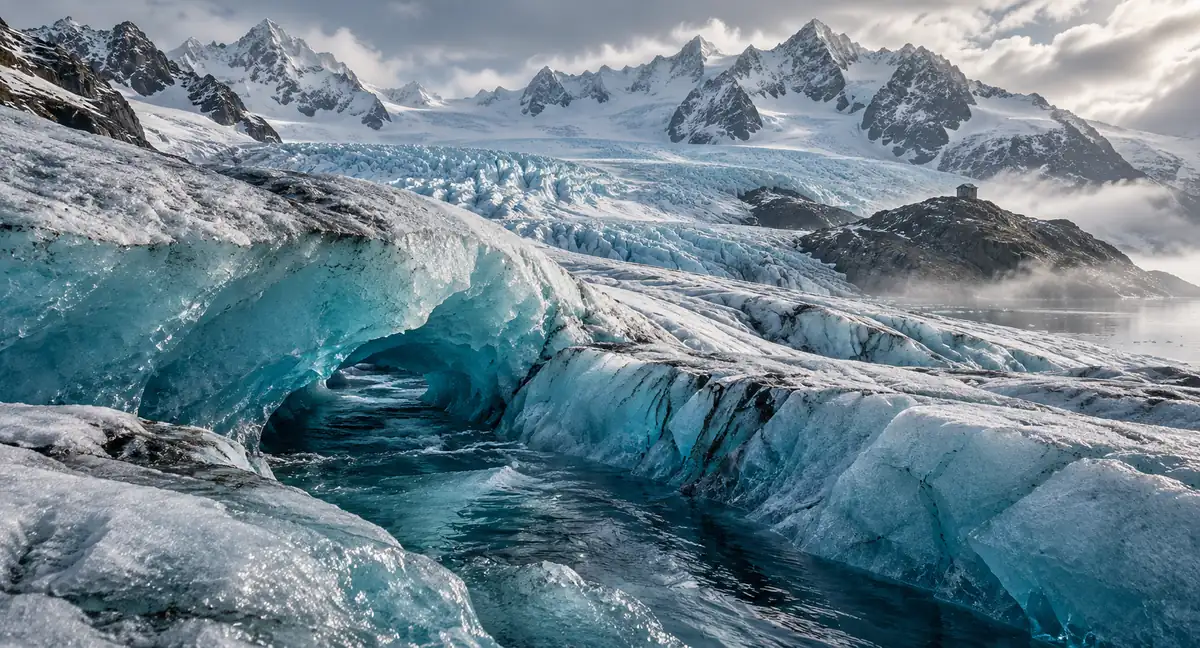
The glacier was melting in a place sunlight couldn’t reach, and Dr. Kai Minose had checked her instruments seven times.
On the eighth, someone set a mug beside her laptop.
“Does it become a different answer if you look hungry enough?”
Kai looked up.
The man wore orange climbing trousers, a faded station fleece, and the patient expression of someone who had already spoken once without being heard. Snow glittered in his dark hair.
“Usually it becomes an instrument error.”
“And today?”
“Today it’s being difficult.”
“Then you’ll get along.”
She glanced at the mug. Tea, no milk. He had noticed her abandoned cup by the kettle.
Outside the research station’s triple-glazed window, wind dragged streamers of snow from the Chugach ridges. The glacier below lay folded between mountains, blue fractures showing through its spring covering.
“I’m River Thorncombe,” he said. “Your field support.”
“Dr. Kai Minose.”
“I know. You labelled your cheese.”
“People eat things.”
“It said ‘Minose—do not compromise sample.’”
“It worked.”
His smile arrived slowly.
At thirty-six, Kai had become suspicious of easy charm. She preferred people who could tell her precisely what they knew and what they were guessing.
River pointed at her screen.
“Is that the west tributary?”
She turned the laptop a few degrees. “Yes.”
“Then your survey stakes are below a hanging cornice.”
“They’re below the ridge.”
“The cornice falls farther.”
She studied him more carefully.
“Show me.”
He pulled up a chair.
By dinner, River had moved three of her proposed sampling sites, and Kai had explained why the temperature readings beneath the glacier made no sense.
He listened without pretending to understand.
“Start with the part where ice stays solid below freezing and still moves,” he said.
They sat at a scratched steel table while the station cook scraped baked halibut from a tray. Six other researchers talked around them. A generator hummed beneath the floor.
Kai used a folded napkin, her mug, and two packets of mustard.
“Gravity deforms the ice. Water at the bed can make it slide faster. But the amount of water depends on several things, including heat.”
“Sun. Warm air.”
“Friction. Pressure. Heat coming up through the rock.”
“And your mustard?”
“An exceptionally sophisticated glacier.”
He nudged one packet. “This bit looks unstable.”
“That bit is your dinner.”
The anomaly came from a routine NGO survey: radar showing an unusual pocket of water, a warm outlet stream persisting through winter, and a pattern of basal melt far above what her calculations predicted.
Any one could have another explanation.
Together, they bothered her.
“The regional model treats heat from below as roughly uniform,” she said. “If warm groundwater is rising along a fault, that assumption could be wrong.”
“Volcano?”
“Not necessarily. Water can circulate deep enough to heat up, then rise through fractured rock. But I need evidence before I start renaming mountains.”
“What evidence?”
“A temperature profile through four hundred metres of ice. Water samples at the bed. Ideally, samples where the groundwater enters.”
He stopped moving the mustard.
“That’s a bigger expedition than surveying stakes.”
“I know.”
“Do you?”
She heard the question beneath the mild delivery.
“My NGO can afford helicopter fuel or a new drill hose. Not both.”
“Then we start with what can be done safely.”
“We start with what can answer the question.”
River considered her.
“Those need to become the same thing.”
Alder Research Station stood on a rock shoulder at eight thousand feet, held together by steel anchors, scheduled deliveries, and a fierce belief in duct tape.
Kai had come for three weeks.
On her fourth morning, she found the name of a dead—or missing—scientist in a maintenance ledger.
ELENA HARTHWEN. WEST OUTLET. REPLACE CORRODED SENSOR.
The entry was eight years old.
Station manager Ruth handed her a cardboard box from beneath the radio desk.
“She worked on subglacial drainage. Disappeared during a solo instrument check. We searched until October.”
“Solo?”
“Different rules then.” Ruth’s mouth tightened. “Some of our current ones have her name underneath them.”
The box contained field notebooks, cable receipts, a cracked magnifier, and photographs of stakes that no longer existed.
Kai had heard of Harthwen. Everyone studying this part of the Chugach had encountered her drainage paper: precise, cautious, frustratingly brief.
There was nothing in it about anomalous heat.
In the final notebook, however, Kai found three words underlined twice.
Not atmospheric forcing.
Below them were columns of numbers, station names that did not exist on any current map, and repeated references to “the kitchen.”
River found her on the floor beside the box.
“Have you misplaced something?”
“Possibly eight years.”
He crouched, one leg extended farther than the other. She had noticed that he took stairs smoothly but sat down with care.
“Your knee?”
“Ankle. Bad landing. Excellent surgeon. Mediocre obedience afterward.”
“Still climb?”
“Not the way I used to.”
He said it without inviting sympathy.
She showed him the notebook.
“Does ‘the kitchen’ mean anything locally?”
“The station kitchen is where the food lives.”
“I had eliminated that possibility.”
“Methodically?”
“Twice.”
He leaned closer. His shoulder warmed hers through two layers of fleece.
“Harthwen used old survey names,” he said. “There’s a Cook’s Basin east of here.”
Kai opened the map.
It was a plausible lead.
That was the trouble with plausible leads.
Cook’s Basin cost them six hours, a snapped ski strap, and most of Kai’s remaining patience.
They found an ordinary meltwater channel beneath a sun-warmed cliff. The temperature was barely above freezing. The rock showed none of the mineral deposits she hoped to see.
River stood beside her while she recalibrated the probe.
“Instrument error?”
“No. Disappointingly good instrument.”
Clouds were building across the pass. He checked them, then the slope above.
“We turn around in ten minutes.”
“I need fifteen.”
“What happens in the last five?”
“A second reading.”
“What does it change?”
She wanted to snap at him. Instead, she looked at her first measurement, the duplicate sample, the blank control.
“Nothing consequential.”
“Ten, then.”
On the return, he stopped her before a shallow gully.
Kai saw an easy descent.
River saw wind-packed snow bulging beneath a ridge.
He drew a little cross-section with his pole.
“Yesterday’s wind came from there. This morning’s came from there. The new slab is sitting on a weak layer, and that gully collects whatever breaks.”
“It doesn’t look steep enough.”
“The bit above us is.”
He took them along exposed rock instead.
Halfway across, Kai looked back. A small sheet of snow peeled from the slope and slid into the gully with a dry, soft roar.
River watched without satisfaction.
“Mountains give demonstrations,” he said. “I prefer the optional ones.”
That evening, she brought him the field thermos she had washed and refilled.
“What happens in the last five minutes?” she asked.
He looked up from repairing the ski strap.
“What?”
“It’s a good question.”
He accepted the thermos. “You can use it.”
“I was planning to.”
The funding committee wanted certainty before paying for the equipment needed to establish certainty.
Kai listened to the satellite call in the station’s cramped communications booth, where somebody had taped a cartoon puffin over a water stain.
“Could the anomaly reflect seasonal drainage?” asked a committee member.
“Yes,” Kai said. “Which is why we propose measuring—”
“And frictional heat?”
“We’ve bounded that contribution using velocity and bed geometry.”
“But you cannot rule it out.”
“Not without the measurements.”
A pause.
They offered enough for a preliminary investigation. Not enough for drilling.
When the call ended, Kai stayed in the booth.
Two years earlier, Professor Martin Calderwick had presented her ice-core reconstruction at a conference under his own name. He had thanked her for “technical assistance.”
She had pursued a formal correction, obtained it, and discovered that winning could still leave a room uninhabitable.
Now she earned less, ordered her own sample bags, and put her own name on her work.
She had thought that would make uncertainty easier to bear.
River knocked on the open doorframe.
“I heard the silence.”
“They want a photograph of the thing beneath four hundred metres of ice.”
“Can you give them a cheaper reason to look?”
She almost said no.
Then she followed him into the kitchen, where he had spread Harthwen’s notebooks beside the current maps.
“I didn’t solve anything,” he said. “Before you look at me like that. But these numbers repeat.”
He pointed to entries beside “kitchen.”
Forty-seven. Fifty-two. Forty-nine.
“Temperatures?” he asked.
“Too hot for the stream. Possibly source temperatures, but there’s no unit.”
“Page numbers?”
She considered the older notebooks.
Not a location code, then. A reference.
They pulled out pages forty-seven, fifty-two, and forty-nine.
Calibration tables.
Kai felt something sharpen inside her.
Harthwen had developed a shorthand using instrument identifiers and offsets. The apparent coordinates in her last notebook weren’t geographical coordinates at all.
“They’re corrected sensor values,” Kai said.
She worked through a row, then another.
River stayed beside her, passing notebooks as she asked for them.
Near midnight, the first column resolved into temperatures.
The second was electrical conductivity.
The third was a sequence of sample numbers.
The readings were extraordinary.
But three entries had thick crosses beside them, and beneath the table Harthwen had written:
Line contamination? Repeat at source. No claim yet.
Kai sat back.
“She couldn’t publish because she couldn’t trust her samples.”
“Why write it like a spy?”
“She didn’t. Like a scientist who assumed she would remember her own system.”
“That seems more dangerous.”
Kai laughed, suddenly and helplessly.
River smiled at her over the wreckage of their investigation.
For the first time since arriving, she forgot to look at the clock.
They spent the next week finding out how much they did not know.
Harthwen’s sample archive contained twelve empty slots. Her original logger had never been recovered. Historical aerial photographs showed that the glacier’s western edge had retreated substantially since her disappearance.
A thermal camera found a persistent warm strip along a rock rib. It could still have been sun exposure. Kai repeated the flight before dawn.
The strip remained.
She combined that result with radar profiles and Harthwen’s corrected readings, then sent a revised proposal.
No promises of hidden volcanoes. No claim that atmospheric warming had stopped mattering.
A testable hypothesis, staged costs, and clear conditions for stopping.
The NGO director found a small research foundation willing to split the expense with a university field programme. Alder already housed a modular hot-water drill. What they lacked was the crew, fuel, and replacement hose.
Those would come.
The agreement gave Kai scientific leadership and guaranteed shared access to the data. She read the authorship terms three times.
River read the field plan once.
“You’ve put the cave survey after drilling.”
“If the borehole confirms warm groundwater, we trace the outlet toward the source.”
“And if the cave route isn’t safe?”
“Then remote sampling only.”
He looked at her until she added it to the written plan.
She found that irritating.
She also found that she trusted him more afterward.
Preparations stretched across three weeks as spring reached farther up the mountain.
River taught her rope transitions on the station’s steel staircase. Kai taught him how ancient air became trapped in ice and why a bubble could survive long enough to answer a question no living person had thought to ask.
He was a good teacher because he noticed the exact moment explanation became embarrassment.
She was a good teacher because she never mistook a simple question for a stupid one.
One evening he asked her to explain isotopes again.
She did, using raisins and biscuits.
“You’re enjoying this,” he said.
“Your isotope ratios are delicious.”
Later, she heard him correctly explaining fractionation to the drill mechanic.
She went upstairs smiling.
At thirty-nine, River had learned to leave space in a day for pain.
Kai discovered that when she found him on the back steps with an ice pack against his ankle.
The sun lingered above the ridges. Far below, the valley held a blue dusk that had not yet climbed to them.
“Bad?”
“Annoying.”
“An expertly uninformative answer.”
He shifted so she could sit.
She brought two bowls of noodles. Hers was crowded with the dried mushrooms her mother mailed from Seattle; his had extra chilli because she had noticed.
“My climbing partner and I were trying to finish a route,” he said eventually. “Weather moving in. I could have backed off. Instead, I made a tired move and landed badly.”
“Your partner?”
“Fine. Furious. Correct.”
She handed him chopsticks.
“Is that why you teach?”
“I taught before. Now I admit it’s the part I liked best.”
“People listen to you.”
“Some people negotiate for five more minutes.”
“Difficult people.”
“My favourite category.”
She looked at him.
He was watching the ridgeline, but the corner of his mouth moved.
“I miss the version of my body that didn’t require a committee meeting,” he said. “I don’t miss the person who thought turning around was a character flaw.”
Kai stirred her noodles.
“I used to believe that if my work was exact enough, nobody could take it away.”
“Calderwick?”
She glanced up.
“Ruth told me you left a university. The rest was in the correction attached to your paper.”
“You read my paper?”
“I got through most of the abstract with dignity.”
The laugh came easier with him now.
“He didn’t take the work,” she said. “That’s what I tell myself. He took a year I could have spent doing more of it.”
“Do you believe yourself?”
“Occasionally.”
River did not offer a lesson about letting go.
He held out his bowl.
“Trade? I underestimated the chilli.”
She exchanged bowls with him.
Their fingers touched, and neither hurried.
The cave appeared first as an absence in a photograph.
Kai was comparing Harthwen’s old survey images with a current drone mosaic when she noticed a triangular rock tooth along the western margin.
Eight years ago, ice had covered its base.
Now, a dark opening lay beneath it.
She carried the laptop to River.
He studied both images.
“That’s accessible from the moraine,” he said. “Maybe. The hanging ice above it isn’t.”
“The warm strip ends there.”
“So does a very ugly slope.”
She laid Harthwen’s notebook beside the screen.
One sketch showed three jagged lines and a small square. Kai had assumed it represented a fractured core.
River turned the notebook sideways.
“That looks like the rock tooth.”
Kai opened the conductivity table. The warmest samples had a mark she had taken for an asterisk.
It matched the square.
“The kitchen,” she said.
A place where the water heated.
They had needed the old photograph, the glacier’s retreat, and River’s eye for terrain to make the sketch intelligible.
There was another notation below it.
Left shelf. Above pulse.
Kai felt the discovery become something heavier.
“She went inside.”
“Possibly.”
“She might have left equipment.”
“Possibly.”
“You’re doing that on purpose.”
“Yes.”
He studied the drone image again.
“We can examine the approach. Nobody enters until we know what the water’s doing.”
For the first time, Kai wanted to argue for reasons that had little to do with science.
Harthwen had known something important. She had tried to verify it. Then she had disappeared, leaving other people to decide what her silence meant.
Kai recognised too much in that.
River waited.
Finally, she said, “All right.”
Their first cave reconnaissance ended at the entrance.
A broad tunnel ran between bedrock and old basal ice, its ceiling ridged like the underside of a wave. Water moved through a central channel. Along the wall, a rock shelf remained dry.
Two hundred metres beyond daylight, the passage bent out of sight.
River and their second guide, Amara, examined the approach while Kai installed a water-level logger.
On the wall above the shelf, fine grit formed three horizontal bands.
“Previous high water,” she said.
River measured them against the floor.
“Too high.”
“Without timing, we don’t know how often.”
“So we get timing.”
They left cameras, temperature probes, and a pressure sensor. Amara checked the gas monitor before they backed out.
No discovery justified becoming another line in Ruth’s safety manual.
Nevertheless, Kai dreamed that night of a yellow notebook dissolving beneath dark water.
In the morning, River found her reviewing the camera feed before breakfast.
“Sleep?”
“Some.”
“Convincing.”
She rubbed her eyes.
“I know she isn’t waiting for me.”
He sat beside her.
“I know.”
“But something of her might be.”
“Then we find out what we can. We don’t promise what the mountain gets to decide.”
She looked at the feed. The stream shone under their infrared camera.
“Does everything you say sound irritatingly sensible before coffee?”
“Only the things you dislike.”
She leaned against his shoulder for one brief, deliberate moment.
He stayed perfectly still until she moved away.
The night before the drill crew arrived, the station ran out of bread.
This produced more collective alarm than the loss of a satellite antenna the previous week.
River volunteered to bake. Kai found him contemplating a sticky mass in a steel bowl.
“You said you knew how.”
“I know the principles.”
“That’s what people say before ruining a laboratory.”
He held out the recipe.
She read it.
“At this elevation, you need to adjust the proofing. And stop adding flour.”
“You can model bread?”
“Bread is a gas-retention problem.”
“Romantic.”
The word settled between them.
Neither pretended not to notice.
Outside, the wind pushed snow against the dark windows. Inside, River stood close enough that she could see flour caught in the hair at his wrist.
Kai took the bowl.
They made two imperfect loaves. While they baked, he asked what she would do if the borehole found nothing unusual.
“Publish the negative result. Fix whatever assumption produced the anomaly. Be unbearable for a week.”
“Only a week?”
“To you, perhaps longer.”
“I’d risk it.”
She looked at him.
He was no longer smiling.
“I’ve been trying,” he said, “to determine whether you want me to kiss you or whether we simply share strong feelings about sample integrity.”
“Those aren’t mutually exclusive.”
“No.”
“I want you to kiss me.”
He came closer slowly enough that she could meet him halfway.
His mouth was warm, his hand careful at her waist. The first kiss held a question; she answered by putting the bowl down and drawing him closer by the front of his shirt.
The second was not careful.
She felt him laugh softly against her mouth when her back touched the counter.
“All right?” he asked.
“Yes. Continue collecting data.”
He kissed her until she stopped finding anything clever to say.
When the oven timer rang, they ignored it for several seconds.
Then Kai pressed her forehead to his.
“The bread.”
“A tragic interruption.”
“You’re responsible for feeding scientists.”
“And you’re extremely distracting.”
She liked the sound of that more than she intended to.
They took the loaves out together.
Nothing was burning.
The drill took thirty-one hours to reach the bed.
Kai slept in shifts while hot water hissed through the hose and exhaust drifted across the glacier. The crew worked beneath floodlights in a world without edges, cloud flattening sky and snow into the same white surface.
River managed safe access, checked anchors, and made people eat before they became too tired to notice they were hungry.
He kissed Kai once behind the instrument shelter.
Briefly. Privately.
It sustained her through four hours of recalibrating a stubborn probe.
The first breakthrough was disappointing.
Water reached the bed, but their sampler returned a diluted mixture dominated by drill water.
Kai closed her eyes.
“Can we use it?” asked the drill engineer.
“For learning how much patience I possess.”
They waited for the borehole to settle, lowered the temperature string, and repeated the sampling with blanks and duplicate bottles.
This time the chemistry changed.
Dissolved silica. Conductivity well above surface melt. A temperature pattern rising sharply toward the bed.
Kai checked the depth correction.
Then she checked the calibration.
River stood beyond the roped work area with two mugs.
“How many times?”
“Three.”
“New personal best.”
She walked over to him, unable to stop smiling.
“We have a real heat anomaly.”
“How big?”
“Too early.”
“How real?”
She let herself answer.
“Real enough.”
He touched his mug to hers.
Below them, four hundred metres of ice concealed warm rock, moving water, and a question that had survived eight years.
The cave logger complicated everything.
Its record showed regular pulses in water level, each arriving roughly seven hours after afternoon warming peaked at the surface.
The warm spring was not causing those surges. Meltwater from higher on the glacier was reaching the passage through a delayed drainage route.
Kai laid the cave hydrograph over the station’s temperature record.
River stood beside her.
“Morning entry,” she said. “After the overnight low. Out well before the next pulse.”
He pointed at the forecast.
“Unless this front brings rain.”
“Forecast arrival is tomorrow evening.”
“Forecast arrival has moved twice.”
They had a window. A narrow one.
Their objective was a short traverse along the bedrock shelf to the suspected spring. A sampling tube could then collect water remotely during future visits.
The camera also showed something on the left shelf, just beyond the bend.
A straight yellow edge.
A case, perhaps.
Kai enlarged the image until it became meaningless.
River watched her hand tighten on the mouse.
“If it’s out of reach, it stays.”
“I understand.”
“I believe you understand. I need to know you agree.”
She turned toward him.
For a moment she wanted to accuse him of confusing affection with authority.
But he would have asked any expedition leader the same question.
“If it’s out of reach,” she said, “it stays.”
His shoulders eased.
“Thank you.”
She caught his hand before he could move away.
“That doesn’t mean I won’t hate it.”
“I can work with that.”
They entered at seven the next morning.
Amara remained at the mouth with the radio relay and emergency equipment. Kai and River wore helmets, harnesses, dry protective layers, and compact packs. The water-level display at Kai’s wrist showed a steady low.
The cave smelled of stone and cold metal.
Their lights moved through cloudy blue ice. Pebbles hung overhead, embedded in a ceiling that had once been somewhere farther up the mountain.
River tested the bedrock shelf, installed protection where the drop into the channel deepened, and kept them away from unsupported ice.
Kai stopped at every tributary trickle.
Most were cold and dilute.
At the bend, one thin stream emerged from a fracture in the rock.
Her thermometer climbed.
Six degrees.
Nine.
Eleven point eight.
“Oh,” she said.
River looked back.
A pale mineral crust surrounded the fracture. Water slid over it into the glacial stream.
Kai sampled the source directly, filling duplicates and field blanks. She recorded the location, photographed the deposits, and installed the intake tube.
The chemistry would still need laboratory confirmation.
But this was water arriving warm from the mountain.
Not sunlight. Not her faulty arithmetic.
She looked at River.
He understood before she spoke.
His grin was startling in the headlamp glow.
Then his light caught the yellow case.
It sat on a higher shelf twelve metres beyond them, beside the corroded remains of a tripod.
Between lay a washed-out section of ledge.
River assessed the gap.
“No.”
Kai stared.
The case was close enough to read its black lettering.
HARTHWEN.
Below it lay a collapsed orange pack.
“Could we reach it with—”
“No anchor on that side. Undercut ice above. If the shelf breaks, the channel takes you underneath.”
She could hear her own breath inside her hood.
Eight years.
Twelve metres.
Then the water alarm chirped.
For one second, Kai assumed a sensor fault.
The reading had jumped too quickly.
She looked down.
A twig spun past in the stream.
There had been no twigs before.
“Surface water,” she said. “Early pulse.”
Amara’s voice crackled through the relay.
“Rain at the entrance. Front’s here. Level rising.”
River was already turning.
“We leave.”
Kai capped the final bottle and secured it. He glanced at the case once, then at her.
She looked away from it.
“Leaving.”
They moved quickly along the shelf.
At the bend, water had covered the lowest crossing. It was rising visibly against a pale stripe in the rock.
River checked their line and the current.
“Not across that.”
“There’s no other surveyed exit.”
“Then high ground.”
He pointed to the broad bedrock bench they had passed beside the spring.
They retreated upward as a deep knocking sound travelled through the passage.
Kai knew that sound from recordings: stones moving in water powerful enough to lift them.
Her mouth went dry.
River radioed their position. Amara confirmed that the entrance remained open, but the crossing was disappearing under turbulent water.
“We stay on rock,” River told Kai. “We wait for the peak. We keep talking.”
The bench rose well above the old silt bands.
That did not make it a guarantee.
Kai looked at the graph on her wrist.
The water had risen thirty centimetres, then another ten.
River secured their packs and clipped himself beside her. His movements were controlled, but she saw him shift weight off his injured ankle.
“Pain?”
“Manageable.”
“Useful answer, please.”
“Four out of ten. Stable.”
She nodded.
Below them, the current struck a lodged block of ice and sent spray across the shelf they had just left.
Kai thought of Harthwen’s crossed-out readings.
No claim yet.
The missing scientist might have stood here, waiting for a safe interval that never came.
Kai pulled out the waterproof field tablet.
“What are you doing?” River asked.
“Finding out whether waiting helps.”
The previous pulses had looked like ordinary peaks on a chart.
Now Kai expanded the time axis.
Each had a sharp leading edge, a flatter interval, then a rapid fall.
Not just runoff travelling downstream.
Something upstream was storing water until pressure opened a temporary path.
She compared the borehole pressure record, cached that morning, with the cave logger.
There.
A pressure drop beneath the glacier preceded every surge in the cave.
Two earlier measurements, meaningless separately, became a mechanism.
“It’s filling and draining a pocket,” she said. “The rain triggered it early.”
“How long?”
“The previous releases lasted twenty to twenty-six minutes.”
“Does that tell us this one will?”
“No. But the borehole pressure can tell us whether it’s still feeding.”
She radioed the drill crew.
The reply came broken through two relays.
Pressure falling.
Still falling.
Then steady.
Kai watched the cave level. It climbed another three centimetres.
Stopped.
She did not call it finished.
For nine minutes they sat shoulder to shoulder while the stream roared below.
River took her gloved hand.
Not to quiet her. Not to hold her in place.
Simply because they were there.
“I’m glad we kissed before this,” she said.
He turned his head.
“I had plans for considerably more kissing.”
“Good.”
“Somewhere with chairs.”
“Ambitious.”
The water began to fall.
Kai waited through five consecutive lower readings, checked with the drill crew, then nodded.
“The release is ending. There’s still runoff, but the stored volume’s gone.”
River assessed the crossing through binoculars.
“Another ten centimetres.”
They waited.
When he judged it passable, he used their existing line to reach the next anchor, tested the footing, and brought Kai across one careful movement at a time.
She kept the logger visible and called the trend.
Down.
Still down.
At the entrance, rain shone silver beyond Amara’s headlamp.
Kai stepped into it with shaking legs.
River came out behind her.
For a while, none of them said anything except what was needed to get home.
The yellow case remained in the cave.
Kai wrote that sentence in her report before she wrote about the warm spring.
Then she called Ruth and the search coordinator.
They had seen Harthwen’s equipment. They had not seen Harthwen.
They had new information about the drainage hazard.
No one would go back until conditions changed.
That evening, Kai found River in the equipment room, laying wet ropes in loose coils.
She took the other end.
“I wanted to cross to the case,” she said.
“I know.”
“I could make it sound like a scientific obligation. It wasn’t entirely that.”
He waited.
“I wanted her to have been right. I wanted someone to bring her work back.”
“And now?”
“I still do.”
He fed another loop through his hands.
“But I don’t want you paying for it,” she said. “Or Amara. Or me.”
River looked up.
“I wasn’t sure you’d turn around.”
“That’s fair.”
“I’m glad you did.”
She set down the rope.
“I wasn’t sure you’d believe me when I agreed.”
“That’s fair, too.”
He crossed the small space between them, stopping close enough to ask without words.
Kai put her hands on his face and kissed him.
This time there was no timer, no drill shift, no experiment waiting to be finished.
Only wet wool, his warm mouth, and the steady pressure of his arms when she moved into them.
Later, in his narrow room, they lay beneath a blanket while rain tapped the metal sill. He traced the flour-burn scar on her wrist from their bread-making evening.
“We’re very glamorous,” he murmured.
“You should see my conference clothes.”
“I’d like to.”
She turned toward him.
It was a small future. Ordinary enough to believe.
“Yes,” she said. “You should.”
Recovering Harthwen’s case took twelve more days and a tracked inspection robot borrowed from an engineering team in Anchorage.
Kai helped design the cradle. River and Amara established the operating position outside the unstable section. The machine crossed the broken ledge on rubber tracks and brought the case back without anyone following it.
Inside were a memory card, sample records, and a letter in a waterproof envelope.
Not a confession.
Not a revelation conveniently addressed to posterity.
A frustrated draft to Harthwen’s laboratory manager, requesting clean tubing and enough funding for one more visit.
Her initial samples had been contaminated by antifreeze from an old instrument line. She had suspected real geothermal water beneath the contamination but refused to publish an unsupported conclusion.
The memory card contained a final route log.
Harthwen had left the cave after a rapid rise in water. Unable to cross the swollen outlet, she had attempted to return above it, along a rock gully outside the original search area.
When weather cleared, a specialist search team followed that route.
They found her beneath an old rockfall, with identifying equipment nearby. Formal identification followed.
Ruth closed the radio-room door when the news arrived.
Kai sat outside it with River for a long time.
Later, Harthwen’s sister called.
“Did she find what she thought she found?”
Kai looked at the laboratory results on her screen.
Deep-circulating groundwater. A fault-fed heat source. A measurable contribution to basal melting that the regional model had missed.
“Yes,” she said. “She did. And her caution helped us prove it properly.”
By late June, the glacier’s surface had turned to rough white grain, and meltwater threaded the ice in bright blue channels.
The discovery did not overturn the climate crisis.
It did something more useful: it corrected a consequential part of the regional picture. Kai’s preliminary modelling showed that the hidden heat source influenced where the glacier slid, where water accumulated, and how suddenly it could drain.
The station changed its access rules.
The NGO funded a full season of monitoring.
Kai deposited Harthwen’s recovered observations alongside her own, with the uncertainties intact. Her manuscript named every contributor, including the guides whose field knowledge had shaped what could safely be learned.
Then she declined a university offer that required moving immediately and proposed a visiting appointment instead.
She wanted the laboratory access.
She wanted her independence.
For once, she asked for both.
On the morning of her departure, River carried one of her equipment cases to the helicopter pad. His guiding season would keep him in Alaska until September.
She would spend July in Seattle, then return for the late-summer survey.
They had discussed it with calendars open.
There had been remarkably little mystery.
“I booked the flight,” he said over the distant rotor noise.
“September eighteenth?”
“Window seat. You promised mountains from the ground.”
“And chairs.”
“Vital.”
She touched the zipper of his jacket, straightening something that did not need straightening.
“I’ll call Thursday.”
“I’ll read another page of your paper by then.”
“Ambitious.”
“I have a demanding teacher.”
The helicopter rounded the ridge, stirring snow from a shaded hollow.
Kai kissed him before the noise swallowed everything.
When she stepped back, River held out a small paper parcel: two slices of their latest bread, wrapped around cheese.
Across the paper he had written, Minose—do not compromise sample.
She laughed, tucked it safely into her jacket, and caught his hand for one more moment. Behind them, the glacier shone beneath the long northern light; ahead lay a flight, a Thursday call, and a window seat already booked.
Every ending is somewhere new.
Find your next story →