The Weight of Sound Stone
With Harrowmere's floodgate cracking, a disgraced stone-mender has one night to save the village—and tell the truth about the fault she once helped hide.
The crack announced itself through Nessa Flintmere’s supper.
Her spoon struck the bowl just as something beneath the village gave a low, grinding note. Broth trembled against the rim. Dust sifted from the lintel.
Then the flood bell rang.
Nessa was already on her feet.
She took her leather roll, her storm lantern and the mittens drying above the stove. She put the right mitten on by watching her fingers. The little finger and the one beside it had felt neither wool nor winter for seven years.
Outside, water ran down streets that had been dry at sunset.
Her sister stood in the bakery doorway opposite, flour white along one cheek.
“Tell me that’s the spill channel,” Mara said.
Nessa crouched and dipped her good hand into the trickle.
Bitter cold. Grey grit.
“Take your strongbox up the stair.”
“Nessa.”
“And your blankets.”
She left before Mara could ask what she had not answered.
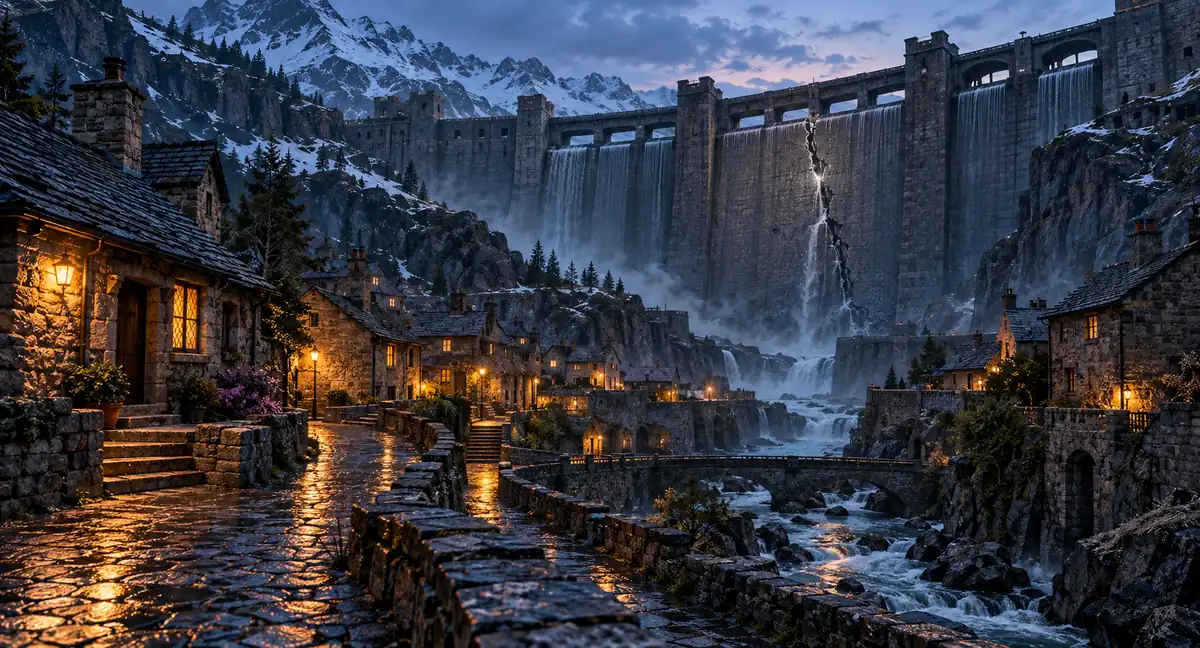
Above Harrowmere, the floodgate filled the notch between two black cliffs. Its stone face rose higher than the mill roof, holding the mountain’s first thaw in a narrow basin. Once the river channels had been cleared of winter debris, its timber shutter would be raised a handspan at a time, feeding water safely through the village.
That was tomorrow’s work.
Tonight, something was opening without permission.
At the gatehouse, Tavin was pulling the bell rope with both hands. He had inherited the keeper’s post in autumn, along with a coat too large for him and Master Pell’s iron keys.
“Stop ringing,” Nessa said.
He stared at her.
“Three strokes, then a pause. That means take the stair. You’re ringing for fire.”
He obeyed. In the silence between strokes, she heard water striking stone inside the wall.
“Who’s below?”
“Orren. He said fetch a mender.”
“Then you’ve got one.”
He glanced at her right hand before he could stop himself.
Nessa passed him and descended into the inspection passage.
The ancient builders had left a narrow space behind the gate’s downstream face: enough for a person, a lantern and an uncomfortable understanding of the weight overhead. Water should have sounded distant there.
Tonight it hissed.
Orren, the reeve, held a lamp beside the western jamb. A crack ran diagonally through three pale blocks, fine as a hair near the roof and wide enough for a fingernail below.
Nessa set her lantern down.
“How long?”
“First leak at dusk. We thought a joint needed packing.”
“Did you turn the shutter wheel?”
“Half a turn. It wouldn’t move.”
“Don’t touch it again.”
“The basin’s three marks below the red line.”
Nessa looked at the lowest cracked block.
Its outer edge had dropped barely the thickness of a coin.
Her stomach tightened.
Orren mistook her silence.
“Pell said this gate would outlast our grandchildren.”
Nessa put her left palm against the stone.
Far below it, something clicked.
“Yes,” she said. “He did.”
She made them bring measuring rods, chalk and the gatehouse book.
Tavin arrived with the book wrapped in his coat. He held it against his chest while Nessa checked the water gauge through the outer hatch.
Two marks below the red line now.
Beyond the lantern’s reach, floating ice knocked against itself. The warm wind blowing down from the heights smelled of wet earth. Somewhere above them, snowfields were emptying into the basin in the dark.
“How long before it overtops?” Orren asked.
“The face will fail first.”
He waited.
“If nothing changes, perhaps dawn.”
“And can you mend it?”
She returned to the passage and scraped limewash from the tails of the cracked stones. Numbers appeared beneath her knife: the weights cut into them when the gate was built.
Two hundred and forty pounds. Three hundred and twelve. Two hundred and forty again.
“I need sound stones at these weights. Whole stones. No cement, no rubble bundled together.”
“The quarry shed,” Orren said.
“Empty since the bridge repairs.”
“The stair, then.”
They all knew which stair.
It climbed from the upper end of Harrowmere to the shepherds’ ridge, two hundred broad stone steps laid after a flood no living person remembered. Summer brambles hid its lower courses. Children dared each other to climb its broken railing. Every spring the council promised to clear it.
The steps themselves were sound.
Enough good stone to mend half the gate.
Nessa imagined three gaps across its steepest flight: old people lifting their feet in darkness, someone carrying a child, water arriving below.
“If the repair fails, they’ll need it,” she said.
“If you don’t repair the gate, they’ll need it anyway.”
“Yes.”
Orren rubbed his mouth. “I can order the steps taken.”
“Wait.”
She took the book from Tavin and opened it on a dry ledge.
Pell’s handwriting filled the pages: neat figures, weather observations, small complaints about the price of oil. Nessa found the survey from seven years before.
Western footing examined. Sound throughout.
Beneath it lay two signatures.
One was Pell’s.
The other had the large, careful loops Nessa used when she was twenty-three and still believed a signature made her important.
She shut the book.
“We’ll need the inspection pit opened.”
Orren looked down. Beneath their boots lay a wooden hatch, swollen shut.
“Why?”
“Because those three stones didn’t split by themselves.”
Tavin fetched a pry bar.
While the men worked, Nessa examined the jamb. The cracks were fresh. She could mend them, provided she had donors. She could persuade broken stone to remember its old shape and make another stone accept the damage.
She could not make the weight above them disappear.
The hatch came up with a wet gasp.
The pit below was scarcely deep enough to stand in. Nessa lowered her lantern first, then climbed down the iron rungs.
At the bottom, the western bearing block rested between two bedrock shoulders. It carried the jamb and half the gate’s downward thrust.
Its front had been neatly faced.
Its rear, hidden until Nessa reached around with the lantern, was coming apart in thin, wet flakes.
She knew the pale stripe crossing it.
She had once held her hand there for six minutes.
“Nessa?” Orren called.
She touched the block with her two numb fingers.
There was no recognition in them. There never would be again.
“Get everyone away from the gatehouse,” she said. “Except the people willing to work.”
Mara found her outside, drawing on the gatehouse door with chalk.
Behind them, Harrowmere was filling with voices. Lanterns climbed towards the evacuation stair. Someone had brought a goat that objected to every step. The bell sounded three times, paused, sounded again.
“You’ve sent half my customers up the mountain without breakfast,” Mara said.
“Send the other half.”
“What do you need?”
Nessa drew the bearing block beneath the jamb, then the two shoulders of bedrock beside it. The old builders had cut square shelves into those shoulders. Iron lifting screws had once stood there during construction. The shelves remained, and the screws were kept in the gatehouse against the day the shutter needed replacing.
She marked them with two crosses.
“Two screws here. A timber bearer across them. We take the weight off this block, pull it out and put another in.”
“How heavy?”
“Nine hundred and sixty pounds.”
Mara looked at her.
“With rollers,” Nessa added.
“And then?”
“The top two cracks first. They must hold together while we lift the jamb. We shore them with timber, change the bearing, then mend the lowest stone. That one's carrying the settlement. Mend it too soon and it'll split again.”
Mara studied the drawing.
“And if the new bearing doesn't fit?”
“We go up the stair while the props still hold.”
Nessa wrote LOWEST STONE LAST beneath the drawing. Pell would have kept the order in his head. Anyone else could read hers.
Orren had come out behind her.
“You said sound stones,” he said. “We’ve got sound stones.”
“The stair stays.”
“You don’t get to decide that.”
“No. But you should know the whole choice before you make it.”
Nessa turned towards the square below.
At its centre stood Master Pell, carved in grey limestone, one hand resting on a little model of the floodgate. Beneath his boots, four broad courses of granite formed a plinth.
The statue had been put up three years before his death. Nessa had watched the unveiling from her window and stayed inside.
“The plinth,” she said.
Orren followed her gaze.
“No.”
“It was built from the gate’s reserve stock. The same quarry. The same standard weights. There’s a bearing block in the bottom course.”
“It’s a monument.”
“It’s stone.”
“That’s not all it is.”
Nessa’s chalk broke between her fingers.
She had expected resistance. She had not expected how badly she would want to let it defeat her.
Mara looked from one to the other.
“What’s wrong with the block underneath?” she asked. “Why can’t you mend that too?”
Nessa could hear Pell answering.
No use troubling people with a fault we’ve already put right.
Seven years, and his voice still arrived before hers.
“Because I’ve mended it once.”
Tavin stood in the doorway.
“The book says—”
“I know what the book says.”
Nobody spoke.
Nessa wiped chalk dust on her trousers.
“There’s a seam through it. Soft material trapped inside the granite. When we opened the pit seven years ago, it had started to crush. Pell said we could transfer the fracture and seal the back against water.”
“And could you?” Orren asked.
“We transferred the fracture. That made the stone whole. It didn’t change what was inside it.”
Mara’s face had gone still.
“A mended stone can’t be mended again,” she said.
“No.”
“Pell knew?”
“Yes.”
“And you?”
Nessa looked at the gatehouse door, at her plain white drawing.
“I knew enough to ask for a replacement. He said lifting the jamb would cost more than the village could bear. He said the seam was dry and would stay dry.”
“Then he was wrong,” Tavin said quickly.
“He told me to face the back with lime and stone slips. He told me not to cut the mender’s mark where the next keeper would see it.”
Tavin’s mouth opened, then closed.
“I did it,” Nessa said. “And I signed the survey.”
From the square below came a woman calling for a missing dog.
Orren spoke very softly.
“We’ve been living under that.”
“Yes.”
“You left because of it?”
“I left because I couldn’t bear him telling me I’d done good work.”
Mara stepped back half a pace.
That hurt more than Orren’s anger.
Nessa made herself continue.
“If we mend the visible cracks and leave that block underneath, the jamb will settle again. The props will buy us time to change it. They aren't a foundation. Taking the stair won't give us one.”
Orren looked towards the monument.
“Come down to the square,” he said. “You’re going to tell them.”
By the time Nessa stood on Pell’s lowest step, there were thirty people in the square.
Others were still moving uphill. Orren had told them to keep moving. Those who remained had come because their hands were needed, or because they wanted to hear why Nessa Flintmere proposed knocking down the man who had kept their water safe for forty years.
She knew their faces.
Hett, who ran the sawpit, had once paid Nessa in timber because neither of them had money. Old Davren had brought Pell broth throughout his last illness. Sella had named a child after him.
Nessa told them about the seam.
She told them about the transfer and the hidden mark and her signature.
She did not say she had been young until Davren said it for her.
“You were his apprentice.”
“I was twenty-three.”
“He should have known better.”
“He did know better.”
“And you’ve said nothing all this time?”
“No.”
The word seemed very small for the years it contained.
Hett folded her arms.
“Why should we believe your repair now?”
Nessa had expected that question most of all.
She laid the gatehouse book on the monument’s step.
“You can read what I signed. You can look at the block. Tavin’s seen the seam. Orren’s seen the crack. I’ll show anyone who wants to come.”
“Time enough for a tour?” someone asked bitterly.
“No. But you don’t have to take my word in the dark again.”
Mara stood at the edge of the lantern light. She had carried two baskets of bread from the bakery. People were taking pieces without noticing.
Nessa went on.
“I can repair the gate if we replace the bearing block and mend the three stones above it. I can’t promise nothing else will break. The stair must stay whole.”
“And him?” Davren looked up at Pell.
The sculptor had given him an expression of patient certainty.
“We lower the figure onto timbers,” Nessa said. “We take apart the plinth. Four of those blocks carry the same weights as the stones we need. We dress them to the gatehouse standard weights before I touch them.”
“You’d put his monument under the gate?”
“The biggest block, yes.”
“And the others?”
“They’ll take the cracks. They won’t be safe for building after.”
Davren turned away.
For a moment Nessa thought he was leaving.
Then he took off his coat.
“I’ve got rope in the cart shed.”
Hett let out a breath.
“I’ll fetch the rollers. Nobody touches a lever until I’m there.”
Hett put a rope into Orren's hands. He took his end without looking at Nessa.
Before he could follow her towards the statue, Nessa caught his sleeve.
“The culverts. We can't open the shutter into blocked channels.”
He stopped, then called three names from the crowd. Those men were to clear the channel mouths, working uphill from the river, and report to Mara. Until they did, the wheel stayed shut.
Not everyone stayed.
Sella drew her shawl close and headed uphill. One man spat beside Nessa’s boot. Two others followed him, taking their families towards the stair.
Nessa watched them go.
They had listened. They had made a choice. She had no right to ask for another.
Mara came forward with the bread.
“Eat.”
“I’m not hungry.”
“I didn’t ask.”
Nessa took a piece.
Her sister kept hold of the basket.
“You could have told me.”
“Yes.”
“I asked you so many times.”
“I know.”
Mara looked at the statue, then back at her.
“Get them through tonight,” she said. “We’ll still have tomorrow to be angry.”
They lowered Pell onto a bed of sawpit timbers with a rope round his middle.
Hett directed the work, her voice sharp enough to cut through the water’s growing roar. Twice she stopped everyone and reset a roller. Once she made Orren take his hand out from beneath a block.
“You’re reeve of your fingers too,” she told him. “Keep them.”
Under the statue, the plinth stones bore the old quarry marks.
Nessa chalked numbers beside the blocks they needed. On the smaller inscription stone she wrote SPARE.
“Keep that whole. Leave room round it for the sled.”
Nessa had remembered correctly.
She hated the relief that brought.
While the others dismantled the upper courses, she and Tavin returned to the gate. The water gauge stood one mark below red.
In the inspection passage, the lowest crack had widened.
Nessa chalked a line across it and wrote the time beside it.
Tavin watched her draw.
“Was any of what he taught us true?”
“Most of it.”
“How do I know which parts?”
“You measure.”
He stared at the line.
Nessa handed him the chalk.
“Stay here while they fetch the stone. If the ends move apart, call me. Don't wait for it to look serious.”
“Is it serious already?”
“Yes.”
He swallowed, then bent to make a second mark higher up.
The first donor arrived on a low quarry sled. Hett’s crew hauled it through the gatehouse doors and along the passage, where the floor had been built to carry replacement masonry. It left a pale scrape beside generations of older ones.
Nessa checked its weight against the standard iron weights on the gatehouse balance.
Too heavy by six ounces.
She dressed one edge with a chisel, collected the chips, weighed it again.
Orren watched impatiently.
“Near enough?”
“No.”
Another sliver. Another weighing.
The beam settled level.
The old masons had been careful people. Their weights had names worn smooth by centuries of hands. Nessa wished she had trusted them more than the man who had taught her to read them.
Hett's crew had wedged stout timbers beneath the upper courses. Nessa checked each packing piece before sliding the donor beside the uppermost cracked block. There was still room to work between the props. When the bearing came out, there would be no room for a mistake.
“Keep clear.”
“Will it jump?” Orren asked.
“Sometimes.”
She took off her right mitten.
The two numb fingers were pale and slightly crooked. The others looked ordinary. The loss had begun at the little finger and crept inwards with each mending; the palm went last. She could choose which hand to pay with. Nothing else.
She put the heel of her hand against the damaged gate stone and stretched her fingers onto the donor. The gap between them was narrow enough to bridge.
Cold granite. Grit. A ridge beneath her thumb.
She held the two stones in her mind: equal weight, unequal injury.
The craft required no words. It required attention precise enough that, for a few breaths, everything else became an interruption.
She found the crack.
She followed its branches.
She asked the sound stone to receive them.
A dry snapping noise ran down the donor.
Under her palm, the gate’s fracture closed.
Nessa jerked her hand away.
Her middle finger no longer existed to her.
She could see it. She could bend it. She could press its nail against her teeth hard enough to leave a mark.
Nothing came back.
Orren looked at the new crack in the donor stone.
“That’s one.”
Nessa nodded.
Tavin crouched beside the repaired block. With the chalk, he drew the small open triangle that meant mended.
He made it large.
The second transfer took her forefinger.
By then, the basin had reached the red line.
The gatehouse floor shivered whenever a broad piece of ice struck the shutter. Water had begun spurting through a mortar joint above the western jamb, clear at first, then cloudy.
They had to replace the bearing before the third repair. Without support beneath it, mending the lowest block would only make it break again.
The great plinth stone came up from the square on rollers, with twelve people pulling and Hett walking beside it.
Mara walked behind, carrying fresh lanterns.
One side of the granite still bore part of Pell’s inscription.
FOR HIS FAITHFUL—
The rest remained on a stone in the square.
No balance this time. This block would replace the old bearing, not receive its damage. Its weight mattered to the hauling crew; its fit mattered to the gate.
Nessa laid her measuring rods along it and marked the cuts. There was sound granite to spare in every direction. Hett made her check the socket measurements twice.
Hett and two quarrymen took turns with the chisels while Nessa set the lifting frame below.
The gatehouse screws were stiff with old grease. She checked each thread with her left fingertips. They set them on the bedrock shelves, laid the timber bearer across, and packed it tight beneath the jamb’s projecting course.
At her word, Orren and Hett began turning.
A quarter turn each.
The timber creaked.
Another quarter.
Dust ticked from the stone overhead.
Nessa knelt in the pit, watching the narrow joint above the failed bearing. Tavin stood on the ladder with his lantern.
“Enough,” she said.
The jamb had risen less than the thickness of a knife blade.
It was enough.
They set wedges beside the screws and attached a hauling line to the old block.
When the men pulled, only its front moved.
The back stayed behind.
Nessa saw the wet flakes separate.
“Stop.”
The front portion hung crooked. Beyond it, water shone through the seam like glass.
“Can you mend that?” Hett asked from above.
“No.”
Nessa reached into the gap with a hooked bar. The broken rear would have to come out piece by piece.
She had known that might happen.
Knowing did nothing to make the water quieter.
They worked in turns. Nessa loosened the fragments. Tavin passed them up. Orren carried them from the hatch and returned with empty hands.
The water rose over Nessa’s boots.
“Leave it,” Orren said. “We can get everyone up the stair.”
“Not from this side if it goes now.”
There was no anger in it. Only geography.
The gatehouse stood on the wrong bank of the spill channel. They would have to cross the square to reach the stair.
Nessa lifted another flake.
A narrow jet struck her sleeve.
Above, Hett said, “The screw’s moving.”
Nessa looked up.
The western screw had begun to lean. Its foot was steady on bedrock, but the timber bearer was twisting as the jamb’s weight shifted.
“Don’t turn it,” she said.
“I’m not.”
The last piece of the bearing lay wedged at the back, too deep for the hook.
Nessa put her right hand into the opening.
She could see her fingers pressing against the fragment. Only her thumb and the heel of her palm could feel it; the fingers curling behind it gave her no sign that they had caught.
She pulled.
Her hand slipped.
A thin red line opened across her knuckles.
“Nessa,” Tavin said.
She reached again, harder.
“Stop.” He caught her wrist. “You’re pushing it sideways.”
She almost shook him off.
Instead she withdrew her hand.
“Tell me where.”
He brought the lantern lower.
“Left. Under the dark edge. Your thumb needs to go under it.”
She used her left hand.
The stone was slick and painfully cold. She welcomed the pain. It told her where she was.
The fragment came free.
Water poured through the empty socket.
“Block!” she shouted.
They had built a little track of iron bars and greased boards down the passage and into the pit. The replacement waited at its head, slung from the gatehouse lifting beam.
Hett eased it down.
The block settled onto the track with a heavy knock.
Nessa moved behind it, out of the line of the opening.
“Pull.”
The hauling rope tightened. Beyond the hatch, people grunted.
The stone slid forward.
Six inches.
A foot.
Then it stopped.
“Don’t pull harder.”
Nessa lowered the lantern.
The new block's leading corner had caught on a lip of old mortar. Water swept over it, hiding the edge.
She reached for her chisel.
Her right hand closed badly and dropped it.
For one wild moment she wanted to hit the hand against the wall, demand that it behave like the thing it appeared to be.
Instead she picked up the chisel with her left.
“Tavin. Hold this point here.”
He looked into the rushing water.
“Here?”
“Closer to me. Yes. Keep your fingers behind the head.”
She struck with the mallet.
Once.
Twice.
The mortar lip broke.
“Now.”
The stone moved.
Its leading edge entered the socket, dividing the stream. The rope strained. Nessa guided it with a bar while water climbed her shins.
Then it was in.
Not all the way.
Three inches of dark space remained beneath the back of the jamb.
The frame groaned.
Above them, something cracked loudly enough to silence the pulling crew.
Tavin looked up.
A fresh fracture had opened through the projecting jamb stone against which the timber bearer pressed.
Nessa had checked it before they started. It had been sound.
Now the gate’s weight had found another weakness.
“We need that last stone seated,” she said.
Orren leaned over the hatch.
“The frame—”
“I know.”
“Can you mend it?”
“Yes. But we need another donor.”
“The one for the lowest block?”
“Wrong weight.”
The cracked support carried its number on the underside.
One hundred and eighty pounds.
Nessa saw it clearly in the lantern light.
She saw again the quarry mark on the small inscription stone. One hundred and eighty. The spare.
Still down in the square.
“Orren. The inscription stone. One hundred and eighty. Bring the balance weights too.”
“How long have we got?”
She watched a grain of granite drop from the new crack.
“I don’t know.”
He went.
They held the gate on timber, iron and people who had nowhere else to put their hope.
Hett added a second wedge beside the leaning screw. Nessa made everyone stand clear of the bearer's ends. Mara checked the route back through the gatehouse and shifted the spent donors out of it. Each return brought her close enough to glance into the pit.
“Still here,” Nessa told her.
“I can see that. Keep it that way.”
The next block arrived with one corner chipped and Pell’s name facing the floor.
Nessa checked it against the weights on a portable balance sling.
They had brought it slightly heavy.
“Thought you'd rather cut than wish,” Orren said.
Nessa shaved the chipped edge until the balance settled.
This transfer would take her thumb.
One repair would remain after it.
Mara stood beside the lantern.
“You can use the other hand.”
“Yes.”
The word carried a choice Nessa had avoided making all night.
Her left hand could still distinguish a hairline crack from a vein. It could judge grain beneath dust, feel a loose flake before it shifted. With it she could earn a living, provided she learned to let her eyes do what her right hand no longer could.
Four fingers on the right had already paid for her craft. Only the thumb and palm remained. Taking a fresh patch from her left hand would leave her two damaged hands to learn again. She needed one she could trust without looking.
“Hold the light higher,” she said.
Mara did.
Nessa laid her right hand between the two stones.
She found the fracture moving.
Tiny movements, but real. A weight pressing down while she tried to gather the shape of what it had broken.
She shut her eyes.
The crack branched through the donor with a noise like a stick breaking across a knee.
The support block became whole.
Her thumb vanished.
She opened her eyes.
Tavin was already making the mark.
Nessa bent over the pit.
“Pull again.”
The crew pulled.
This time the replacement bearing slid home.
Hett and Orren turned the screws back together, slowly lowering the jamb onto its new foundation.
Nessa watched the joint close.
No crumbling.
No fresh line.
The water beneath the bearing dwindled to a muddy thread.
For the first time that night, the gate settled without making a sound.
The lowest cracked block still had to be mended.
They moved its donor into place.
Nessa’s knees shook as she climbed out of the pit. She had been cold for so long that the lantern seemed to give off warmth from six feet away.
Orren went to the shutter wheel.
“Not yet,” she said.
He took his hands off it.
The lowest fracture had widened while they worked. On its repaired neighbours, Tavin’s triangles stood bright and clear.
Nessa crouched beside the final donor.
Two hundred and forty pounds. Weighed and dressed. Ready.
The heel of her right hand rested against its edge.
She could still feel the roughness there.
She had a sudden memory of Pell teaching her to sharpen a chisel. His broad hand guiding hers. His pleasure when she got the angle right.
That had happened too.
The memory did not excuse him. She was tired enough, at last, to let it remain what it was.
Mara knelt beside her.
“Tell me what happens.”
“The last of the hand goes.”
“Can you still move it?”
“Yes.”
“Will it hurt?”
“Afterwards? No.”
Mara understood the answer in the way Nessa had meant it.
She put a folded cloth beneath Nessa’s wrist so the cold stone would not scrape it raw.
Nessa looked at the last patch of feeling she owned in that hand: a narrow crescent across the heel of her palm.
Then she set it against the gate.
The water roared on the far side. The basin was above the red line now. They had no time left for fear to ripen into courage.
She followed the crack.
At its deepest point, it forked around a black mineral inclusion. She gathered both branches, refusing the temptation to hurry past the smaller one.
Equal weight.
Whole stone.
All the damage.
The donor snapped.
Nessa’s hand became something she had to watch.
For a moment she could not make herself lift it. It seemed attached to the gate by the absence of anything telling her otherwise.
With her left hand, she took her right wrist and drew it back.
Tavin bent to inspect the block.
He held the lantern close, checking the repaired face and the joint above it.
Then he made the final triangle.
“Mara. The channel crew?”
Her sister went to the doorway and called into the square. One of the channel crew came up, mud to his knees.
“All three back. We've cleared the culvert mouths. There are branches farther down, but the water's getting through.”
“Stay on the banks. If it starts backing up, shout.”
Only then did Nessa turn to Orren.
“The wheel.”
It moved.
At first Orren turned it alone. Then Hett joined him, and the shutter rose with a prolonged wooden complaint.
Water thundered into the spill channel.
Mara flinched.
Nessa watched the western jamb.
“Stop there.”
Orren stopped.
A handspan was enough to begin. More would send a wave through streets already carrying water.
They waited.
Nessa checked the chalk lines. Tavin checked the pit. Hett listened to the lifting frame, though it no longer carried the load.
Nothing moved.
After a while, Tavin climbed to the outer gauge.
His voice came back small through the hatch.
“Still rising.”
No one spoke.
Then he said, “Slower.”
Nessa went to the wheel and looked down the spill channel. Water raced between its banks, carrying branches towards the river. The village culverts were taking it.
“Another finger’s breadth,” she said.
They opened the shutter farther.
The sky beyond the cliffs had begun to pale.
By dawn, the basin had fallen below the red line.
The people on the ridge saw the bell change before they heard it: one stroke, a long pause, another. The signal to wait for instructions. Not yet to come down.
Orren insisted on checking the channel through the village first.
Nessa approved.
She sat on the gatehouse step while he went, her right hand wrapped loosely in a clean cloth. She had cut it in three places and bruised two fingers without noticing.
Mara brought her tea.
Nessa tried to take the cup in her right hand.
Mara caught it before it tipped.
Neither spoke.
Nessa took it with her left.
Below them, the square was strewn with ropes, stone chips and the cracked blocks that had received the gate’s injuries. Pell lay on his timbers with rainwater collected in one carved ear.
Davren came up from the square.
“What happens to him?”
“I don’t know,” Nessa said.
He looked down at her wrapped hand. Then back towards the square.
“The stones that split?”
“Don’t build with them.”
“I meant can we use them for gravel.”
“Yes.”
“Good. Lower lane needs it.”
He left her with that.
Tavin came out carrying the gatehouse book.
He opened it across his knees and held out a pencil.
Nessa looked at the old survey. At her name beneath Pell’s.
On the next clean page, she wrote what they had found.
She wrote which bearing they had removed, how the new one had been fitted, and the weights and positions of all four mended stones. Her left-handed letters lurched and crowded one another.
She did not rewrite the page to make it prettier.
At the bottom she wrote her name.
Tavin read the entry slowly.
Then he signed beneath it.
Mara sat beside Nessa, close enough that their shoulders touched.
“I’m still angry,” she said.
“I know.”
“Come for breakfast when you’re done.”
Nessa looked towards the intact stairway. Figures waited along its upper turn, small in the morning light.
“I will.”
She rested her right hand on her knee and, with her left, turned the book back to the survey from seven years before.
Under the words Sound throughout, she drew a single line.
Then she began the correction.
Every ending is somewhere new.
Find your next story →