The Warmth Beneath
At a remote Chugach research station, a glaciologist and a mountain guide uncover heat beneath ancient ice—and the unfinished work of a vanished scientist.
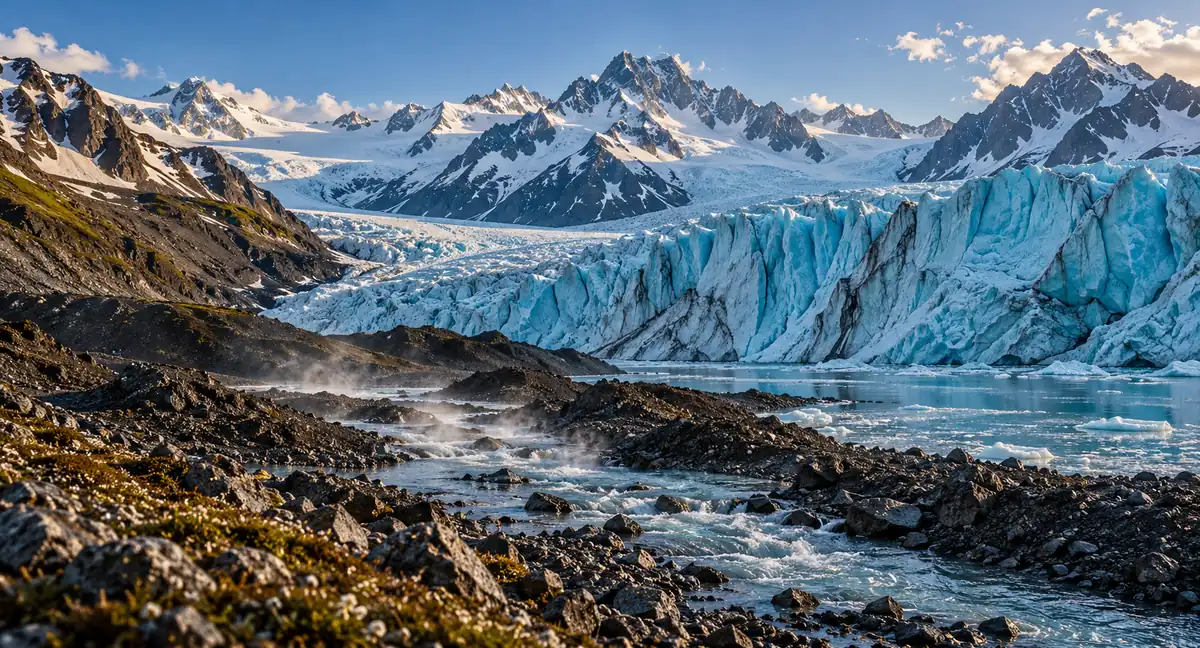
The glacier was melting in the wrong place, and Dr. Kai Minose had spent three days trying to make it her fault.
She recalibrated the probes. Reprocessed the satellite images. Checked whether somebody had confused feet with metres, a mistake capable of surviving three committees and a respectable journal.
The anomaly remained.
Along the glacier’s shaded eastern margin, where thick debris should have insulated the ice, meltwater emerged seven degrees warmer than it should.
At breakfast, she laid her map across the only dry section of the station’s dining table.
“I need to get here.”
The man opposite her lifted his coffee before the paper reached it.
“Today?”
“If possible.”
He studied the contour lines. Outside, wind pushed fine snow against the windows, although it was late May and the valley below had begun turning green.
“That route crosses an avalanche runout.”
“The slope is twenty-two degrees.”
“The slope above it is forty.”
Kai looked again.
He pointed with a blunt fingernail. “You’re measuring where you’d stand. Snow doesn’t always respect that distinction.”
She appreciated the correction enough to dislike him slightly less for making it.
“You’re River.”
“And you’re the person who labelled the communal jam with the date it was opened.”
“There was mould in the previous jar.”
“A compelling defence.”
River Alderwick was thirty-eight, the station’s contracted mountain guide, and apparently untroubled by either her reputation or the weather. He had brown eyes, a weathered face, and a way of sitting that suggested his body usually preferred movement. A walking pole leaned beside his chair.
Station manager Lorna had mentioned an old climbing injury. She had not mentioned that he smiled as though he already knew which things were worth worrying about.
He turned Kai’s map slightly.
“We can approach from the ridge tomorrow, if the wind drops. What are we looking for?”
“Possibly a bad sensor.”
“You brought three?”
“Four.”
His gaze returned to her face.
“Then I’ll bring the longer rope.”
Alder Station stood on rock above a tributary of the fictional name everyone still used: Bellwether Glacier. The official designation was an unlovely combination of letters and numbers. Even Kai preferred Bellwether.
The station had six bunks, a laboratory converted from a shipping container, and windows that trembled when helicopters came in. Supplies arrived according to weather rather than desire.
Kai had come for a six-week survey for Northline Conservation. At thirty-five, she earned less than she had as a university research fellow, but the data on her laptop belonged to her project, and nobody could remove her name from it.
That remained an astonishing luxury.
The following morning, River made her demonstrate her crevasse-rescue skills on the practice anchors.
“I’ve worked on glaciers for eleven years,” she said.
“Good. This should be quick.”
He did not apologise. She liked that more than she intended.
On the ridge, wind had carved the snow into ribs. River stopped beside a shallow drift and brushed its surface with his glove.
“What does that tell you?”
“Recent wind loading.”
“Which side?”
She considered the stripped rocks behind them. “The lee side. Here.”
“Exactly. The mountain leaves a record.”
“So does ice.”
“Your record seems easier to put in a freezer.”
“Only until somebody unplugs it to charge a phone.”
He looked horrified.
“It happened once.”
“I hope there was a trial.”
By noon they reached the eastern margin. River chose the anchors; Kai chose the sampling points. Neither interfered without a reason.
Water slipped beneath a shelf of blue ice and gathered in a narrow channel between glacier and rock. Kai measured temperature, conductivity, discharge. She took duplicate samples and a blank.
River watched her rinse a bottle three times.
“Why not just fill it?”
“Because whatever was in the bottle becomes part of the answer.”
“And three rinses removes it?”
“Reduces it. Science is mostly finding defensible ways to be less wrong.”
“That sounds exhausting.”
“It is.”
Her second probe settled at the same temperature as the first.
Eight-point-one degrees.
She stared at it.
“How bad is that?” River asked.
“Potentially very interesting.”
“You’ve said that without moving your face.”
“I’m moving it internally.”
He crouched beside her, carefully outside her clean sampling area.
She explained the possibilities: sunlight warming shallow pools, friction beneath moving ice, groundwater passing through warm rock. Geothermal heat did not require a volcano. Water could circulate deeply along faults, acquire heat, and rise again.
“But an outlet temperature alone proves almost nothing,” she said. “We need to know what happens under the glacier.”
“How far under?”
“Four hundred metres.”
River looked across the enormous white surface.
For once, he had nothing light to say.
The first funding response arrived two days later.
Compelling preliminary observations. Please provide confirmation of a geothermal source before resubmitting a drilling request.
Kai read it aloud.
Lorna, repairing a cupboard hinge, said, “Have you considered requesting money to confirm that they understand the purpose of research?”
The station had housed a university drilling programme years earlier. Its old equipment inventory suggested that some reusable gear remained in storage, but the pump and boiler were gone. Hiring replacements, bringing in a qualified crew, and supplying fuel would cost more than Kai’s entire annual survey budget.
She opened the historical records instead.
Bellwether had been measured intermittently for forty years. Most of the files were mundane: snow accumulation, surface velocities, complaints about batteries.
One folder contained photographs of notebooks belonging to Dr. Ellis Brackenholt.
The last page was dated eight years earlier.
Brackenholt had disappeared during a solo instrument retrieval below the eastern moraine. A storm had prevented the initial search. Later teams found a broken survey pole near a rockfall, but no body.
Kai remembered the news vaguely. Another name attached to another mountain.
His notes were full of coded entries.
W3 / H–6 / blue hour.
Mother breathing. Daughter cold.
No clean conclusion. Do not let them turn this into a claim.
There were sketches of branching lines, repeated triangles, and numbers that fitted neither coordinates nor dates.
She enlarged one page.
Beside a temperature series, Brackenholt had drawn the same warm outlet she had sampled.
Kai went to find River.
He was outside, teaching two visiting field technicians how to build a snow anchor. He waited until each had tested the other’s work before coming over.
“Brackenholt found it,” she said.
River’s expression changed.
“You knew him?”
“No. I worked with one of the search teams later. We checked the lower gorge.”
“Was there a cave?”
“A rock overhang. Some openings in the moraine. Nothing stable enough to enter.”
She showed him the sketches.
He studied them without touching her tablet.
“This might not be a map.”
“What else?”
“Depends on who drew it.”
For the first time since the funding email, Kai felt something besides frustration.
A problem with edges.
Their first promising lead consumed four days and ended at an ordinary pond.
Kai had assumed W3 referred to Brackenholt’s western sampling transect. The station records contained W1 and W2, so she extended the sequence.
River helped her carry a portable temperature logger over two ridges. They camped on gravel while freezing rain clicked against the tent.
The pond was sun-warmed, shallow, and chemically unremarkable.
Kai stood beside it with her notebook closed.
“I brought us to a puddle.”
“A very thoroughly investigated puddle.”
“We lost four days.”
“We eliminated an explanation.”
She glanced at him.
“You’re using my language against me.”
“I’m a fast learner.”
On the return, River’s left leg began to stiffen. He shortened his stride without comment.
Kai stopped at a sheltered rock.
“I need to check the samples.”
“You checked them twelve minutes ago.”
“They remain fascinating.”
He leaned on his poles, looking at her.
Then he sat.
While she pretended to examine bottle caps, he loosened the brace under his trousers.
“A fall?” she asked.
“Climbing. Three years ago. Bad rock, bad landing. Several exciting new pieces of metal.”
“Does it hurt all the time?”
“No. It negotiates.”
“And today?”
“Today it wants a union representative.”
She handed him the thermos.
He accepted the rest without making her offer it more directly. That, too, felt like a kind of skill.
Kai negotiated an extension to her field assignment and built a smaller proposal.
Instead of promising a regional breakthrough, she listed competing explanations and the measurements required to separate them. She obtained a discounted equipment loan from a university programme whose drilling crew had a gap in July. Northline would cover laboratory analysis if she secured transport.
River helped cost the field operations.
“You’ve budgeted one weather day,” he said.
“I know.”
“You’ve written three in the narrative.”
“I was hoping nobody would compare them.”
“I’m beginning to understand grant writing.”
She changed the spreadsheet.
Across the following weeks, the station settled into a rhythm around them.
Kai taught River to read annual layers in an ice core left from an earlier project. He held the cylinder against the laboratory light, watching dust bands emerge.
“So that summer is still in there.”
“Parts of it.”
“And if the layers melt together?”
“You can’t recover everything. You have to admit what’s gone.”
He looked at her then, but did not turn the sentence into a question.
River taught her to distinguish an old avalanche crown from a wind feature. He showed her why a safe route in morning shade could become an unreasonable choice after lunch.
She began adding time to her maps.
He began asking about measurement uncertainty.
Once, over lentil stew, he said, “If your warm water is groundwater, couldn’t it have travelled from somewhere outside the glacier?”
Kai lowered her spoon.
“Yes.”
“Bad question?”
“Expensive question.”
The next morning she added another control site.
At night, she worked on Brackenholt’s notebooks. River sometimes sat opposite her with a book, his injured leg stretched onto a chair. He never demanded conversation.
His quiet was different from solitude.
She found herself saving remarks for him.
A particularly absurd reviewer comment. A cloud that resembled a collapsed soufflé. The fact that Lorna’s repaired cupboard now opened by itself whenever somebody boiled the kettle.
One evening Kai called her mother in Seattle and slipped into Japanese, describing the station stove’s determination to burn rice.
When she hung up, River was smiling.
“What?”
“You sound less severe in Japanese.”
“My mother had just accused me of washing the rice incorrectly.”
“Was she right?”
“Unfortunately.”
He began leaving the rice to her.
She began leaving the last square of dark chocolate beside his book.
Neither mentioned the arrangement.
Brackenholt’s code finally yielded because River disliked one of his drawings.
“That’s not a branch,” he said.
Kai looked up.
“It’s a cliff seen from the side. Those marks are ledges.”
They were halfway through June. Rain ticked against the laboratory roof.
She rotated the scanned page.
The triangles that she had taken for mountains could be survey stations viewed in elevation.
“Then H isn’t a compass bearing,” she murmured.
“Height?”
“Possibly.”
She searched the station’s old instrument manuals. An obsolete optical survey system used local coordinates, anchored to a benchmark rather than satellite positioning.
The benchmark register was missing.
For two days, the idea went nowhere.
Then Kai found a maintenance photograph of the station before its new roof. Behind a younger Lorna stood a painted survey board marked H0. The brass bolt beneath it was still outside, half hidden by a fuel cabinet.
They measured it. Kai reconstructed the old grid using surviving survey points, rejected one that frost had displaced, and translated Brackenholt’s positions.
W meant window.
Not west.
His sketches showed openings along a limestone band exposed between the glacier and the valley wall.
H–6 was six metres below his height datum.
The correct opening lay high above the pond they had investigated, behind a curtain of seasonal snow.
But that was only half the discovery.
Kai compared Brackenholt’s “blue hour” entries with his temperature records and old weather data. He had visited before direct sunlight reached the glacier. Even at the coldest time of day, one source stayed warm.
Mother breathing. Daughter cold.
She pulled up River’s photographs of the eastern cliff.
“Two water sources,” she said. “A warm spring in the rock. Cold glacial water joining it farther down.”
“So we sampled the mixture.”
“Yes. Which means the source could be warmer.”
River leaned over her shoulder. His sleeve brushed hers.
For a moment she lost the next number.
Then she found it.
“His measurements were inconsistent because the mixing ratio kept changing. He couldn’t separate the sources.”
“And now?”
“Now we know where to look.”
River straightened slowly.
“That opening is below unstable snow.”
“I know.”
“We wait until it sheds.”
She looked again at the translated coordinates. The answer seemed close enough to touch.
“How long?”
“A week. Perhaps two.”
The old instinct rose in her: work faster, reach it first, leave nobody room to take it away.
River waited.
Kai shut the notebook.
“Then we use the time to make the drilling plan better.”
He nodded once.
It pleased her more than praise would have.
The funding came through in pieces.
A conservation foundation covered helicopter hours. A university collaborator supplied the drilling team in exchange for an agreed analytical role. Northline found emergency money after Kai rewrote the proposal for the third time.
She circulated a data and authorship agreement before accepting anything.
River found her staring at the sent message.
“Bad email?”
“Preventive email.”
He waited.
“My doctoral mentor published a model I developed. My analysis, my code. I appeared in the acknowledgements.”
River’s face became still.
“What happened when you challenged him?”
“He said I was confusing contribution with ownership. Then he offered to help me find another position.”
She could say it cleanly now. It had taken two years.
“Is that why you count everything four times?”
“I counted things four times before. He merely expanded the applications.”
River sat on the bench beside her.
“Brackenholt’s notes,” she said. “I keep thinking somebody stopped him, too.”
“Maybe. But he wrote that he didn’t have a clean conclusion.”
“I know.”
“You don’t have to make his story yours.”
She looked out through the window. Evening light lay gold across the glacier, exposing every crease.
“No,” she said eventually. “I suppose I don’t.”
River rubbed his knee through his trousers.
“After the fall, I kept planning climbs that would prove I was still the same person. My physiotherapist asked whether I actually wanted to climb them.”
“What did you say?”
“Something sophisticated and defensive.”
“And did you?”
“Some. Not all.”
He smiled faintly.
“I like teaching. Took me an embarrassingly long time to stop treating that as evidence of defeat.”
Kai shifted closer, leaving a small space between them.
“I like my work now,” she said. “The pay is terrible.”
“The rice is improving.”
“It was always excellent.”
“There she is.”
His hand rested on the bench, palm down. She put hers beside it, their little fingers touching.
He looked at the contact, then at her.
Neither moved away.
The cave reconnaissance took place in the fifth week.
By then, much of the snow curtain had fallen. River and a consulting cave specialist named Saira inspected the rock entrance while Kai installed a water-level logger outside.
They found a limestone passage, not a hollow excavated inside ice. That distinction made entry possible, though hardly safe by default.
The passage ran beneath the valley wall toward the glacier bed. One branch ended in collapse. Another widened into a chamber where warm water rose from a fissure before disappearing under ice.
They did not enter that chamber.
Saira surveyed from a safe ledge, tested the air, and marked old flood levels. River established retreat points and a second exit through an upper slot.
Kai sampled the spring from the ledge using an extension pole.
Twenty-six degrees.
She sat back so abruptly that River steadied the sampling pole before it struck the wall.
“Your face moved,” he said.
“Considerably.”
The cave was still not enough.
Warm groundwater could exist beside a glacier without supplying meaningful heat beneath it. To establish the connection, they needed borehole measurements at the bed, plus chemistry and flow estimates. To change regional models responsibly, they would need further sites over time.
That evening, Kai wrote the limitations before the findings.
River watched from the doorway.
“You look happy.”
“I’m trying very hard not to.”
“Working?”
“No.”
He offered her a mug.
They walked beyond the station’s machinery noise to a slab of sun-warmed rock. Below, the glacier bent into shadow. Far away, a serac fell with a sound like a door closing in another house.
“The crew arrives Monday,” Kai said.
“If the weather holds.”
“If the weather holds,” she agreed.
River smiled. “You’re becoming dangerously reasonable.”
She turned the mug between her palms.
“I’d like to have dinner with you.”
“We’ve had dinner together for five weeks.”
“A dinner where Lorna doesn’t ask us to move propane cylinders afterwards.”
“That sounds like a date.”
“It was intended to.”
His answer came without teasing.
“Yes.”
She looked at him, suddenly aware of how carefully she had managed everything except this.
“Good.”
“Very persuasive invitation.”
“I had supporting documents.”
He laughed, and she wanted to feel that laugh closer.
“River.”
“Yes?”
“Would you kiss me?”
He set his mug on the rock.
“Gladly.”
He touched her jaw first, giving her time to close the distance. His mouth was warm, his beard rough beneath her fingers. The kiss began gently, then changed when she caught the front of his jacket and drew him nearer.
His hand settled at her waist. She felt the restraint in it, the question, and answered by moving closer.
For a little while there was no next measurement.
When they parted, his forehead rested against hers.
“I’ve wanted to do that,” he said.
“I was gathering evidence.”
“Enough?”
She kissed him again.
The drilling rig arrived in three helicopter loads, accompanied by two drillers, several kilometres of hose, and an argument about the weather forecast.
Kai liked the drillers immediately.
For four days, the glacier became a small, disciplined industrial site. The crew melted and filtered water, heated it, and circulated it through the drill hose. River maintained the marked access routes and monitored changing snow conditions. Kai logged every instrument and every metre.
At three hundred and ninety-two metres, the drill descended more slowly through debris-rich basal ice.
At four hundred and seven, the pressure changed.
“Bed,” said the lead driller.
Nobody cheered yet.
They lowered temperature and pressure instruments, collected water samples with duplicates, and deployed a camera. Its lamp revealed suspended sediment, a sliver of pale rock, and water moving through a low cavity.
Kai checked the readings twice.
Then a third time.
The basal water chemistry resembled the cave spring’s, diluted by meltwater. The temperature profile and repeated measurements indicated heat arriving from below. Mineral chemistry supported deep circulation through the fractured rock.
Several independent observations were finally pointing in the same direction.
Not a hidden volcano. Not an explanation for all the glacier’s retreat.
A concentrated source of heat that regional models had omitted.
“Is it real?” River asked quietly.
Kai looked up from the screen.
“Yes.”
His smile spread slowly.
She wanted to kiss him in front of everyone. Instead she gripped his wrist, hard, and he turned his hand to hold hers.
There was still work to do.
The borehole instruments could measure conditions under the ice. The cave installation would help them estimate how much warm water entered the system and monitor seasonal changes.
Saira approved a short visit to the spring chamber after several days of stable water levels. The team established a conservative turnaround time, watched the weather, and assigned a surface observer to the borehole pressure feed.
During the reconnaissance, Saira had also seen something beyond the spring.
A faded orange strap.
Too straight to belong to the cave.
They entered at six the next morning: Kai, River, and Saira.
The rock passage smelled of wet stone. Their lights picked out scalloped limestone and a pale seam where floodwater had polished the wall.
Kai carried the compact sensor assembly. River carried the emergency kit. Saira led, checking their earlier survey markers.
The spring chamber lay under the glacier’s edge, beneath a roof of bedrock. At its far end, ice sealed a low archway, water slipping beneath it.
Warm vapour blurred Kai’s glasses.
She attached the logger to the agreed anchor and measured the spring’s discharge while Saira surveyed the channel.
River approached the orange strap from the stable side of the chamber.
“Pack,” he said.
Kai looked over.
It lay beneath a slab at the edge of the old collapse, beyond the safe boundary. A name had been written on its shoulder webbing.
BRACKENHOLT.
Nobody spoke for a moment.
River raised his light. Beside the pack, partly shielded by rock, lay a boot with a human bone visible above it.
Kai lowered her eyes.
Eight years of absence became a person who had not made it home.
“We mark the position,” River said softly. “Photographs from here. The recovery team needs to assess the collapse.”
Kai nodded.
There was no rescuing him now. There was only the work of bringing back certainty.
A yellow instrument case rested closer, on their side of the boundary. Saira checked its position and retrieved it without disturbing the slab.
Inside were water-stained pages, two sample vials, and a small field recorder sealed in a pouch.
Kai photographed everything before closing the lid.
Then the radio crackled.
Lorna’s voice came through the repeater they had placed at the entrance.
“Pressure’s rising at the borehole. Faster than your threshold.”
Kai checked her watch.
They had been underground twenty-seven minutes.
“Copy. Leaving now.”
She reached for the new sensor’s cable.
A deep thump travelled through the chamber.
The spring’s surface shivered.
River was already turning toward the exit.
The first water reached their boots in the narrow passage.
It was cold.
Kai felt it through a seam in her glove when she braced against the wall.
“Glacial water,” she said. “Not the spring increasing.”
Their lights caught a brown current spreading across the floor ahead.
The lower exit was taking water.
Saira stopped at the junction. The line they had followed inward disappeared around a bend, vibrating in the current.
“Upper route,” she said.
River radioed their change of plan. Kai heard Lorna confirm, then static swallowed the rest.
They climbed onto the surveyed ledge leading toward the second exit.
Behind them, water struck rock with a hollow, accelerating roar.
Kai’s sensor assembly remained in the chamber. It held the local backup of their first detailed flow measurements. Her instinct pulled at her with almost physical force.
River saw her look back.
“How much time would retrieval take?”
“Four minutes. Possibly six.”
“How certain?”
“Not enough.”
He waited for her decision.
Kai tightened the straps on her pack.
“Leave it.”
They moved.
The upper passage climbed sharply. River favoured his left leg on the larger steps, using his arms where the rock allowed it. Saira went ahead to the slot they had inspected.
Then her light stopped.
“New debris.”
A fall of loose stones and old snow had slumped into the outer opening. Daylight showed through, but the gap was too narrow.
River assessed it beside her.
“We can clear from this side if the larger block is stable.”
“Two people,” Saira said. “Kai, stay back from the fall line.”
Kai wedged herself on a broad shelf and took out the handheld reader linked to the pressure logger at the spring. The signal flickered, returned.
The water beneath them continued rising.
She made herself look at the numbers.
The pressure at the spring was now higher than at the borehole after correcting for elevation. Earlier, flow had moved from rock toward glacier. Now the gradient had reversed.
A subglacial drainage change was forcing cold water into the cave.
“Lorna,” she said into the radio. “Do you copy?”
A broken reply.
Kai moved the antenna higher.
“Do not approach the lower entrance. This is glacier drainage backing into the rock system. Keep the surface team above the gorge.”
“Understood,” came the faint answer.
River and Saira passed stones inward, placing them where they would not roll onto Kai. A blade of outside light widened.
Then a larger piece shifted.
River recoiled, swore once, and pressed himself against the wall.
“My leg’s fine,” he said before Kai could ask. “My opinion of limestone has deteriorated.”
Saira examined the block.
“It’s holding the snow above. We stop pulling underneath.”
The obvious opening was no longer a safe one.
For several seconds, only the water spoke.
Kai looked past them at the wall.
At shoulder height, a dark groove ran into the rock beside the blocked slot. She recognised its shape from Brackenholt’s sketches: a ledge, viewed from the side.
But she did not trust recognition alone.
“Saira. Your survey. Was there a recess above the entrance?”
“A chimney. Too narrow at floor level.”
“The drawing showed a shelf.”
Kai opened Brackenholt’s photographed notebook on her phone with wet fingers. The triangles she had mistaken for peaks marked vertical stations. Above Window Three was a short horizontal line, then an open circle.
A second opening, higher up.
She showed Saira.
The caver raised her lamp and climbed two steps onto the side ledge, protected by River’s rope.
“There’s a turn,” she called. “And light.”
River glanced at Kai.
“That’s useful.”
“Please put it in the report.”
The chimney was passable above the constriction, but getting into it required an awkward traverse over the rising channel.
River built the protection from a solid rock horn and a checked anchor. Saira climbed first, carrying the rope through the upper opening.
Kai went second.
Halfway across, her boot slipped on wet limestone.
The rope caught her before she dropped more than a few inches. She hung still, breathing hard, while River kept the line steady.
“Your right foot,” he said. “There’s a notch below your knee.”
“I can’t see it.”
“You found it coming in.”
She slowed down enough to remember.
Her boot found the notch.
She pushed up and reached the shelf.
At the upper opening, daylight struck her face so fiercely that her eyes watered. Outside, Saira had secured the rope to an exposed rock rib.
Kai clipped in and turned back.
River was moving more slowly now. His knee would not bend far enough for the final step.
“I need a little tension,” he called.
Saira managed the rope while Kai lay flat on the protected shelf, guiding it clear of a sharp edge. River placed his good foot, tested it, and pushed.
His head emerged, then his shoulders.
Kai caught his sleeve only after he was safely clipped to the outside line.
For a moment they remained there, face to face, breathing the cold morning air.
“Hello,” he said.
She laughed once, shakily.
“Terrible date.”
“Haven’t had the date yet.”
“Good. I have standards.”
Below them, muddy water burst from the lower cave mouth and thundered toward the gorge.
They stayed on the high route all the way back.
The station smelled of coffee, damp wool, and somebody’s ambitious attempt at cinnamon rolls.
Kai sat beside River while Lorna examined his knee. Saira filed the incident report. The drilling team secured the field site until the drainage event had passed.
No one pretended they had escaped through brilliance alone.
The monitored thresholds had bought time. The surveyed alternative had given them options. The old sketch had helped when one option failed.
And they had still been frightened.
Later, Kai found River on the back step with an ice pack tucked beneath his trouser leg.
She sat beside him.
“I nearly went back for the logger.”
“I know.”
“I wanted the complete record.”
“Of course you did.”
She looked at him.
He shifted the ice pack.
“Wanting isn’t the same as choosing.”
The distinction loosened something in her chest.
“I left it,” she said.
“Yes.”
She took his hand.
For several minutes, they watched cloud shadows travel over the glacier.
Then River said, “I was frightened in there.”
“Me too.”
“I’d like you to know that without having to make a joke immediately afterwards.”
Kai turned toward him.
“All right.”
He leaned against her shoulder, and she rested her cheek against his hair.
Brackenholt’s recorder still worked after the battery contacts were cleaned.
They listened with Lorna present.
His voice was brisk and tired. He described the spring, the conflicting samples, the need for borehole access. His funding application had failed twice.
Then came a longer pause.
I can demonstrate warmth. I cannot yet demonstrate its contribution beneath the glacier. These are different claims, however much I want them to be the same.
Kai closed her eyes.
There had been no stolen discovery in his account. No hidden conspiracy.
An underfunded scientist had found something important and understood that he had not proved enough.
The last recording concerned a retrieval trip before bad weather. His field notes showed that he had entered the chamber to collect instruments near the collapse.
The recovery team later concluded that rockfall had trapped him.
His sister received the news before anything was released publicly.
With her permission, Kai included Brackenholt’s observations in the project’s historical record. His work would be credited precisely: what he had measured, what he had inferred, and what remained unfinished.
She found that more satisfying than turning him into a legend.
The missing logger did not take the discovery with it. The borehole records, duplicate samples, surveyed spring, and measurements already transmitted to the station were enough to establish the heat source. Further work would determine its wider significance.
Kai’s report stated both things plainly.
Then she submitted a proposal for a regional survey.
Their first proper date happened nine days later, after the field equipment had been secured and River’s knee had settled.
There was no restaurant.
Lorna surrendered the dining room for two hours in exchange for their promise to repair the cupboard properly.
Kai made rice. River cooked salmon in a pan that had survived several scientific administrations. They put a jar of dwarf fireweed on the table and covered the scratched surface with a clean survey sheet, blank side up.
River arrived in a dark shirt she had never seen.
“You packed that?”
“I occasionally anticipate civilisation.”
Kai had put on earrings small enough to fit inside an instrument case.
He noticed. She could tell by the brief, quiet pause.
Over dinner, she told him about the next survey proposal.
“Three sites this year, if it’s funded. Longer monitoring here.”
“Good.”
“I’d like you on the expedition team. Professionally.”
“Send me the scope.”
“I will.”
“And unprofessionally?”
She set down her fork.
“I’d like to keep seeing you when there’s no glacier requiring supervision.”
“I live in Anchorage most of the winter.”
“I know.”
“You live in Seattle.”
“I also know that.”
His mouth curved.
“You’ve considered the geography.”
“I’m trying not to produce a schedule before dessert.”
“Show me afterwards.”
She laughed.
Later, outside beneath a sky that refused to become dark, he drew her close and waited for her to lift her face.
This kiss held no interruption, no radio, no clock running toward a turnaround time. She slipped her hands beneath his open jacket and felt him relax against her.
Beyond the station, Bellwether stretched down the valley, its hidden water moving through channels they were only beginning to understand.
Kai would leave in three days. She would come back for the work she had chosen. In between, there would be flights, messages, ordinary dinners, and the pleasure of discovering who they were away from danger.
River brushed his thumb over her cheek.
“What happens next?”
For once, she let the question remain larger than the plan.
“Breakfast,” she said, and kissed him again.
Every ending is somewhere new.
Find your next story →