The View from Upstairs
Back from Crete, Maddie navigates a working day of stubborn code, cooling tea and the field beyond her window, while Blinks the cat keeps a timetable of her own.
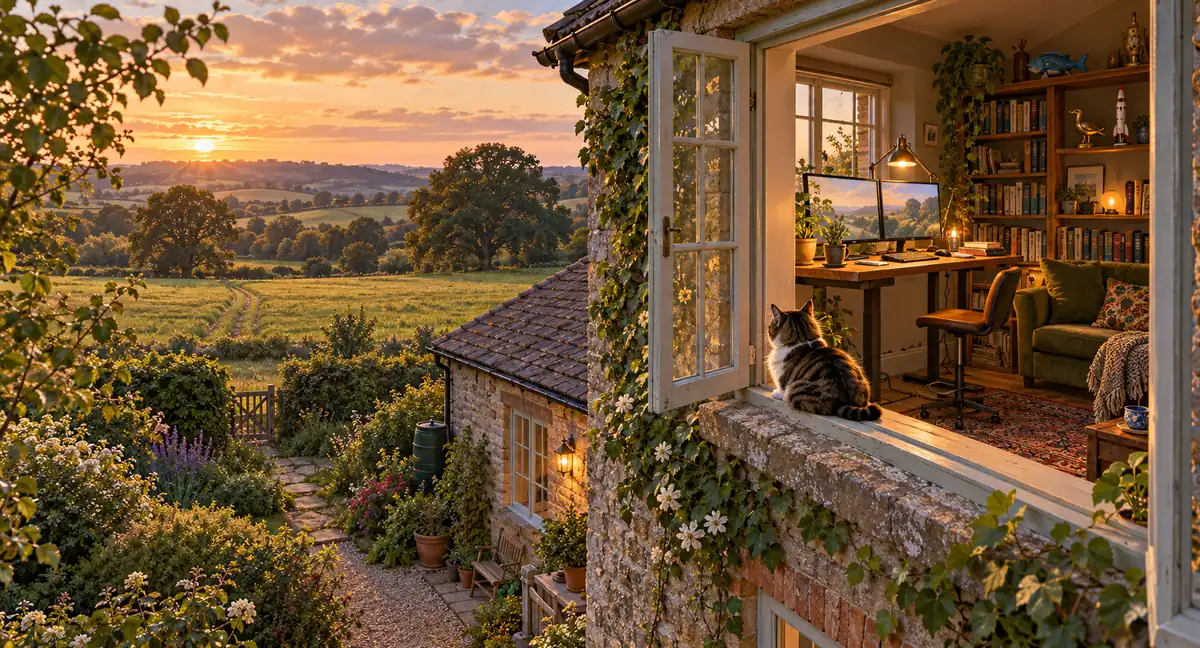
Blinks comes through the cat flap at eight seventeen carrying absolutely nothing, which Maddie considers an encouraging start to the day.
The cat pauses on the kitchen mat. There is a narrow line of mud along one foreleg and a small piece of something green caught in the fur above an ear. Blinks looks at Maddie, looks at the food bowl, then walks past both of them towards the water dish.
“Good morning to you too.”
Blinks drinks for quite a long time. Maddie waits until the cat has finished before bending to remove the green thing. It turns out to be a leaf. Blinks accepts this service without comment and goes back through the cat flap.
Maddie has only been awake for twenty minutes. Already somebody else has accomplished a complete round trip.
She fills the kettle, opens the kitchen window and puts two pieces of bread into the toaster. The field behind the house is pale where the sun catches the grass, darker along the hedge. Beyond it stand several large trees whose branches she knows almost as well as the shelves in her office. One has a forked top where the rooks congregate. Another leans at an angle that looks alarming in winter but has apparently suited it for decades.
Nearly four weeks ago, she was eating breakfast beside the Libyan Sea with Lou. They had nine nights in Crete, which had seemed an extravagant stretch of time until it was over. There had been Beth's terrace, olive trees, a fishing boat, the sort of night sky that made Maddie feel she had been looking at the wrong one for years.
She remembers all of it clearly. The feeling of having absolutely nothing she ought to be doing is harder to bring back.
The toaster clicks. Maddie puts her mug beside the kettle, which she has not switched on.
“Oh.”
She presses the switch.
There are things she likes about working from home. The view, for one. The ability to make toast whenever she wants it. The absence of the journey to an office where everyone would then put on headphones and speak to one another through computers anyway.
There are disadvantages too. Most of them involve discovering, at half past four, that the washing has been in the machine since eleven and she has spent six hours within twenty paces of it.
Today she intends to remember the washing.
She starts a load of washing, writes hang washing on the back of an envelope beside the fruit bowl, eats her toast and carries her tea upstairs.
Her office is the room at the back of the house. It is a sensible size, which is to say large enough for a standing desk, a chair, a comfortable sofa and all the things Maddie has persuaded herself are necessary to have close at hand. The shelves contain programming books, novels, boxes of old video games, some newer ones and a collection of ornaments acquired in shops, on trips and from people who know she likes unusual little things. A glazed ceramic fish sits beside a model rocket.
The sofa is moss green and has a blanket over one arm. It is where Maddie reads when the light is good, thinks when a problem has become stubborn, and occasionally plays a game for twenty minutes that she has decided not to count.
Her desk faces the window. When she raises it to standing height, the top of her monitor almost meets the lower line of the distant trees. Sometimes, on bright mornings, she lowers the blind because the sun is inconveniently beautiful.
She sets down her mug and wakes the computers.
Two screens brighten. A third, smaller one, set sideways, displays a list of messages and tasks. Beneath it is a notebook with a bent cover, a pencil, and several notes on scraps of paper. One says ASK JESS ABOUT TITLES. Another says BETH — OLIVES? in handwriting large enough to suggest a thought she was unwilling to lose. She doesn't remember writing the second note, though she does remember Beth telling her that some olive harvests are early and some are late and the trees won't be hurried merely because somebody has booked a weekend.
For more than seven years Maddie has worked as a software engineer at a media production house. The work ranges from short adverts to film, television and videos made for the internet, and the systems involved don't always agree with one another. Some are new, some considerably older, and an occasional ancient tool still does one particular job so well that nobody wants to retire it.
Maddie likes the variety. She writes and maintains the software that keeps these things talking, making it a little easier for the editors, sound team and everyone preparing work for delivery to get on with their jobs.
Mostly, when things go right, nobody notices.
She takes a sip of tea and reads her messages.
There is a note from Jess, one of the editors, about a new set of videos coming from a shoot next week. There is a message from accounts asking whether Maddie knows what a particular old software licence is for. There is a reminder to update a small internal tool. And there is a notification from a package she uses in a project, cheerfully announcing that a new version is available.
Maddie looks at the notification for a moment.
“That's nice,” she says, and does not click on it.
A few years ago she might have clicked. These days she likes to know whether a new version is likely to make her Tuesday better before inviting it into the house.
At ten fifteen she has a call with Jess and Farah from production. Before then she wants to answer three messages and see whether yesterday's code builds properly.
She writes these things in her notebook. Then she circles the call time because time can be remarkably quiet when it's going past.
Outside, something large and black lands in the forked tree. A rook. Another arrives a moment later. They arrange themselves some distance apart, as though there has been a disagreement.
Maddie watches long enough to find out that nothing further happens.
When she looks back, her tea is already getting cold.
She answers the first two messages, finds the old licence in a folder whose name was sensible at the time, and sends a short explanation to accounts. The third message requires her to look at a list of filenames. She opens it, finds the relevant entry, and notices that someone has named one file FINAL_FINAL_USE_THIS_ONE.
This is not an unusual filename in media production. It is not even in the top ten.
She writes Jess a quick note to check which version really is final and turns to the code.
The build starts. Text runs down a small window in neat rows. Maddie watches it until it stops with a red message.
She blinks at the screen.
The code had built yesterday.
She starts it again, not because she expects a different result but because experience has taught her the occasional alarming truth that sometimes there is one.
There isn't.
“All right,” she says.
She opens the error log. At first sight it seems to be complaining about something it ought to have known how to do for years. The message is long and specific, but somehow not informative. She makes a note of it and starts checking the changes she made yesterday.
At ten twelve the meeting reminder appears.
Maddie checks the time on her screen, closes the log and finds her headset. The headset isn't where she left it. It is on the sofa, under the corner of the blanket, where she remembers putting it down after a call the previous afternoon.
“Of course.”
She joins the call with thirty seconds to spare.
Jess is already there, drinking from a mug almost as big as her face. Farah arrives a moment later with a notebook and an apologetic expression.
“Morning,” Farah says. “I'm just waiting for the studio to send the latest schedule.”
“Morning,” says Maddie. “I can send them an older schedule, if that helps. I've got several.”
“Please don't.”
Jess laughs into her coffee.
The call is about a forthcoming shoot for a group of short adverts. There will be still photographs as well as moving footage. A few clips are intended for the client's website, others for social media, and there's a longer version that may need to go to television later. It is all quite ordinary, except that ordinary jobs can become complicated when everyone has a slightly different picture of what is being made.
Maddie listens while Farah talks through the proposed timetable. She asks whether the team will be providing the original files as well as the edited selections, which versions need captions, and who will be approving the final titles. Jess wants to make sure the editors won't have to pull names and dates out of a collection of emails.
“Can we have all that in one place?” Jess asks.
“I'll put it in the delivery notes,” Farah says.
Maddie has heard this promise before, but Farah is one of the people who generally does it.
“Could you include the actual destination as well?” Maddie asks. “Not just ‘online’. It makes a difference what the receiving system expects.”
Farah writes something down.
“That's exactly why I wanted you here.”
They spend another fifteen minutes sorting out what will arrive, who will see it and when the different versions might be needed. Nobody raises their voice. Nobody declares an emergency. Jess tells them that the new editor has finally settled in and has brought in a small cactus for the desk, which is already attracting opinions.
“Does it have a name?” Maddie asks.
“Not yet,” Jess says.
“Give it a week,” says Farah. “Someone will put it on the equipment list.”
When the call ends, Maddie adds three short notes to the project page and sends Jess a message confirming what they've agreed. The information will save somebody a conversation later, perhaps several. She knows from experience that a missing answer can spend an entire afternoon travelling between people who are all busy doing something else.
She stretches, pushes her desk higher and stands for a while reading through the code that failed to build.
The rook has gone. There are three smaller birds in the tree now, hopping between branches too quickly for Maddie to count them reliably. On the shelf beside her, a small brass bird stands with one foot slightly longer than the other. Its shadow falls across the spine of a book.
A soft thump comes from the landing.
Blinks appears in the office doorway.
The cat surveys the room, crosses to the sofa and jumps up into the middle of the blanket. After three turns, Blinks lies down facing the window. There is no interest in the computer screens, the waiting messages or Maddie, who has briefly stopped typing to watch.
“Come to check my work?”
Blinks closes both eyes.
Maddie returns to the screen.
For a little while she makes useful progress. The error seems to involve something the build process is looking for in the wrong place. She checks one setting, then another. A small change makes the original complaint disappear and produces a different complaint two lines farther down.
This is both encouraging and irritating.
She writes the new message beside the old one in her notebook. She has learned not to trust herself to remember the precise wording of an error once it has been replaced by a more interesting one.
By half past twelve she is hungry enough to notice that she is hungry, although she first notices it as a sudden conviction that she would work much better if she rearranged the books on the shelf nearest the door.
She is holding a paperback in one hand when her stomach growls.
“Fair point.”
Downstairs, the washing machine is silent.
Maddie opens it. Inside is a load of clothes still slightly warm from having finished earlier. She takes them out and hangs them on the airer near the back door. There are socks, two tops, a pair of jeans and a tea towel she doesn't remember putting in.
She makes lunch from bread, cheese, tomatoes and a little of Beth's olive oil. The bottle is almost empty. Maddie turns it slowly to coax out the last of what will come, then sets it aside to wash rather than throw away. She likes the shape of it.
As Maddie sets her lunch on a plate, she hears the soft thud of paws on the stairs. Blinks appears in the kitchen doorway, apparently finished with the sofa.
“Lunch?” she asks.
Blinks walks past her towards the water dish.
Maddie eats at the kitchen table, looking out at the garden. The sky has clouded over. A farm vehicle passes somewhere beyond the hedge, its engine reaching her in a low uneven hum before fading into the distance. There are several leaves caught against the bottom step, the first that have begun to come down in any number.
She could take her sandwich back upstairs. She doesn't.
Instead she finishes it, rinses the plate and steps outside.
The grass is slightly damp. There is a smell of earth and cut stems. At the far end of the garden a narrow opening in the hedge leads to a short path that runs along the edge of the field. Maddie walks as far as the gate and rests her arms on the top rail.
The view is much the same as the one from her office, but lower down. From here she can see the places where the ground rises and dips, the old fence posts leaning into the hedge, and a strip of pale earth at the edge of the field where a vehicle has passed recently. It is odd how a change of a few metres can make things look entirely different.
She has been thinking about the build error without meaning to. She tries not to think about it now. A breeze lifts the hair from her neck. Somewhere behind her, a wood pigeon makes the same three sounds twice.
There is a movement in the hedge. Blinks slips through a gap several yards away, pauses to inspect something in the grass and disappears along the boundary without so much as a glance in Maddie's direction.
The cat has places to be.
Maddie stays at the gate a little longer.
She thinks of the beach in Crete, the water sliding over her feet and Lou sitting beneath the vine with her book. She remembers Beth on the terrace, talking to someone about a water fitting while a glass of wine waited beside her plate. There had been work going on there too, of course. Olive trees didn't stop needing attention because visitors had arrived.
A cloud passes over the field and the colour of the grass changes.
When Maddie goes back inside, twenty minutes have passed. She washes her hands, makes fresh tea and takes it upstairs.
The office is cooler now. She lowers the blind a little and settles into her chair. Before opening the build log she reads the two messages that have arrived while she was away. One is a reply from Jess, thanking her for the notes. The other is from a colleague in sound, asking whether a tiny conversion tool Maddie wrote months ago is still available.
She sends the link.
Brilliant, comes the reply. That saves me doing all of these by hand.
Maddie smiles, sets her mug down and turns back to the code.
The answer isn't waiting for her. It rarely is. But the message she was looking at before lunch seems less mysterious now, and she notices a setting she had passed over twice that morning. It's pointing to an older part of the project, one which has been gradually replaced. Two pieces of the system are looking for slightly different things.
She checks the new setting, makes one change and starts the build again.
While it runs, she does not watch the progress window. She opens the notes for next week's shoot and reads through the questions they settled during the call. There is one answer missing, so she adds a reminder to ask Farah tomorrow.
A small sound comes from the other monitor.
The build has finished.
Successfully.
Maddie looks at it, then at the notes in her notebook. She opens the result, checks the part she was working on and runs a short test. It behaves exactly as it ought to.
“Lovely,” she says.
She saves the change with a short explanation so that whoever looks at it next—including Maddie, quite possibly—will know why it was made.
The afternoon continues.
There are messages about completed videos that need the right labels and destinations. She checks that a small change to a delivery tool hasn't disturbed the older projects which still use it. Jess sends a picture of the cactus, now with a handwritten label reading STUDIO ASSET — DO NOT MOVE.
Maddie studies it for a moment before replying.
Does it get an asset number?
Jess sends back a photograph of an actual numbered sticker on the pot.
Maddie laughs, softly enough not to disturb anybody. The room is empty except for her and a spider in the upper corner of the window, which has been there long enough to be regarded as a permanent fixture.
At four she stands at the desk again. The clock on the shelf has needed a new battery for months, so she checks the time on her screen. She prefers standing for some jobs and sitting for others, although she isn't entirely consistent about which are which. She works through a few straightforward changes and finishes the notes from the morning call. She doesn't get through everything she had written down. The third item has grown into two more, and something she expected to take an hour took twenty minutes.
It balances out often enough.
By half past five the light has gone soft and gold across the field. Maddie sends a final message, checks tomorrow's first appointment and closes the work applications. There is another task she could start, one that looks interesting and may well keep her upstairs until late if she allows it.
She reads the first line of the description.
Then she puts it on tomorrow's list.
On other evenings she might stay upstairs with an interesting problem until midnight, pleased with the work and surprised by the hour. This evening the field looks particularly lovely, and she wants to see a little of it before the light goes.
She leaves the office door open and heads downstairs.
The house is quiet. In the kitchen she washes the little olive-oil bottle and puts it on the draining board. She takes the dry washing from the airer, folds it and leaves a stubborn pair of jeans to finish drying. Outside, the last sun is catching the top of the hedge.
Maddie goes into the garden with a cup of tea. She sits on the back step and watches the light move across the trees.
There is a brief rustle in the hedge, followed by the small, unmistakable knock of the cat flap.
Blinks has come home.
A moment later the cat appears in the open kitchen doorway, pauses with one paw raised and looks towards Maddie on the step. Maddie moves her feet to make room. Blinks steps outside again, passes close enough for a quick brush against her ankle, then sits at the edge of the paving with an excellent view of the garden.
They stay there together for a while.
When the air cools, Maddie gets up to make supper. Blinks goes inside ahead of her and settles near the kitchen door, where any movement towards the food cupboard can be monitored.
Maddie puts a pan on the hob. A message arrives from Lou.
How's the week going?
Maddie thinks about the call, the stubborn build, Jess's cactus, the warm field and the way Blinks has spent most of the day without once explaining any of it.
Quite well, she replies. The computer and I have come to an understanding.
That's good. Did you eat lunch?
Maddie smiles.
Yes. On a plate and everything.
Impressive.
Maddie puts her phone down. The water begins to simmer. Outside the kitchen window the trees have become dark shapes against the last pale strip of sky.
Blinks stretches, turns twice on the mat and lies down.
Upstairs, the office is waiting for morning.
Every ending is somewhere new.
Find your next story →