A Little Further South
Nine nights on Crete's south coast give Maddie and Lou time for olive groves, village friendships and long suppers with Aunt Beth, who takes feeding people very seriously.
The trouble with airports, Maddie thinks, is that everyone knows where they're going except the people who have been put in charge of telling everyone where to go.
There are arrows. There are screens. There are people holding signs with other people's names on them. An enormous advertisement promises that happiness can be purchased in a bottle shaped like a shoe. Maddie has been staring at it for nearly a minute, trying to decide whether the shoe is part of the perfume or whether the perfume is part of the shoe.
“Mads.”
“Mm?”
“Car.”
Lou is standing beside a small white hire car with the driver's door open. She has the keys, the booking confirmation, and the expression she gets when a plan has advanced from the theoretical into the manageable.
“You said it was blue.”
“I said the picture was blue. The booking said or similar.”
“That's a very broad category.”
“Get in before the category changes.”
Maddie gets in. Her bag goes on the back seat, where Lou has already placed a paper map, two bottles of water, a little bag of apricots and a packet of tissues. The tissues have been taken out of their plastic wrapper and put into a pouch. Maddie is impressed by the amount of preparation that has occurred while she was considering the shoe.
“How far?” she asks.
“About seventy-three kilometres. A little longer on the road than it sounds. We go south, over the hills, then down to the sea.”
“Right.”
“Do you want to navigate?”
“Do you want to arrive?”
“No, you're right.”
Lou sets off with the calm concentration of someone who has driven this route before and knows where the surprises live. She visits her aunt Beth at least once a year, although usually only for a few days. Sometimes she arrives alone, sometimes with Maddie. The last time they came together they stayed so briefly that Maddie remembers the airport sandwich almost as clearly as the sea.
This time they have nine nights, arriving on a Sunday with the whole of the coming week ahead of them.
Nine nights is a magnificent amount of time. Long enough to finish a book, start another, and discover that the first one has been accidentally left under a pillow. Long enough, possibly, to become a different sort of person who remembers to put on sun cream before she's burnt.
Lou has packed sun cream. She has packed enough for both of them.
Leaving Heraklion takes longer than either of them expects. At the first set of lights a motorbike slips past carrying a man, a parcel and what looks like a potted plant. Maddie turns round to check whether the plant has survived the manoeuvre.
“Is it always like this?”
“Near the airport? More or less.” Lou edges the white car into the correct lane. “Wait until we get into the hills.”
“Will there be more plants on motorbikes?”
“Fewer lanes, anyway.”
Maddie has left the route entirely to Lou. Lou has brought a paper map even though the hire car has navigation, because the last time a satnav offered an alternative route it turned out to involve a track, a gate and three unusually confident chickens.
Past the edge of the city, the workshops thin out. There are roadside stalls with crates of fruit, low houses behind walls and occasional shrines set into small glass-fronted niches. The road begins to rise. Olive groves spread across the slopes in uneven ranks, their leaves silver when the wind turns them. Far above, the mountains hold patches of shadow that the afternoon sun cannot quite reach.
Maddie watches a little white chapel pass between two terraces of trees. She almost asks whether it is still used, but Lou is concentrating on a bend. Instead she lowers her window and lets in the dry, warm air. Somewhere along the road somebody is burning cuttings; for a moment it smells of smoke and wild herbs.
“Beth always takes this road?” she asks.
“She knows two others. One's prettier but slower, and one she insists is quicker because she once drove it in forty minutes. Nobody has ever seen her do that again.”
“How long have you been coming here?”
“Since she moved over. At least once a year, usually for a long weekend. When I can manage it.”
“Do you actually rest?”
“I sit in her kitchen and tell her she's doing the olive accounts wrong.”
“Ah. A family holiday.”
Lou smiles. “She tells me I'm wrong about my spreadsheets. Then she feeds me until I stop arguing.”
After another stretch of climbing, Lou slows beside a roadside café with a shaded terrace and three cars parked beneath a tree.
“This place,” she says. “I usually stop here.”
“Do they know you?”
“No. I know where the loo is, though, and the coffee's good.”
That seems to Maddie an excellent basis for loyalty.
They sit beneath the shade with cold water and small coffees. A man brings out a plate of apricot pastries from the counter, and Lou orders one to share without consulting any part of her itinerary. A delivery van pauses in the road while its driver exchanges a few words with the café owner. Nobody seems bothered by the delay. Across the valley a strip of road bends between terraces, vanishes behind a hill and reappears much higher up.
“Is that ours?” Maddie asks.
“Part of it.”
“It looks as if somebody dropped it and couldn't be bothered to straighten it.”
Lou breaks the pastry in half. The filling is warm and tastes of fruit rather than sugar. Maddie eats hers slowly while the breeze stirs the edge of the paper napkin beneath her cup.
“You're quieter than you were at the airport,” she says.
“So are you.”
“Yes, but that's less reliable.”
Lou looks over the valley. “I always feel better once we've passed the city.”
They finish their coffees. Maddie visits the loo, which is precisely where Lou said it would be, and buys a bottle of cold water for the road. The woman at the till adds two small wrapped biscuits to the bag. Maddie doesn't discover them until they're halfway up the next ridge.
For the following hour the road takes its time. It curls through a village of close-set houses and balconies, out again between olive trees, then climbs past bare rock where the horizon seems to have been folded. They pass a small truck stacked with crates, a flock of sheep being moved along a verge, and a turning Lou recognises before any sign appears.
At another bend a new colour opens between the hills: a bright line of blue so far below them that Maddie takes a moment to understand it is the sea.
“There,” Lou says.
Maddie presses closer to the window. “Oh.”
“Libyan Sea. We're heading down towards it now.”
“Is Libya over there?”
“Eventually.”
“Seems a long way to go for a swim.”
The road drops in long loops towards the coast. The air warms again. Terraces of olive trees give way to patches of scrub, then to glimpses of white houses scattered above bays. They stop at a safe pull-in where the view runs across pale folds of land towards the water. Thyme grows through stones at the edge of the track. The wind pushes at Maddie's hair.
They eat the biscuits from the café, leaning against the car. Lou points to a headland, then another. Beyond the second, she says, is the little village where Beth lives.
Maddie looks for it and finds only sea, rock and a great deal of sky.
“It's well hidden,” she says.
“That's why Beth likes it.”
For a little while neither of them speaks. The cicadas are doing enough talking for everybody.
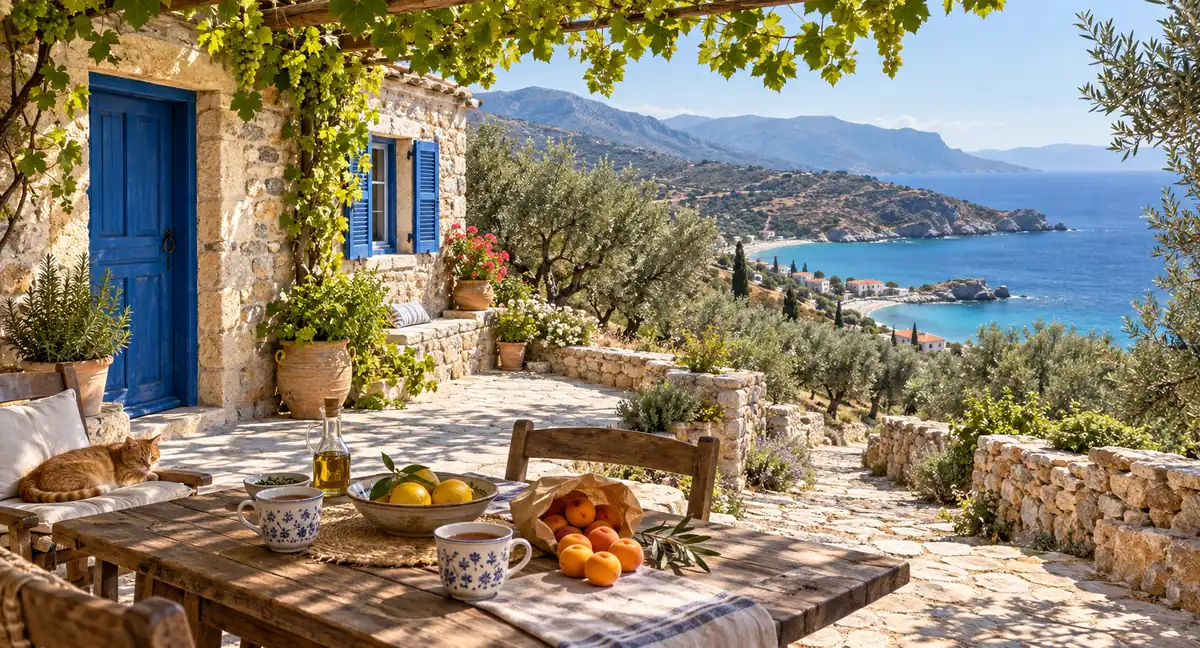
Beth's house stands above a small seaside village at the end of a track lined with olive trees. A stone wall runs beside it, old in some places and very recently repaired in others. There is a broad modern farmhouse with shutters, a shaded terrace and an unreasonably large table. Just beyond it, across a courtyard of pale stone, is a smaller house with thick walls, a blue door and a climbing vine that appears to have been given the run of the place.
A woman comes out of the farmhouse carrying a garden hose and a mobile phone.
She is barefoot, in shorts and a faded linen shirt. Her dark hair is tied behind her head with a piece of string, which strikes Maddie as a sensible use of string. She gives the hose a sharp twist. Somewhere behind her, water stops running.
“Lou!”
Lou is out of the car before Maddie has worked out which of her shoes has trapped the seat belt.
Beth embraces her niece, then holds her at arm's length.
“You look well.”
“You said that last year.”
“And I was right last year.”
She turns to Maddie.
“Hello, you. Still putting up with her?”
“Mostly.”
“Excellent. Come and see what I've broken.”
Beth, in her early fifties and known as Elisabeth only to people filling in forms, leaves her mobile phone face down on a wall and leads them across the courtyard.
The land is plainly working land. There are stacked harvest crates, a water tank, a shed full of tools and olive trees stretching down the slope. Beside the broad modern farmhouse stands the older family house, which Beth has restored for visitors. The stonework has been repaired where it needed repairing; the doors and shutters have been painted blue.
Inside Beth's farmhouse, a desk carries two screens. One shows a market chart; the other shows a camera view of a gate.
“Is that security?” Maddie asks.
“Goats.”
“What are they stealing?”
“My patience.”
Beth glances at the chart, presses a key to silence a notification and walks away without another look. Lou notices Maddie watching.
“She used to trade in London,” Lou says. “Properly. She still does a little.”
“For fun,” Beth says. “Not nearly as often as I used to.”
Beth shows them the small house. It has a cool main room, an open kitchen, a table beneath a window and two bedrooms with wooden shutters. The stone floor is smooth in the places where generations of feet have crossed it. Shelves hold a mixture of new books, old crockery and things nobody has had the courage to throw away. In the larger bedroom, a framed photograph shows a solemn man standing beside a mule.
“Your ancestor?” asks Maddie.
“Not exactly. That was the mule. The man worked for my great-grandfather. Apparently the mule had more sense.”
Maddie studies the photograph. The mule does look reliable.
Outside the back door, a narrow footpath winds between olive trees, down past a wall of thyme and towards the village roofs.
“Beach that way,” says Beth. “Five or ten minutes depending on whether you stop to admire things. Forty minutes if you're Maddie.”
“How do you know?”
“Lou told me.”
Lou looks unrepentant.
“Come up for supper when you've unpacked,” Beth says. “Nothing fancy. And before either of you starts making lists, I've already got food.”
“I'm not making a list,” Lou says.
“You've got the face on.”
“What face?”
“The face that makes spreadsheets nervous.”
Lou takes her suitcase into the cottage. Maddie follows, feeling already that nine nights might be insufficient.
Unpacking takes longer than Maddie intends because there are three different places she might keep her books, and because one shutter opens onto a view of olive branches moving against the sea. Lou puts their toiletries in the bathroom, checks the water is hot and opens both bedroom windows. Maddie finds a ceramic bowl on the kitchen table containing three lemons and a note in Beth's handwriting: For drinks. Or whatever lemons are for.
When they walk up to the farmhouse, the heat has eased. Beth has set plates beneath the terrace awning. There is a bowl of tomatoes cut thickly, bread, olives, roast peppers, a dish of beans, cheese and a tray of potatoes with herbs. Something is still warming in the kitchen. The table could comfortably feed six.
“Are we expecting people?” Lou asks.
“No,” says Beth. “But I was hungry when I started cooking.”
They sit as the first evening shadows move between the olive trees. The tomatoes are sweet and cold; the potatoes have crisp edges. Beth pours water and opens a chilled bottle of Vidiano from a winery inland. She fills three small glasses, then tells Maddie which olives came from her own trees and which have been bought from a neighbour who will be offended if anyone pretends not to notice the difference.
“Is that local?” Maddie asks, trying the wine.
“Cretan. Niko keeps a few bottles for me. We'll show you the shop tomorrow.”
“That's lovely.”
“There's more, though I'm not taking responsibility if you decide you like all of it.”
Lou raises her glass. “To nine nights.”
“About time,” Beth says, and they drink.
“Do you grow all of these yourself?” Maddie asks, indicating the trees below the wall.
“I look after them. The growing is their department.”
Lou reaches for the beans. “She came here because of the old family house.”
“It was already family land,” Beth says. “My great-great-great-grandfather had it. The paperwork's a nightmare; the house was worse. By the time I came to sort it out, half the roof was trying to become part of the garden.”
“You came to sort it out and stayed?”
“At first I thought six months. Then I found that you can't tell olive trees you'll finish with them by September.”
Maddie considers the grove, its rows disappearing down the slope. “Were you always a farmer?”
Beth laughs. “No. I was in trading in London when the internet was going to make everybody rich. Some of us did rather well before it reminded everybody about arithmetic. I carried on for years after that.”
“She used to work ridiculous hours,” Lou says.
“And wore terrible shoes. But I enjoyed it, mostly.” Beth reaches for the bread. “Now I enjoy this. I still trade when I feel like it. There are fewer meetings.”
“You have meetings with goats,” Maddie says.
“They don't send minutes. Much better arrangement.”
A little later a neighbouring farmer calls from beyond the courtyard wall. Beth gets up to discuss a water fitting with him, their voices carrying back and forth. Maddie watches Lou take another helping of tomatoes and settle back in her chair. She hasn't checked a time once since they arrived.
Beth returns carrying two figs the neighbour has given her. She cuts them into quarters for dessert, though nobody has room.
“Remember the harvest when you brought your own clipboard?” Beth asks Lou.
“You told me the crates were getting mixed up.”
“They were. For about ten minutes after you arrived, and then they weren't.”
“You wouldn't let me label the shed.”
“I still wouldn't.” Beth passes her a piece of fig. “But I'd let you organise the crates again tomorrow.”
Lou looks faintly pleased. Maddie suspects Beth has noticed.
“You'll find the path to the beach behind the old house,” Beth tells Maddie. “Niko's shop is by the square. And the café does breakfast if you fancy letting someone else make it. No need to do anything tomorrow unless you feel like it.”
“What's the catch?” asks Maddie.
“Sometimes the café runs out of the good pastries.”
That seems a manageable risk.
Later, walking back across the courtyard, Maddie can see the lights of the village down below and hear a distant sound of dishes being cleared. In the cottage, Lou opens the shutters to let the cooler air through. They sit for a few minutes at the little kitchen table, too full to do much else.
“Your aunt's lovely,” Maddie says.
“She is.”
“And terrifyingly good at feeding people.”
“You've only had supper.”
Maddie considers this, then goes to put the lemons in the fridge.
The following morning they follow the winding path down through the olive trees. It is narrow in places, shaded by low branches, and ends beside a wall where somebody has planted rosemary in old clay pots. By the time they reach the lane above the beach, Maddie has begun to recognise the shape of the village. It sits between a curve of sandy beach and low cliffs whose rock changes colour as the sun moves. A few fishing boats are pulled up close to the harbour. Behind them run whitewashed houses, terraces and one narrow lane that becomes the road up into the hills.
A boat engine coughs into life at the harbour, followed by a call from one fisherman to another. A small farm truck comes up the lane with empty crates rattling in the back, and Maddie and Lou step against a wall to let it squeeze past. Outside the shop a delivery van has its back doors open while two men unload boxes of bottled water. There is plenty of quiet here, Maddie thinks, but nobody has mistaken it for a day off.
There is a shop which has everything a reasonable person could need and several things a reasonable person had no idea existed.
Maddie goes in for bread and comes out with bread, peaches, two kinds of honey, a jar of little green peppers and a packet of biscuits depicting a ship whose rigging seems to have gone very wrong.
The shopkeeper, Niko, recommends a local cheese and then recommends a different one because the first would be too salty with the tomatoes they're buying. He has a grey moustache and the confident patience of someone who has explained the same cheese to visitors for years. Behind him are jars of thyme honey, bottles of olive oil and a little row of Cretan wines. Maddie recognises the label on the Vidiano Beth poured the night before.
“Have you got a favourite?” she asks, looking at the wines.
“For which evening?” Niko replies.
Maddie thinks this is a serious question and hasn't got a serious answer. Niko shows her a bottle of Liatiko from an inland producer and tells her to come back when she knows what's for supper.
“Your aunt?” he asks Lou.
“Beth.”
“Ah.” He nods gravely. “Then take the strong one.”
“Why?” Maddie asks outside.
“Beth likes it.”
“Does Niko know everybody?”
“Pretty much.”
“Does he know which biscuits are wrong?”
Lou examines the packet. “Those aren't wrong. That's a ferry.”
“Then it's having a difficult crossing.”
At the end of the lane the café and bar has tables under a patched awning and chairs facing the water. The restaurant next door shares a kitchen with it, or perhaps the café shares the restaurant's kitchen; Maddie can't establish where one establishment ends and the other begins. Either way, they serve excellent coffee in the morning and good food at night.
On their second evening, after a day of swimming and wandering between the shop and the shore, they eat tomatoes with olive oil, bread still warm from the oven, grilled fish for Lou and baked vegetables for Maddie. An orange cat sits beneath their table and gazes steadily at Lou's shoes.
“Is it yours?” Maddie asks the waitress.
“No.”
“Whose is it?”
The waitress looks at the cat. “Depends who has fish.”
Maddie decides this is an admirably flexible system of ownership.
The next morning the same cat appears outside Niko's shop, where it is ignored by three customers and politely moved out of the doorway by Niko himself. By lunchtime it has returned to the café. Maddie begins to suspect it owns several businesses and lets the humans believe otherwise.
The waitress at the café, Eleni, remembers that Lou likes her coffee strong and Maddie likes hers with milk. On the third visit she puts down two cups before they order, then smiles at Maddie's surprise.
“Do you remember everyone?” Maddie asks.
“Only the ones who come back,” Eleni says.
By Tuesday they have settled into something that isn't quite a routine. They wake when they wake. They make breakfast in the little kitchen or take coffee by the sea. They read on the terrace in the shade. They go swimming before the beach becomes warm enough to make the sand uncomfortable underfoot, and sometimes again when the sun has slipped behind the hills.
Maddie is finally reading the lighthouse-keeper novel she'd recommended to Lou after seeing a handwritten note in a shop: Cried on the bus. Worth it. Lou had read it first, cried on a bus as predicted, and maintained that Maddie owed her an apology for the lack of warning. Lou herself is now reading a detective novel with an elaborate family tree in the front. She has placed a tiny folded piece of paper in it to keep track of who is related to whom.
“You're not supposed to solve it with a spreadsheet,” Maddie tells her.
“It isn't a spreadsheet.”
“You've drawn connecting lines.”
“That's evidence.”
“That's how spreadsheets start.”
Lou continues reading.
One afternoon Maddie finds her beneath the vine, shoes off, book open but resting on her chest, eyes closed. There is a breeze moving the leaves above her. She looks entirely content.
Maddie leaves her there and goes into the kitchen to cut up a peach.
On the way back she finds Beth sitting on the steps with a screwdriver and an object that might once have been a radio.
“Is it broken?” Maddie asks.
“Not in the way I expected.”
“What's wrong with it?”
“I don't know,” Beth says.
Maddie waits. Beth turns the dial.
“At the moment it only picks up one station. In Italian. At enormous volume.”
A burst of singing comes from the radio. Beth leaves it playing while she studies the back.
“Are you going to fix it?”
“Perhaps. I quite like this song.”
Maddie sits beside her. Neither of them feels any need to hurry the singer towards the end.
Beth knows which days the wind is likely to make the water choppy and which parts of the beach are best left to the fish. She knows where the sand gives way to rock pools, and which path above the cliffs is easy in the morning but hot by lunchtime. She also knows people who have been arguing about olive oil for longer than Maddie has been alive.
Beth mentions the rock pools over supper, after Maddie has spent a full ten minutes wondering where the tiny crabs go when the waves wash over their rocks. The next morning the three of them walk around the headland early, carrying water, hats and an assortment of breakfast leftovers in a tin.
The rock pools lie in shallow shelves beneath honey-coloured stone. They are busy places if you look carefully. Tiny fish dart between patches of weed. A small crab holds its claws open from a crack as though demanding payment for admission.
Maddie kneels and studies it.
“Good morning.”
The crab doesn't respond.
Beth looks over her shoulder. “That one's the mayor.”
“How can you tell?”
“He's doing absolutely nothing useful but appears very certain he's in charge.”
Lou laughs and nearly drops the tin.
They sit in the shade of a rock overhang and eat bread, tomatoes and slices of the very strong cheese Niko recommended. Beth explains how harvest time changes the rhythm of the smallholding, how the olives are collected and taken to the mill, and how she learnt not to assume that owning trees automatically meant knowing anything about them.
“First year I spent a fortune on equipment I didn't need,” she says. “And bought a machine that had a very impressive brochure and couldn't cope with half the ground here.”
“Wasn't that frustrating?” Lou asks.
“Very. I swore at it in three languages. Then a neighbour showed me how to do the job properly with an old tool and some patience.”
Maddie considers the little crab, now carefully moving a pebble twice its own size.
“Did you keep the machine?”
“No. Sold it. Bought this place a better water tank.”
“Was that a better investment?”
“Best one I made that year.”
Beth brushes crumbs from her shorts and announces that if they don't swim now the sun will turn the return path into an oven.
They swim in water so clear that Maddie can see the shadow of her own feet on the sand below her. She floats on her back and listens to the muffled sounds of the others nearby. For a few moments the sky is all there is.
When she stands, Beth is trying to persuade Lou to put her face in the water and look at a fish.
“I've seen fish before,” Lou says.
“Not that fish.”
“How do you know?”
“I've spoken to him.”
Lou gives Maddie a look. Maddie smiles but offers no assistance. They linger in the shallows a little longer, watching sunlight shift over the sand.
On Thursday they hire bicycles from a man called Petros, who also maintains fishing nets and appears to be responsible for finding the correct key whenever anything in the harbour needs unlocking.
Lou asks him about the road along the coast. Beth has already checked the weather and says it will be a good morning to go.
Petros provides two bicycles, helmets and a warning about a hill. He says the hill is not difficult, although he says this while looking at Lou rather than Maddie.
The hill turns out to be very difficult.
“Why,” Maddie asks from halfway up, “does anybody build a road like this?”
“Because,” Lou says, a few metres ahead, “they didn't have a choice.”
“They could have built it down.”
“That's what we're doing later.”
At the top they stop to drink water. Below them is the bay, the little village reduced to pale squares among trees, and beyond it the immense blue sea. The reward for the hill is worth the complaint.
They cycle on past low fields and a chapel no larger than a garden shed. A goat stands on a stone wall and watches them pass.
Maddie is wary of goats. They have the eyes of creatures who know something you don't and intend to keep it that way.
They reach another village in time for a late lunch. A small square opens beside a chapel, shaded by a plane tree. The tables outside the café are occupied by people doing almost nothing at all, which Maddie finds reassuring after the hill.
They lean the bicycles against a low wall. The café owner points them to an empty table and brings water before they ask. Lou orders a plate of vegetables, a salad and bread. While they eat, Maddie watches a man repairing a wicker chair in a doorway across the square. Every few minutes a neighbour stops to talk to him; each time he puts down his work and resumes it without showing the slightest impatience.
“Will he ever finish?” she asks.
“Probably,” Lou says.
“What if everybody in the village comes past?”
“Then he might not.”
The man catches Maddie looking and lifts the chair to show her the newly woven seat. She gives him a thumbs-up, which he returns before getting back to work. Later, when Lou pays for lunch, Maddie buys three small pastries to take home to Beth. One doesn't survive the journey to the bicycles.
They return at an easier pace. On the descent Maddie discovers that a road can be simultaneously extremely enjoyable and something on which she would prefer to apply the brakes.
Before heading back up to the cottage, they return the bicycles to Petros at the harbour. Beside his shed, the hire-boat business also has two little sailing dinghies. Maddie studies them each time they pass. The sails, when raised, make the boats look like folded letters opened against the sky.
Maddie asks enough questions about the sails that Lou suggests they come back when the wind is gentle. She is still talking about ropes when they reach the cottage. They wash dust from their legs and spend the afternoon doing nothing more strenuous than turning pages.
That evening they take the two surviving pastries up to Beth. She makes coffee, sets one pastry aside for breakfast and cuts the other into three pieces. Maddie points out that she bought them both for Beth. Beth says she knows and offers her the largest piece.
On Friday morning Lou asks Petros whether they might take one of the dinghies out.
“Have you sailed before?” he asks.
“A bit,” Lou says.
Maddie looks at her.
“You didn't tell me you could sail.”
“You never asked.”
They take a short sail with Petros aboard to show them the local shallows and changes in wind. Before they go he checks the weather again, shows Maddie where to sit during a turn and makes sure they each have a correctly fitted buoyancy aid. Lou handles the tiller under his guidance. Maddie is entrusted with a rope and spends several minutes attempting not to develop a personal relationship with it.
There is a quiet moment beyond the headland when the little boat moves smoothly and the village looks very small. Maddie watches the water slip past.
“This is lovely,” she says.
“It is,” says Lou.
Then the wind shifts and Petros tells Maddie to bring the rope in. She does, slightly too enthusiastically, and receives a gentle lesson in why sailing is not improved by trying to win an argument with the sail.
That evening they take some tomatoes from Niko to Beth. At supper she asks whether they enjoyed themselves.
“I have learnt several things about ropes,” Maddie says.
“Good. We might need those on Saturday,” Beth replies.
“Why?”
“Boat trip.”
“What boat trip?”
Lou looks up from her plate. “Ah.”
Maddie puts down her fork.
There is a certain ah Lou uses when a plan has existed for some time and Maddie is about to learn of it.
The invitation is to a party on a beach beyond the eastern headland. A local farmer named Manolis is hosting it for friends, family and neighbours, and because the place is awkward to reach by land, a large fishing boat will take a group from the village harbour in the early evening.
Manolis and his family hold the gathering most summers, when there is a little space between the busiest work on the land and the next round of jobs. Beth has known Manolis for years. They have a long-running disagreement about whose olive oil is better, a dispute neither intends to settle because both enjoy it too much.
“Does he own the beach?” Maddie asks.
“No,” Beth says. “He farms above it. The party's on the beach, not a claim of sovereignty.”
“How many people?”
“Enough.”
“Is that a number?”
“In Crete it often is.”
Lou, naturally, knows the departure time. She knows which shoes are sensible for getting on and off the boat, and has put towels, their swimming things and a light jumper into a bag. Maddie is pleased she has chosen to travel with someone who appreciates the concept of a jumper even when it is thirty degrees.
On Saturday afternoon Beth arrives carrying a covered dish and wearing a blue dress with large yellow flowers, the sort of dress that seems to have been designed to make any disagreement with its wearer extremely difficult.
“You look lovely,” says Lou.
“Thank you. It has pockets.”
She demonstrates the pockets, which are extensive.
“What have you got in them?” Maddie asks.
“Keys, a torch, two sweets and some twine.”
“Why twine?”
“Because I once didn't have any.”
There is no arguing with this.
They walk down the winding path together. The village is already gathering at the harbour. Children are being counted and counted again. Bags of food pass from hand to hand. Someone carries a folding chair; someone else carries a long instrument case; a woman with a broad straw hat carries an entire tray of pastries without once looking where she is putting her feet.
The boat is a sturdy fishing vessel with a wide working deck. Nets and equipment have been secured out of the way, and its skipper, Yannis, is supervising boarding with a seriousness Maddie finds comforting. People take their places on benches and low seats. The crew point out the lifejackets, and the skipper checks everyone aboard before casting off. Beth and Lou each help with a bag. Maddie is given the sacred responsibility of carrying the covered dish.
“What is it?” she asks.
“Courgettes.”
“Why is it so heavy?”
“You'll find out.”
The engine starts. The harbour wall slips behind them, and the village becomes a line of bright houses beneath darkening hills.
Maddie sits with her back against a rail and watches the light on the water. The boat rocks steadily, not unpleasantly, and the air carries salt, diesel and something delicious escaping from one of the baskets.
Two children are trying to guess how many fish the boat has caught in its lifetime. A man with a moustache maintains that he once caught a fish longer than the bench on which he's sitting. His wife tells him that the fish has grown another twenty centimetres since last summer.
Lou leans close.
“He says that every year.”
“Does he know she's measuring?”
“Absolutely.”
Near the bow Beth is talking with Yannis, gesturing towards the headland. Between questions about the route she asks after someone's mother and whether a neighbour's roof has finally been finished.
The journey takes longer than Maddie expects, and she is pleased about that. First the harbour disappears, then the houses, then even the road above the village is only a pale line. On one bend in the coast, Lou points out the ridge where they stopped on the drive from Heraklion. Maddie cannot possibly identify it among the hills but appreciates being shown.
The boat passes cliffs streaked with ochre and grey, little caves dark beneath their ledges, and a narrow inlet where the water is almost green. A teenager near the stern passes around a bag of figs. The man with the enormous fish tells his story again to someone who has just boarded the argument, and his wife corrects the length without looking up.
For a stretch the boat is quiet. The coastline passes in long folds of rock and scrub, with the occasional little beach shining between them. Maddie watches a gull follow in the boat's wake, apparently convinced that fishing boats owe it something.
She finds Lou's hand beside her on the bench. Neither comments on it.
Then they round the headland.
The beach lies beneath a sloping shelf of land. It is a long crescent of sand and pale stones with shallow water at one end and darker rocks at the other. On the upper beach, lanterns hang from poles and tables have been set beneath canvas shade. Smoke rises from cooking fires, and people wave as the boat approaches.
“That's the party?” Maddie asks.
“Yes,” says Lou.
“It looks like somebody has invited a whole village.”
“Two, possibly.”
Yannis steers towards a small landing place sheltered by rock. Everyone waits while the crew secures the boat, then goes ashore in an orderly, slightly noisy procession. The pastries survive. Beth's dish survives. Maddie feels this may be the greatest achievement of the voyage.
Manolis comes down the beach to meet them. He is broad-shouldered and sun-browned, with a beard trimmed close and a linen shirt already marked with charcoal.
“Beth!”
They embrace. Then he holds her at arm's length and looks at the covered dish.
“Olives?”
“Courgettes.”
“Disappointing.”
“You haven't tasted them.”
“I know your cooking.”
“You know nothing.”
Maddie looks at Lou. Lou is smiling. This, apparently, is how old friends say hello.
Beth explains on the walk up the beach that Manolis started hosting these evenings when his children were small. Now there are grown children helping with the cooking and smaller children trying to steal the first pieces of bread. Some guests have come by boat, some have walked down from farms above the cove, and several are still arriving carrying dishes beneath cloths.
The party is already in motion. There are long platters of tomatoes, bread, cheeses, grilled vegetables and fish; shallow dishes of olives, chickpeas dressed with herbs and little pastries brought by relatives from the next valley. Children run between tables. Someone pours water into glasses as soon as people sit. At the end of one table stand carafes of local wine, white and red, beside bottles labelled with the names of Cretan grape varieties. There is no suggestion that anybody should hurry through their supper. At one end of the beach an older man is tuning a Cretan lyra, drawing a few questioning notes from its strings, while a younger woman beside him tests chords on a laouto.
Maddie has been to parties where everybody spends the first hour deciding whether the party has begun. Here nobody appears to have asked the question.
Beth introduces them to Manolis's wife, Sofia, who takes one look at their empty hands and directs them to the food. She speaks English slowly and clearly, and Maddie attempts a few phrases of Greek that Beth taught her on the walk down. Sofia smiles, helps with the pronunciation, and puts another spoonful of courgettes on Maddie's plate. She tells them her sister brought the wines from a small producer inland: Vidiano for anyone who wants white, Liatiko for anyone who wants red.
The courgettes turn out to be full of rice, herbs and something sharp and lovely that Maddie can't identify.
“They're stuffed,” Lou says.
“So am I going to be.”
They find seats at a long table among people who have met them once and people they haven't met at all. Conversation slips between Greek and English. Nobody minds if Maddie misses a joke, although sometimes Lou translates and the joke becomes less funny halfway through.
Beth brings back three little glasses and asks which wine they'd like. Maddie chooses the red, Lou the white; Beth tries a sip of each before deciding on the red. They raise their glasses to Manolis and Sofia, who are too busy persuading people to eat more to notice. The Liatiko is soft and fragrant, very good with the roasted vegetables. Lou tastes Maddie's, then quietly trades glasses with her for a moment so they can compare.
“Which is better?” Maddie asks.
“Mine,” Lou says, taking back her white.
“An admirably unbiased assessment,” says Beth.
They drink, eat, laugh with their neighbours and go back for more of Beth's courgettes, which Manolis has been describing as disappointing while helping himself to a second portion.
At the edge of the food tables sits a ginger cat with a torn ear. It watches a plate of fish with the fixed concentration of a person trying to remember a six-digit security code.
“Does it belong here?” Maddie asks Sofia.
“It comes when we cook.”
“Does it have a name?”
“Maybe three.”
“Ah,” says Maddie. “A professional.”
The cat eventually receives a suitable scrap from someone who knows what is safe to give it, and retires behind a rock to consider its evening.
Later, when the light has gone honey-coloured and the sea looks almost silver, the music begins properly.
The older musician draws a lively tune from the lyra, and the laouto chases it with a brisk, bright rhythm. A circle of dancers forms on the sand. People join, leave, clap and return. A little boy dances with such determined seriousness that Maddie suspects he has been appointed to the position.
The plates are moved aside. As the musicians begin another tune, Beth stands.
“No,” Lou says immediately.
“Yes,” says Beth.
“I know that face.”
“Good. You'll save us time.”
Beth takes Lou's hand and pulls her gently towards the dancers. Lou resists for approximately three steps, then laughs and follows. Maddie stays seated, delighted to watch. Beth is not the best dancer in the circle. She knows the steps well enough to begin, forgets one, finds it again and laughs with the woman beside her.
Then Lou comes back for Maddie.
“I don't know what I'm doing,” Maddie says.
“Neither did I.”
“Beth does.”
“Beth knows some of what she's doing. Come on.”
Maddie goes.
The sand moves differently under her feet from a wooden floor. Someone shows her the rhythm, someone else makes space, and she follows the circle with more enthusiasm than accuracy. At one point she finds herself facing Beth, whose yellow flowers are flashing in the lantern light.
“You're going the wrong way!” Maddie calls.
“I know!” Beth calls back, and carries on.
They dance until Maddie is out of breath and laughing. At one turn she and Lou find themselves clapping the same slightly wrong rhythm, just as they used to with cutlery, and both start laughing harder. When they finally return to the table, Lou takes a drink of water, sets down her glass and puts her forehead briefly against Maddie's shoulder.
“Your aunt,” Maddie says, “is a menace.”
“She is.”
“An organised menace.”
“Runs in the family.”
A little later Beth joins them, cheeks flushed, hair escaping its string.
“Good party,” she says.
“Do you know what time it is?” Lou asks.
“Yes.”
“What time?”
“Party time.”
Lou closes her eyes, but she is smiling. The musicians begin another tune, and the dancers move back into the circle.
By late evening the younger children are falling asleep on blankets, the music has softened and several people have gone for a paddle at the water's edge. The wine from supper has given way to cold water, slices of melon and unhurried conversation. Yannis has confirmed the time for the return boat. They still have a while.
Beth is deep in conversation with Manolis, apparently discussing rainfall and the price of harvesting. Lou and Maddie take their sandals off, bring Lou's bag and walk along the sand, away from the lanterns.
The sea is dark and very calm near the shore. Farther out it catches scraps of moonlight. Behind them the party continues, the music and voices travelling across the beach without needing to be loud.
“Swim?” Maddie asks.
Lou looks towards the lights, then at the water. They know this part of the beach now; the sheltered shallows are clear of rocks, and a few people are still nearby. They agree to stay close to shore and to each other.
“Only a little one,” Lou says.
“Those are dangerous words in our family.”
“I'm not your family.”
“You've got my other glove in your handbag half the time. That's more or less adoption.”
They change into their swimming things behind a sheltered outcrop, leaving their clothes and the bag safely above the waterline. Then they go into the water together, slowly at first. It is warm near the surface and cooler around their legs. Once they're deep enough they swim a short distance parallel to shore, where the lanterns still show them their way back.
Maddie rolls onto her back and looks up at the stars. Without the village lights there are so many that she feels almost personally underprepared.
“You all right?” Lou asks beside her.
“Fine. Trying to work out where they all were earlier.”
“In the sky, probably.”
“Very funny.”
“I learnt from you.”
They float a little longer. The sounds of the beach are faint now. Maddie can hear Lou breathing and water slipping against her arms. She lets the gentle swell lift and lower her. Beside her, Lou floats with one hand trailing in the water.
Eventually they swim back and walk out onto the sand. The night air feels cooler on their wet shoulders.
Beth is waiting beside Lou's bag near the sheltered outcrop, holding out the two towels.
“You two look pleased with yourselves.”
“We went swimming,” Maddie says.
“I gathered that from the sea.”
“Did you have a swim?” asks Lou.
“Earlier. While you were making friends with the musicians.”
“When?”
“When I felt like it.”
Lou shakes her head affectionately and wraps the towel around her shoulders. Maddie dries her hair, rather less successfully.
They return to the party for a little more food and a final drink of water. Manolis makes a speech of about twelve words, which earns an enthusiastic cheer. Beth claims he has broken his previous record by using two fewer words than last year.
When Yannis calls everyone back, people begin collecting dishes, folding chairs and searching for sandals. Maddie helps carry the empty covered dish, now a much more manageable weight. The ginger cat watches the departures from a stone, as though disappointed by the sudden reduction in catering.
The journey home is quieter. A child sleeps against her father's shoulder. The man with the enormous fish story has stopped talking. The instrument case is tucked safely beneath a bench.
Maddie and Lou sit together near the stern, Beth on Lou's other side. The engine hums steadily as the dark coastline passes, and distant lights come into view around the headland.
Lou rests her head against Maddie.
Beth takes off her sandals, looks at the stars for a moment and says, “I might take Sunday off.”
“From what?” asks Maddie.
Beth considers this.
“Excellent question.”
Nobody feels a need to answer it.
Sunday is quiet, as Beth predicted on the boat, although by midday she has already been down to the lower grove to check a water line. She arrives at the cottage carrying a basket of figs and claiming this does not count as work.
They sleep late, have coffee and bread with honey under the vine, and spend the morning moving between their books and the sea. Maddie has learnt which terrace chair catches the breeze without tipping backwards, and which shutter requires a firm lift before it will close. A gecko watches from the wall above the kitchen door, motionless until the moment she tries to show Lou.
“There's one there,” she says.
“Where?”
“There. No, there was.”
“I believe you.”
“That's not the same as seeing it.”
Lou looks at her over the top of the detective novel. “Some of us have a murderer to identify.”
By afternoon Lou has finished the book and decided the cousin did it, although she isn't sure she's pleased about it. Beth borrows it when she comes over for coffee and studies the little diagram Lou has drawn of the family relationships.
“You've included the dog,” Beth observes.
“He was in the house,” Lou says.
“Fair enough.”
They go for a long swim when the sun has softened. Afterwards they stop at the café, where Eleni brings Maddie the milky coffee she now orders without thinking and leaves a bowl of water outside for the ginger cat. Niko is eating at a nearby table with his wife and two children. He calls over to ask whether they have finished the strong cheese yet.
“Almost,” Maddie says.
“Good. I'll keep some for you next time.”
The words next time catch her by surprise.
On the following day Beth takes them into the grove after breakfast, before it grows too hot. She shows them the younger trees and an older one with a trunk twisted around a hollow. The path between the rows is stony and uneven; she walks it with the ease of someone who knows exactly which rock will shift.
“Do you ever miss London?” Maddie asks.
“Of course. Friends. A particular bakery. Being able to buy things after nine at night without waking anybody up.” Beth checks a branch and brushes a dry leaf away. “I don't miss being expected somewhere every evening. But it's not a competition. London was good to me.”
Lou bends to pick up a fallen olive, rolling it between her fingers. “You'd be bored if you didn't still trade.”
“Probably. For an hour or two.”
“What do you do after the hour?”
“Usually find something here that's broken.”
They return to the farmhouse with dusty shoes and help Beth prepare a final supper. Nothing is complicated: roasted vegetables, bread, salad, fish for Lou, and a large bowl of potatoes Maddie decides she could happily live beside. The three of them set the table outdoors. Lou carries glasses, Maddie slices tomatoes, and Beth moves a chair twice because she wants to see the sea between the olive trees while she eats.
Beth sets two bottles on the table, a local white and the Liatiko Maddie admired at Niko's shop.
“Which one?” she asks.
“Both,” says Lou. “It is our last evening.”
Beth looks delighted. They open the white first, leave the red for the later part of supper, and take their time over both. The food disappears gradually, interrupted by stories Maddie hasn't heard and stories she has heard but doesn't mind hearing again.
After supper, long after the plates have been cleared, they remain on the terrace. A few lights mark the village below. Beth tells them which neighbour has promised to help with the next harvest and which has promised for four years running.
“Will you miss us?” Maddie asks.
“No,” Beth says. “I intend to enjoy the peace.”
Lou looks at her aunt.
“Terribly,” Beth adds, after a moment. “But don't tell anyone. They'll start coming to stay.”
They laugh. Beth gets up to collect the last glasses, and Maddie goes with her. In the kitchen Beth presses a clean tea towel into her hands and sets another beside the sink.
“Come for longer next time,” Beth says, more quietly.
“We'd like to.”
“Good. I'll try not to make any plans.”
Maddie smiles into her tea towel.
On their final morning Maddie wakes before Lou. She opens the shutters and looks out towards the pale strip of sea below the olive trees. The air is already warm. Somewhere in the courtyard a bird is making a determined effort to imitate a squeaky hinge.
She makes tea and carries two cups to the terrace. Lou comes out in her dressing gown, hair untidy, and sits beside her.
“Do we have to go?” Maddie asks.
“Yes.”
“Would anyone notice if we didn't?”
“Beth would. She'd start charging us for the olives we've eaten.”
They sit looking at the morning light. Lou has organised the trip back to the airport, of course. They have time for breakfast with Beth, time to say goodbye in the village, and time to return the hire car without rushing.
Beth arrives with a paper bag of pastries and a small bottle of olive oil for each of them.
“Don't put those in your hand luggage,” she says, setting down the bottles. “And don't pretend I didn't tell you.”
Lou smiles. “Already accounted for.”
“Of course it is.”
They have breakfast at Beth's large table. There is talk of next year's harvest, of another book Lou might like, of whether Petros's new bicycle will ever acquire a working bell. Beth asks when they're coming back.
“Next year,” Lou says.
“For longer,” Beth replies.
“We'll see.”
“Good. I shall take that as yes.”
From the terrace Maddie can see the old house with its blue door and the path winding down towards the sea. The courtyard step will still be warm in the evening after they've gone. She knows that now, just as she knows which shutter sticks and where Eleni puts the bowl of water for the cat.
Lou folds the breakfast napkins and puts them in a neat pile. Beth immediately adds two more, just to annoy her.
At the car Beth embraces them both. She tells Lou to drive carefully, tells Maddie to eat a proper lunch and presses a paper bag of apricots into her hands for the journey. Then she steps back to examine the small white car.
“You rented that?”
“Yes,” says Lou.
“Looks like a fridge.”
“It's been very reliable.”
“So has my fridge. Doesn't mean I'd drive it to Heraklion.”
Maddie laughs. Beth kisses them both on the cheek, waves once and walks back towards the farmhouse, where the olive trees are waiting and, presumably, so are the goats.
Lou starts the engine. The house disappears behind a bend, and the road climbs slowly away from the sea.
“Good holiday?” Lou asks.
“Very good.”
“Favourite bit?”
Maddie thinks of Beth dancing in her yellow dress, of the little house with its blue door and of the boat moving beneath the stars. Choosing just one seems unreasonable.
“Can I have several?”
“Of course.”
“Good. Because I think a whole holiday has rather a lot of favourite bits.”
Lou reaches over briefly and squeezes her hand before returning it to the wheel.
The road bends inland. Through the rear window, between the hills, the sea is still visible for a moment.
Maddie looks back until it isn't.
Then she opens the bag of apricots Beth has insisted they take for the journey and offers one to Lou.
“Do you think your aunt really does nothing serious any more?” she asks.
“About trading? Pretty much.”
“No. About anything.”
Lou thinks for a moment.
“She takes the olives seriously.”
“Yes.”
“And her friends.”
“Yes.”
“And making sure people eat.”
Maddie looks at the bag in her lap. There are enough apricots to feed a small committee.
“She's very good at that.”
“She is,” says Lou.
They travel on towards the airport, the windows open a little, the car full of warm air and the smell of fruit.
Every ending is somewhere new.
Find your next story →