The Space Between Signals
When a vanished physics paper threatens her clean-energy breakthrough, Claire follows its traces across Berlin with a meticulous conservator whose guarded warmth proves equally difficult to resist.
The graph on the wall described a failure that Claire’s engineers had discovered eleven days earlier, but the paper it came from had been missing since 1996.
She stepped closer.
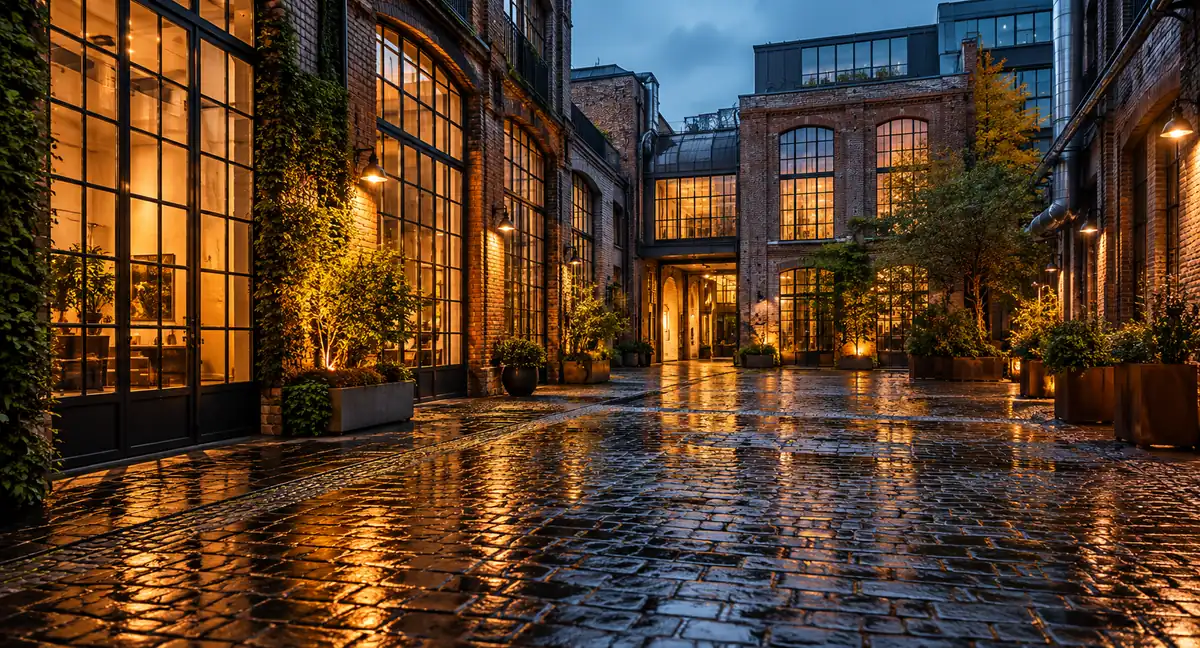
Around her, people balanced wineglasses beneath the exposed pipes of a Berlin gallery. Rain shivered against the courtyard windows. Someone was explaining why a sculpture made from telephone wire expressed loneliness.
Claire studied the photograph behind it.
A woman stood beside a laboratory bench, holding a sheet of paper toward the camera. Most of the page was blurred. The graph was not: three rising curves, a hooked boundary, a small island of apparent stability.
Claire knew that island.
Her company had spent eight million euros discovering why it wasn’t safe.
“Please don’t touch the frame.”
The man beside her wore a charcoal shirt with the sleeves rolled neatly above his wrists. His hair was dark, silver beginning at the temples. A small pale scar divided one eyebrow.
“I’m not touching it.”
“You were considering moving it.”
“The reflection’s obscuring the caption.”
He shifted a spotlight by six inches.
The graph emerged.
“Better?”
“Much.”
She read the caption aloud. “‘Dr. Eva Falkenried, laboratory closure, Berlin, September 1996.’ Where’s the paper?”
“That,” he said, “is a considerably more difficult question.”
Claire turned toward him.
“Good. I was beginning to dislike the easy ones.”
His name was Jonas Eichenroth. He conserved scientific archives and instruments, and the exhibition was the result of eighteen months spent sorting the belongings of a research institute that had outlived two governments and three names.
Claire gave him her surname.
His expression changed slightly.
“The wind-storage company.”
“Formerly. I sold my shares four years ago.”
“And now?”
“I invest in things sensible people refuse to build.”
“Professionally?”
“Almost exclusively.”
He looked back at the photograph. “What interests you about Falkenried?”
Claire took out her phone and opened an engineering plot.
“We’re developing controls that let small renewable grids reconnect without depending on one central controller. Hospitals, islands, districts with unreliable supply. Individually, our inverters behave beautifully.”
“Together?”
“Occasionally, they develop opinions.”
She showed him the graph.
Jonas compared the two images without pretending to understand more than he did.
“Same shape,” he said.
“Same peculiar shape. That doesn’t prove they describe the same thing.”
“But you’d like to find out.”
“Very much.”
He guided her through a door marked STAFF into a workroom smelling of paper and wheat paste. On a table lay a dismantled leather case, weighted flat with small glass squares.
“Falkenried studied coupled oscillators,” he said. “Among other things. This exhibition follows researchers whose work scattered when their institutes closed.”
“Did she publish?”
“Until the early nineties. The paper in that photograph appears in a correspondence list, but there’s no copy in her surviving files.”
“Family?”
“Her daughter donated everything she had. Falkenried died in 2012.”
Claire felt the small, familiar ache of arriving late.
Jonas opened a catalogue on his laptop.
“‘Collective instability under delayed coupling.’ Twenty-seven pages, six figures. Sent out in August 1996. No publication recorded.”
“That could be it.”
“Could be.”
She glanced at him. “You ration enthusiasm.”
“I work with people who frequently discover Napoleon’s shopping list.”
“Does he buy anything interesting?”
“Usually twentieth-century paper.”
Claire laughed.
Jonas studied her for a moment, then returned to the catalogue.
“I have a contact sheet from the photographer. We can look tomorrow.”
“I’ll pay for your time.”
“Yes,” he said. “You will.”
For some reason, she liked him better for that.
At nine the following morning, Claire arrived at the conservation studio in Moabit carrying coffee and the fear that she had made too much of a photograph.
Her technical director had called at seven.
The planned demonstration could proceed with a restricted operating range, he said. They could avoid the unstable region.
Claire had asked what happened when twenty independent operators eventually configured twenty different systems.
There had been a silence.
Now she sent a final message postponing the demonstration.
Jonas watched her put away the phone.
“Expensive coffee?”
“Expensive morning.”
She explained.
“You cancelled before finding the paper?”
“The problem exists whether we understand it by Friday or not.”
He moved a clean board onto the table.
“All right,” he said. “Let’s see what she knew.”
The contact sheet held thirty-six tiny images. Falkenried packing books. Falkenried beside an oscilloscope. Two men carrying a cabinet down a corridor. A kettle on a hotplate beneath a notice forbidding kettles.
Jonas placed a magnifier over the frame preceding the gallery photograph.
Here the paper lay on the bench.
Claire leaned in.
The title was partly covered by a screwdriver, but underneath it sat a handwritten line.
For the room, not the journal.
“An instruction?” she asked.
“Or a joke.”
Jonas retrieved the relevant correspondence folder. A submission acknowledgement confirmed that a journal had received the paper. Six weeks later, a letter returned it with two reports.
The manuscript itself was absent.
“Publisher’s archive?” Claire asked.
“I’ve requested it. There’s also a collection at the university that absorbed some departmental records.”
“Then we start there.”
“We start by checking what they actually hold.”
“You’ve met people with money before.”
“Yes. They often think archives become faster when addressed firmly.”
“And do they?”
“No. The archivists become slower.”
She sat down.
“Explain your system.”
He slid a pencil toward her.
“We record what we know separately from what we hope.”
By noon, she had filled two pages.
On the third, without comment, Jonas placed a sandwich beside her elbow.
The university archive was cool, windowless, and disappointing.
They spent four hours with accession registers, editorial correspondence, and three boxes labelled Falkenried that contained mostly examination scripts belonging to an unrelated mathematician.
The publisher’s reply arrived while Claire was examining a water-stained folder.
The journal had retained decision records but routinely destroyed returned manuscripts after ten years.
One reviewer’s report survived.
Jonas read it silently before passing it over.
Claire’s jaw tightened.
“What?” he asked.
“The reviewer says her unstable region must be a numerical artefact. She’s told to repeat the calculation using identical coupling delays.”
“Would that help?”
“It would remove the thing she was investigating.”
She read the paragraph again.
“He’s simplifying the system until the problem disappears.”
Jonas settled back in his chair.
“That sounds familiar.”
“It should. We did it ourselves for six months.”
He looked at her.
“Our simulations used neat average delays,” she said. “Real equipment has untidy ones. Different sensors, different cable lengths, different processing times.”
“So you need her calculation.”
“I need to know whether she found a general rule.”
“And if she didn’t?”
“We go back to doing the work.”
He nodded, apparently satisfied.
At closing time, they emerged onto a pavement bright with rain. Trams rang beyond the junction. Claire’s heels hurt, and the folder under her arm contained eighteen photographs of documents that had failed to help.
Jonas glanced at her shoes.
“Tomorrow, wear something that permits disappointment over longer distances.”
“Is that your professional recommendation?”
“My professional recommendation is to stop calling this a treasure hunt.”
“What should I call it?”
“Tuesday.”
She laughed harder than the joke deserved.
He smiled then, properly, and she found herself looking at his mouth.
That was inconvenient.
Not unwelcome.
They ate beneath the striped awning of a Turkish bakery because the rain had become serious and neither wanted to admit the day was over.
Jonas ordered lentil soup. Claire bought enough bread for a small committee.
“Do you always respond to setbacks with carbohydrates?” he asked.
“Only the soluble ones.”
He tore a piece of bread and pushed the basket closer.
At forty-two, he had the stillness of someone who made delicate decisions for a living. Claire, thirty-nine, had spent most of her adult life encouraging other people to move faster.
She found his pace alternately maddening and restful.
“What made you leave the company?” he asked.
“I didn’t leave. I sold.”
“A useful distinction.”
“It used to feel like one.”
Outside, a cyclist stopped beneath the awning and shook water from his gloves.
Claire turned her spoon.
“I liked building systems. Eventually my work became explaining quarterly numbers to people who thought weather was a management failure.”
“And now you can choose.”
“Yes. Which makes choosing badly more personal.”
Jonas considered that.
“My father repaired radios,” he said. “He believed almost anything could be made useful again if you listened long enough.”
“Is that why you do this?”
“Partly. Also, old instruments rarely ask for a presentation.”
His phone lit up.
A message from the photographer’s assistant, whom he had contacted that morning, included a scan of the original job envelope.
On the back was an invoice reference.
Demonstration transfer. Hall project. H. Auenfeld.
Claire straightened.
“Someone took the paper to a conference?”
“Possibly.”
“‘For the room.’ A lecture room?”
Jonas enlarged the scan.
“Or the paper went with the demonstration equipment.”
He opened the photograph of the men carrying a cabinet.
Claire had barely noticed it earlier. A waist-high wooden housing supported three metal discs, each suspended on a spring.
“That’s not standard laboratory equipment,” she said.
“No,” Jonas replied. “That’s why I photographed the inventory separately.”
His voice had changed. There was energy beneath the restraint now.
She liked hearing it.
The next morning, Claire wore boots.
Jonas looked down when she arrived.
“Progress.”
“Don’t become unbearable.”
“That happened some time ago.”
They worked through the institute’s disposal inventory together. Most apparatus had gone to universities or scrap dealers. The cabinet had been transferred at no charge to a project called A Room of Separate Clocks.
The recipient’s name was Hannes Auenfeld.
There was no address.
Claire searched exhibition catalogues while Jonas examined the physical inventory sheet under angled light.
By eleven, she had found six Hannes Auenfelds, including a dentist and a man selling a racing pigeon.
Jonas found a number pressed into the paper by handwriting on the page formerly above it.
“Telephone?”
“Asset reference,” he said. “The digits match their instrument labels.”
“You can read that?”
“Not all of it.”
He changed the light angle again.
Claire watched the indentations appear.
For the first time in years, she experienced the particular pleasure of being beside someone whose work she could not do.
The reference matched an equipment photograph: three oscillators connected through adjustable delay circuits.
Claire pulled the image closer.
“Those discs are visual indicators. The actual coupling is electronic.”
“Useful?”
“Very. They weren’t illustrating a theory after the fact. They could vary delays and watch the system break synchrony.”
Jonas pointed to a little tube attached inside the cabinet door.
“Document holder.”
“Could the manuscript be in it?”
“Could be instructions for changing a fuse.”
“You’re enjoying this.”
“A little.”
The project appeared at last in a digitised arts newsletter. Auenfeld had designed an installation for a temporary exhibition at the Funkhaus in Nalepastraße.
Claire read the description twice.
Three voices attempt to sustain a common note. Each listens too late.
“That,” she said, “is an unexpectedly good explanation of our control problem.”
A photograph showed the cabinet standing under a perforated acoustic panel.
On its side, barely visible, Falkenried had chalked a word.
Listen.
The Funkhaus rose beside the Spree in long walls of brick and glass, its former broadcasting studios holding an almost physical hush.
Their visitor passes had taken six emails and a helpful facilities manager named Petra, who met them carrying a ring of keys large enough to anchor a boat.
“The installation was here for eleven days,” Petra said. “Thirty years ago.”
“We appreciate the improbability,” Jonas replied.
“I don’t think you do.”
She led them into a storage room.
Old microphone stands leaned together like exhausted birds. There were chairs, cable drums, cracked music stands, and enough unidentified metalwork to start an argument.
Auenfeld’s papers had gone to an arts foundation after his death. Petra had already called them.
No installation records survived.
Claire stood very still.
Another promising lead, dissolving.
Jonas crouched beside a low shelf and examined the labels on a row of tape boxes.
“Do you retain installation photographs?”
“Sometimes.”
“Maintenance logs?”
Petra stared at him.
“Those, yes.”
For two hours, they searched binders in an office overlooking the river.
The cabinet had repeatedly blown a building fuse. An electrician’s report described a replacement transformer and noted that the piece was subsequently collected by its fabricator.
Not Auenfeld.
Berg & Sohn, Köpenick.
Claire checked the date against the institute inventory.
“That’s six months after the exhibition.”
“It stayed in storage,” Jonas said.
“But the laboratory photograph was taken after the exhibition ended.”
They looked at each other.
They had assumed the cabinet left the institute and then went on display.
The dates proved the reverse.
“It came back,” Claire said.
“With the rejected paper,” Jonas added.
He spread their copies across the desk.
The manuscript had returned from the journal in early September. The laboratory closed at the end of that month.
Falkenried had written For the room, not the journal after the rejection.
Claire pictured her standing at the bench, faced with packing away years of work.
“She revised the demonstration,” she said. “The installation originally showed synchronisation. After the rejection, she changed it to show the instability.”
“And sent it back to the fabricator.”
“With the explanation.”
Petra leaned over their shoulders.
“I assume that expression means I should make more coffee.”
They found Berg & Sohn behind an auto-body shop in Köpenick.
The son was seventy-one and wearing a blue cardigan with a cigarette burn near the pocket. His father had been dead for twenty years. He remembered Auenfeld chiefly as a man who changed his mind after invoices were issued.
“The singing cupboard,” he said when Jonas showed him the photograph.
Claire smiled. “That’s the one.”
“Never sang properly.”
“It may have been behaving exactly as intended.”
He looked unimpressed by this defence.
The cabinet had stayed in his workshop until 2008, then gone with several other abandoned pieces to a commercial storage facility in Oberschöneweide.
He had no paperwork readily available.
Claire saw Jonas prepare himself for another slow, careful negotiation.
She took off her coat.
“What would help you find it?”
The old man gestured toward a steel cupboard packed with ring binders.
They spent the afternoon on the workshop floor.
Berg supplied coffee in mugs advertising a brand of sealant. Jonas sorted dates. Claire checked invoice numbers. Rain ticked against a skylight patched with yellowing plastic.
At four, she found a transport receipt.
At four fifteen, they learned the storage business had closed.
At four thirty, its former manager explained that the remaining unclaimed goods had been purchased as a single clearance lot.
The lot was being dismantled for salvage.
Tomorrow.
Claire thanked him, ended the call, and immediately dialled the salvage company.
Jonas watched her.
“Slowly,” he said.
“I am speaking slowly.”
“You’re breathing like you plan to buy the district.”
She covered the phone.
“Would that help?”
“No.”
The salvage supervisor agreed to halt work on a cabinet matching their photographs, if it was still intact. They could attend at seven the next morning.
When Claire finally lowered the phone, Jonas was holding her coat.
She slipped her arms into it.
His fingers briefly touched the back of her neck as he freed her collar.
Both of them paused.
Then he stepped away.
Outside, evening had turned the wet paving stones blue.
“Dinner?” she asked.
“Yes.”
The answer came without hesitation.
They ate in a small restaurant near the river, where candles stood in mismatched saucers and the windows misted at the edges.
Claire ordered fish. Jonas ordered the same after discovering the kitchen had run out of his first choice.
“You accepted that remarkably well,” she said.
“I conserve things. I don’t control the potato supply.”
She laughed, then looked down at the table.
“What?”
“Nothing.”
“Claire.”
“I’ve been looking forward to hearing what you’ll say next. It’s distracting.”
He set his glass down.
“I’ve been taking slightly longer than necessary to show you documents.”
The admission warmed her more than the wine.
“That’s ethically questionable.”
“Deeply.”
A waiter arrived with bread, saving them from themselves.
For a little while, they discussed everything except the cabinet. Jonas lived in Wedding, in a flat where one room was permanently occupied by a half-restored radio. Claire rented in Charlottenburg but travelled so often that the building’s newest resident believed she was a visiting sister.
“Do you like that?” he asked.
“The travelling?”
“Being temporary.”
She considered giving the easy answer.
“No. Not as much as I used to.”
He nodded without seizing on it.
“What about you?”
“I was married. We were very good at respecting each other’s schedules.”
“And?”
“Eventually there was nothing else in the calendar.”
“I’m sorry.”
“So am I. We should have noticed sooner.”
Beyond the window, a tram threw a brief sheet of light across his face.
Claire said, “I don’t want to be another person who turns up and disappears.”
“You’ve known me four days.”
“I know. I’m not offering you a joint mortgage. I’m telling you what I’m thinking.”
His smile was slow.
“I’d like you to keep doing that.”
Later, they walked along the river. The rain had stopped. Across the water, apartment windows glowed above dark trees.
Jonas halted beside a railing.
“I want to kiss you,” he said.
Claire stepped closer.
“I was hoping your next sentence would improve on storage invoices.”
His hand settled at her waist, lightly enough for her to choose the remaining distance.
She chose it.
The first kiss was gentle, almost questioning. The next was not.
Claire caught the front of his coat and felt his restraint give way to something warmer, hungrier. He drew her closer. His mouth moved against hers with a confidence that made the river, the cold railing, and the entire complicated week recede.
When they parted, she rested her forehead against his.
“Seven tomorrow,” she said.
“Unfortunately.”
“You could kiss me again before then.”
He did.
At six forty-five, Berlin smelled of wet leaves and bakery exhaust.
Claire arrived at the salvage yard with sturdy gloves, a charged phone, and a message from her engineers.
Their latest tests had confirmed something important: the unstable region expanded when three different processing delays overlapped. Two delays were manageable. Three produced the strange hooked boundary.
She read the message twice.
Three voices.
Three discs.
Jonas approached carrying a rigid document case.
“You look worried.”
“I look like someone who kissed you under a streetlamp and then spent half the night thinking about phase response.”
“I’m choosing to take that well.”
She showed him the results.
Before he could answer, the supervisor opened the gate.
Marek was broad-shouldered, brisk, and plainly unhappy.
“We found the cupboard.”
Claire exhaled.
“Good.”
“Not so good.”
Inside the warehouse, dismantled equipment stood in rows beneath skylights opaque with dirt. Their cabinet lay on its back under a collapsed section of shelving.
A pipe had burst overnight.
Water dripped steadily through a rack of office furniture and onto the cabinet’s broken rear panel.
Jonas put down his case.
“How long?”
“Security found it at five. Water’s off now. We’ve had that rack cleared for lifting, but nobody goes under it.”
Claire could see the document tube.
It had been crushed flat.
Something pale protruded from its split seam.
Her stomach dropped.
Jonas looked at Marek. “We need plastic sheeting over it while you arrange the lift. From the side. No one underneath.”
Marek nodded and called to a worker.
Claire crouched beyond the marked safety line.
The cabinet’s electronics were exposed. A large capacitor assembly sat beneath a modern-looking power supply, its cover dented.
“Has anyone powered this?”
“Yesterday. They were checking the motors.”
“Tell your electrician before anyone touches inside. That supply may hold charge.”
Marek stopped the worker reaching for the sheeting.
Jonas glanced at Claire.
There was no compliment in his look. Only acknowledgment.
She found that steadier than praise.
It took ninety minutes to make the cabinet accessible.
Claire used the time to secure permission for its transfer. Marek could sell the physical object, he explained, but could promise nothing about ownership of papers hidden inside it.
“That’s fine,” she said. “We’ll document the chain and settle the manuscript separately.”
The price he quoted was modest.
She paid it without negotiating.
Jonas, meanwhile, built a drying station in the yard office and called his studio to arrange cold storage if the papers were saturated.
When the lifting crew finally raised the shelving, the cabinet’s swollen side panel separated with a crack.
Water spilled onto the floor.
Claire flinched.
Jonas did not.
“Let it drain,” he said.
The crew moved the cabinet onto supports. The electrician tested the components and declared them safe. Only then did Jonas kneel beside the document holder.
He opened the damaged tube a few millimetres at a time.
Inside was a rolled bundle.
The outer page had gone translucent.
Claire recognised an equation through the wet fibres.
“There.”
“I see it.”
“The lower line—”
“Claire.”
She stopped.
Jonas kept his eyes on the paper.
“I need you to give me space to do this.”
She stood and moved back.
It cost her more than she expected.
He slid a thin support beneath the bundle and lifted it free. No tearing. No triumphant flourish.
On the table, the title became visible.
Collective Instability Under Delayed Coupling.
E. Falkenried.
Claire pressed her knuckles against her mouth.
Jonas glanced up.
“Now,” he said softly, “you can be enthusiastic.”
The manuscript contained twenty-seven pages.
It did not contain the six figures.
By noon, back in Moabit, enthusiasm had become a more complicated emotion.
Jonas had separated the damp sheets with patient, precise movements. Several could safely be photographed. Others needed treatment before they could be handled further.
Claire read from the images while her engineers watched over a secure call.
Falkenried’s argument was rigorous. She had identified the instability and derived a test for it.
But the final worked example referred to a calibration matrix printed in Figure Six.
Without that matrix, they could not establish whether her experimental system matched the assumptions in the derivation.
One engineer sighed.
“We can rebuild the model from the equations.”
“How long?”
“A couple of weeks to do it properly.”
They would do that anyway. Finding an old paper was not validation.
But without the figure, they might never know whether the author had demonstrated the result or merely predicted it.
Claire muted the call.
“She put the figures somewhere else.”
Jonas looked up from the treatment table.
“Perhaps they were lost before the cabinet arrived.”
“Perhaps. But she sent a demonstration to an artist. She wanted people to see it.”
He considered that.
They reviewed every photograph they had taken, starting at the beginning.
In the laboratory image, six broad sheets lay beneath a metal ruler.
In the Funkhaus installation photograph, light fell through the cabinet’s upper window and cast shapes onto the wall behind it.
Claire enlarged the image.
“Those aren’t shadows from the mechanism.”
Jonas came around the table.
Fine curved lines appeared between the three circular silhouettes.
“They’re projections,” he said.
She opened the salvage photographs.
The cabinet’s lamp housing had been removed and placed on a separate pallet. Inside it was a rectangular cartridge Marek’s crew had marked as an optical filter.
Six edges showed at its open end.
Claire felt the pieces meet.
“The paper was for the room,” she said.
Jonas was already reaching for his phone.
Marek answered over the sound of machinery.
The optics pallet had left an hour earlier.
For a moment, neither Claire nor Jonas spoke.
Then she asked where it was going.
A consolidation yard at Westhafen. The parts would join a shipment of second-hand technical equipment leaving by road that evening.
“Can you stop it?”
“I can ask. It’s not my shipment now.”
“Please ask. And send us the consignment number.”
Claire ended the call.
Jonas was checking the time.
“We should get a courier.”
“For an unidentified cartridge in a mixed pallet?”
“You’re exhausted.”
“So are you.”
“That’s not an argument for both of us driving badly.”
She held up her phone.
“Taxi.”
He looked at her, then laughed once.
“Yes. Taxi.”
On the journey across the city, Claire spoke to three people before reaching the yard dispatcher. They could inspect the pallet until four, provided the consignee authorised its opening.
At three twelve, the consignee answered.
He wanted to know whether they were removing something valuable.
“Possibly,” Claire said.
Jonas turned toward her.
“Historically valuable,” she continued. “We don’t know yet. We can purchase the entire lamp assembly, record what we remove, and give you the recovery report.”
The man named a price.
She accepted.
Afterward, Jonas said, “You could have called it scrap.”
“Yes.”
“Why didn’t you?”
“Because I’d like to enjoy finding it.”
He took her hand across the seat.
She held on all the way to the harbour.
Westhafen was a geometry of cranes, brick warehouses, and stacked freight under a low white sky.
The dispatcher checked their identification, their payment confirmation, and their patience.
At three forty-one, a forklift brought the pallet into an inspection bay.
The lamp housing was there.
The cartridge was empty.
Claire stared at it.
“No.”
Jonas examined the retaining clips.
“Opened recently.”
The dispatcher called the sorting crew. Nobody remembered removing documents. There had been dirty glass, they said. Or plastic. Some packing material.
“Where?”
A shrug.
“Waste cage.”
The cage stood beside a loading door. Inside were cardboard sleeves, broken moulded foam, and sheets of clear material slick with water and dust.
Claire started forward.
Jonas caught her attention with a raised hand.
“Look first.”
She stopped.
One transparent sheet lay under a fractured reflector. It carried a thin black curve.
They worked from opposite sides of the cage, lifting away debris. A yard worker brought a shallow tray. Jonas showed Claire how to support each sheet flat without rubbing its surface.
One.
Two.
Four.
Five.
The sixth was nowhere.
A lorry engine started outside.
Claire closed her eyes for a second.
The figures had been mounted in sequence inside the projector. Six slots. Five loose sheets.
She looked back at the lamp housing.
The last slot sat behind a fixed baffle, almost invisible from the front.
“There’s a second retaining plate.”
Jonas brought the torch.
She had serviced enough early prototypes to recognise a spring latch disguised by accumulated dirt. With the dispatcher’s screwdriver, she depressed it.
The plate swung open.
A transparent sheet remained trapped against the back, its ink protected from the debris outside.
Across the top, in small, decisive handwriting:
Not an error. The delays are different.
Claire began to laugh.
It came out unsteadily.
Jonas bent beside her, read the words, and smiled.
“Tuesday,” he said.
“It’s Friday.”
“Archives,” he said, “become slower when addressed firmly.”
She kissed his cheek, right there between the pallet and the dispatcher.
The dispatcher checked his watch.
They packed faster.
By Sunday afternoon, Falkenried’s six figures lay safely supported beneath the studio lights.
The crucial matrix survived intact.
Claire’s team had recreated the original experiment in simulation, then independently checked the derivation. Falkenried’s paper did not contain a finished controller for a modern renewable grid. It contained something more useful than a miraculous answer: a clear explanation of the mistake they had been making.
The separate delays could not be averaged away.
Her criterion predicted the dangerous boundary with startling accuracy. The team now had a defensible route toward a safer design, and several weeks of testing ahead.
Claire read their report twice.
Then she called Falkenried’s daughter.
They had spoken briefly during the search. Now Claire explained what had been recovered, what it appeared to mean, and what she hoped to do.
“The original belongs somewhere people can consult it,” she said. “With the apparatus, if possible. We’ll fund the conservation.”
“And your company?”
“Will cite your mother’s work. We’d also like permission to help publish a complete digital edition with a technical commentary.”
A long silence followed.
“My mother used to say the experiment worked,” the woman said. “Even when the people didn’t.”
Claire looked through the glass partition.
Jonas was making a small cradle for the damaged document tube. He tested its fit, frowned, and adjusted one support by a fraction.
“I think,” Claire said, “some people are catching up.”
That evening, she found Jonas on the studio’s narrow balcony, holding two cups of tea.
The courtyard below smelled of somebody’s garlic frying. A neighbour had draped a bright yellow duvet over a railing. Somewhere, a radio was playing too quietly for the song to be recognisable.
Claire accepted a cup.
“I have a proposal.”
“Should I sit down?”
“It has a budget.”
“Definitely.”
She leaned beside him.
“I want to fund a small programme to identify overlooked research before it ends up in a waste cage. Archivists decide what needs preserving. Scientists help assess where it might be useful.”
He watched her over his cup.
“No promises of buried breakthroughs?”
“No. Mostly proper cataloguing and unglamorous work.”
“That sounds expensive.”
“I’ve developed a taste for it.”
“You should talk to three institutions, not just me.”
“I intend to.”
“And appoint an independent panel.”
“Yes.”
He nodded.
“Then I’ll help you make the introductions.”
Claire set down her tea.
“That was the professional proposal.”
“I wondered.”
“I’m staying in Berlin for the testing programme. Afterward, I’ll still travel. I’m not going to pretend otherwise.”
“I wouldn’t ask you to.”
“But I’d like to see you when there isn’t a missing document involved.”
“Risky.”
“Extremely.”
He moved closer.
“What do you suggest?”
“Dinner on Wednesday. You choose somewhere. I arrive without graphs.”
“I’d rather you brought the graphs.”
She smiled.
“Really?”
“I like what happens to your face when you explain them.”
For a moment, she had no clever answer.
Jonas touched her cheek, giving her time to find one.
Instead, she kissed him.
Six weeks later, the cabinet stood in the gallery where Claire had first seen Falkenried’s photograph.
Its damaged wooden casing had been stabilised. The original electronics remained disconnected, carefully preserved. Beside it, a modern simulation let visitors adjust three separate delays and watch the projected curves change.
The recovered paper was available online.
Claire’s team had postponed their demonstration twice more, corrected the controller, and completed the first independent tests. Progress had become slower, more reliable, and considerably easier to defend.
She considered that an excellent return on investment.
Across the gallery, Jonas was explaining the recovered transparencies to an elderly woman who listened with her hands clasped tightly together.
Falkenried’s daughter.
When she touched his arm, he bowed his head slightly to hear her.
Claire waited beside the cabinet.
On the wall behind it, three points of light found a rhythm, lost it, and began again.
Jonas joined her carrying two glasses of water.
“Wine’s over there,” she said.
“You’re explaining the mathematics at seven.”
“You have an alarming memory.”
“Wednesday dinners. Sunday breakfast. One discussion about storage conditions that you pretended wasn’t interesting.”
“I didn’t pretend convincingly.”
“No.”
She took her glass.
Below the original photograph, the gallery had added a new caption describing the recovery. Claire’s name appeared among a dozen others.
She liked it there.
Jonas followed her gaze.
“Worth moving the spotlight?”
She turned toward him.
“Yes.”
He offered his hand, and she took it.
Behind them, the three lights slipped out of step. Claire watched for a moment, interested rather than afraid, then let Jonas lead her through the warm, crowded room toward dinner.
Every ending is somewhere new.
Find your next story →