The Shore Between the Lines
An Ottoman map leads conservator Leila Nahrani from Istanbul to an Aegean cave library, where a collector’s family claim threatens the truth drawing them together.
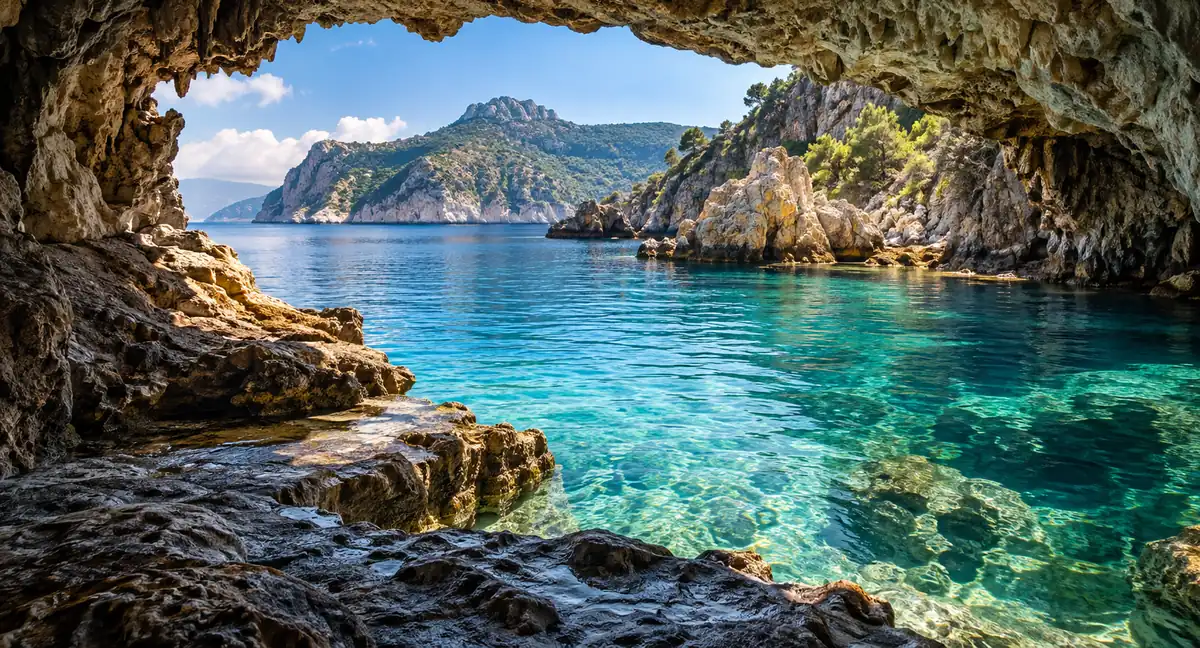
The island on the map had moved overnight, although the ink was three hundred years old.
Leila Nahrani checked the photographs again.
Yesterday’s image showed a pale coastline beneath a brown tide mark. Today, under angled light, a second boundary curved around the island and joined it to an administrative district on the opposite shore.
Someone had carefully washed away the line.
Or tried to.
Outside the Istanbul laboratory, a ferry sounded through November rain. Leila leaned closer without touching the sheet.
“Please tell me,” said the man at the door, “that expression means it’s valuable.”
“It means someone has interfered with it.”
“Recently?”
“That is a better question.”
Gabriel Stavrenis stayed behind the yellow tape marking the examination area. He had arrived in a charcoal coat, carrying coffee in a cardboard tray rather than wearing the expression collectors generally brought to her laboratory: the tender anguish of people watching their possessions become evidence.
He set the tray on a cabinet.
“Your colleague said plain Turkish coffee.”
“My colleague wants something.”
“Apparently you owe her a condition report.”
Leila looked up. He was broad-shouldered, perhaps mid-forties, with rain caught in his dark hair and a face that seemed accustomed to withholding its conclusions.
“Coffee stays there,” she said.
“I assumed the seventeenth century didn’t need caffeine.”
She almost smiled.
He had contacted UNESCO’s programme for displaced documentary heritage two weeks earlier, offering access to six Ottoman maps bought from a deceased shipping agent’s estate. Leila had expected another complicated provenance inquiry.
Instead, the final sheet depicted the small Greek island of Kalyra inside a boundary that contradicted the catalogue, subsequent surveys, and the interpretation Stavrenis’s lawyers had already circulated privately.
Her assignment was to authenticate the series and establish its history. Nobody had asked her to rearrange the Aegean.
“What did your lawyers call this?” she asked.
“A territorial anomaly.”
“Convenient phrase. It makes a dangerous claim sound like a printing error.”
“They were explicit that later treaties would matter.”
“Later treaties determine modern borders. An old map doesn’t overturn them.”
“I know.”
“Then why send their interpretation with the documents?”
His attention remained on the washed-out line.
“Because I wanted you to know what people were already hoping to find.”
That answer interested her more than the coffee.
She turned the monitor towards him. In the enlarged image, tiny breaks showed where the paper’s fibres had lifted.
“The boundary predates the abrasion. But genuine paper can carry fraudulent ink, and genuine ink can record a genuine mistake.”
“So we know almost nothing.”
“We know which questions are worth asking.”
He pulled up a chair outside the tape.
“All right,” he said. “Ask.”
By six, rain had erased the Asian shore.
Leila had established that the six maps shared a paper stock, although two had been repaired much later. The chain lines and divided watermarks were consistent with imported European paper used by Ottoman offices. Their scripts differed, but the corrections followed the same disciplined hand.
Gabriel watched her reconstruct the sequence from wormholes and old folds.
“They weren’t made as an atlas,” she said. “They belonged to a working file. Folded inside a wrapper, probably with written registers.”
“The seller had no registers.”
“Did you ask about loose pages?”
“I asked about everything.”
“Collectors often mean everything attractive.”
He considered that.
“I bought a box of freight invoices too. They’re not attractive.”
“Now you’re courting my approval.”
“Is it working?”
“Provisionally.”
They examined the invoices through photographs on his phone. Twentieth-century bills, insurance notices, receipts. Nothing useful until Leila found a reference to a sale from a monastery’s former mainland agent.
She wrote down the name.
Gabriel’s expression changed.
It was slight: his jaw settling, his hands becoming still.
“What?” she asked.
“My grandmother’s family acted for that monastery.”
She put down her pencil.
“Was that in your provenance statement?”
“No.”
Silence filled the room, broken by the fan in the extraction hood.
“My family has an interest in the island,” he said. “I should have told you before you began.”
“Yes.”
He accepted that without qualification.
“The Stavrenis family trust owns the old customs warehouse and claims a share in the eastern anchorage. The municipality disputes the second part. The estate papers suggested these maps might establish the original grant.”
“An ownership dispute.”
“Yes. One adviser believed the boundary might indicate something larger.”
“And you?”
“I thought it might help us win.”
The directness did not make the omission smaller. It made it possible to discuss.
“Who is ‘us’?”
“My aunt, two cousins, me. I administer the trust.”
“And you approached UNESCO because an independent authentication would be useful.”
“Also because the documents might have been displaced unlawfully.”
“Both things can be true,” Leila said. “But I need to know both things.”
He nodded.
She sent an immediate disclosure to her programme director and copied Gabriel. His role would be recorded. Independent legal specialists would interpret any property evidence. He would have no advance editorial control over her findings.
Then she turned the laptop towards him.
“Read that before we continue.”
He did.
“Add that I’ll supply the complete trust file.”
“The complete file?”
“Including the opinions I dislike.”
For the first time, she saw something less guarded in his face. Not charm. Embarrassment.
She could work with embarrassment.
When he left, he took both untouched coffees.
At the door he said, “Would it help if I apologised again?”
“It would help if you brought the invoices.”
The Ottoman archive gave them two days of patient disappointment.
Leila found references to customs revenue, a winter anchorage, and deliveries of lamp oil to the Monastery of Saint Elias on Kalyra. She found three men with the same name and incompatible careers. She found a catalogue entry so promising that she forgot lunch.
The file contained a dispute over goats.
Gabriel read her expression when she emerged.
“Territorial goats?”
“Relentlessly local.”
They sat in a café where wet umbrellas dripped beside the stove. Beyond the glass, a delivery rider argued with a taxi driver while balancing a tower of bread.
Gabriel slid a plate of warm börek across the table.
“Before you ask, I didn’t bribe anyone for these.”
“You’re learning.”
He had brought the trust records, including a solicitor’s warning that the family’s anchorage claim rested on an uncertain translation. He had also found the shipping agent’s executor and obtained photographs of every remaining box.
None contained the missing register.
Leila opened her notebook.
“The map’s inscription uses the word tâbi. Your adviser translated it as ‘belonging to’.”
“Incorrectly?”
“Incompletely. It can describe dependency or attachment. Attached for what purpose? Tax collection? Administration? Jurisdiction? The missing noun matters.”
“And you can’t read it.”
“Someone scraped through it. I can see the beginnings of two letters.”
“Could we infer it from another map?”
“We can propose possibilities. Then we try to kill them.”
“That explains your manner with the catalogue.”
She laughed into her tea.
He looked pleased, then carefully looked away.
“What do you actually do,” she asked, “when you’re not buying potential diplomatic incidents?”
“Marine logistics. I built a company that moves awkward things into awkward harbours.”
“How awkward?”
“Hospital generators. Wind turbine components. Once, an entire glass furnace.”
“Did it survive?”
“The furnace did. My enthusiasm for furnaces didn’t.”
That explained his attention to the charts, the weather, the weight of the document boxes.
He asked about her work. She told him about soot damage, brittle paper, and finding fragments from the same manuscript in three countries.
“And you like that?”
“I like giving scattered things a history people can verify.”
He waited, neither pressing nor retreating.
“My grandfather had a collection in Beirut,” she said. “Arabic newspapers, family letters, Ottoman deeds. My mother taught me Turkish from some of the letters. He used to let me unfold them if my hands were clean.”
“What happened?”
“The building burned in 1989. I was eleven.”
“I’m sorry.”
“For years, everyone described the collection differently. My mother remembered correspondence. My uncle remembered valuable books. I remembered a blue folder.”
“Did you ever find any of it?”
“No.”
The café owner brought fresh tea without asking.
Leila warmed her fingers against the glass.
“I don’t restore things because I believe everything can be saved,” she said. “That would make it a terrible profession.”
Gabriel nodded.
“My grandmother spoke about Kalyra as if we had misplaced it. I believed her for a long time.”
“And now?”
“Now I’m wondering whether grief is a reliable surveyor.”
Outside, the argument had ended. The bread was moving again.
Leila turned her notebook so they could both see.
On the margin of the map, beside the island, she had transcribed an abbreviated instruction: second copy, house of books, above the old water.
“The monastery inventory calls its library the house of books,” she said. “Their modern catalogue lists nothing earlier than 1840.”
“Fire?”
“Roof collapse. The books were moved afterwards.”
“To where?”
“That,” she said, “is finally a question worth travelling for.”
They reached Kalyra by scheduled ferry three days later, after interviews on the Turkish coast established that the monastery’s mainland office had been demolished in the 1950s.
Leila stood at the rail while the island emerged from low clouds: pale houses, a blunt bell tower, terraces held up by dry-stone walls.
Gabriel came outside carrying two paper cups.
“Coffee is permitted on this side of the yellow tape,” he said.
She accepted hers.
They had spent the crossing reviewing scanned documents. His grandmother’s correspondence mentioned a “lower store” beneath the monastery. Leila had cautioned that store could mean anything from a storeroom to a shop.
“Have you been here often?” she asked.
“Childhood summers. Then funerals. Lately, lawyers.”
“An unfortunate itinerary.”
“I was hoping to improve it.”
He said it lightly. She felt the weight of his attention anyway.
At the quay, a harbour engineer named Eleni waited beside a van spattered with salt. She shook Leila’s hand, then greeted Gabriel with the wary familiarity of someone who had known him before he could afford good coats.
“You look like your father when paperwork went badly,” she told him.
“That is now my face.”
Eleni explained the immediate problem as they climbed towards the monastery.
The municipality was repairing the public landing below it. A contractor had been scheduled to drive anchors into the cliff, but a drill had unexpectedly entered a void. Work had stopped pending an inspection.
“The church says old drains. The contractor says a natural fissure. I say nobody drills another hole until we know.”
“Good,” Leila said.
“I hoped you’d say that.”
The monastery was small, active, and patched with several centuries of practical repairs. Father Andreas met them beneath a fig tree stripped nearly bare by wind.
He had already placed the catalogues in a reading room.
“I would like the books to exist,” he said. “But wanting has made several visitors quite inventive.”
“I’ll try to be disappointing accurately,” Leila said.
His smile appeared slowly.
The promising inventory led them to a cellar behind the kitchen. It contained rusted lamp stands, cracked roof tiles, and a stone water tank.
There were no books.
They measured walls, checked blocked openings, and inspected masonry by torchlight. Eleni compared the room against the contractor’s survey.
The void lay farther downhill. The cellar couldn’t connect to it without passing through solid rock.
By late afternoon, Leila’s notebook was spotted with damp, and the back of her neck hurt.
Gabriel crouched beside a recess filled with empty jars.
“Could the library have been here and cleared?”
“Yes.”
“Could the maps have survived somewhere else?”
“Yes.”
“Could you give me an answer that feels better?”
“No.”
He stood, dusting his hands.
“Admirably consistent.”
She was tired enough to lean against the doorway beside him.
Below them, the sea had gone the colour of beaten lead. A workboat knocked against its fenders at the landing.
For the first time since Istanbul, she wondered whether she had brought everyone towards an absence.
Gabriel offered her the last piece of bread from their lunch.
She broke it in two and handed half back.
That evening, Father Andreas produced a wooden box of uncatalogued maintenance records.
No revelation waited on top.
They worked through roofing bills, orchard accounts, complaints about a broken pump. Gabriel translated twentieth-century Greek annotations while Leila tracked the older Ottoman references copied into the margins.
At nine, Eleni returned with the cliff survey and a bag of sesame rings.
“The contractor has requested permission to resume in the morning,” she said. “I’ve refused. But I need something better than an interesting map by the end of the week.”
Leila spread three pages across the table.
The old library inventory placed it “above the old water.” A nineteenth-century repair account paid labourers to move books “to the dry shelves below the west garden.” A modern plumbing plan showed two water systems: the kitchen cistern and an abandoned spring gallery.
They had followed the wrong water.
Gabriel drew the plumbing plan closer.
“This pipe runs towards the cliff.”
“The survey void?” Eleni asked.
“Possibly. But the entrance isn’t marked.”
Leila returned to the inventory. The next line had seemed to describe a cupboard: two doors, between which the damp is kept.
She read it again.
“Not a cupboard. An entrance passage. Two doors separating the chamber from moist air.”
“A library inside the rock?” Gabriel said.
“A dry chamber inside the rock. If the monks had one, it might be more stable than a leaking building.”
Eleni laid the survey over the plumbing plan.
The void sat beneath the west garden.
For several seconds, nobody spoke.
Then Gabriel said, “We spent six hours looking inside a water tank.”
“We eliminated a hypothesis,” Leila said.
“Thoroughly.”
Access still took a day.
The heritage officer on the neighbouring island required photographs and a written plan. Eleni brought in a structural engineer to inspect the spring gallery. Father Andreas located the old gate under a cascade of brambles behind the garden.
It opened onto a narrow passage, not a treasure chamber.
The engineer cleared only the first section. Farther in, fallen stones obstructed the way.
Leila hated the delay and supported it.
Gabriel noticed both.
They ate late at a café above the harbour, where the proprietor served chickpea stew and accepted no opinion about portion sizes.
“You could have argued for going in,” Leila said.
“So could you.”
“You’re used to making things happen.”
“I’m also used to cranes. Confidence doesn’t increase a load rating.”
She looked at his hands around the glass. A faint scar crossed one knuckle. His sleeves were rolled to the forearms.
He caught her looking.
“Paper cut,” he said.
“A very ambitious sheet.”
“Steel cable. I was twenty-seven and thought experience was something other people needed.”
“And now?”
“Forty-six. Better at hiring people who disagree with me.”
“Promising.”
The word stayed between them.
He set down his glass.
“Leila, I’d like to take you to dinner when you aren’t assessing my honesty.”
“I suspect that will remain an ongoing project.”
“Then somewhere with good lighting.”
She smiled, but did not let him escape into humour.
“I’m responsible for documents that could affect your family. Until we know what they say, I need room to do that.”
“You have it.”
There was no wounded silence, no attempt to negotiate.
Outside, he walked her to the guesthouse. At the door, his hand moved towards her, then stopped.
She touched his wrist briefly.
“Thank you for asking.”
His pulse shifted beneath her fingers.
“Thank you for making the answer clear.”
She went upstairs carrying the warmth of that small contact.
The library smelled of stone, dry wood, and something faintly bitter.
It took the engineer and two labourers most of the following morning to clear the passage safely. Beyond the obstruction, a stone threshold led into a short vestibule. The remnants of two doors stood several feet apart.
Leila stopped there.
No one rushed past her.
They recorded temperature and humidity, photographed the entrance, and let the heritage officer, Sofia, establish a numbered route through the chamber.
The cave had been made into a room with a limewashed vault and raised masonry shelves. Wooden chests sat above floor level. Several had collapsed. Others remained closed beneath gritty dust.
At the back, a ventilation shaft rose into darkness.
“Not abandoned all at once,” Leila said.
“How do you know?” Gabriel asked.
“Different repairs. Some boxes were moved after those shelves failed.”
A pencilled date on one chest read 1912.
The library had survived in use far longer than the modern catalogue suggested.
Leila knelt beside an open case. The outer leaves of the first bundle were damaged, their edges resembling old pastry. Inside, the paper remained supple enough to examine with supports.
She did not open the folded maps immediately.
They first documented every visible seal, binding, and label. Gabriel held lights where she asked and said nothing when a single page took twenty minutes.
Then she found the wrapper.
Its heading named the same survey official whose corrections ran through the Istanbul series.
Inside lay a map with a familiar coastline.
Leila’s breath caught.
The island sat beneath the same disputed boundary. Here, however, the inscription was intact.
Attached to the mainland district for collection of anchorage dues.
She read it aloud twice.
Gabriel rested the lamp on its stand.
“So the line isn’t sovereignty.”
“It marks a fiscal arrangement. We’ll need independent readings, but that’s what it says.”
“And the property grant?”
“There are written schedules.”
She looked at him.
“We don’t have to examine your family’s claim in front of everyone before—”
“Yes,” he said. “We do. Same process as everything else.”
The corresponding register took another hour to identify.
It recorded the warehouse grant to a predecessor of Gabriel’s family. The harbour landing was reserved for common use. Its income supported maintenance, fresh water, and the monastery’s books.
There was a continuation.
A steward’s right could pass to descendants, but the landing could neither be enclosed nor sold.
Gabriel bent over the translation she wrote on the recording sheet.
His family did have a historical connection.
It was an obligation, not the ownership they claimed.
Sofia photographed the page. Father Andreas sat down heavily on an empty stone bench.
Gabriel studied the seal.
“My grandmother called us keepers of the harbour,” he said.
Leila remembered the correspondence.
“Your solicitor translated it as proprietors.”
“Yes.”
The cave seemed suddenly very quiet.
“I’m sorry,” she said.
He looked up.
“You didn’t write it.”
For the first time, she wanted to touch him and could think of no professionally defensible reason.
She stayed beside him instead.
By evening, preliminary images were with two independent Ottoman specialists. The matching corrections, seals, paper structure, and binding context strongly supported the Istanbul series as genuine.
Final laboratory work would take longer. The maps could still contain errors. But they were no longer six isolated sheets with a collector’s story attached.
They belonged to a surviving administrative record.
Gabriel’s family responded less enthusiastically.
Leila heard only his half of the telephone call from the guesthouse terrace.
“No. I’m not asking her to delay.”
A pause.
“Because that would imply the evidence is ours to manage.”
A longer pause.
“I understand what you think I’ve cost us.”
He turned when she stepped outside, and she started to retreat.
He shook his head.
“No,” he said into the phone. “Publish the full history of our claim if you want. The whole thing.”
Afterwards he stood looking down at the harbour lights.
“Your aunt?”
“Cousin.”
“Angry?”
“Creatively.”
She leaned on the wall beside him.
“My report won’t adjudicate present ownership. Historic grants, later conveyances, modern law—they all need separate review.”
“I know.”
“But this weakens the claim.”
“Yes.”
He exhaled.
“I liked being the person who could recover something for the family.”
“You can still recover the history.”
“That sounded much more satisfying before I had to do it.”
She laughed softly.
He glanced at her.
“There. A cruel streak.”
“An appreciation of accuracy.”
Wind lifted her hair across her mouth. She tucked it away.
“You could have kept the trust file back,” she said. “It might have taken us months to discover your interest.”
“I considered it.”
She turned.
“In Istanbul. Before I came to the laboratory. I told myself I should wait until you knew me better.”
“What changed your mind?”
“You asked the right question. And I disliked how much I wanted to dodge it.”
It was not a polished account of virtue. That was why she believed him.
Below, someone was dragging chairs inside a café. Their legs scraped the paving in short, familiar bursts.
“My mother died in April,” Leila said.
Gabriel stayed still.
“She was the last person who remembered the blue folder. I’ve spent six months wanting to ask questions I no longer can.”
“I wondered why you looked angry when you told me about it.”
“I am angry. With time, mostly. A difficult correspondent.”
He nodded.
She let the silence last.
Then she said, “My findings are recorded. Your interest is disclosed. Sofia now has independent custody of the material.”
His expression shifted, very slightly.
“That sounded unusually formal.”
“I’m trying to finish being formal.”
“Take your time.”
She stepped closer.
“Do you still want that dinner?”
“Yes.”
“And would you like to kiss me first?”
“Yes,” he said again, without smiling this time.
His hand settled lightly against her cheek. He waited through the last small distance until she closed it.
The first kiss was careful. The second was not.
Leila caught the front of his sweater and drew him nearer, feeling his breath change against her mouth. His other hand found her waist, steady and warm, and she pressed into him with a pleasure so immediate it silenced every thought about how long it had been.
When they parted, he rested his forehead against hers.
“I had a very good dinner plan,” he murmured.
“Keep it.”
His laugh brushed her lips.
She kissed him again.
The rain arrived before dawn.
By seven, water was running down the guesthouse stairs from a blocked roof drain. By eight, Eleni called.
“The cliff inspection hole is taking runoff,” she said. “We’ve covered it, but water is entering the void. Sofia’s on her way.”
Leila was already pulling on her boots.
The cave entrance lay above the spring gallery, but the new borehole provided a direct route from the saturated garden into the rock. The forecast had worsened overnight. More rain was expected, driven by a southerly gale that had closed the ferry route.
At the monastery, water clicked steadily into buckets beneath the cloister roof.
The engineer inspected the library passage before allowing anyone in. No fresh movement showed at the entrance. Inside the chamber, however, a dark stripe ran down the wall behind the lowest shelves.
One chest stood in water.
Leila crouched beside it, keeping clear of the wet wall.
“We lift the whole chest with a rigid support. No pulling bundles out here.”
Sofia checked the inventory.
There were twenty-three containers in the threatened section. The passage would allow only two people carrying a narrow box. Several chests were too wide.
The emergency conservators could not cross until the weather eased.
Gabriel examined the route, then the measurements.
“We can move the loose bundles in supported trays. The large chests need to stay level. I can get platform trolleys from the warehouse.”
“The threshold won’t take wheels,” Eleni said.
“Portable ramp over it. Timber, padded edges. Nothing fixed to the masonry.”
The engineer nodded.
Leila’s phone vibrated.
Her director had forwarded a news post: ANCIENT MAP CHALLENGES GREEK ISLAND BORDER.
A photograph from Gabriel’s original sales catalogue illustrated it.
For one furious second, she looked straight at him.
He read the screen.
“That’s my cousin’s adviser,” he said. “The one I told not to circulate anything.”
“Call him. Get the source documents to your lawyer. We need a correction.”
“I’ll do it outside.”
Sofia touched Leila’s arm.
“The water first.”
She was right.
Leila put away the phone.
The collection could not be carried up the steep garden path quickly enough in the rain. The monastery’s available rooms leaked or lay beyond stairs too narrow for the chests.
The nearest dry, accessible space was Gabriel’s disputed customs warehouse.
She disliked the choice immediately.
Putting the discovery in the claimant’s building would feed every suspicion already gathering online.
Gabriel returned before she spoke.
“The warehouse is empty,” he said. “You can seal it under Sofia’s authority. I’ll surrender every key.”
“We need documented emergency custody.”
“Yes.”
“No access by your family. No private photography. No lien for storage costs.”
“Write it down.”
Eleni was watching the waterline.
Leila made the decision.
“Then we use it.”
She would explain the choice in her report. Every alternative, every risk. Transparency had to be useful under pressure, not merely attractive over coffee.
Gabriel’s warehouse had once smelled of tobacco. Now it smelled of limewash and clean timber.
He called three employees from the island freight depot and gave them precise jobs. Eleni diverted surface water above the cliff while the engineer monitored the passage. Sofia recorded each container at both ends of the move.
Leila established a dry receiving area with tables, protective sheeting, absorbent material, and empty transport crates.
“No wet plastic wrapped around books,” she told the freight team. “Nothing stacked. If a bundle shifts, stop.”
One man nodded towards Gabriel.
“He already said you’re in charge.”
“An excellent start.”
They worked for two hours.
Rain hammered the temporary roof over the loading doorway. Gabriel moved between the passage and warehouse, adjusting the route whenever a corner or uneven slab threatened a load.
Leila checked each arrival.
Most bundles were dry. Two needed isolation for suspected mould. One chest had taken water through its base; she supported its damaged contents without attempting to separate the leaves.
Then Eleni radioed.
“The upper drain’s overflowing. We’re getting faster ingress.”
Six containers remained.
The engineer reduced the work window. Nobody would enter once water began crossing the raised threshold at the chamber door.
Gabriel looked at Leila’s list.
“We can do three more runs.”
“Four if the lighter bundles go together.”
“Not through that bend.”
She pictured it: the narrow turn, the projecting stone, the carriers forced sideways.
He was right.
The remaining containers included the paired survey register, already documented but still in its original chest. Beside it sat two uncatalogued cases from a lower shelf.
“We know what’s in the register,” Sofia said quietly.
Leila looked towards the passage.
For most of her life, the impulse would have been simple: save the document that answered the question. Save the thing whose value could be named.
But the uncatalogued cases were closer to the rising water.
“The two lower cases first,” she said. “Then the register. It’s higher and still dry.”
Gabriel checked her face.
She nodded.
They moved.
The first case came out on a padded board. Then the second, carried so slowly around the bend that Leila’s shoulders ached in sympathy.
At the warehouse she opened only the outer wrapping necessary for assessment.
Letters. Account books. Small paper packets labelled in several hands.
Ordinary lives.
Her throat tightened, but her hands stayed steady.
The radio crackled.
“Final run,” Gabriel said.
Leila returned to the entrance to receive it.
He and the freight supervisor emerged carrying the register chest on its board, their rain jackets streaked white with limestone dust. Behind them, Sofia brought the final inventory sheet.
Water spread across the chamber threshold.
The engineer closed the passage.
Three containers remained on high shelving. They had been photographed, covered without sealing in moisture, and raised farther from the floor. Leila hated leaving them. She had no doubt that stopping was right.
At the warehouse, Gabriel lowered the chest onto its supports.
His hands trembled with fatigue.
Leila passed him a towel.
“Any pain?”
“Only in the muscles I own.”
“Sit down.”
“Is that a professional recommendation?”
“An interested suggestion.”
He sat.
She leaned briefly against his shoulder while Sofia applied numbered seals to the warehouse doors.
Outside, the rain began to ease.
The remaining containers were recovered two days later, dry.
No chamber had collapsed. The water had drained through the old spring channel after the runoff was diverted, leaving silt, damaged shelving, and an expensive conservation problem.
It was a good outcome. Leila had worked long enough to recognise one that came without perfection.
The independent readings confirmed hers. Material analysis and comparison established the maps as authentic seventeenth-century working documents, with later alterations to one sheet. The purpose and timing of those alterations remained under investigation.
The boundary concerned anchorage revenue.
It did not redraw a modern border.
The paired register also supplied the clause omitted from the family’s surviving copy: the harbour facilities had been entrusted for communal use.
Gabriel released the complete trust file to the municipal legal team. He could not settle every ownership question alone, but he could withdraw the claim he administered. He did.
His cousin called it surrender.
At their first uninterrupted dinner, Gabriel called it “an unpleasantly educational month.”
They sat in a small restaurant above the water, where grilled fish arrived with lemons and the proprietor pretended not to recognise him.
Leila had changed out of her work clothes. Gabriel noticed immediately, then became sufficiently distracted by the open collar of her dress that she had to repeat a question.
“What?”
“The warehouse.”
“Yes,” he said. “Still there.”
She laughed.
He covered his face briefly with one hand.
“I’ve been more articulate.”
“I remember.”
The municipality and trust were discussing a long lease for the warehouse as a conservation and public research space. The monastery retained ownership of its collection under an agreement providing supervised access and digitisation.
Leila had proposed the project.
She had also chosen to lead its first stage: scheduled visits, a local training programme, and a searchable catalogue that recorded uncertainty instead of concealing it.
“I don’t want to become the person everyone has to wait for,” she told him. “Someone here should be able to continue without me.”
“Eleni has already suggested three candidates.”
“Of course she has.”
“And what happens when you’re not here?”
“Beirut. Istanbul. Wherever the next assignment is.”
He poured water into her glass.
“I spend a great deal of time in ports.”
“That is not a relationship plan.”
“No. It’s relevant infrastructure.”
She smiled.
He set down the jug.
“I’d like to see you when there aren’t documents between us. And when there are. I can come to Istanbul next Thursday, if you’re free.”
“I’m working Thursday.”
“Friday?”
She reached across the table and took his hand.
“Friday.”
Six weeks later, Leila returned to Kalyra with archival boxes, two humidity monitors, and a blue folder.
The sea was bright under a hard winter sky. At the landing, Gabriel took the box she offered him and left the folder in her hands.
“What’s in that?”
“New correspondence.”
“Anything valuable?”
“Ask me in three hundred years.”
They walked past the harbour wall, where the first sign for the research room had been mounted beside the warehouse door. Through the window, Leila could see Eleni helping a trainee adjust a document support.
Gabriel stopped beneath the sign.
“I booked dinner.”
“Optimistic.”
“I’ve also learned to keep bread available.”
She put the folder safely into the box he carried, freeing both hands. Then she caught his coat and kissed him in the pale sunshine, slowly enough that a passing fisherman wished them a good afternoon twice.
When she stepped back, Gabriel was smiling.
“Shall we go in?”
“In a minute.”
She took his hand, and together they stayed a little longer at the edge of the water.
Every ending is somewhere new.
Find your next story →