The Road That Held
Lost in the Moroccan desert with dwindling fuel, Ben joins a resourceful surveyor to find a vanished road, a town with water, and an unexpected reason to stay.
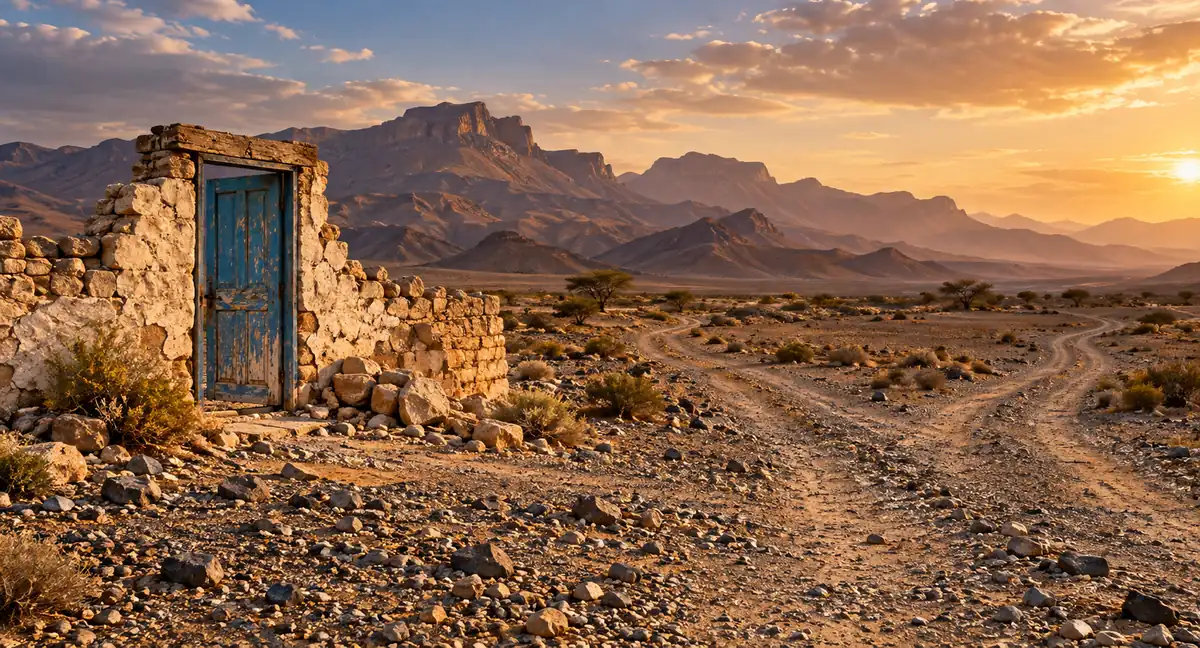
The second time Ben passed the blue door standing upright in the desert, he stopped trusting the road.
There was no house around it. Only a square of peeling paint, a limestone threshold, and one stubborn hinge holding to a fragment of wall.
He had photographed it an hour earlier.
Then, the mountains had been on his left.
He switched off the engine.
The silence arrived with a ticking sound beneath the bonnet. Beyond the windscreen, pale tracks forked across gravel, separated, and joined again. Every one of them looked purposeful.
“Well,” he told the car. “One of us is having a wonderful time.”
The Peugeot said nothing. At thirty-one years old, it had learned the value of withholding judgement.
Ben checked his phone. No reception. The blue location dot sat inside a beige emptiness, three kilometres from a road the map insisted existed.
He had nine litres of drinking water, a fuel gauge that became philosophical below a quarter tank, and a reservation in a town called Tazrout, where a woman named Malika had promised him a room, supper, and somewhere to park.
He wanted all three. He especially wanted the tap.
For twelve years, Ben had repaired refrigeration systems in supermarkets, hospitals, and warehouses. He could find a blocked capillary tube by touch. He could hear a failing compressor through a concrete wall.
Apparently, he could not follow a road through an empty landscape.
Except the landscape wasn’t empty.
Someone was standing beside the blue door.
A woman in a rust-coloured shirt raised one hand, palm outward.
Ben lowered his window.
“If you keep going that way,” she said in French, “you’ll be back here before lunch.”
He looked at the dashboard clock.
“It’s already after lunch.”
“Then you’re making excellent time.”
She was perhaps his age, mid-thirties, with a dark braid tucked beneath a faded cap. Dust whitened her trousers below the knees. A measuring pole lay beside a canvas bag.
A motorcycle rested in the shade of the ruined wall.
Its front wheel was no longer convincingly circular.
Ben got out, taking his water bottle.
“Are you hurt?”
“No. Are you lost?”
“I was hoping to describe it more positively.”
“Of course.”
She accepted the bottle only after he told her how much water remained, took two careful swallows, and handed it back.
“I’m Salma.”
“Ben.”
She glanced at the Peugeot’s British number plate, the spare tyre strapped to its roof, and the wire holding one headlamp in place.
“Is this a journey or a mechanical experiment?”
“Those categories overlap.”
That earned him the beginning of a smile.
Salma had been checking road damage for a provincial survey team. Three nights earlier, rain in mountains they could barely see had sent water through the dry channels south of Tazrout.
The rain had also removed the junction marker Ben had been looking for.
“The old track loops around the pumping station,” she said, pointing at the ruin. “The new track crossed the channel. That crossing is gone.”
“And your wheel?”
“A stone under muddy water. I was moving slowly.”
“Slowly seems to have hit quite hard.”
“It did.”
Ben crouched beside the motorcycle. The rim was bent inward, the tyre torn near the bead. The fork had twisted.
He stood without pretending.
“I can make a cold room work with a doorbell transformer. I can’t make that round.”
“I appreciate a man who knows where his miracles end.”
“Usually just after the invoice.”
Her smile appeared properly this time.
Salma unfolded a paper map across the bonnet, weighting a corner with her radio.
Tazrout lay forty-six kilometres northeast in a straight line. The usable road lay beyond a broad flood channel. Behind them, the route Ben had taken led back to a fuel station almost a hundred and seventy kilometres away.
He showed her his last fuel receipt and the distance on the trip meter.
She did the calculation.
“We’re not going back.”
“I reached the same inspiring conclusion.”
“There may be a southern approach. An old quarry road.”
“May be?”
“I surveyed the road north of it last year. The southern section wasn’t in our contract.”
The radio hissed when she tried it. A man’s voice broke into fragments, then disappeared.
“Hamid,” she said. “He’s at our field office in Tazrout. The ridge blocks us.”
“Does he know where you are?”
“He knows my survey area. If I’m not back this evening, he’ll start enquiries. But there are several tracks, and the flood has changed them.”
Ben looked at the narrow shadow of the wall.
They could wait. They had shade, some water, and the reasonable expectation of eventually being missed.
They also had a functioning car and a woman who understood the ground.
“What would you do if this were your Peugeot?”
Salma considered him before answering.
“Leave a note here. Take the southern track to the observation ridge. From there we should reach Hamid. Then make the next decision with better information.”
Ben unlocked the passenger door.
“That sounds considerably better than my current method.”
“Which is?”
“Passing the blue door until it becomes a town.”
Before they moved, Ben opened the bonnet.
Salma watched him squeeze a coolant hose, inspect the belt, and run a finger beneath the radiator.
“You think something’s wrong?”
“I think the gauge has climbed too high for a car doing so little.”
He found dust caked over the radiator fins, packed thickest behind the grille. With a soft brush from his toolkit, he cleared what he could without bending the delicate metal.
Then he checked the fan wiring.
A connector came apart in his hand.
“There you are.”
He trimmed the brittle wire, crimped on a fresh terminal, and secured it away from the fan.
When he started the engine and bridged the temperature switch, the fan spun.
Salma’s gaze shifted from his hands to his face.
“You carry electrical terminals on holiday?”
“I have several personal failings.”
“That one can stay.”
They transferred her equipment, two litres of water, dates, and a bag of flatbread into the car. She took a compact first-aid kit from the motorcycle and left the vehicle locked to the doorway with a note describing their route and departure time.
Ben added his registration number.
Salma read it.
“Good.”
The word pleased him more than it should have.
They left at three seventeen.
For the first kilometre, she said almost nothing. She watched the land through the windscreen while he kept the Peugeot in second gear.
Then she pointed.
“Left at the dark stones.”
“There are dark stones everywhere.”
“The ones arranged by someone who wanted you to turn left.”
He slowed. Three stones stood upright beside a low cairn.
“Oh.”
“Now you see them.”
“Will there be an examination?”
“You’re taking it.”
The land opened into a plain striped with shallow drainage channels. Far away, mountains floated in the heat like something remembered imperfectly.
Salma marked their progress on the paper map.
Ben liked the way she worked: no theatrical certainty, no wasted movements. When she didn’t know something, she said so. When she did, she gave him enough information to act.
“Keep your left wheels on the gravel,” she told him.
“The smooth bit looks better.”
“It’s silt. The surface has dried. Underneath, perhaps not.”
He followed her instruction.
A little farther on, they passed tyre marks sunk to their axles in the smooth pale ground.
Ben glanced at her.
She looked resolutely ahead.
“You may say it,” he offered.
“I was enjoying your silence.”
The southern approach ended at a well.
It appeared exactly where Salma’s map said it should: a low stone enclosure, an iron pulley, and a trough beneath the spare shade of a tamarisk.
For a moment, Ben felt almost lightheaded with relief.
Water meant options. They could stay until morning. They could let the engine cool without calculating every minute against the contents of their bottles.
Salma took a cord from her bag and tied a small steel weight to it.
“Don’t get excited yet.”
“I’m British. This is excitement.”
She lowered the weight.
The cord ran between her fingers. Ten metres. Fifteen. Then the weight struck something with a flat, dry sound.
She lifted it out.
Dust clung to the metal.
Ben looked into the opening. The darkness smelled of stone.
“Dry?”
“Collapsed. Or deliberately filled. Either way, useless to us.”
Behind the well, the quarry road descended into a channel. The flood had bitten a deep gap through it, leaving a raw bank taller than the Peugeot.
On the far side, the road continued peacefully toward Tazrout.
Ben stood at the edge.
It was an absurdly small distance to be defeated by. Perhaps twelve metres.
Salma walked upstream, studying the banks. He followed at a distance, checking places where the slope looked gentler.
They returned to the car twenty minutes later.
“Nothing?” he asked.
“Not without putting your car somewhere it will remain for a very long time.”
He rested both hands on the roof.
He was tired enough now to feel anger looking for a target. The map. The vanished sign. Himself.
Salma opened the dates.
“Eat before deciding the desert has insulted you personally.”
He looked at her.
“Is it that obvious?”
“You’ve been staring at a ditch as if you might win an argument.”
They sat beneath the tamarisk, knees almost touching.
The dates were warm and soft. Ben drank, measuring the swallow by habit now.
“Tell me something useful,” he said.
“This road was a possibility. We checked it. Now it isn’t.”
“That’s your useful thing?”
“It’s more useful than wishing.”
He let out a reluctant laugh.
She broke the bread and gave him half.
The observation ridge took another forty minutes to reach.
They left the Peugeot on firm gravel below the crest and walked the last stretch. The wind caught Salma’s shirt, pressing it against her shoulders. Ben found himself watching the movement, then made a serious study of a rock.
At the top, she raised the radio.
This time, Hamid answered clearly.
Her voice changed slightly when she spoke Arabic, quicker and more musical. Ben caught Tazrout, the motorcycle, and his own name, pronounced carefully.
Then Salma looked at him.
“He wants to know whether your car has four-wheel drive.”
“Tell him it barely has two.”
Hamid laughed when she translated.
The news was less amusing.
The main southern crossing was impassable. The team’s pickup had reached the northern side that morning and turned back. A machine was working on access from the east, but the driver expected no through route until the following afternoon.
They could arrange a vehicle to meet them on firm ground south of town, if they could reach it. Otherwise, Hamid would organise a search along their recorded route at first light.
Ben looked west. The sun had begun its long descent, taking the worst heat with it.
Salma asked about the old quarry road.
Hamid’s reply lasted a while.
She drew a line in the dust with her boot.
“There was a haul road over the western saddle. Trucks used it years ago. He doesn’t know whether it still connects.”
“How far?”
“Perhaps thirty kilometres from here. Perhaps more if the lower section has gone.”
“Fuel?”
Ben had been listening to the engine, feeling the throttle, remembering the climbs. His estimate had narrowed to six or seven litres.
“Enough if the road behaves.”
“And if it doesn’t?”
“Then we stop somewhere we chose, instead of somewhere the car chose.”
She nodded.
They gave Hamid their position and agreed on radio calls at seven, then eight the next morning. Salma described two possible routes so he would know where to look.
Before descending, she stood for a moment with her face turned into the wind.
Ben waited beside her.
“You don’t have to sound calm for my benefit,” he said.
“I’m not.”
“Oh.”
“I sound calm for mine.”
He understood that.
Below them, the Peugeot looked smaller than when they had left it.
They found the quarry road by following a line of broken concrete posts.
At first, it seemed promising. The surface was broad enough for two trucks, its base laid with angular stone. The Peugeot stopped rattling quite so violently.
Then the road ran into a fan of flood debris.
Boulders, branches, pale mud. Beyond it, a bulldozer blade leaned against the remains of a shed.
Salma climbed onto a rock to look ahead.
Ben walked to the shed.
Inside stood the skeleton of a diesel pumping unit, its cylinder head missing. A thick steel pipe emerged from the floor, followed the wall, and disappeared underground toward the mountains.
He crouched beside a corroded flange.
“Well,” he said.
Salma stepped into the doorway.
“Something useful?”
“Possibly.”
He pointed at the pipe.
“Too large for drinking water at a little roadside station. And that pump’s high-pressure. They were moving water uphill.”
“For the quarry.”
“Probably. But look at where it goes.”
Outside, the pipe reappeared briefly where the flood had stripped away soil. It ran west, away from the ruined haul road.
Salma unfolded her map.
“There’s a dotted line here. I thought it was a boundary.”
“Could be a maintenance track?”
“Could be a pipeline.”
She took a ruler from her bag, lined up the pumping shed and the exposed section, then followed the angle across the map.
The dotted line climbed toward the western saddle.
Ben felt the small, clean pleasure of a problem beginning to reveal its shape.
“The blue door,” he said.
She looked up.
“There was pipe in the wall beside it. I thought it was drainage. Same diameter.”
Salma’s finger moved back across the map.
“The pumping station. This shed was a booster.”
“And somebody had to service both.”
“A pipeline route isn’t necessarily a road.”
“No. But heavy pumps don’t arrive on donkeys.”
She studied the contours.
Then she smiled at him, slowly.
It was different from her earlier smiles. Less amused. More personal.
“You’re much better when you stop driving in circles.”
“I’ve always suspected.”
They found the maintenance track under a drift of sand.
It wasn’t invisible once they knew what to seek. Parallel stone edges. A squared culvert. Rusted pipe supports appearing at intervals up the slope.
Salma walked ahead while Ben brought the Peugeot forward. Where the ground disappeared beneath fine sand, she tested it with her measuring pole.
They made four kilometres before the first washout.
This one was shallow enough to cross after they moved loose stones into its deepest part. The work left them sweating and quiet. Ben lifted; Salma fitted the stones so they wouldn’t roll beneath the tyres.
When he offered her his gloves, she inspected the split across one palm.
“Do you own anything new?”
“My toothbrush.”
“Reassuring.”
They crossed without scraping the sump.
At the next bend, the desert opened behind them, enormous and gold. The blue door had disappeared into distance. Ahead, the track climbed into purple rock.
Ben stopped to let the engine cool.
Salma leaned against the passenger door.
“You could have kept going when you saw me.”
“You had a measuring pole. I assumed you were in charge.”
“I’m serious.”
“So am I, partly.”
She watched him.
He wiped his hands on a rag.
“You knew something I needed. I had something you needed. That seemed straightforward.”
“People don’t always find straightforward things straightforward.”
“Do you?”
“At work.”
“And otherwise?”
She folded her arms, considering.
“Otherwise, I sometimes revise the survey.”
He laughed.
The wind lifted a loose strand of hair across her cheek. Without thinking, he almost reached for it.
Almost.
She noticed. Her eyes stayed on his for a second longer than necessary.
Then the radio crackled.
Both of them moved toward it too quickly, and Salma laughed first.
Hamid could hear them, but only just.
Salma gave him the pipeline route and their position. He confirmed that the northern pumping reservoir lay above Tazrout, beside an old service descent.
If they could cross the saddle, the town would be below them.
Then the signal broke apart.
They tried again twice.
“Good enough,” Salma said. “He knows the line we’re following.”
The sun touched the ridge.
They reached a roofless valve house shortly afterward and stopped for the night. Ben parked on a level patch with the nose pointed toward the track. Salma checked the slope above for loose stones before declaring the place acceptable.
Together they stretched his canvas groundsheet from the car to the wall.
Supper was bread, dates, almonds, and a tin of sardines Ben had bought with ambitions far beyond his camping equipment.
Salma opened it with her pocketknife.
“You travel with a soldering iron but no tin opener.”
“The soldering iron is very small.”
“An important distinction.”
Night gathered rapidly. The rock held warmth after the air cooled, and the first stars appeared above the wall.
Ben lay back on his elbows.
He was thirty-six. Two months earlier, he had sold his share of the refrigeration business he had built with his brother. There had been no argument. That was what people found disappointing about the story.
He had simply realised he could describe every emergency he would attend for the next ten years.
“Was your brother angry?” Salma asked.
“He bought me a road atlas.”
“A subtle man.”
“He wrote, ‘Try being unavailable.’”
“Have you?”
“I’ve answered three technical questions this week.”
“Only three?”
“One was a photograph of a dog.”
She laughed, then grew quiet.
“I like my work,” she said. “But I’m tired of proving I can do it by accepting every impossible deadline.”
Ben turned his head toward her.
“How long was today’s survey meant to take?”
“Six hours.”
“Strong performance.”
She nudged his boot with hers.
After a moment, she told him about a post she had been offered in Agadir. Better equipment. A permanent team. More office work than she wanted.
“They expect an answer next week.”
“Do you want it?”
“I want parts of it.”
“That seems inconveniently adult.”
“Yes.”
He liked her in the half-light, tired and unguarded, with dust on her jaw and a small crease between her eyebrows. He liked that she didn’t ask him to interpret her life for her.
He handed her the last almond.
She broke it with her teeth and gave him half.
“That’s unnecessarily precise,” he said.
“I’m a surveyor.”
Later, they stood beyond the shelter while Ben checked the sky for clouds.
“Do you know what you’re looking for?” Salma asked.
“Not remotely. But I’ve seen people do this in films.”
“Excellent. We have cinema on our side.”
She stepped closer to look at the horizon with him.
Their shoulders touched.
Neither moved away.
“I’m glad it was you at the door,” he said.
“That’s an odd thing to say about a woman who has directed you to a dry well and an abandoned pipe.”
“I have unusual tastes.”
“So I’m learning.”
He turned toward her.
The humour remained in her face, but something else had come forward. Something that made him aware of the small distance between them and the sound of her breathing.
“I’d like to kiss you,” he said.
“Yes,” she answered. “I’d like that too.”
Her hand closed gently around the front of his shirt as he leaned in.
The first kiss was careful only for a moment.
Then she rose onto her toes, and his arm settled around her waist, and the day’s long restraint changed into something warm and immediate. She tasted faintly of almonds. Her palm found the back of his neck.
Ben forgot the road without forgetting where they were.
When they separated, her forehead rested against his.
“I was beginning to think you’d need a marked junction,” she murmured.
“I’ve had a difficult day with unmarked ones.”
She kissed him again, laughing against his mouth.
They slept beneath the groundsheet on separate blankets, close enough that, when she reached for his hand in the dark, she found it easily.
At dawn, Ben discovered that the Peugeot had been leaving part of itself behind.
A dark stain marked the gravel beneath the engine.
He touched it, rubbed thumb against forefinger, and smelled.
Petrol.
He closed his eyes briefly.
Then he got the fire extinguisher from behind his seat.
Salma emerged from the shelter.
“How bad?”
“Don’t start anything electrical.”
She stopped immediately.
He disconnected the battery and slid beneath the car on the groundsheet. The fuel hose near the rear axle had rubbed against a displaced clip. A fine crack opened when he flexed it.
Not a torn tank. Not a split metal line.
Repairable.
That distinction steadied him.
He pinched the hose closed, removed the damaged section, and replaced it with a spare length from his kit. The work was awkward, the space narrow. Petrol ran over his wrist before he tightened the clamp.
Salma passed him tools without guessing which one he meant.
When he came out, she handed him water to wash his skin.
He used as little as possible.
“How much did we lose?”
“I don’t know yet.”
Using the drain plug and a clean marked container, he measured what remained in the tank.
Just under three litres.
They stood looking at it.
The saddle was still twelve kilometres away. The descent beyond might be fifteen, might be twenty. Low gears and rough ground could consume what they had before the crest.
“We stay,” Salma said.
Ben looked toward the climbing track.
“If we can reach the saddle—”
“If.”
“We know Hamid can hear us there.”
“He knows our route. He’ll come.”
“From which end? The washed-out road or the pipeline he’s never driven?”
She set the container down carefully.
“We have shade here. Four litres of water. Moving spends both our options.”
“Staying spends them too.”
Her expression tightened, but her voice didn’t.
“I know. I’m asking you to count the cost of being wrong.”
Ben looked away.
For a moment, he wanted to argue because she had challenged him. He recognised the impulse with embarrassment.
So he crouched beside the map instead.
“Then let’s count.”
They worked through it together.
The climb to the saddle was steady but not steep for most of its length. Salma’s contours showed two short, sharper sections. Beyond the crest, the pipeline followed a long descending spur.
Ben inspected the repaired hose, then ran the engine briefly and checked again. No seepage.
He measured fuel into the tank.
“I can’t promise three litres gets us to town,” he said. “I think it gets us to the saddle. After that, if the descent is intact, we need much less.”
“And if the track is broken?”
“We park. We call. We wait somewhere Hamid can locate from below.”
Salma traced the ridge with one finger.
“The saddle has no shelter.”
“We have the canvas.”
“Wind.”
“We tie it low.”
She sat back.
He waited.
At last she nodded toward a bend above them.
“We walk to there first. We inspect the next section before spending fuel.”
It wasn’t a surrender. It was a better plan.
They left a second note in the valve house, weighted with a stone.
The morning walk revealed a firm track climbing through black rock. From the bend, Salma could see the first steep section and the old retaining wall beyond it.
Intact.
When they returned to the Peugeot, she put a hand on Ben’s arm.
“Yesterday, I was certain that well would help us.”
“You said not to get excited.”
“I was telling myself.”
He covered her hand briefly.
“Then today we can both be uncertain accurately.”
She smiled.
“That,” she said, “I can work with.”
The Peugeot climbed.
Ben drove with the concentration he usually reserved for machinery that could injure someone if he got careless. No hard acceleration. No unnecessary stops. Enough momentum for the rises without striking exposed stone.
Salma watched the road ahead, calling the hazards early.
“Shallow rut on your right.”
“I see it.”
“Sharp turn after the next post. You won’t see the exit until you’re in it.”
“Understood.”
At eight, they stopped on a wide shelf and tried the radio.
Hamid answered through static.
He was in a pickup with water and fuel, waiting on the northern service road. He could see the saddle.
Salma’s shoulders dropped a fraction.
Then his next sentence brought them up again.
She asked him to repeat it.
Ben watched her face.
“The upper descent,” she said. “There’s been a rockfall. He can’t get the pickup past it.”
“How far below the saddle?”
“About two kilometres.”
They were still five kilometres from the crest.
Ben looked at the windscreen, at the thin line of road climbing across the mountain.
“All right,” he said.
Salma listened to Hamid again.
“No. We need to see it. Don’t climb toward us yet.”
She lowered the radio.
“He says we should leave the car at the top and walk down.”
Ben glanced at their water.
That would be possible in the cooler morning, if they reached the crest soon. It also meant carrying supplies down loose rock and abandoning the Peugeot until a machine could clear the road.
He didn’t like it.
But disliking something wasn’t evidence against it.
“We’ll decide when we see the ground,” he said.
Salma touched his knee once, then pointed ahead.
“Left wheels high.”
They reached the saddle with the engine beginning to hesitate on corners.
Beyond it, Tazrout lay in a fold of tawny hills: flat roofs, a pale minaret, a thin green line of palms. Sunlight flashed from a water tank.
Ben laughed once, sharply.
“There you are.”
Salma was smiling too.
He wanted to kiss her. Instead he parked, because the car was on a slope and his judgement had survived this long.
They walked down to inspect the rockfall.
It was worse than he had hoped. A slab the size of a wardrobe occupied the centre of the track. Smaller boulders filled the inside edge. On the outside, loose rubble dropped toward a steep gully.
No gap wide enough for the Peugeot remained.
Below, Hamid’s pickup looked maddeningly near.
Salma called him. He climbed toward them carrying two water bottles and stopped on the stable road beneath the fall.
“We can walk down the inside,” she said after inspecting it. “Slowly. Nothing above us looks fresh.”
Ben studied the broken ground.
Then he noticed the pipe.
It emerged beside the road, crossed the gully on low concrete supports, and disappeared behind a rocky shoulder.
“Where does that go?”
“To the reservoir.”
“The service road follows it?”
“Not here. It cuts around—”
She stopped.
They looked at each other.
“The maintenance track,” Ben said.
Salma took out the map.
The dotted line crossed the shoulder. The haul road curled away from it.
Two routes. They had treated them as one since the saddle because the visible road was so much better.
She climbed three metres up the inside bank and stood on a flat rock.
“There,” she said.
Beyond the pipe, almost hidden by scrub, lay a narrow shelf.
The bypass had not seen a vehicle in years.
They inspected every metre before moving the car.
It crossed the gully upstream on a stone culvert, then dropped through two tight bends to join the lower road. The surface was firm. The culvert’s arch stood clear, with no fresh cracking or missing stones.
But at the entrance, a washout had cut diagonally through the track.
Salma measured it.
Ben measured the Peugeot’s clearance.
“Not as it is,” he said.
They carried stones from the slope, fitting them into the rut until the tyres would have a gradual ramp. Hamid brought a shovel from the pickup and worked from the opposite side.
Nobody tried to make conversation.
By the time they finished, Ben’s shirt clung to his back. Salma’s braid had come loose, and dust striped one cheek.
He wanted very much to see her somewhere with chairs.
She stood ahead of the Peugeot, where he could see her clearly through the open window.
“I’ll signal you through. If I cross my arms, stop.”
“If you disappear from view, I stop.”
“Yes.”
He started the engine.
It caught, stumbled, then settled.
The first wheel entered the stones.
Salma guided him left by a few centimetres, then straight. He kept his foot steady. The car tilted. A loose stone clicked beneath the tyre.
Her arms crossed.
Ben stopped.
She approached from the side, keeping clear of the wheels, and crouched to inspect the rear.
“One stone has turned.”
They secured the car before moving it back into place.
Then she returned to her position.
“Again.”
The Peugeot climbed out of the rut.
Ben let out a breath he hadn’t realised he was holding.
Salma walked ahead across the culvert. He followed slowly, hearing every rattle, every small complaint of the suspension.
At the second bend, the engine faltered.
He eased onto the wider patch beyond it.
The engine died.
For a moment, all three of them were silent.
Then Hamid, waiting below, lifted a red fuel can.
Ben put his forehead against the steering wheel.
Salma came to his window.
“You found a very good place to stop.”
“I’ve been practising all week.”
She leaned in and kissed his dusty cheek.
They reached Tazrout shortly before noon.
The fuel station had two pumps, a sleeping cat, and a man who listened to Salma’s account before looking at the Peugeot with renewed professional interest.
Ben filled the tank.
Then he bought six large bottles of water, drank half of one, and poured the rest over his head.
Salma watched from the shade.
“Elegant.”
“I’m saving my best work for supper.”
Malika’s guesthouse stood behind a green metal gate. She took one look at them and moved the reservation book aside.
“Showers first,” she said. “Explanations after.”
There were rooms on opposite sides of a small courtyard. A lemon tree grew in its centre, with a basin around its roots and a chipped blue chair beneath it.
Ben showered until the water ran clear.
When he came out, his phone had connected to the guesthouse Wi-Fi. Messages arrived. One from his brother. Two from former clients. A reminder of a ferry booking six days away.
He answered his brother.
Made it somewhere worth stopping.
Then he put the phone down.
In the courtyard, Salma sat with wet hair and a clean blue shirt borrowed from Malika. Without the cap, she looked both different and entirely familiar.
He took the chair beside her.
“Hamid’s arranged to collect the motorcycle tomorrow,” she said. “And I’ve marked the bypass for inspection. It needs proper work before anyone else uses it.”
“Good.”
“Your car needs a new fuel hose all the way through.”
“I know.”
“And better headlamp brackets.”
“You’re getting personal.”
She smiled into her glass of tea.
For a while, they sat listening to pans clatter in the kitchen and someone calling across the lane. Ordinary sounds. Wonderful sounds.
Then Ben said, “I’d like to take you to supper when neither of us is calculating how much water it costs.”
Salma set down her glass.
“I’m in town for four more days.”
“I can stay four more days.”
“Would you want to, if I weren’t here?”
He considered the question seriously.
“Probably two.”
Her smile widened.
“An honest beginning.”
He changed his ferry booking that afternoon.
Not indefinitely. Four days.
Salma called the office in Agadir and asked whether the post could include a regular field rotation. Ben heard only her side of the conversation, conducted from the far end of the courtyard, but he recognised the expression on her face.
She was making a plan she actually wanted.
Later, they walked through town while evening cooled the walls. A mechanic had already sourced proper fuel hose for the Peugeot. Hamid had sent a photograph of the temporary closure signs going up at the missing junction.
The road behind them would be safer for the next person.
At a bakery, Salma bought warm bread and made Ben carry it because, she said, he needed experience transporting something that didn’t require a socket set.
They stopped on a low terrace overlooking the palms.
“Where were you going after this?” she asked.
“North eventually.”
“That’s a generous itinerary.”
“I’m improving it.”
She turned toward him.
He put down the bread before touching her, and she laughed softly at his care.
This kiss had no dwindling light to outrun, no radio call waiting, no hard ground beneath a makeshift shelter. Her hands settled at his waist. He drew her closer, and the town carried on around them.
When they parted, Salma brushed her thumb along his jaw.
“Tomorrow,” she said, “I know a road you might like.”
“Does it go somewhere?”
“Yes.”
“Will you come?”
She took his hand and led him toward the warm lights of the square. “That’s why I’m telling you.”
Every ending is somewhere new.
Find your next story →