The Quiet Between Pings
When a quiet inlet on Titan begins answering sonar pulses differently, an instrument engineer must determine what the sea remembers before her own station changes it forever.
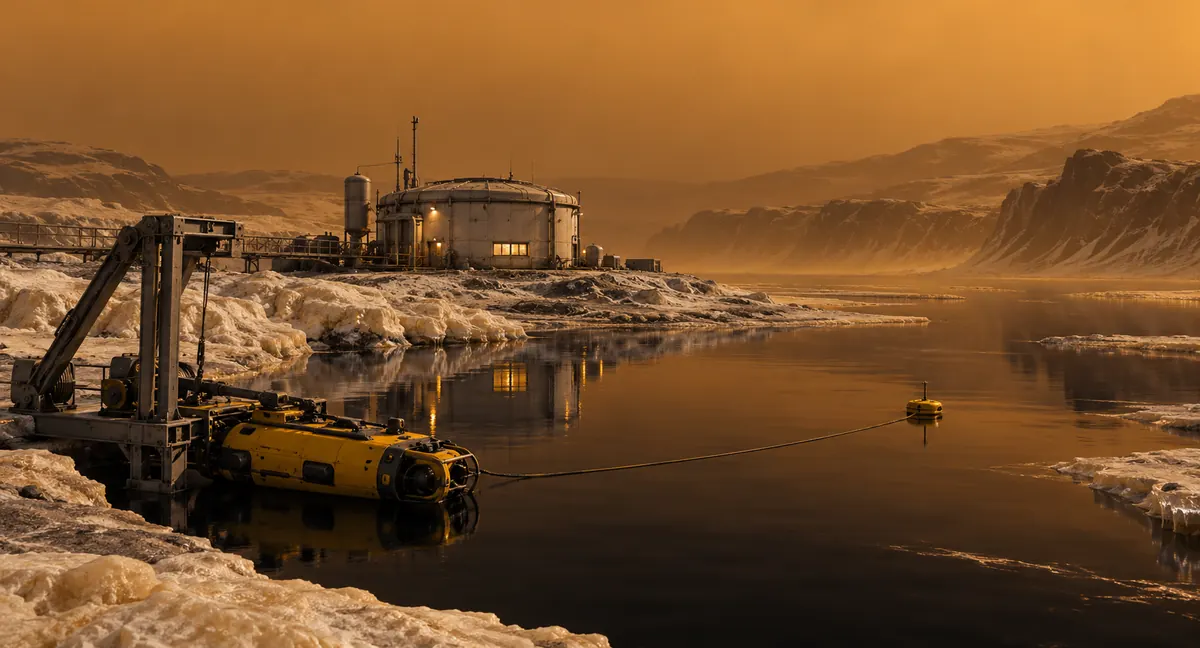
The empty inlet answered correctly eleven times.
On the twelfth, it returned an echo from something that should have been behind the lake bed.
Iona Tesswick took her feet off the desk.
“Don’t get interesting,” she told the display. “I’m nearly finished.”
Outside Aster Quay’s pressure hull, liquid methane and ethane moved beneath orange haze. Inside, a circulation fan clicked once every seven turns. Iona had requested a replacement bearing twice. The procurement system had offered her a replacement fan, a replacement housing, and advice on workplace noise.
She replayed the calibration.
A low pulse. A high pulse. The standard interrogation chirp.
The final echo had acquired a narrow second shoulder, as if the sound had found an extra surface below the first.
She reversed the first two pulses.
The shoulder disappeared.
Iona looked at the inlet camera. Its heated window showed a blurred strip of black liquid between pale banks of water ice. Nothing moved except a cable float nodding offshore.
She ran the sequence again.
Low, high, chirp: two shoulders.
High, low, chirp: one.
“Absolutely not,” she said.
At thirty-eight, after three rotations maintaining other people’s instruments, she had learned that machinery could produce almost any apparent discovery if sufficiently neglected.
She disconnected the automatic gain correction.
The shoulders remained.
She bypassed the software that removed electrical noise from the station.
The shoulders remained.
Then she turned to the second receiver, forty metres farther along the shore, which used different electronics and had spent most of the season being unhelpful in entirely unrelated ways.
It heard the shoulders too.
Above her screen, the service countdown changed to 04:41:00.
At the end of that countdown, Aster Quay would release six weeks of accumulated heat through its shore exchanger. A warmer plume would move through the inlet before mixing into Kraken Mare.
Iona opened the map.
The anomaly occupied a patch twenty metres across, directly in the predicted path.
Under environmental classification, the inlet read: INACTIVE SUBSTRATE. NO SIGNIFICANT STRUCTURE.
She recognised the wording.
She had written it.
Commander Saye was eating lentils from a pouch when Iona found her in the service bay.
“Is it an immediate safety problem?”
“No.”
“An approaching safety problem?”
“Not for us.”
Saye stopped eating.
Behind her, Emil Varga lay under an open pump cabinet, holding a torque wrench against his chest as though somebody might steal it.
“The inlet remembers the order of sounds,” Iona said.
Emil turned his head.
“The inlet would like us to stop testing it during lunch.”
Iona passed Saye the plot.
“Same final pulse. Same listening window. Different result depending on which pulse came first.”
“How different?”
“Seven times the measurement uncertainty. Repeatable. Two receivers.”
“Same transmitter?”
“Yes.”
“So it might be the transmitter.”
“Yes.”
Saye studied her. “You usually wait longer before bringing me an instrument fault.”
“The discharge starts in four hours and thirty-seven minutes.”
That made the room quiet enough to hear the pump cabinet cooling.
Aster Quay housed six people. Two were asleep ahead of the service operation. Of the four awake, Emil maintained the heat system, Nadi Bensaïd handled chemistry and environmental sampling, Saye carried responsibility for everything that could kill them, and Iona kept the underwater survey network from becoming expensive seabed decoration.
Saye wiped a thumb along the folded edge of the pouch.
“What do you want?”
“An independent source in the inlet. A look at the bed. The tethered sub.”
“We need that shore route clear before discharge.”
“I know.”
“And we cannot keep the storage bank charging indefinitely.”
“I know that too.”
Emil rolled out from under the cabinet.
“We have four hours of comfortable argument,” he said. “After that, the argument starts using engineering margin.”
The station’s power plant produced useful electricity and inconvenient heat. During quiet science periods, a phase-change bank held much of that heat so the base would not warm the water it was measuring. Periodic discharge restored the bank’s capacity.
There was another option: shut down the research loads and deploy the emergency heat-rejection array over the ice ridge behind the station.
It could keep the people and essential systems safe. It could not support the research programme. Once deployed and cooled, it required depot servicing before another science campaign. The reserve power and maintenance allowance would send them home on the next scheduled transport, seven months early.
No one had to die over an interesting echo.
But a great deal of work could.
Saye handed the plot back.
“You have ninety minutes of sub time. Show me a material reason to change the plan.”
“I can’t promise—”
“I’m asking for evidence, Tesswick. You brought me evidence. Get more.”
Nadi arrived at the instrument bench carrying a mug she had sealed with laboratory film.
“I hear you found a ghost.”
“A fault with unusual persistence.”
“Much less marketable.”
Nadi leaned over the plots. She had a narrow, thoughtful face and the habit of keeping her hands still when she was thinking.
“Why those frequencies?”
“They’re our routine boundary-layer calibration. One penetrates the upper sediment. The other mostly scatters.”
“And you’ve been doing this all season?”
“Across the network. Not this exact sequence here.”
“Why here now?”
“Discharge baseline.”
Nadi glanced at the countdown.
“Oh.”
They worked through explanations on the wall display.
Transducer ringing. Amplifier recovery. Automatic gain. Reflections from moving liquid layers. Bubbles.
“Bubbles would be convenient,” Nadi said.
“Bubbles rarely care about my convenience.”
They reduced the pulse strength. They increased the gaps. They left the inlet untouched for twelve minutes and returned with the interrogation chirp alone.
The extra shoulder was still there.
After twenty minutes without sound, it had weakened but not vanished.
Something retained a condition after the stimulus ended.
That could still be sediment settling into different arrangements. It could be a property of cold hydrocarbons in pores. It could be a receiver fault with a remarkably good sense of geography.
Iona directed identical sequences at the calibration plate near the dock.
No history dependence.
At a patch of coarse rubble west of the inlet.
None.
Back at the anomaly.
Two shoulders.
Emil called from the submersible locker.
“Little saint is ready. Battery predicts a hundred and eight minutes. I’d like her back before the prediction becomes literature.”
The submersible’s official name was Field Survey Vehicle Three. Someone had painted a saint’s halo around its forward camera after it survived a jammed winch. The paint had peeled into a pale, disapproving eyebrow.
Iona sent their observations to Earth, including raw data, equipment configurations and three competing explanations. She marked the packet urgent, then checked the light time.
Seventy-eight minutes one way.
An answer to the first question would arrive after they had already needed to ask six more.
Under proposed action, she wrote: Investigating before thermal service. No biological interpretation warranted.
Then she added: Potentially fragile structure.
She deleted potentially, considered the evidence, and put it back.
Launching anything on Titan involved insulation, connectors, and patience.
Iona was good at two of those.
In the shore vestibule, she and Emil locked their suit helmets and checked each other’s seals. The outer door opened onto a dim orange afternoon. Aster Quay’s white cylinders stood on short legs above the ice, linked by insulated passages. Beyond the docking cradle, the sea absorbed what little light reached it.
Their boots crunched through grains of frozen hydrocarbons.
Titan’s gravity made the sub seem deceptively manageable. Its mass remained stubborn. When Emil nudged the cradle, it slid farther than he intended, and both of them had to lean into the rail to stop it.
“Graceful,” Iona said.
“I was demonstrating inertia.”
The shore cable ran from the base to an anchored junction at the waterline, then into the sub’s slender tether. It carried commands and video. The vehicle’s battery powered propulsion, instruments and the heaters that kept its electronics alive.
A damaged tether would not freeze anyone. It would strand their only close view of the inlet, along with any samples.
Iona checked the armoured section where it passed over an ice shelf.
A pale groove marked the outer jacket.
“That’s new.”
Emil crouched.
“Shore settling. I checked it yesterday.”
He fitted a curved guide over the edge and anchored it farther inland.
“Slow on retrieval,” he said. “No sideways pull.”
They lowered the sub into liquid dark enough to look solid.
Back inside, Iona took the pilot’s chair. Nadi settled beside her with a sampling console. Emil remained at the winch controls.
Saye stood behind them.
On the screen, the dock’s underside drifted past: rough water ice, white under the lamps, cut by black cracks. Then suspended grains crowded the image.
“Visibility sixty centimetres,” Iona said.
“Optimist,” Nadi replied.
They navigated by short-range sonar and the known shore profile. Iona kept the thrusters low. In this gravity, fine sediment could take a long time to settle after a careless jet.
The inlet sloped gently down to twelve metres. At its centre, the bed returned the odd double echo.
The camera showed an untidy pale fuzz.
Iona stopped.
The fuzz resolved into clusters of thin blades rising from dark sediment. Each cluster was barely taller than a fingernail. Between them lay smooth areas, little corridors of exposed bed.
Nadi moved closer to the screen.
“Organic precipitate?”
“From the image?”
“From the image, I can confidently say it’s pale.”
The blades quivered under the weak flow from the vehicle.
Iona backed off.
The sub carried a small acoustic projector used for navigation tests. It had no connection to the shore transmitter’s amplifier or timing circuit.
She sent the low pulse, the high pulse, then the chirp.
Two shoulders.
Reversed the sequence at an adjacent patch.
One.
Saye put a hand on the chair back.
“Location fixed?”
“Within twelve centimetres.”
“Can motion explain it?”
“Possibly.”
Iona hated how small the word sounded. It was still the right one.
They held the sub still for another trial.
The blades changed.
Not all at once. Not like something turning to face them. Across one cluster, bright edges became dark, while others caught the lamp. A slight opening or folding, visible only because Iona had locked the camera exposure.
Nadi whispered, “Save that separately.”
“I am.”
After the pulse order reversed, several edges shifted again.
Saye watched the sequence twice.
Then she said, “That is a material reason.”
The countdown stood at three hours and eleven minutes.
The first sample fell apart.
Nadi closed the scoop beneath a cluster and lifted it with the lightest motion the arm allowed. Pale blades detached and drifted away. In the sample cup, the remainder became a shapeless tangle.
“Too much,” she said.
Her voice was flat.
Iona felt the same unreasonable distress she felt when a repaired instrument failed on its first deployment. They had not known how to hold it. That did not make the damage less real.
They moved to the edge of the patch, where a thin crust lay over firmer sediment.
On the second attempt, Nadi used a shallow coring shoe and lifted a plug with its supporting bed intact. The structure entered a transparent cold cell filled with local liquid.
The lid closed.
At Titan’s surface temperature, the sample could remain cold in an exterior rack. Bringing it into a laboratory would destroy its context before anyone reached for a microscope.
“One intact,” Nadi said.
She looked at the ruined first sample.
“One disassembled.”
Iona stared at the two cells.
Then she opened a fresh notebook page.
Until then, each test had answered the fault they had thought of immediately before it. Useful, but easy to fool themselves. They needed an experiment that made the explanations disagree in advance.
“Same liquid,” she said. “Same cell. Same amount of material, as nearly as we can manage.”
Nadi followed her gaze.
“One keeps the structure. One doesn’t.”
“Plus a liquid-only cell.”
“And a fixed reflector,” Saye said. “Something you already understand.”
Iona turned.
Saye shrugged. “I do listen at meetings.”
They had four sample positions on the sub’s rack. The fourth could take the small ribbed calibration tile used to check its close-range sonar.
The test would happen at the exterior dock, away from the inlet and the shore survey network. They would pulse the cells with the sub’s projector and read them with a separate receiver on the docking arm.
They would assign the pulse sequences beforehand, in balanced order. Neither the operator recording the echoes nor the person marking the camera images would see which sequence had been sent until the scoring was complete.
Each cell would receive equal total sound energy. Only the order would differ.
If the transmitter or liquid carried the history, the blank or reference should show it. If loose grains were merely settling, the damaged sample might behave similarly. If intact architecture mattered, the effect should travel with that architecture when they changed rack positions.
“It won’t tell us it’s alive,” Nadi said.
“No.”
“It may just tell us it’s an interesting piece of sediment.”
“I would be delighted to understand an interesting piece of sediment.”
Saye checked the service clock.
“How long?”
“Forty minutes after we dock. If the effect lasts.”
“And if it doesn’t?”
“We report that.”
They took two small supporting samples and left most of the patch untouched.
On the way out, Iona turned the camera back.
The lamps revealed a diminishing circle of pale blades. Beyond it, the inlet continued unseen.
For the first time since the anomaly appeared, she wanted an answer badly enough to distrust herself.
At the shore bend, the tether tension rose.
Not sharply. Just a slow increase against the winch’s steady recovery.
Emil stopped the drum.
“Hold position.”
Iona stopped the sub.
The tension remained.
On the overhead dock camera, the protective cable guide had tilted. A piece of the shelf beneath it had fractured away, leaving the tether pulled against the guide’s anchor.
“Can you lower it free?” Saye asked.
“I can put slack in,” Emil said. “I can’t tell where the slack will go.”
The sub’s endurance estimate read twenty-nine minutes.
The sample rack blurred in the rear camera, its cells rimmed with reflected light.
Iona eased the vehicle backwards along its incoming course.
For a moment, the tension fell.
Then the tether caught again.
She stopped before instinct could make her add thrust.
Outside, low gravity made moving the guide easy and getting a secure footing difficult. Emil would need a safety line, tools and someone at the inner door. That would take time.
“We can abandon the vehicle,” Saye said.
The words landed without drama.
There was enough acoustic data already to show a real anomaly. There was not enough to distinguish a vulnerable material from a persistent trick of their apparatus. The clean experiment was in four little cells hanging beneath a stranded machine.
Iona looked at the power estimate.
“Suit Emil,” she said. “Give me the slack he asks for. No more.”
Nadi rose to help him.
Saye remained behind Iona’s chair.
“You have something you want to say.”
It was irritating how often she knew.
“If we lose the samples, that doesn’t make the inlet empty.”
“No.”
“And if this is all mineral mechanics—”
“It may still matter.”
Iona tightened her hands on the controls.
“I wrote the baseline classification.”
“You had different evidence.”
“I had a faint layer I called bottom clutter. I could have looked harder.”
“Did anyone have time to look harder?”
“That isn’t a scientific defence.”
“No,” Saye said. “It’s a question about how we work.”
On the suit feed, Emil’s breathing grew loud. His helmet lamp swept across the ice.
He crawled the last few metres, clipping his safety line to a shore anchor. A boot pushed loose fragments away. They fell with dreamlike slowness.
“Guide’s trapped under the slab,” he said. “Cable’s intact as far as I can see.”
The battery estimate reached eighteen minutes.
He could lift the slab, but without weight to brace him, the effort moved his body instead. He stopped, changed his tether position and hooked one knee around the anchor post.
“Now give me half a metre.”
Iona fed the slack.
The tension dropped.
“Hold.”
Through Emil’s camera, she saw a narrow loop of cable against black water. He lifted it into the guide.
“Recover. Very slowly.”
Iona brought the sub towards the dock at less than walking pace.
Nobody spoke until its nose entered the cradle.
Emil laughed once over the suit channel.
“Saint has become a demanding religion.”
The vehicle locked into place with eleven minutes of usable battery left.
The intact sample did nothing.
That was how it seemed during the first two trials.
At the exterior docking station, the cell sat in its rack beneath a shield that prevented warmth leaking from the hull. Native liquid filled the acoustic path. A thermometer beside the sample showed less than a tenth of a degree of change.
Iona sent the next coded sequence.
The receiver showed a small, untidy reflection.
Nadi marked the image and closed it.
No one commented.
The method had required them to decide what counted before seeing the result. Iona had selected a ratio between two parts of the echo, plus the visible angle of several identifiable blade edges. Now she regretted every choice.
The inlet had been easy to see. Here, with a weaker projector and a much smaller sample, the signal looked miserable.
Saye left them alone and went to engineering.
The service countdown fell through two hours.
The automatic advisory changed from green to amber.
At the sixth trial, Nadi paused over an image.
“What?” Iona asked.
“Nothing I’m allowed to tell you yet.”
“That was cruel.”
“Experimental discipline is an ugly personality.”
They completed the first block.
Iona swapped the cells between rack positions using the dock manipulator, then repeated it. The receiver remained fixed. Every cell took a turn nearest the projector.
The damaged sample produced larger, messier echoes than the blank. The intact one produced smaller echoes than either of them had expected.
Small did not mean meaningless.
They finished the coded trials with seventy-nine minutes until the scheduled discharge.
Nadi overlaid her image measurements with Iona’s echo ratios. Emil, back inside with his hair damp from the suit, supplied the sequence key.
Two groups separated on the display.
Iona checked the labels.
Then checked them again.
The intact sample retained the order effect in every rack position. The reference tile did not. The liquid blank did not. The disassembled material shifted randomly, with no consistent relation to pulse order.
The camera measurements agreed with the acoustic ones.
Something in the intact blades settled into different configurations depending on which disturbance arrived first.
The effect had travelled from the inlet to the dock.
It had survived the return journey.
And it had persisted through intervals when every instrument looking at it was switched off.
Nadi sat back.
“Well,” she said.
Iona’s hands had begun to shake. She tucked them under her arms.
“Check the timestamps.”
They checked.
“Check whether the cell codes were visible in the images.”
They were not.
“Check—”
“Iona.”
Nadi turned the screen towards her.
One blade stood near the wall of the cell, its forked tip recognisable in both image sets. In one state, it leaned against a neighbour. In the other, the gap between them remained open.
“You can keep checking,” Nadi said. “But you’re allowed to see it.”
Saye convened the duty crew in the galley because engineering had become too loud.
The heat-storage bank’s pumps were circulating faster now. Their vibration came through the table.
Iona put three images on the wall: the inlet bed, the sample, the split between the coded trials.
“We have a physical structure that stores disturbance history,” she said.
Her voice sounded awkward in the room. The explanation had been clearer when she was addressing a machine.
“Not indefinitely. We haven’t established a decay time. Not every sample. We have one intact specimen, one damaged specimen, and controls that rule out several instrument explanations.”
“Could the structure be ordinary chemistry?” Saye asked.
“Yes.”
“Could it be something we’ve made?”
“Contamination remains possible. The patch is near our shore operations.”
Nadi shook her head slightly.
“Possible, but we haven’t used anything with this appearance. We’ll need a proper chemical comparison.”
“Could it be alive?”
“We can’t answer that,” Iona said.
“Could heat damage it?”
Nadi enlarged the cell image.
“The blades are thin and mechanically fragile. We don’t know their composition. We don’t know whether warming changes their solubility or the liquid between them. The discharge would expose them to conditions we haven’t tested.”
“How far outside natural variation?”
“We don’t have a full Titan year of local measurements.”
Saye folded her hands.
“That is a lot of uncertainty.”
“Yes,” Iona said.
She felt the old urge to qualify herself into silence. A meeting could turn an honest limitation into a reason to move on. She had allowed that to happen before.
This time she kept speaking.
“We know enough to withdraw the word empty. We don’t know enough to predict what our plume will do. If we discharge now, we change the thing before we understand the measurement.”
Emil rubbed his forehead.
“The emergency array could hold us at minimum load through transport arrival. That was checked this morning.”
“And the campaign?” Nadi asked.
“Ends. Cold storage stays cold. Life support stays boring. The rest starts shutting down today.”
Nadi looked at the table.
Her atmospheric chemistry programme had been waiting two years for the coming seasonal conditions. Three of the instruments had travelled from Earth before she joined the project.
Iona knew the quiet instrument pod by its diagnostic sound. She had kept it alive through two heater failures.
“I’m sorry,” she said.
Nadi looked up.
“For finding this?”
“For the cost.”
“You don’t get all of it,” Nadi said.
Saye’s expression changed slightly.
Nadi continued, “I haven’t agreed yet. But you don’t get to make this your solitary moral injury. Some of the cost is mine.”
Emil nodded.
“I’d like my share itemised. I have excellent complaints.”
Saye brought up the discharge model.
There was no honest way to divert the plume. Aster Quay’s exchanger outlet lay beneath the shore, fixed in place. Pumping more slowly would broaden the exposure. Releasing at another point required equipment they did not have. Holding a few more hours would consume margin without creating a new option.
They could complete the expensive mission as planned.
Or they could stop.
“Give me ten minutes to inspect the emergency sequence,” Saye said. “Then I’ll make the call.”
While the commander checked the safety case, Iona returned to the cold sample.
The instruments were silent.
Without the pulse sequences, the little blades looked like debris caught in a transparent box.
She wanted to name them. Something memorable. Something that might attach her to the discovery when the papers began and the larger institutions arrived.
For three rotations, her work had lived in acknowledgements or nowhere at all. She had coaxed batteries through the cold, separated real signals from bad connectors, and spent one entire week persuading a sediment profiler that its pressure sensor was attached.
She had imagined going home with a beautiful result carrying her name.
Now the most defensible sentence she could write was: An intact specimen exhibited reproducible history-dependent mechanical states.
It was not beautiful.
She read it again.
It was hers.
Nadi came in with two sealed food pouches.
“Eat.”
“I’m documenting.”
“Then document sauce.”
They sat side by side.
“Do you think there are more?” Nadi asked.
“In the inlet?”
“Elsewhere.”
Iona looked at the map. The network covered a sliver of the shore of an immense sea. Their survey routines averaged faint, messy echoes because the researchers wanted clean measurements of larger things.
“Probably a great deal we’ve been calling clutter.”
Nadi pushed her pouch flat.
“I don’t want to lose the season.”
“Neither do I.”
“I also don’t want to publish a careful description of what was here before we serviced a radiator.”
Iona gave a brief laugh.
“That would be a poor title.”
The station chimed.
Saye’s voice came over the room speaker.
“Duty crew to engineering. We’re deploying the emergency array.”
The decision became real through a sequence of ordinary losses.
Nadi powered down the atmospheric instrument pod. Its warm-up cycle could not be repeated on reserve allowances.
Emil isolated the laboratory heat loops.
Iona shut down the deep survey transmitters, one by one. Across her map, active symbols became grey. Months of planned crossings and acoustic profiles disappeared from the schedule.
The sleeping crew were woken, briefed, and given jobs. Nobody cheered. One asked whether the discharge could wait until Earth replied. Saye showed him the storage margin and the communication clock.
He read them, nodded, and went to secure the laboratory freezers.
Outside, the emergency array unfolded over the ridge: dark panels lifting from insulated cassettes, coolant lines stiffening between them. It had to reject heat into Titan’s atmosphere and sky, away from the shore experiments.
Its capacity was smaller than the normal service system. Enough for a quiet station waiting to leave.
Not enough for the station they had intended to be.
As the panels reached position, a coolant valve reported incomplete travel.
The deployment paused.
Iona watched Saye’s face.
Emil called up the manual actuator camera.
“Position sensor,” he said. “Maybe.”
“Verify.”
He sent the actuator back and forward once. The camera showed the stem reaching its mark. The downstream temperature lagged, then began to change.
A second independent sensor confirmed flow.
Emil released a breath.
“Valve open. Feedback switch sulking.”
“Log it,” Saye said.
The array accepted its first heat load.
On the storage display, the rising line slowed.
Held.
Began to fall.
Only then did Saye cancel the thermal discharge.
There was no grand announcement. She entered the reason in the operations log, read it once, and signed.
New evidence invalidates environmental baseline at receiving site. Emergency mode selected to preserve investigation options.
She passed the console to Nadi, then Emil, then Iona.
It was Saye’s command decision. The additional names recorded that they had reviewed the evidence and understood the consequence.
Iona signed carefully.
She had defended an idea in a meeting.
She wished the achievement had come with less nausea.
The first Earth reply arrived after dinner.
It acknowledged receipt, requested raw files already sent, suggested tests they had already performed, and warned against premature biological interpretation.
Emil read that part aloud.
“Excellent. We shall refrain from electing it.”
No one had the energy to laugh much.
A later packet would bring experts, arguments, proposals, and probably questions that made Iona feel foolish. That was welcome. They had preserved something those questions could still be asked about.
Saye sent the operational decision and the complete control results. She requested specialist review, a transport adjustment, and a revised environmental survey before any future shore discharge.
Then the crew began preparing to leave.
The intact sample remained outside, in an insulated cold cradle with independent temperature logging. The damaged specimen stayed beside it. Nadi insisted on keeping that one too.
“It tells us what our handling did.”
Iona understood.
They returned the liquid-only control to the inlet through a clean line and retained the cell for contamination testing. Every tool that had touched the bed was bagged for later analysis.
For the next two days, the station used only sparse, low-energy observations at a single marked part of the patch. No broad sweeps. No repeating the exciting result for visitors on the communications queue.
The decision to stop had changed their questions.
How little sound was enough to measure a state?
How long did that state last without interference?
What did their ordinary calibration routine do to an environment that kept its disturbances?
Iona rewrote the network software to retain pulse history beside every observation. Not merely the sound used to make a measurement, but the sounds that came before it.
The old files had discarded most of that information.
She left the missing fields empty.
On the third morning, the inlet gave them something they had not asked it to do.
Iona was comparing images from a fixed camera lowered at the edge of the patch. It used brief lamp exposures and no sonar.
A cluster disturbed during their sampling had partly collapsed. In the first image, two blades lay against the sediment, still connected to the base. In the next, taken nine hours later, their angles had changed.
She checked the camera registration against three grains of ice.
No movement.
She checked the lamp geometry.
No change.
She called Nadi.
Together they followed the tiny bright edges through the sequence.
Liquid moved through the inlet in a slow, measured current. The connected blades had shifted with it, settling into a new arrangement. A detached fragment nearby had simply rolled away.
The standing cluster now scattered light differently from its undisturbed neighbour.
They had not seen growth. They had not seen purpose. They had seen an intact structure respond to a natural disturbance and retain a different shape afterwards.
The inlet did not require their instruments to acquire a history.
Iona sent Saye the images with three sentences and no adjectives.
The commander came down in person.
For a while, the three of them watched the loop.
“Can we explain it?” Saye asked.
“Partly,” Nadi said. “The current supplies the motion. The architecture constrains it. We don’t know what maintains the architecture.”
Saye nodded.
“Keep that wording.”
Before departure, they would mark the inlet as a protected investigation site in the station’s operating maps. It was a local precaution, within Saye’s authority, subject to review. Future crews would have the evidence and the coordinates. They would also inherit a requirement to account for disturbances before adding new ones.
Iona entered the final classification herself.
STRUCTURED SUBSTRATE. HISTORY-DEPENDENT RESPONSE. THERMAL SENSITIVITY UNKNOWN.
She left room beneath it.
Outside, the orange haze hid the far shore. Kraken Mare continued beyond their small field of view, dark and cold, carrying currents through places no instrument had listened.
Behind her, the circulation fan clicked once every seven turns.
Iona opened a maintenance ticket, then closed it.
She could change the bearing before they left.
For the inlet, she had finally learned to leave a different kind of space: enough time, and enough quiet, for the next question.
Every ending is somewhere new.
Find your next story →