The Missing Years of Cwm Eithin
When an Oxford historian uncovers a vanished Welsh valley, her search for the truth threatens a cherished nature reserve—and draws her toward the man trying to save it.
The valley disappeared on a Thursday, somewhere between the receipt for six barrels of oats and the cost of hanging a thief.
Dr. Eleanor Wychmere turned the parchment back.
There it was in 1387: Cwm Eithin, eleven holdings, two mills, grazing rights above the alder wood. Four years later, nothing. Not abandoned. Not forfeited. Simply absent.
She checked the stitching.
Across the reading room, someone coughed with the elaborate restraint of a scholar who wished to survive without inconveniencing history.
Eleanor brought the manuscript closer on its foam cradle.
The surviving leaves had been renumbered. An old index contained a scraped patch exactly where the valley should have appeared.
“Well,” she whispered. “That seems excessive for oats.”
At fifty-four, she had developed considerable patience for medieval clerks. University committees received less.
Her current project concerned disputed Welsh land tenure, a subject her funding panel had described as valuable provided she could make it sound less like disputed Welsh land tenure. She had six months left on the grant and a promised book chapter already three weeks late.
She requested another bundle.
By closing time, the gap had spread.
The valley had vanished from the lordship’s rent account, its surviving court summary and a later copy of its boundaries. These were records of a crown-administered estate, temporarily in royal hands. Different clerks. Different purposes.
The same four missing years.
Outside the Bodleian, October rain polished the cobbles. Eleanor stood beneath the arch, settling her hand around her cane.
She had intended to spend the winter making a sensible argument about inheritance.
Instead, someone dead for six centuries had tried to hide a valley.
That seemed discourteous enough to investigate.
Nine days later, James Penrath arrived at her college carrying a map tube and two coffees.
Eleanor glanced at the cups.
“A bold interpretation of an invitation to discuss documentary evidence.”
“Your secretary said you’d forgotten lunch.”
“She’s the college administrator. She resents being mistaken for my secretary almost as much as she resents my forgetting lunch.”
“I’ll apologise.”
He was forty-three, according to the biography she had read before agreeing to meet him: ecologist, former river restoration specialist, director of the Cwm Eithin Nature Partnership. In the photograph, he had been standing knee-deep in water.
In person, he wore a repaired waterproof jacket and had the disconcerting composure of someone comfortable being watched.
He put one coffee within reach and spread his map across her office table.
The valley was there, inconveniently real.
Woodland gathered along a river. Wet meadows widened below an abandoned country house. The reserve’s proposed boundary enclosed almost everything.
“We’ve spent four years negotiating the acquisition,” he said. “The estate’s selling at a substantial discount. Our main grant decision is next month.”
“And my inquiry to the county archive reached you.”
“The estate solicitor forwarded it. Something about eleven vanished farms.”
“Holdings. A holding might support several households.”
His expression sharpened.
“How many people?”
“I don’t know.”
He waited rather than filling the silence. She liked that.
Then he tapped a blue curve on the map.
“This boundary you requested information about—the old mill leat?”
“Yes.”
“It isn’t a leat. The slope’s wrong. It carries floodwater away from the river.”
Eleanor looked again.
The modern map labelled it Mill Race. Her working transcription called it the lower water.
“Who named it?”
“An estate surveyor, probably. We inherited several confident errors.”
“Academia has the same arrangement.”
He smiled.
She showed him the account photographs. He leaned over without touching the originals on her desk.
“So the valley stopped paying rent.”
“The record stops saying it paid rent. Those aren’t necessarily the same thing.”
“Could the boundaries have changed?”
“Yes. I’ve spent nine days trying to prove something dull happened.”
“And?”
“The dull explanations are putting up disappointingly little resistance.”
James sat back.
“I hoped this might help us. Historical continuity. People caring for the same place for centuries.”
“It might.”
He heard the qualification.
“And it might not.”
“I don’t write conclusions in advance. It saves trouble with the evidence.”
For the first time, his confidence looked less effortless.
“Would you come and see it?”
She glanced at her calendar. Two meetings concerned whether a third meeting should take place.
“When?”
The road into Cwm Eithin narrowed between banks dark with rain.
James met her at the station in a muddy electric van whose passenger footwell contained a wader, a folded survey pole and a packet of ginger biscuits.
“Excellent filing system,” Eleanor said.
“The biscuits are indexed.”
She moved the wader herself. He put her case in the back and asked whether the seat gave her enough legroom.
It did.
Beyond the village, the hills opened.
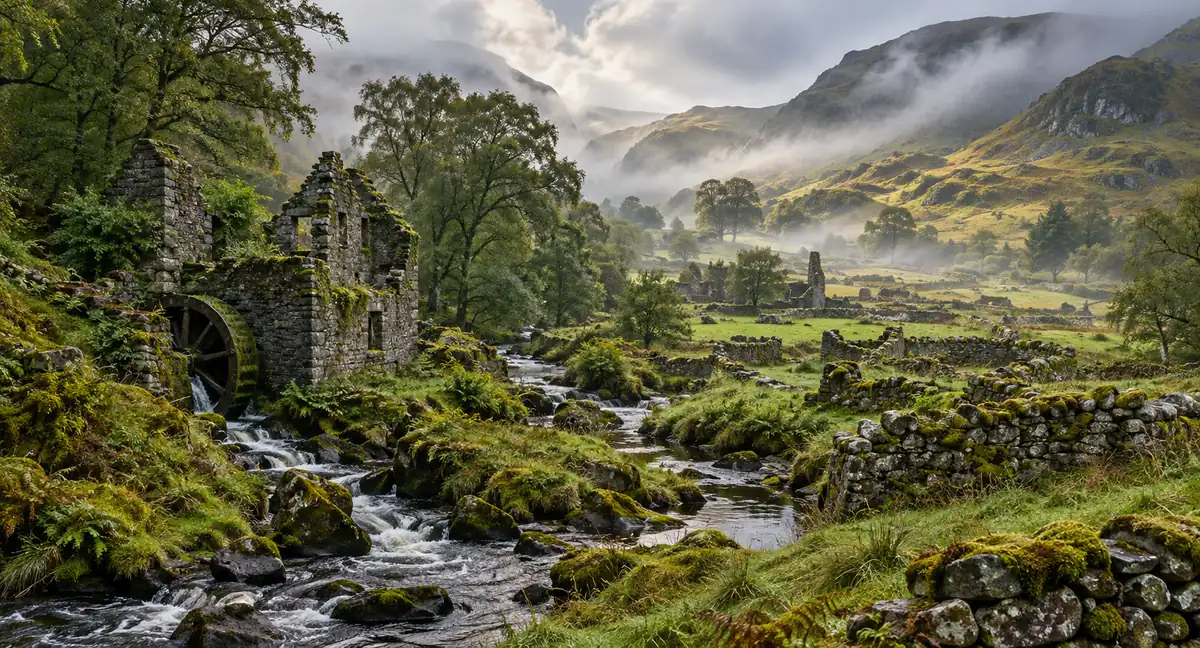
Gold bracken climbed the slopes. Sheep stood against ruined field walls. The river flashed through alder trunks, then spread into a pale, reed-fringed reach.
James stopped beside a low building that had once housed estate machinery.
“This will be the field station. If everything happens in the correct order.”
“And if it doesn’t?”
“It will remain an expensive shed.”
A woman in a red wool hat emerged carrying a sampling tray.
“Dr. Wychmere? Carys Trefellan. Community liaison, occasional fence repair, frequent breaker of printers.”
“Eleanor. Medieval property law and related disappointments.”
Carys laughed and shook her hand.
Behind them, the valley rose towards Plas Eithin. The house stood shuttered above a terrace, its chimneys uneven against the cloud. Rhododendrons crowded the lower windows.
“The estate papers are still inside?” Eleanor asked.
“What’s left,” James said. “We’ve permission for tomorrow. The safe rooms, anyway.”
Carys’s smile faded.
“My grandmother cleaned there. She said the family kept everything except money.”
“Did she know an older name for the valley?”
“Cwm y Cloch.”
Eleanor looked up.
“Valley of the bell?”
“Supposedly there was a chapel. Nobody’s found it.”
James pointed upstream.
“People put it near the old quarry.”
“On what evidence?”
“Mostly that there’s somewhere flat.”
“A powerful school of archaeology.”
He gave her a sideways look.
“I’m beginning to understand why you came alone.”
They walked to the river by the accessible survey track. James shortened his pace without fuss, stopping to show her where the bank had been cut back so winter floods could spread across the meadow.
Eleanor studied the hills.
Her vanished holdings had owed rents in oats, cheese and labour. Down here, the ground was wet enough to swallow a boot.
“Where would you grow grain?”
“Higher. Those terraces on the eastern slope.”
She had taken them for natural shelves. Now she saw their regular edges.
James followed her gaze.
“We thought they were nineteenth-century.”
“They may be. But I’d like to see the survey.”
“And I’d like to know why you just stopped looking cold.”
For a moment she almost told him: because the people in her account had acquired somewhere to stand.
Instead she said, “Professional excitement. It’s embarrassing but rarely fatal.”
The first promising lead occupied most of the next day and produced absolutely nothing.
An 1892 catalogue listed a chest at Plas Eithin containing “ancient muniments of the lower valley”.
The chest survived.
Its contents did not.
A burst pipe in the 1970s had reduced the bottom layers to a leathery block. Above them lay Victorian shooting permits and three immaculate bills for piano tuning.
Eleanor stood in the estate library beneath a ceiling propped by steel supports.
“Perhaps the medieval tenants played.”
James, who had spent an hour easing the swollen chest open, lowered himself onto a dust-sheeted chair.
“Badly, judging by the maintenance.”
They had permission to examine the library and adjacent office. Red tape marked a corridor the structural surveyor had forbidden anyone to enter.
Eleanor kept away from it.
Failure annoyed her. Being crushed by an orangery would annoy her more.
By afternoon, she had found only an incomplete nineteenth-century translation of a medieval account. The translator had rendered a phrase as “expenses following the submission of the men of the valley”.
“Submission sounds peaceful,” James said.
“It can be. So can ‘settlement’, until lawyers arrive.”
The original was missing. The translation had no reliable reference.
She photographed it as a lead, nothing more.
James found the estate survey rolled behind a cabinet. Together they weighed its curling corners with clean glass weights.
It showed the river before straightening, a lost track and a rectangle labelled Old Pound.
The pound lay halfway up the eastern slope.
Eleanor copied its position.
Outside, rain began rattling against the library’s boarded window.
“You think people were hurt,” James said.
“I think several administrative records were altered. People might have been moved. Their tenures might have been changed. A settlement might have been destroyed.”
“And you won’t choose yet.”
“No.”
He rubbed dust from his wrist.
“I’m trying to decide whether I find that reassuring.”
“You could wait for more evidence.”
He looked at her, then laughed.
On the way out, she noticed three iron deed boxes behind the former steward’s desk. Their labels ran from mortgages to water rights.
The archive catalogue had never mentioned them.
A handwritten inventory inside the top box began in 1908.
She asked for permission to return.
They spent the following evening in the field station, with a portable heater clicking beneath the table.
The deed boxes were still at the house. The estate solicitor had agreed to supervised examination on Friday. Meanwhile, Eleanor compared photographs of the survey with the estate’s modern title plan.
James worked opposite her, preparing an objection to a proposed drainage culvert.
Occasionally he swore quietly at his laptop.
“Academic writing?” she asked.
“Grant portal.”
“My condolences.”
He got up to make coffee and returned with a cushion from the van.
“For the chair,” he said. “Its designer seems to have objected to the pelvis.”
She accepted it.
After a while, she put two maps side by side.
“Your purchase boundary includes the eastern terraces.”
“Yes.”
“The estate’s sale particulars from 1923 describe those as excluded land.”
His fingers stopped over the keyboard.
“How much?”
“Perhaps seventy acres. The plan’s detached, so I can’t be certain.”
“Our solicitors examined the registered title.”
“I would hope so.”
“What exactly are you suggesting?”
“Nothing yet. A sale catalogue isn’t a conveyance. But ‘excepting the lands held under the Eithin settlement’ deserves a question.”
He came around the table.
The reservation covered the wet meadow too. The future field station stood close to its edge.
“Could someone still have a claim?”
“Possibly. Not because their ancestor paid rent in 1387. Modern ownership needs a modern legal basis.”
“Descendants have approached us before. Family stories about land taken from them.”
“What happened?”
“We referred them to the estate.”
Eleanor looked at him.
“I know,” he said. “It sounds inadequate now.”
“It may have been inadequate then.”
He stood still.
She regretted the sharpness, though not the point.
“We were trying to buy land for public benefit,” he said.
“Which is admirable. It doesn’t establish who has the right to sell it.”
After a moment, he nodded.
“I’ll ask our solicitor to explain the exclusion.”
It was a small answer. She trusted it more than a large one.
Later, as they packed up, he said, “I did assume you’d be on our side.”
“I’m rather hoping the evidence allows me to be.”
“And if it doesn’t?”
She closed her notebook.
“Then I’ll be particularly tiresome.”
His mouth moved, almost a smile.
“I think I’d already allowed for that.”
Back in Oxford, the massacre emerged from three documents that had never been kept together.
The first was an account Eleanor had dismissed because it concerned transport, not land. It recorded payment for carts bringing quicklime to the “lower enclosure” in 1389.
Quicklime alone proved little.
The second was a petition preserved among ecclesiastical papers. A Welsh colleague helped her resolve an abbreviated place-name and the damaged Latin describing a bell carried away, households confined, and survivors refused burial of their kin.
The petition named a royal commissioner.
The third was a payment made under that commissioner’s authority: wages for armed men guarding the enclosure, followed by an instruction that the valley’s arrears and tenancies be omitted from the next accounting.
Not forgiven.
Omitted.
Eleanor sat very still.
She had wanted an answer. The arrival of one did not feel like victory.
She called James.
He came to Oxford the next afternoon, bringing the modern solicitor’s response and sandwiches that had suffered badly on the train.
They worked in the college library after dinner, at a table beneath a portrait of a benefactor famous for generosity with money acquired elsewhere.
“The commissioner reported a rebellion suppressed,” Eleanor said. “No names. No households. The petition describes people driven into an enclosure after refusing an extraordinary levy.”
“The Old Pound.”
“Perhaps. The petition places it above the flood channel and below cultivated terraces.”
He opened his laptop.
“We surveyed a raised rectangle there. Rubble under the turf. I thought it was a livestock enclosure.”
“It might have become one later.”
He studied the account.
“Can you prove the king ordered it?”
“No. Royal officers committed it. Crown administration paid for it and concealed the consequences. Anything beyond that would be an unsupported claim.”
“And the missing records?”
“Removing tenures made the survivors disappear as lawful occupiers. Then the accounting history could begin again.”
James pushed his sandwich away.
Beyond the window, bicycle lights slid through the rain.
“What did our solicitor say about the excluded land?” she asked.
He passed her the letter.
The estate had registered its title in the 1980s. The registration file mentioned a missing settlement deed, dismissed after a statutory declaration from the owner. There had been no surviving trustees to challenge it.
The reserve’s grant required satisfactory title.
A credible claim could stop the purchase.
“They say we need the executed settlement and its plan,” James said. “Without them, nobody knows what was excluded or for whose benefit.”
“Friday, then.”
“Our funder won’t hold the award indefinitely.”
“No.”
“Four years,” he said quietly. “People gave us weekends. Pensioners sent ten-pound notes. We’ve got water voles breeding along a channel that was sterile when we started.”
Eleanor looked down at the petition.
“And other people have been waiting much longer to be believed.”
“I know.”
He sounded angry. Not with her alone.
She let the silence stand.
At ten, the librarian came to lock the room. They packed their papers and walked beneath the cloister, the stone shining damply in the lamps.
“Did you always know you wanted this?” James asked.
“Late nights with contradictory documents?”
“The work.”
“Yes. It was the simplest thing about me.”
“What was complicated?”
She considered giving him a joke.
“Making room for anything I couldn’t schedule.”
He waited.
“I never married. There was always another fellowship, another manuscript abroad. Eventually people stopped asking whether I minded.”
“Do you?”
“Some days. Not enough to pretend I chose badly.”
“That sounds fair.”
She glanced at him.
“What about you?”
“Divorced. Six years. I used to treat every difficult conversation as something we could have after the current project.”
“Did you run out of projects?”
“No. She ran out of patience.”
He said it without asking to be excused.
At the lodge, he reached for his umbrella and discovered he had left it in the library.
Eleanor opened hers.
“It’s narrow,” she said.
“I’ve done fieldwork.”
They crossed the quadrangle close enough for their shoulders to touch.
Friday brought bright weather and an unhelpful solicitor.
Not hostile. Worse: reasonable.
On a video call from Cardiff, the estate’s representative explained that the proposed sale could not proceed amid allegations based on incomplete records.
“Then we should complete them,” Eleanor said.
The representative adjusted his glasses.
“The owners are concerned about reputational damage.”
“The people confined in the enclosure had similar concerns about physical damage.”
James looked down at his hands.
The solicitor agreed to the search.
Afterwards, James said, “That wasn’t diplomatic.”
“No.”
“It was quite satisfying, though.”
They returned to Plas Eithin with Carys and an archive conservator named Bethan, hired from the reserve’s dwindling research budget.
The first deed box contained mortgages.
The second held drainage agreements and an astonishing dispute about a gate.
The third contained correspondence about a settlement established in 1908 by the estate owner’s widowed sister, who had inherited land separately.
There was no executed deed.
Eleanor kept working.
The correspondence referred to local families, displaced customary tenants and an obligation acknowledged by the family “following examination of the old papers”. One letter described land to be held for named households and their successors under defined conditions.
A schedule listed surnames still common in the village.
Carys read them without speaking.
At the bottom lay a solicitor’s invoice for engrossing a deed in duplicate.
One copy had gone to the trustees.
The other had been placed in “the western strong cupboard, steward’s office”.
James glanced at the room around them.
No cupboard.
“The office moved,” Eleanor said.
She laid the 1892 floor plan beside the modern safety survey.
The current office had been a smoking room.
The old steward’s office lay beyond the red tape.
They did not go through it.
This disappointed Eleanor sufficiently that James bought Welsh cakes on the way back.
“Bribery,” she said.
“Blood sugar.”
The structural surveyor could attend on Monday. The county archive would search its uncatalogued solicitor deposits for the trustees’ counterpart, but not before the following week.
Meanwhile, the title inquiry had reached the funder.
James was given until Wednesday to explain whether the acquisition remained viable.
That evening, they walked the lower track. Rain hung over the distant ridge, but sunlight still caught the river.
Carys’s grandmother had been one of the named households’ descendants. She was helping organise a village meeting, with independent legal advice requested.
“The grant team suggested we describe the historical research as preliminary,” James said.
“It is preliminary in places.”
“And avoid mentioning the settlement until the deed appears.”
Eleanor stopped beside a gate.
“Are you asking me to?”
“No. I’m telling you what they suggested.”
“What did you say?”
“That our title review had uncovered a material question.”
She watched a bead of water move down the gate’s top bar.
“That was expensive.”
“Potentially.”
“You’re allowed to resent it.”
“I do resent it.” He leaned against the post. “I also resent that the estate was prepared to take our money without explaining a missing deed.”
“The registration may have been made in good faith.”
“You’re defending them now?”
“I’m refusing to know things I don’t know. It’s a dreary habit.”
He laughed, then grew quiet.
“If this fails, I don’t know what I’ll do with the valley.”
“It won’t stop being here.”
“The restoration team might.”
She understood that. A project was never just an idea. It was people’s wages, borrowed faith, promises made in rooms that smelled of instant coffee.
“I won’t let them simplify your work into the villain of this,” she said.
“You can’t control that.”
“No. But I can be precise.”
He turned towards her.
She had become aware of him in small, inconvenient ways: the lift of his eyebrow before an argument; his voice when speaking to volunteers; the care he took to answer the question she had actually asked.
Now he was standing close enough that she could see rain caught in his hair.
“I’m trying,” he said, “to work out whether asking to kiss you would make an already complicated week worse.”
“No,” she said. “It would introduce a separate complication.”
“Would you welcome it?”
“Yes.”
He touched her cheek first, giving her time.
Then she caught the front of his jacket and kissed him.
The restraint between them broke with startling warmth. His hand settled at her waist; hers moved to the back of his neck. The gate pressed cold against her hip, the river sounded below them, and for several breaths the century they occupied seemed entirely sufficient.
When they drew apart, James rested his forehead lightly against hers.
“Separate complication,” he said.
“Substantial research potential.”
His laugh warmed her mouth when he kissed her again.
On Monday morning, the surveyor cleared a route through the old service entrance to the steward’s office.
The main corridor remained unsafe. The outside route involved six steps, a landing and a door swollen in its frame.
Eleanor inspected it, then inspected James.
“Don’t look so carefully indifferent.”
“I’m deciding whether to offer an arm.”
“Offer. I can decline.”
He did. She accepted it on the uneven steps and released him at the top.
Inside, damp had blistered the paint. The room smelled of wet plaster and old coal.
The strong cupboard occupied the west wall behind a fallen panel.
Its lock had seized.
A locksmith was booked for Tuesday.
By then, heavy rain was forecast.
James checked the guttering, the drain beside the service entrance and the slope above it.
“This room flooded in the winter survey,” he said.
Bethan examined the cupboard’s rusted base.
“If there’s paper inside, tomorrow morning is better than tomorrow afternoon.”
The estate agreed. The locksmith moved another appointment.
They left with measurements, photographs and a retrieval plan.
That night, Eleanor prepared two documents: a carefully qualified historical summary for scholarly review and a factual account of the title evidence for the village meeting.
James sat across from her at the field station, cancelling a launch reception.
At half past eleven, he closed his laptop.
“Our largest private donor has suspended their pledge.”
“How much?”
“Enough that I’d prefer not to say it before bed.”
She took off her glasses.
“I’m sorry.”
“I know.”
For a moment, the table between them felt very wide.
Then he came around it and held out his hand.
“Would you like company?”
She took it.
They sat together on the battered sofa beneath a blanket that smelled faintly of clean laundry and field station. Eleanor rested against him, feeling the day slowly loosen.
“I’m not particularly good at this,” she said.
“Blankets?”
“Allowing another person to be present when I’m unhappy.”
“You seem to be managing.”
“I’m making notes.”
His lips brushed her temple.
They talked until the heater switched itself off. When he walked her to the guesthouse, neither pretended the kiss was an accident they could file away.
By Tuesday morning, the rain had found every weakness in Plas Eithin.
Water spilled from a broken downpipe. The drain beside the service entrance was backing up.
James called the estate manager before they unloaded.
“The culvert’s obstructed. We need your grounds contractor here now.”
The locksmith opened the cupboard at nine seventeen.
Inside stood shelves of metal dispatch tins and tied bundles, dry above, damp below.
Bethan began directing the removal.
“Keep the bundles supported. Don’t separate wet sheets. Eleanor, can you record labels?”
Eleanor sat at the sound end of the room with a pencil and numbered crates.
For twenty minutes, they worked steadily.
Then James came in from outside.
“The contractor’s forty minutes away. Water’s crossing the landing.”
Bethan looked at the lowest shelf.
“Ten minutes?”
James checked the threshold.
“Five, then reassess.”
The settlement was not in the tin labelled Settlements.
That contained marriage portions and a faded photograph of a horse.
Nor was it among the deeds under Eithin.
Eleanor felt the peculiar panic of a researcher watching time become physical.
She went back to the inventory photographs.
The solicitor’s invoice had been folded with correspondence dated 1911. She had treated that date as irrelevant: the deed had been executed in 1908.
Now she read the covering letter again.
Returned after endorsement of appointment.
“Trustees,” she said.
Bethan looked up.
“It was taken out when the trustees changed. It may have been filed under appointments.”
James handed her the tin.
Outside, something struck the steps with a hollow clatter.
“The drain cover,” he said, and went to the door.
Eleanor lifted a bundle marked Appointments and Retirements.
There lay a thick folded parchment, its outer face stained brown along one edge.
A plan had been sewn into the fold.
Bethan slid a board beneath it.
“Don’t open it here.”
Across the doorway, a thin sheet of water entered the room.
James returned.
“We leave now. The contractor can manage the drainage when he gets here.”
There were still two shelves.
Eleanor looked at them, then at the crate containing the possible deed.
She wanted everything. Every missing name, every explanation.
“Agreed,” she said.
They carried the crates through the service entrance. Bethan took the documents; James handled the heavier tins. Eleanor followed with the inventory secured inside her coat, testing each wet step before committing her weight.
At the foot of the stairs, James pointed towards the upper drive.
“We can’t use the lower track.”
Water was already sheeting across it.
“The survey,” Eleanor said. “There’s a path behind the kitchen garden.”
“Blocked by the fallen cedar.”
“Not that one. The earlier path. It joins your flood channel.”
He looked uphill, considering the ground rather than the map.
“The bank beside it would stay above this.”
“It reaches the west gate.”
“I can check the first bend.”
He did, returned, and took two crates ahead while Bethan accompanied Eleanor along the firm gravel ridge beneath the moss.
The old route curved through dripping hazel.
Below them, floodwater entered the channel the modern map called Mill Race.
James stopped long enough to look back.
“It’s doing exactly what you said,” Eleanor told him.
He shook his head.
“What somebody understood a long time before me.”
At the west gate, the van waited on higher ground.
Only after the documents were inside did Eleanor realise her hands were shaking.
James held out a towel.
She took it, then caught his wet sleeve.
“Next time,” she said, “we investigate a dry county.”
The settlement unfolded beneath controlled light in Bethan’s conservation studio two days later.
There was no triumphant cracking of seals. There were supports, patience and a long discussion about a fragile fold.
Eleanor rather preferred it.
The deed established a trust for specified valley households and eligible successors, with provisions for replacement trustees. Its purpose included common grazing, access and relief of hardship.
The attached plan excluded seventy-three acres from the surrounding estate.
The wet meadow. The eastern terraces. The land beneath the proposed field station.
It was not a six-hundred-year-old title magically restored.
It was a twentieth-century legal instrument that the later registration had failed to account for.
The accompanying papers explained why it had been made.
The landowner’s sister had read a medieval petition preserved in the estate collection. She had commissioned genealogical inquiries, imperfect by modern standards, and sought to make a practical settlement with local families.
Her letter to her solicitor ended without sentiment.
I cannot repair what was done. I can stop receiving its entire advantage.
Eleanor read it twice.
The modern lawyers would have to determine beneficiaries, revive the trust’s administration and seek correction of the title. There would be objections, delays and costs.
But there was now something solid to argue from.
James stood beside the table.
“The grant won’t survive this timetable.”
“No,” Eleanor said.
He looked at the plan for a long time.
Then he asked Bethan for permission to photograph it.
At the village meeting, Eleanor spoke first.
She distinguished proof from probability. She explained what the records established about royal officers, what remained uncertain about numbers, and why archaeology would be necessary before identifying any burial site.
She read the surviving names.
The room went quiet in a way no academic lecture had ever achieved.
Then the solicitor explained the settlement.
A man near the back raised his hand.
“So we get the land?”
“Some of you may be beneficiaries,” the solicitor said. “That requires investigation. The trust would own the land, not individual households.”
“And the reserve?”
James stood.
“Our present purchase cannot proceed as planned.”
Disappointment moved through the room.
He did not try to quiet it with reassurance.
“We’ve lost the acquisition grant. We may have to reduce staff hours. The estate still owns substantial land we hoped to protect.”
Carys folded her arms.
“What are you proposing?”
“A conservation lease from the trust, if trustees are properly appointed and if they decide it serves the beneficiaries. With access, local oversight and terms you help write.”
“What about grazing?”
“We’d negotiate where and when. Some grazing would improve the meadow.”
“And that visitor building?”
“Paused.”
Someone muttered that pausing buildings was the most believable thing said all evening.
There was laughter, rough but useful.
Eleanor watched James answer questions without reaching for the easy promise.
Later, when the chairs were being stacked, Carys came to her.
“My grandmother used to say our family had land here once. We thought she meant before the war.”
“She may have meant several things at once.”
Carys nodded.
“Will you put the names in your book?”
“Yes.”
“All of them?”
“All I can establish.”
Across the hall, James was washing cups.
Eleanor joined him with a tea towel.
“You’ve acquired a difficult landlord,” she said.
“Potentially thirty-seven difficult landlords in a legal structure.”
“You sound almost cheerful.”
“I prefer knowing who I’m negotiating with.”
He passed her a cup.
Their fingers touched. Neither moved away quickly.
Four months later, the field station was still an expensive shed.
It was also, following an interim agreement with newly appointed trustees, a functioning one.
The title correction had been accepted in principle after the estate’s own lawyers examined the deed. Final boundaries and compensation remained under negotiation. The nature partnership had secured a smaller bridge grant, enough to continue river work and retain its core staff on reduced hours.
There would be no visitor centre that year.
There would be a reserve.
A different one, with local trustees at the table.
Eleanor returned on a Saturday carrying proofs of her article and an overnight bag.
She had declined an invitation to become the project’s unpaid historical adviser. Instead, she had negotiated a funded research partnership with the community trust: oral histories, documentary work, a careful archaeological survey.
Her dean had called the arrangement unusually assertive.
She had thanked him.
James met her outside the station.
“You’re early.”
“The train became ambitious.”
He kissed her beside the van, unhurriedly enough that she forgot the cold for a moment.
They had spent the winter learning ordinary things.
He disliked sleeping with windows shut. She read in bed with a pencil. He sometimes went quiet when worried; she now asked whether he wanted company before assuming silence meant solitude.
There had been weekends in Oxford, two arguments about working through dinner, and one extremely satisfactory Sunday with no historical discoveries at all.
Nothing required her to abandon the life she had made.
It had simply acquired another place she wanted to be.
At the reserve, a temporary sign stood beside the lower track.
Cwm Eithin.
Beneath it, in smaller letters, Cwm y Cloch.
An archaeological survey had located the chapel foundations above the flood channel. Investigation of the enclosure would proceed slowly, with the community involved. Nobody was calling it an attraction.
James took Eleanor up the restored path to the eastern terraces.
The ground was firm. Someone had installed a bench where the valley opened below.
“Practical,” she said.
“Carys insisted. Apparently ecologists underestimate sitting.”
They settled with a flask between them.
Far below, volunteers were planting willow cuttings. The river shone through the new growth. Plas Eithin stood on its hill, smaller now without its power to keep everything beneath it unquestioned.
James poured coffee.
“I’ve been offered some restoration work near Aberystwyth in June. Three days.”
“Congratulations.”
“There’s a ruined abbey nearby. I wondered whether you’d come for the weekend afterwards.”
“An invitation involving medieval landownership. You’ve identified a weakness.”
“I was hoping for a strength.”
She took his hand.
“Ask me again without the abbey.”
He turned towards her, smiling now.
“Will you come away with me?”
“Yes.”
The wind moved across the terraces. Eleanor set her cane against the bench and leaned over to kiss him, with the named valley opening beneath them and, for once, no missing years between where she was and where she wanted to be.
Every ending is somewhere new.
Find your next story →