The Long Way Into Morning
A midsummer climb above Fernie draws restless accountant Abi Ferncross closer to an old climbing partner, until two missing friends turn sunrise into a test of trust.
By the time someone suggested moving the party to the top of a mountain, Abi Ferncross had already decided she couldn’t spend another year approving expenses for things she would never see.
She hadn’t decided what to do instead.
There was a difference, and the accountant in her insisted on acknowledging it.
“Horseback Ridge!” Dev announced from the garden table. “Sunrise. Who’s in?”
Fifty people cheered. Someone dropped a sausage into the fire. Across the lawn, a woman wearing a climbing helmet and a sequinned jacket began collecting car keys.
Abi laughed so hard she nearly spilled her drink.
She had driven down from Calgary that afternoon with an overnight bag, climbing shoes and a work laptop she resented like an unpleasant relative. Now she stood in a back garden in Fernie, surrounded by people who knew her before she’d learned to describe a disappointing salary increase as a useful conversation.
The mountains were dark shoulders beyond the roofs.
Someone had put lights inside an old canoe. Someone else was explaining that the party celebrated a birthday, a new hip or possibly the successful repair of Dev’s gearbox.
Abi hadn’t established which.
“You’re doing the calculation.”
Paul Asterwick stood beside her with two glasses of water.
“What calculation?”
“Departure time. Elevation. Whether you can be back in Calgary by Sunday without admitting you’ve been enjoying yourself.”
“The last one takes a complicated spreadsheet.”
He handed her a glass.
At thirty-five, Paul looked broadly as he had at twenty-eight, when they’d climbed together almost every weekend: dark hair, steady grey eyes, a mouth that seemed reluctant to give away its plans. There were new lines beside his eyes and a pale scar across one knuckle.
He worked on ropes for a living now, inspecting rock faces and stabilising slopes above roads. He still moved as if he knew exactly where his feet were.
“You climbing?” she asked.
“If we organise this before enthusiasm starts driving.”
“An unpopular approach.”
“I’ve survived worse reviews.”
Across the garden, Dev shouted that thirty people were coming.
Abi looked at Paul.
“Thirty people,” she said. “One announcement. No list.”
His mouth shifted.
“There she is.”
The last time a Fernie party had relocated into the mountains, three people had extended the outing into a four-day camping trip without remembering to tell anyone.
That story was being enthusiastically retold when Abi took the chalkboard off the drinks table.
“Nobody disappears into the woods this time,” she said. “Write your name, your vehicle and whether you’re climbing or staying at the meadow.”
“You’ve changed, Ferncross.”
“Yes. I now know how expensive searches are.”
The laughter settled into cooperation.
Experience helped. Most of these people climbed, skied, biked or worked outdoors, and affection for spontaneous adventures hadn’t erased their knowledge of cold rock and long drops.
Neither had the prospect of a two-hour walk erased the effects of alcohol.
“The walk will sober us up,” someone said.
“The walk will make you tired,” Paul replied. “If you’ve been drinking, you watch from the meadow.”
He said it without embarrassment or apology. Abi liked that.
She had stopped after a single beer hours earlier, switching to lemonade because she’d originally intended to drive to her mother’s empty house. Paul had been drinking soda all evening. Others volunteered as drivers or cheerfully accepted meadow duty.
The sequinned woman, Jess, allocated seats among pickups and vans. Gear came out of garages. Helmets knocked against garden furniture. Someone made sandwiches with the focused intensity of a surgeon.
Abi photographed the chalkboard, then sent it to their friend Mairi, who was staying behind.
“Route, names, expected return,” Abi said into a voice message. “We’ll check in from the ridge. If plans change, you’ll hear.”
Paul glanced over her shoulder.
“You’ve put emergency contacts on there.”
“Romantic, isn’t it?”
“Deeply.”
She looked at him.
He was already lifting a coil of rope into a truck.
By two in the morning they were at the trailhead beneath a sky crowded with stars.
Thirty people gathered in overlapping pools of headlamp light. The truck engines ticked as they cooled. The air smelled of dust, spruce and warm brakes.
Abi counted heads, then names.
Paul waited until she nodded before shouldering his pack.
“Ready?”
“For something,” she said.
He looked as if he might ask what she meant.
Instead, he held aside a branch and let her choose the pace.
Horseback Ridge was a local name rather than one Abi had ever seen consistently printed on maps. It described a long spine beyond the familiar resort bowls, with a wooded approach, a hanging meadow and a broken limestone shoulder that caught the first light.
She had grown up exploring these mountains. They lived in her body as much as her memory: the angle at which a trail steepened, the scent of a damp hollow, the peculiar silence before a creek appeared.
Behind them, thirty headlamps moved through the trees.
Fernie had become a scattering of lights between black mountains.
“You still running?” Paul asked.
“Along the Bow. Between meetings about meetings.”
“Sounds challenging.”
“The pedestrians are unpredictable.”
“And work?”
“The pay isn’t bad.”
“That wasn’t the question.”
She stepped over a root.
“I’m good at it. That makes leaving feel wasteful.”
“What would you leave for?”
“That’s the inconvenient part.”
He didn’t tell her to follow her dreams. She appreciated him for that almost as much as she appreciated the quiet.
At a creek crossing they paused to regroup. The water was low enough to expose pale stones, though wet debris clung higher along the banks.
Paul shone his light upstream.
“Storm last week,” he said. “Hit this drainage harder than town.”
“Did it touch the west trail?”
“Don’t know. The footbridge down there was closed in June. Deck was coming apart.”
“I remember that bridge.”
“You remember a lot of bridges.”
“I had an exciting childhood.”
He smiled properly then, and she felt it somewhere unexpectedly low in her stomach.
They hadn’t been alone together for months. When she came home, there was usually a crowd, a climbing plan, someone’s birthday. Paul was part of what she missed about Fernie, but she had kept him safely filed with cold river swims and the bakery on Second Avenue.
It was becoming apparent that the filing system needed attention.
At the meadow, the sky was beginning to pale.
Twenty people settled near a sheltered stand of larch to make coffee and watch the light reach the peaks. Ten continued towards the climbing shoulder, carrying helmets, harnesses and enough rope to protect the steeper steps.
Abi checked the forecast downloaded before they’d lost reception.
“Thunderstorms after eleven.”
“We should be off the ridge by eight,” Paul said.
“That’s the plan.”
“Plans are your favourite.”
“Good plans. Bad plans are just confidence wearing a hat.”
He glanced at Dev’s bright orange cap.
“I heard that,” Dev called.
The climb was familiar enough to feel welcoming and serious enough to demand their attention.
They moved in small teams. Loose gravel gave way to solid limestone ribs. Below them the meadow held tiny lights and a thread of cooking smoke.
At the first protected step, Abi stopped.
“What?” Paul asked.
She pointed to a flake above the obvious foothold.
A fresh pale line ran behind it.
Paul tested it gently from the side. The entire slab shifted.
“Good eye.”
“Last time, that crack was full of moss.”
They moved the line to sound rock farther right. Paul built the anchor; Abi checked it, then climbed through and managed the next group from above.
There was no performance in the way they worked together. He handed her what she needed before she asked. She kept the rope clear of a sharp edge he couldn’t see. When one of the climbers hesitated, neither rushed him.
At the final step, the sun arrived.
Not all at once. First a narrow glow behind distant peaks, then a sudden copper brightness along the limestone beside Abi’s hand.
She climbed into it.
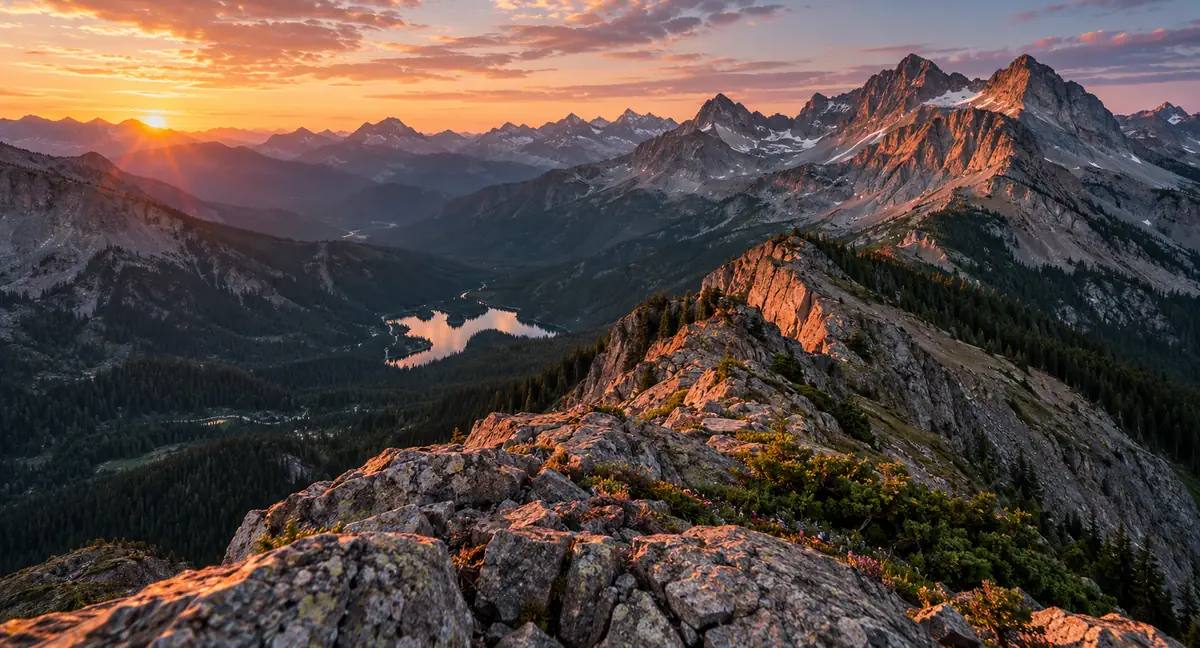
The ridge opened beneath a sky the colour of a cut peach. Mist lay in the Elk Valley. The town was hidden now, and the mountains beyond it went on folding into blue.
Someone behind her whispered something obscene and reverent.
Abi laughed.
Paul came up beside her, clipped himself clear and looked out.
For a while nobody spoke.
This, Abi thought. Not necessarily this ridge, or this morning. But the feeling of being fully present in her own life.
Paul passed her a crushed sandwich.
“You look less likely to murder a printer.”
“I contain multitudes.”
“Mostly sandwich?”
“At present.”
Their fingers brushed as she took it. Neither moved away quite as quickly as necessary.
He noticed. She could tell.
Then his radio crackled.
Jess’s voice came through from the meadow.
“Everyone up?”
“Ten on top,” Paul replied.
“Good. We’ve got some people heading down early. I’m taking six. Dev’s bringing the rest after breakfast.”
Abi checked the time. Just after six.
“Ask her who,” she said.
Paul handed her the radio without question.
Jess listed names. Abi put them into her phone beneath the original roster.
“Send word when you reach the trucks,” Abi said.
“Will do, Mum.”
“I prefer chief financial officer.”
“You would.”
The radio clicked off.
Paul sat beside her, close enough that their shoulders touched.
“Do you miss living here?”
“Yes.”
The answer escaped without its usual qualifications.
“What stops you?”
“Fear dressed as prudence, probably. Also rent.”
“Rent is persuasive.”
“And I don’t want to come back just because I’m tired. I’d like to choose something.”
He looked out across the valley.
“That sounds reasonable.”
She turned towards him.
“You’re supposed to tell me I’m overthinking it.”
“I like the way you think.”
The words were quiet and unadorned.
Abi forgot about the sandwich.
By half past seven, all ten climbers were back in the meadow.
Coffee had gone cold in a dented pot. A sock hung from a branch. Dev was gathering wrappers while three others packed sleeping mats.
Paul radioed Jess. Her group was close to the trailhead, moving steadily.
“Seven left with you?” Abi asked.
“Including me.”
Abi opened her list.
“Dev, how many left here with Jess?”
“Seven. Then Nessa and Cal went after them.”
Abi looked up.
“After them where?”
“Down. Nessa’s knee was sore.”
“Did you see them join Jess?”
“They left ten minutes later.”
Abi counted the people around her.
Fifteen. Ten climbers and five from the meadow.
Seven with Jess made twenty-two.
“Nessa and Cal make twenty-four,” she said. “Where are the other six?”
Dev blinked, then pointed towards the trail.
“Ben’s group. They went before Jess. She passed them at the creek.”
Thirty names, if Nessa and Cal had caught up. But Dev hadn’t seen them join anyone.
She pressed the radio button.
“Jess, how many with you now? Including Ben’s group.”
A brief hiss.
“Thirteen. We joined up at the creek. The seven were the ones who left with me.”
Abi felt her attention sharpen.
She started again, using names instead of numbers.
It was the same habit that found mistakes in accounts: stop trusting totals once the underlying entries became uncertain.
Jess read out thirteen names. Abi checked each against the roster, then called across the meadow to confirm the people still packing. Nobody had seen Nessa or Cal since they left.
Thirteen were below with Jess.
Fifteen were here.
Nessa and Cal were missing.
“Probably close behind,” Dev said, less confidently.
“Maybe,” Abi replied. “Let’s establish that.”
Paul was already studying the trail junction at the far edge of the meadow.
Cal knew the area, though less well than most of them. Nessa had worked on trail crews for years. Both were sensible, experienced and carrying day packs.
That was reassuring.
It wasn’t a location.
Abi called their phones. Neither connected.
“Which way did they leave?” Paul asked.
Dev pointed towards a narrow path disappearing through the larch.
Abi’s stomach tightened.
“That’s the west trail.”
“Cal said it was easier on her knee.”
“It is,” she said. “Until the bridge.”
Paul’s first decision was to stop people scattering.
Dev would take the remaining group down the main trail. Jess would check the lower junction and trucks. Nobody would improvise a search.
Abi and Paul would go a short distance west, looking for information, while two rested climbers waited in the meadow as a radio relay.
They had reception on a knoll above the trees. Paul called emergency services, reported two overdue walkers and gave the last confirmed location. A local search-and-rescue coordinator rang back while Abi was marking the departure times.
“Could they have continued through?” the coordinator, Ruth, asked.
“The bridge is closed,” Paul said. “I haven’t seen it since June.”
“It’s gone,” Ruth replied. “Creek took the remaining span last week.”
Abi looked towards the dark line of the western drainage.
Ruth continued. “We’re organising a team at the lower access. Don’t commit into that creek. Call if you find something.”
Paul handed Abi the phone so she could give names, clothing, equipment and the distinction between what they knew and what people had assumed.
When she finished, he looked at her differently.
“What?”
“You didn’t smooth over the uncertainty.”
“That’s how people end up believing a number nobody actually checked.”
They headed into the larch.
The path crossed dry soil where prints overlapped, then reached a muddy seep. Two fresh sets of boot marks led west. One had a triangular notch missing from the heel.
“Nessa’s,” Abi said. “She complained about those soles last night.”
A broken trekking-pole basket lay beside the mud.
Promising.
Too promising, as it turned out.
Half an hour later, they found the matching pole beside a fire ring, its shaft bleached nearly white. The basket had been kicked onto the path, not broken that morning.
The prints crossed older tracks and vanished over hard limestone.
Abi swore softly.
Paul glanced at the time.
“We turn back to the knoll for reception.”
“We’re close to the bridge approach.”
“And Ruth needs the update.”
Abi wanted to keep moving. The pull of a plausible direction was almost physical.
She took a breath.
“You’re right.”
“We can be right and annoyed.”
“That’s my entire professional identity.”
He offered her water.
She drank, and the simple steadiness of the gesture settled something inside her.
At the knoll, Abi discovered that Dev had sent her three photographs as soon as he reached a patch of service.
Two were useless: coffee, sunrise, someone asleep under a jacket.
The third showed Nessa and Cal leaving the meadow at 6:23.
Nessa carried one trekking pole. Cal had a folded paper map tucked under his pack strap.
Abi enlarged the picture.
“What is it?” Paul asked.
“That map.”
“You can read it?”
“No. But I recognise the cover. The outdoor shop used to sell those when I was at school.”
She stared at the image, pulling a memory apart.
Old trail. Missing bridge. Sore knee.
“The old map shows a second crossing upstream,” she said. “A haul-road bridge.”
“Which also isn’t there.”
“I know. But it wasn’t marked as a footbridge. It looked substantial.”
Paul crouched beside her.
“How would they reach it?”
“From the washed-out bridge, follow the old road north.”
He considered the slope below.
“There was a rockslide across that road in spring. I inspected it for the landowner. You can reach the old bridge abutment from this side, but the return traverse is ugly.”
“Could it have moved in last week’s rain?”
“Yes.”
For a moment neither spoke.
The pieces weren’t proof. But together they made a route that explained why two experienced people hadn’t simply come back.
They called Ruth and described it as a hypothesis.
“The lower team can check the far side,” she said. “Can you safely reach a viewpoint above the old crossing?”
Abi pictured the ridge from childhood wanderings: a blunt limestone nose, goat tracks, a stand of wind-bent fir.
“Yes.”
“Observe only. Give us coordinates if you see them.”
Paul slipped his phone away.
“You know the way?”
“I think so.”
He waited.
Abi smiled despite herself.
“I know the first part. Then I’ll check the terrain.”
“Better.”
“You’re difficult to impress.”
“That’s becoming a problem, actually.”
She looked at him.
He held her gaze for one warm, startling second.
Then they started uphill.
The viewpoint was farther away than Abi remembered.
Everything had been smaller at seventeen, including consequences.
They traversed above the drainage, boots brushing juniper. The sun was hot now, but clouds were building beyond the peaks. Below them, water sounded louder than the narrow creek should have allowed.
At a rocky notch, Paul caught up.
“Two minutes.”
“I’m fine.”
“I know. I need food.”
She stopped immediately, then narrowed her eyes when he handed her half an energy bar.
“You devious man.”
“You get efficient when you’re worried. Sometimes meals fail the audit.”
They sat on a flat stone, knees almost touching.
Abi watched his hands peel back the wrapper. Strong hands, precise without fuss. She had known them for years and apparently had only now acquired the sense to notice.
“Why did you stop going away for whole seasons?” she asked.
Paul used to guide and climb wherever work took him. Lately, whenever she came home, he was here.
“My dad’s arthritis got worse. I wanted to be around while he adjusted.”
“How is he?”
“Angry at jars. Otherwise good.” He smiled. “I found I liked having a kitchen. People who expected me for dinner.”
“You could’ve told me.”
“You were busy.”
“That sounds like something I say when I don’t want to ask.”
He turned the wrapper between his fingers.
“Possibly.”
She let that sit between them.
Then he said, “I didn’t know if you wanted Fernie following you back to Calgary.”
Abi looked at him properly.
“Some parts of it, yes.”
The wind moved through the scrub.
Paul’s expression changed, the restraint thinning just enough for her to see what lay beneath it.
“Good to know,” he said.
They finished the bar.
At the limestone nose, Abi lay on her stomach and eased forward until she could see the old crossing.
There was no bridge. Only square concrete abutments and white water passing between them.
For a terrible moment, there was nothing else.
Then something blue moved against the near wall.
“Nessa.”
Paul lowered himself beside her.
Two people stood on a narrow shelf above the creek. One waved both arms.
Abi waved back, enormous relief rushing through her so quickly it left her shaking.
Then she saw the fresh scar across the slope behind them.
The road they had used to get there was gone.
They established contact by shouting, then moved back where they could speak without leaning over the edge.
Cal’s phone had been damaged by a falling stone. Nessa’s had no service. Neither had heard calls above the creek.
They had reached the missing footbridge, consulted Cal’s old map and tried the upstream crossing. While turning back from the second abutment, they’d heard rock moving across the road cut.
They retreated to the concrete wall.
Nessa had twisted her bad knee in the rush. She could stand, barely.
Abi called Ruth with the location.
Below, Cal helped Nessa sit farther beneath the abutment’s projecting edge.
Paul studied the slope through his compact binoculars.
“Can we get down?” Abi asked.
“Not safely from here. The top’s broken. Any rope would run through loose blocks.”
“What about farther north?”
“Maybe. We need to see it.”
Thunder sounded beyond the next ridge.
They both looked up.
The afternoon storm had arrived early.
Ruth confirmed what they already knew: a helicopter couldn’t be counted on in the building weather. The lower team was approaching the far bank, but the creek was running too hard for a casual crossing, and lifting Nessa from there would require more equipment.
“Stay above them,” Ruth said. “Keep yourselves out of the fall line. We’ll work the options.”
Rain began as separate dark spots on the limestone.
Abi put on her shell.
Paul looked towards the retreating strip of blue sky.
“I want us off this exposed nose.”
“We can’t lose sight of them.”
“We can from the trees.”
His voice had sharpened.
She felt her own answer rise, equally sharp, and stopped it.
“Show me where.”
He pointed to a lower stand of fir that overlooked the concrete wall.
She followed his line and nodded.
“Fine. But we keep looking for another way.”
“Yes,” he said. “We do.”
Under the firs, the rain smelled of hot dust.
Abi checked the map on her phone against the contours below. The modern trail layer showed nothing useful. The old road ended at the crossing.
She zoomed out.
Then in again.
Paul was speaking to Ruth, explaining the rock above the stranded pair.
Abi looked from the screen to the slope.
There was a shallow depression behind them, hardly more than a fold beneath the trees. Water ran through it, heading towards the creek.
Something tugged at her memory.
Not a trail. A winter line.
She and her friends had once skied this shoulder after a long approach, dropping through open timber to an abandoned road. They’d argued for years about whether it had been worth the walk.
The gully hadn’t run to the creek. It had turned.
“Paul.”
He finished the call.
“There’s a bench north of the abutment,” she said. “Hidden behind that rib. I skied onto it once.”
“How steep?”
“Under snow? Easy. Bare ground, I don’t know.”
She showed him the contour shape.
“The map smooths it out. But look at the trees. Those firs are growing upright along the same level.”
He studied the slope.
“If that connects, we might reach them sideways.”
“From stable ground.”
“Possibly.”
It wasn’t a solution yet.
They told Ruth what they intended to inspect and left a bright sling marking their route.
The gully was slick, tangled and slower than Abi hoped. Twice they stopped where she could not see the next section. Paul checked the rock; Abi worked out where winter memory and summer terrain agreed.
At last they emerged onto a wooded bench.
Ahead, beyond a short exposed gap, Cal’s blue jacket showed beside the concrete.
Abi exhaled.
“There you are.”
Paul looked at her, rain caught in his lashes.
“Yes,” he said.
For a second she wasn’t entirely sure he meant the bench.
The last gap was only twelve metres across.
It might as well have been a kilometre for Nessa.
A strip of sloping limestone led from the bench to the abutment, with the creek below and wet gravel scattered across it. Cal could perhaps have crossed alone. Asking him to support someone else would have been reckless.
Paul assessed the trees behind them, then the rock.
“We can protect that,” he said.
Abi called Ruth.
They had climbing ropes, harnesses, helmets and anchor material. Two experienced climbers were still at the meadow with more equipment. Ruth asked specific questions, listened to Paul’s description and agreed on a plan while her lower team watched from across the creek.
No hurried heroics. One person across first. A protected return. If Nessa couldn’t manage it, they would hold position for the rescuers coming around the ridge.
Abi opened the equipment list she’d made before leaving the party.
“The meadow pair have a spare harness,” she said. “And a second full rope.”
“Can they reach you?”
“Yes. I’ll send our track.”
She called them, confirmed what they actually carried and gave directions.
Then Paul said, “I’ll cross.”
Abi looked at the ledge.
He was heavier than she was. More importantly, he had years of experience building systems under load, while she knew Nessa well enough to hear when a brave answer meant no.
“You’re better here,” she said. “Build the line. I’ll go over.”
His eyes moved along the traverse.
“I don’t like the loose patch in the middle.”
“Neither do I. I can reach the higher holds without stepping on it.”
She pointed them out.
He considered, then nodded.
“All right.”
The ease of that mattered to her. He had disagreed, assessed her reasoning and changed his mind.
While he built the anchors, Abi tied in and checked her harness.
Rain ticked against her helmet.
Paul checked her knot. She checked his system.
“Ready?” he asked.
“Ready.”
He touched two fingers lightly to the back of her hand.
Then he let her go.
The limestone was colder than she expected.
Abi moved slowly, placing each foot before shifting weight. Halfway across, she reached above the gravel to a firm edge.
A stone skittered away beneath her boot.
She stopped.
The rope stayed attentive without pulling.
“Good there,” Paul said.
His voice carried evenly through the rain.
She tested the next hold, found it sound and moved.
Nessa began crying when Abi reached the wall.
“I’m so sorry.”
“I’m here,” Abi said gently. “You don’t need to apologise. Let’s get you warm.”
Up close, both looked chilled and exhausted. Nessa’s knee was swollen but not visibly misshapen. Abi asked what hurt, checked that her foot felt normal, and helped her into an extra layer.
Nessa gripped the jacket closed. Her breathing began to settle.
“You can buy me breakfast when we’re down, though,” Abi said.
Cal gave a shaky laugh.
Behind them, small stones clicked down the ruined road.
Nobody looked for long.
“We’re going sideways,” Abi explained. “Paul’s got a line. You’ll have a harness, and I’ll stay with you.”
“I don’t think I can climb.”
“You don’t have to do it standing. We can make it very undignified.”
“Finally. My discipline.”
Abi smiled.
By the time the spare equipment arrived, the rain had strengthened. Paul and the two climbers established the additional protection they needed. Across the creek, a rescuer in a bright helmet watched through binoculars.
Cal crossed first, following instructions carefully.
Then came Nessa.
The process was slow. Abi secured her into the harness, checked it twice and explained each movement before they made it.
At the loose patch, Nessa froze.
“No.”
“All right,” Abi said.
“I can’t put my foot there.”
“Then don’t.”
Water ran down the back of Abi’s neck. Her thighs trembled with the strain of holding position.
She looked at the rock, then at Nessa’s reach.
“Sit down. Face me.”
Nessa obeyed.
“That little shelf by your left hand. Can you push from that?”
A nod.
“Good. We’re going across on our backsides. Extremely prestigious technique.”
Paul adjusted the rope as they moved.
A little at a time, Nessa shuffled beyond the gravel.
When she reached the trees, Cal caught her hands. One of the climbers wrapped her in a spare insulated jacket.
Abi crossed last.
Only when her boots reached soil did she realise how tightly she’d been holding her jaw.
Paul unclipped her.
“All here?” he asked.
She looked around, counting automatically.
Six.
“All here.”
His hand closed briefly around hers.
It was the first touch that had no practical purpose at all.
The rescue team met them partway up the gully.
With Nessa assessed, supported and then carried through the worst section, the journey back became hard work shared among enough people to make it manageable.
Abi took turns carrying equipment. Paul helped with the stretcher over awkward ground.
The storm rolled east.
By the time they reached the main trail, shafts of sunlight were falling through the trees. Everything dripped. The creek they had crossed in darkness was louder now.
At the trucks, Jess handed Abi a mug of tea.
“Thirty,” she said.
Abi closed her eyes.
“Thank you.”
Ruth, mud to the knees and briskly kind, took a final account of their route. She was pleased they had called early. Less pleased with the obsolete map and the casual splitting of the party.
Nobody argued.
Nessa left for an assessment with Cal beside her, promising breakfast, lunch and perhaps a small annuity.
Dev stood near the tailgate twisting his orange cap.
“I should’ve checked which way they meant.”
“Yes,” Abi said.
He nodded miserably.
She touched his arm.
“We all thought someone else knew. Next time we make the handover explicit.”
“Next time I’m celebrating whatever it was at the pub.”
“What were we celebrating?”
He looked at her.
“The gearbox.”
“Right.”
“And my divorce coming through.”
She blinked.
“You might have mentioned that.”
“I didn’t want to bring the mood down.”
Abi hugged him, wet jacket and all.
Behind his shoulder, she saw Paul watching her with an expression he no longer seemed especially interested in hiding.
It was nearly four when Abi found him sitting on the tailgate of his truck, cleaning grit from a carabiner.
Most of the others had left. The clearing smelled of wet leaves and cooling engines.
She sat beside him.
For a minute they said nothing.
Then she offered him the remaining half of a flattened chocolate bar.
“Emergency provisions.”
“Is there a form?”
“Several.”
He took it.
Her phone vibrated. A work email lit the screen: a request to review a revised expenditure forecast before Monday.
She turned the phone face down.
Paul noticed but didn’t comment.
“I’m not resigning in a burst of mountain-induced clarity,” she said.
“Good.”
“Good?”
“I’d hate to be mentioned in the resulting budget crisis.”
She laughed, then leaned back on her hands.
“But I am going to change something.”
“What?”
“Ask about reducing my hours. Work out what I need to earn. Talk to some local businesses about freelance accounts.”
“Fernie has plenty of people who understand snow conditions better than tax.”
“I know. I went to school with them.”
He smiled.
She looked at his shoulder beside hers, close enough to touch.
“What happens if I come home more often?”
“Probably more climbing.”
“Paul.”
He put the carabiner down.
“I’d ask you to dinner.”
“You could ask now.”
“I could.”
The pause was brief, but wonderfully deliberate.
“Abi, would you have dinner with me?”
“Yes.”
“Friday?”
“Yes.”
“In town. Chairs. No head torches.”
“You’ve thought about this.”
His eyes held hers.
“For a while.”
Something soft and bright opened in her chest.
“Why didn’t you say?”
“I liked being your friend. I wasn’t sure whether you were making space for anything else.”
“That’s fair.”
“And I’m saying it now.”
She turned towards him fully.
“So am I.”
He lifted a hand to her cheek, stopping just short of touching.
“Can I kiss you?”
“Yes.”
The first kiss was gentle, almost questioning.
The second wasn’t.
Abi caught the front of his damp shirt and pulled him closer. His hand settled at her waist, warm through the thin fabric of her jacket, and the day’s noise finally fell away: rushing water, radio static, the endless careful calculation of what came next.
He kissed her with the same attention he gave everything that mattered.
When they drew apart, his forehead rested against hers.
“I’ve wanted to do that since you criticised my anchor on Mount Proctor,” he said.
“That was three years ago.”
“It was a very thorough criticism.”
She laughed against his mouth.
Then she kissed him again.
On Tuesday, back in Calgary, Abi sat opposite her manager with a sheet of figures she had checked three times.
“I’d like to go down to four days a week.”
Her manager put her pen down.
“Temporarily?”
“A trial, to start. Three months. Fridays off, with a different day when month-end needs it.”
“We’d have to look at your workload.”
Abi nearly said she could fit it all in. She knew exactly how: longer evenings, lunch at her desk, a laptop open in Fernie while the light went off the mountains.
“Yes,” she said. “We would.”
She slid the sheet across. The client handover was on the first page. The reduction in pay was on the second.
Her manager read both.
“These two accounts could move. Not before the next reporting deadline.”
“That’s fine.”
“And you’ve worked out what the lower salary means?”
“I have.”
She wanted to explain every number, prove she was being sensible, make the request so reasonable that nobody could refuse it. Instead, she left her hands in her lap and waited.
Her manager turned back to the handover plan.
“Let me check coverage. We could start the trial in two weeks, then review it at the end of the three months.”
Back at her desk, Abi opened the spreadsheet again. The smaller salary still made her stomach tighten. She entered the proposed start date beside it.
Three weeks later, Abi returned to Fernie on a Thursday.
The four-day trial had begun. Her accounts were handed over, her savings plan was in place, and she had contacted an insurance broker and found two potential local clients.
None of it was a dramatic escape.
It felt better than that. It felt like work she had chosen.
Nessa’s knee was healing. Cal had replaced his map and joined a volunteer trail inspection day. Dev had organised a proper outing list for every group activity, including, to everyone’s delight, a barbecue.
Abi and Paul had been to dinner twice.
They had also argued amicably about whether a rainy bike ride counted as a date, spent an evening cooking too much pasta and discovered that he kept every birthday card his father had ever written him.
There was still plenty they didn’t know.
She was looking forward to it.
On Friday evening, they walked beside the Elk River while the mountains gathered the last light. Cottonwood leaves flashed silver in the breeze.
Paul carried a paper bag from the bakery. Abi had brought coffee.
“Plans for tomorrow?” he asked.
“Small group. Sensible start. No obsolete infrastructure.”
“Ambitious.”
She slipped her hand into his.
He looked down, smiling.
“Ready?”
Across the river, sunlight touched the ridge they had climbed in darkness. Abi could trace the shoulder now, the familiar rock and the places the mountain had kept hidden until they looked properly.
She leaned up and kissed him, tasting coffee and a little sugar.
“Yes,” she said, and they went on walking, close enough that their shoulders touched.
Every ending is somewhere new.
Find your next story →