The Ground Between Us
When an old colleague calls from across the world, a South Island farmer and a guarded geologist must uncover what lies beneath a threatened valley.
The man who had once talked Sandy Ranscombe out of a burning embassy telephoned while they were trying to persuade a ram to release their coat.
“I need a favour,” Robert Ashenby said.
Sandy braced one gumboot against the feeding trough. “So does the sheep. He’s not getting one either.”
“This may be serious.”
“You said that in Ankara. It was a missing briefcase.”
“It contained a minister’s teeth.”
“Goodbye, Robert.”
“Wait. Can you see Mount Calder from your property?”
Sandy stopped pulling.
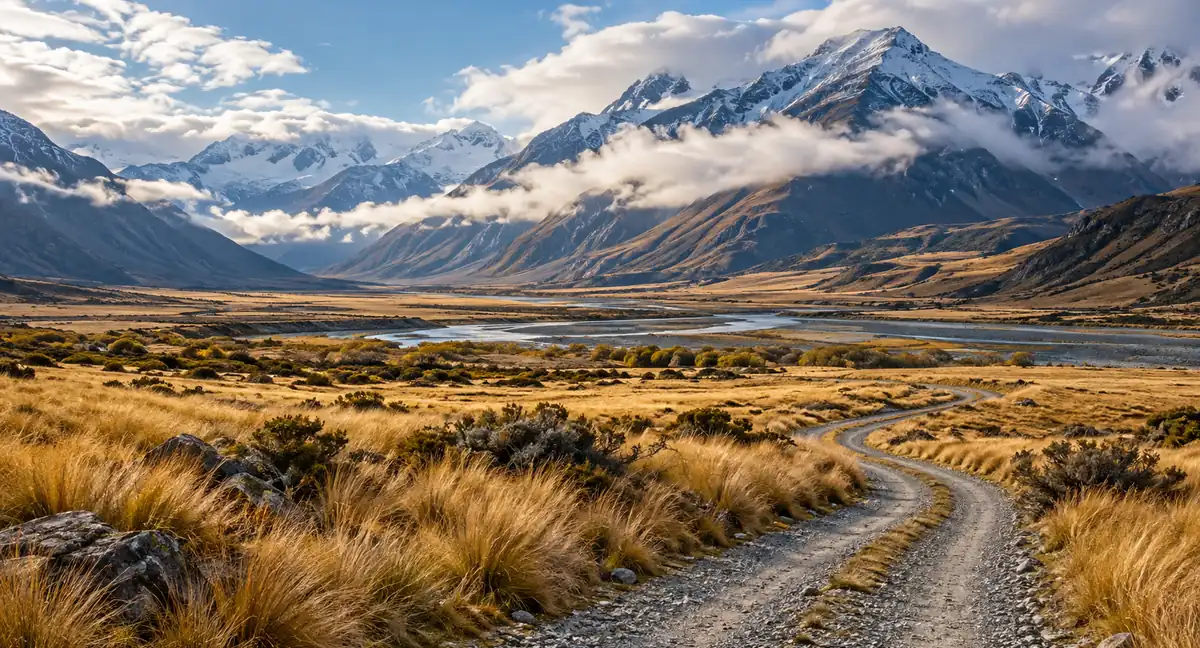
Beyond the vegetable beds, the foothills rose through yellow tussock towards a hard white sky. Mount Calder stood behind them, its southern shoulder hidden by cloud. A temporary workers’ village occupied the valley beneath it.
“Most days.”
“I think there’s something wrong with the ground under the Calder works.”
The ram let go. Sandy stumbled backwards into a sack of sheep nuts.
Across twelve thousand miles, Robert heard the impact.
“Have I caught you at a bad time?”
“You’ve caught me at home,” Sandy said. “Which I’ve found is usually where trouble starts looking.”
Robert was in a hospital in Inverness with a rebuilt hip and the particular indignation of a man injured by a hotel staircase after surviving twenty years of places with armed checkpoints.
His defence contracting company also supplied monitoring equipment to civil engineering projects. Sandy had known this because he had offered them a security consultancy on the Calder access tunnel eighteen months earlier.
They had chosen potatoes.
Now his instruments were sending reports he didn’t trust.
“The processed readings say the slope is stable,” he said. “But one station has been restarting. Before each restart, it records a pressure spike.”
“Tell the engineers.”
“I have. The construction manager has referred it to their monitoring subcontractor. They’re calling it a battery fault.”
“Could it be?”
“Yes. That’s the problem.”
Sandy leaned against the kitchen counter. A tray of leek seedlings crowded the windowsill. Beyond the glass, the ram was eating the label off the sack.
“Robert.”
“I’ve hired an independent engineering geologist. Mara Ellerswick. She’s driving up from Christchurch. She needs access to the original logger, and someone who knows the valley.”
“Hire a guide.”
“I rang because you live there. And because if the official explanation doesn’t fit what’s in front of you, you say so.”
That was uncomfortably close to the truth.
Sandy had spent their first three years on the smallholding learning when to say less. Sheep responded poorly to commands delivered in several languages. Carrots did not care who you had once kept alive.
“How urgent?”
“Significant rain tomorrow night. Thirty-four people sleeping in that village.”
Sandy looked towards the mountain again.
“Send everything. And no private missions, Robert. If there’s a risk, we involve the people responsible.”
“Agreed.”
“If this turns out to be another minister’s teeth—”
“I’ll buy your entire potato crop.”
“You couldn’t afford it. They’re artisanal.”
Mara Ellerswick arrived at seven the next morning in a mud-coloured utility vehicle with two spare tyres and no decorative equipment.
She was tall, perhaps early forties, with dark hair twisted under a cap and a faint white scar through one eyebrow. She stood at Sandy’s gate studying the hillside rather than her phone.
“The bridge on your lower drive,” she said when Sandy approached. “What’s its load rating?”
“Depends whether you’re asking as an engineer or someone who’s already driven over it.”
“I parked before it.”
Sandy liked her immediately, which was inconvenient.
“Three tonnes. The replacement beams are better than the paperwork.”
“I’ll walk.”
A ewe had put her head through the stock netting beside the drive. Sandy caught her under the jaw, turned one ear flat and eased her backwards.
Mara waited without offering unhelpful instructions.
“Ranscombe?” she asked.
“Sandy.”
“Mara. Ashenby says you know the country.”
“Ashenby says many things.”
“He also says you’re reassuring under fire.”
“I’m less reassuring before breakfast.”
“I brought coffee.”
Sandy took the offered cup.
“That is excellent field preparation.”
Inside, Mara spread a topographical map beside Sandy’s unpaid feed invoice. The construction compound sat on a broad terrace above Calder Creek. Farther upstream, a steep spur held the instruments Robert wanted checked.
Mara pointed to four stations.
“We need the raw data from C-four. The server only retains processed reports. I’ve arranged access with the site manager.”
“What will the original tell you?”
“Whether the ground actually moved, whether the sensor failed, or whether the processing removed something it shouldn’t.”
“You don’t know which?”
“No.”
There was no apology in it.
Sandy set down their coffee. They had worked with ministers who would have mobilised an army before admitting that much.
“What’s the weather window?”
“Today is good. Tomorrow gets worse after midday.”
“Then we take the stock track above the creek. Your mapped road lost its middle last winter.”
Mara looked from the map to Sandy.
“That wasn’t in the access notes.”
“Neither are the bulls. We’ll avoid those too.”
The construction manager, Craig Thistleden, met them outside a portable office smelling of printer toner and wet work clothes.
He had permission forms ready.
“I’m not blocking an inspection,” he said before either of them spoke. “But we’ve had false alerts for six months. Frost, batteries, possums chewing cable. Every shutdown costs.”
“And a correct alert?” Mara asked.
He looked at her for a moment.
“Costs less than missing one. I know.”
Sandy’s opinion of him improved.
Thistleden gave them a radio, signed them onto the site and showed them the village evacuation plan. Everyone was to assemble beside the creek bridge, then leave by bus.
Sandy studied the diagram.
“Your assembly point is under a cut bank.”
“Approved when we opened.”
“Move it uphill while we’re here.”
Thistleden started to answer, then followed Sandy’s gaze to the saturated scarp above the parking area.
“I’ll have a look.”
“Have a look now,” Sandy said, mildly enough that he did.
Mara watched without comment.
They took Sandy’s battered farm vehicle as far as the upper paddock, then continued on foot. The creek sounded large below them, although rain had not yet reached the valley.
Mara stopped twice to examine fractures in exposed rock. Sandy watched the wind and chose gates that would not leave them walking through curious cattle.
At a narrow washout, Mara tested the uphill edge with her boot.
“Better below,” Sandy said.
“That surface is loose.”
“Yes. But it’s shallow. The uphill side is overhanging.”
Mara crouched, saw the dark void beneath the turf, and changed course.
A little later, Sandy stepped towards a pale slab.
“Not that one,” Mara said. “See the fresh edge?”
They went around it.
“Efficient partnership,” Sandy observed.
“Mutual interference.”
“I’ve had worse.”
They found C-four above a stand of mountain beech.
Or they found where it had been.
A concrete mounting pad remained. Two bolts stood upright. The enclosure, solar panel and memory unit were gone.
Mara lowered her pack.
“Well,” Sandy said, “that’s impressively unhelpful.”
She checked beneath the pad, then the shallow drainage channel leading downhill. Nothing.
Sandy photographed the bolts.
“No torn metal. Someone removed it.”
Mara called Thistleden. He called his electrician. For twenty minutes they stood in the cold while the answer travelled through three subcontractors.
C-four had been replaced eleven days earlier. The faulty enclosure had gone to a depot in Ashburton.
The depot had forwarded it for recycling.
Mara closed her eyes briefly.
“Ask them to hold everything,” she said into the radio. “Even if they think it’s empty.”
When she finished, Sandy offered her a piece of ginger loaf.
“Does this count as a promising start?”
“It counts as the reason I dislike the phrase ‘the data is all in the cloud’.”
“Cloud looks reliable today.”
She glanced at the thickening grey above the ridge.
“Unfortunately.”
They did not go straight back.
Mara wanted measurements from the replacement station, and Sandy wanted to understand why a spring that usually vanished by February was running hard in late March.
It emerged below the old mounting pad, slipping through tussock with a cloudy, almost milky colour.
Mara filled a sample bottle.
“Has it always carried sediment?”
“Never. The sheep won’t drink it now.”
“Since when?”
“Ten days, perhaps. I moved them because I thought something had died upstream.”
“Did you find anything?”
“No. I walked the whole gully.”
She looked towards the terrace below.
“How much rain in the last fortnight?”
“Eleven millimetres at my place. Less than forecast.”
Mara wrote that down.
On the way back, she measured the height of a narrow crack crossing the track. Sandy had stepped over it twice that week without concern.
“Freeze-thaw?” they asked.
“Could be.”
“You say that a lot.”
“I’m paid to find out. Certainty’s extra.”
Her mouth tilted. It changed her face enough that Sandy looked away a fraction late.
Mara noticed. She said nothing, which somehow made it worse.
By the time they reached the farm, their packs were heavier with samples and their original objective had become less certain.
Sandy put soup on the stove while Mara examined the files Robert had sent.
A ginger cat stepped onto her keyboard.
“That’s Customs,” Sandy said. “He checks incoming goods.”
Mara lifted him gently onto her lap.
“He’s thorough.”
“He once confiscated a trout.”
She worked one-handed until the cat settled.
Sandy found themselves watching the small patience of it.
By late afternoon, the recycling company had confirmed that the old logger’s circuit board was gone.
Their best lead had become a signed disposal receipt.
Robert looked appalled on the kitchen laptop.
“I stipulated retention.”
“Then you’ll enjoy the contractual discussion,” Mara said. “Right now, I need the processing configuration.”
“That belongs to the monitoring subcontractor.”
“Then persuade them.”
Sandy put a mug beside her.
Robert narrowed his eyes.
“Is that the blue mug?”
“Yes.”
“You never let me use the blue mug.”
“You broke its brother.”
“That was in 2009.”
“And yet.”
Mara’s smile appeared again, quick and private.
While Robert made calls, Sandy searched the farm’s old paperwork for rainfall records. The previous owner had saved everything: drenching schedules, tractor receipts, an angry letter about gravel.
A yellowed plan fell out of a folder marked WATER.
Mara looked up.
“What’s that?”
“Old irrigation scheme. Before the valley farms changed hands.”
The plan showed a small reservoir above the present construction village. Sandy knew the basin. It was dry, grassed over, used by rabbits.
Mara drew it closer.
“This embankment isn’t on the engineering base map.”
“Reservoir was decommissioned in the seventies.”
“Does it say how?”
Sandy checked the back.
“No.”
The plan was intriguing, but Mara refused to build a theory around it.
“An old earth bank isn’t automatically dangerous,” she said. “And this could be a proposed layout they never built.”
“Farmers keep proposed bills. Proposed reservoirs, less often.”
“I’d still like evidence.”
Sandy nodded. “Fair.”
Their phone rang. Thistleden had walked the village terrace and found no new cracks. His monitoring dashboard remained green.
Mara requested that nobody work overnight beneath the spur, and that buses stay on site.
Thistleden agreed to the first. He hesitated over the second.
“The buses are on another contract tomorrow.”
“Then arrange replacements.”
“Are you recommending evacuation?”
“Not yet. I’m recommending you remain able to do it.”
After she hung up, Sandy said, “He’s going to hear ‘not yet’ more loudly than the rest.”
“I can’t manufacture a finding because I dislike his timetable.”
“No. But you can make the consequences plain.”
Mara’s expression cooled.
“And you can let me judge the geology.”
Sandy leaned back.
For a moment the kitchen held only the noise of soup simmering.
Then Sandy said, “Yes. I can.”
Mara looked surprised.
“I wasn’t trying to win,” Sandy added. “I’m used to getting people out before I can prove why.”
“I’m used to explaining why they had to go afterwards.”
“That sounds exhausting.”
“It is.”
She turned the old plan towards them.
“Help me prove it.”
They spent the last hour of daylight at the dry reservoir.
The basin lay above the workers’ village like a shallow bowl, empty except for tussock and two rusted fence standards. The retaining bank was broad enough to resemble a natural ridge.
Mara scraped soil from a fresh rabbit burrow. Beneath the dark topsoil lay pale clay.
The same colour as the spring.
Sandy saw her become very still.
“Interesting?”
“Yes. Not enough.”
They followed the probable line of the old outlet. Thirty metres down, it disappeared beneath a newer access road.
Sandy crouched beside a culvert pouring clear water.
“That’s new.”
“The culvert?”
“The volume. This usually barely wets the stones.”
Mara consulted the plan. Then the project map. Then the ground.
“Which way did the old irrigation water go?”
“Along a contour race. You can still see it above my north paddock.”
“And the new road drains?”
Sandy pointed uphill.
“Into that gully.”
The gully fed the abandoned reservoir basin.
Mara walked back up, faster now. Sandy followed her to a slight hollow in the grass. No standing water. Just soft ground that trembled under their boots.
“Off this,” Mara said.
They retreated onto gravel.
She drove a hand probe down at the edge. Water welled into the narrow hole.
The basin was holding water beneath a skin of roots and silt.
“The road drainage is feeding it,” she said. “And the old outlet may be blocked.”
“Meaning the bank’s wet.”
“Meaning an embankment nobody has assessed may be saturated above thirty-four beds.”
Sandy took out their phone.
This time Mara didn’t tell them to wait.
Thistleden moved the workers to the main mess building on the higher western end of the terrace. He ordered replacement buses for morning and suspended the lower work site.
Mara wanted a specialist dam engineer involved. The regional duty officer began arranging one.
Nobody used the word emergency yet.
Back at the farm, Robert finally sent the configuration files.
Mara studied them while Sandy fed the animals in the falling dusk. When they came inside, she had drawn three lines on a sheet of paper.
“The instruments on the rock spur are stable,” she said. “That much is true.”
“And C-four?”
“Measures water pressure near the toe of the old bank. Its readings rise, then disappear when it restarts. The software treats the restarted value as a new baseline.”
Sandy pulled up a chair.
“So it keeps forgetting where it began.”
“Exactly.”
She placed the old irrigation plan beside the computer, then marked the sensor positions.
“C-four wasn’t failing in the same way as the others. Someone applied one correction rule to every station. Each rise got flattened out.”
“Can you recover it?”
“Some. Robert’s diagnostic attachments include the raw value at restart.”
The breakthrough took another forty minutes.
It came without dramatic music, over reheated soup, with Mara swearing softly at a spreadsheet.
Then she turned the screen.
The corrected values rose in a staircase.
The pressure had been building for eleven days.
Sandy looked from the graph to the irrigation plan and the bottle of cloudy spring water.
“Water’s finding a way through the bank.”
“Potentially carrying the bank with it.”
“And tomorrow it rains.”
Mara was already calling the duty officer.
This time her recommendation was unequivocal: evacuate before the weather arrived, and inspect the buried outlet from safe ground.
The last buses would reach the valley by eight the next morning.
Mara stayed at Sandy’s because returning to town would waste three hours they no longer had. Sandy gave her the spare room and a towel that did not smell of sheep dip.
“That’s the premium towel,” they said.
“I’m honoured.”
“You should be. Robert gets the green one.”
They stood in the kitchen after the calls were finished. Outside, wind pressed against the glass. Sandy’s dog, Midge, slept with her chin across Mara’s boot.
“You collect loyalties quickly,” Sandy said.
“She knows I dropped cheese.”
“Still counts.”
Mara rubbed a hand over the back of her neck.
“Do you miss it?”
“Cheese?”
“The old work.”
Sandy dried a plate.
“Some people. The part where everyone knows what they’re doing. Those rare, wonderful five minutes.”
“Why leave?”
They considered giving the short answer. Mara had spent a long day refusing easy ones.
“I was forty-one. I knew the exits of hotels in twenty countries. Couldn’t have told you what I wanted to do on a Sunday.”
“And now?”
“Check the beans. Argue with a sheep. Occasionally make plans involving other humans.”
“Ambitious.”
“I’m building up slowly.”
Mara looked down at the dog.
“I spent three years moving wherever my partner’s next job was. Told myself I liked travelling.”
“Did you?”
“Yes. I didn’t like never being the reason we stayed.”
Sandy set the plate away.
“How long ago?”
“Four years.”
“Have you found somewhere?”
“A flat in Christchurch. Good light. Terrible kitchen. Entirely my decision.”
“I’d like to hear more about the terrible kitchen.”
“That is a dangerously specific invitation.”
Sandy smiled.
Mara’s gaze lingered on their mouth. Neither pretended otherwise.
Then her phone vibrated against the table.
They both looked at it.
“Saved by geology,” Sandy said.
Mara picked it up.
“I’m beginning to resent my profession.”
The buses arrived at seven forty.
So did the rain.
It swept across the valley in long grey curtains, erasing the upper slopes. Sandy had already moved their sheep to high paddocks and left feed under cover.
At the construction village, workers carried bags towards the mess hall. Thistleden stood in a waterproof jacket, checking names.
“First bus leaves in ten,” he said. “Second takes the tools and remaining crew.”
“People first,” Sandy said.
“The tools are hand luggage.”
“Then I withdraw my speech.”
Mara joined the dam engineer on a video call from the safe edge of the reservoir basin. Sandy stayed downhill with Thistleden, watching the creek.
The first bus crossed the bridge.
Upstream, a brown surge rolled around the bend.
Sandy lifted a hand.
“Stop the second one.”
The driver braked.
The surge struck the bridge piers carrying branches, then a length of fencing. Water climbed over the low approach road.
Thistleden spoke into his radio. At the same moment, the far approach slumped. Gravel tipped into the creek as though someone had pulled a cloth from beneath it.
The first bus was already clear.
The second would not be going anywhere.
For a few seconds, everyone stared at the gap.
Then Sandy said, “Back to the mess. Bring your bags. Walk.”
Their voice was quiet enough that people had to listen.
Thistleden repeated the instruction through the radio.
Mara came down the track at a run, stopped beside Sandy and followed their gaze.
“How many?”
“Seventeen workers. Thistleden. You and me.”
She looked towards the old embankment. A fresh ribbon of pale water was spilling through the grass halfway down its face.
Sandy saw her swallow.
“What’s our time?”
“I can’t give you one.”
“Then give me our ground.”
Mara pulled out her map.
The approved emergency route followed the access road east.
A slip had closed it an hour earlier.
Thistleden had requested helicopters, but low cloud and wind meant no pilot could promise a landing. Civil Defence was arranging a rescue team. Their arrival would take time the embankment might not give them.
“There’s the old stock track,” Sandy said.
Thistleden stared. “Across your place?”
“Above it. Through the limestone saddle.”
“That track’s abandoned.”
“I moved sheep along it in spring.”
Mara traced its line.
It climbed west from the terrace, crossed a narrow side gully, then reached a ridge beyond the likely path of a breach.
“Does the gully drain the reservoir?”
“No. Separate catchment.”
“Are you certain?”
Sandy pointed uphill. “See that spur? It divides them. The gully starts on the other side.”
Mara studied the contours, then nodded.
“We need to check the crossing.”
Thistleden turned towards the workers. “I’ll get everyone ready.”
“Count mobility limitations,” Sandy said. “Actual ones. No heroic answers.”
One man had a knee brace. A woman admitted to vertigo. Most had waterproofs; three did not. Thistleden found spare jackets and boots from stores.
Mara and Sandy walked fifty metres up the stock track to inspect the gully.
The little timber footbridge was gone.
Only its anchor posts remained above a violent rush of water.
Sandy exhaled through their teeth.
Mara looked upstream, then at the steep banks.
“We can’t put nineteen people through that.”
“No.”
Below them, the radio crackled. Thistleden wanted news.
Sandy did not answer immediately.
Across the gully, beyond the missing bridge, stood their boundary fence. Beyond that, the north paddock, the polytunnel, the orderly dark stripes of vegetables.
Their whole small, chosen world.
The fence followed an older contour than the track.
Sandy looked uphill.
“There’s another way.”
The old irrigation race ran around the head of the gully.
Sandy had cleared one section when they bought the farm, hoping to restore gravity-fed water to the vegetable beds. It had been too expensive. They had settled for tanks.
Now the faint shelf cut across the hillside might give them a route.
“Might,” Mara said when Sandy explained.
“I know.”
“How far have you walked it?”
“To the rock outcrop. Six hundred metres.”
“And beyond?”
“Seen it from the other side.”
Mara’s face tightened.
Sandy recognised the calculation. They were making the same one.
“I’ll go and check it,” they said. “No group until we know.”
“Together.”
“One of us should stay here.”
“Thistleden can organise people. You need me to assess the slope, and I need you to find the race.”
There was no room in her voice for gallantry.
Sandy nodded.
They told Thistleden the plan and set a ten-minute radio check. If the route failed, the group would shelter on the western knoll while rescue assessed other options.
The race was half hidden under matagouri. Sandy cut branches with the folding saw they carried for farm work. Rain crawled down the back of their neck.
At the rock outcrop, the shelf narrowed.
Mara moved ahead, examining the stone. She tested a block, stepped back, and pointed out a handhold that would come away under weight.
Sandy marked it with orange tape.
Beyond the outcrop, the race continued.
For twenty metres.
Then vanished into a fan of loose shingle.
Sandy’s heart sank.
Mara crouched. Through the rain, they could hear a low, irregular cracking from the reservoir direction.
“The underlying rock continues,” she said. “This is surface wash.”
“Can we cross?”
“One at a time, once we scrape a tread. Supported from the rock side. Nobody below anyone else.”
“Enough?”
“For this group, if we manage it properly.”
Sandy looked towards home.
A fence blocked the far end. Past it, the shortest descent ran through their market beds to the upper drive.
Six months of work. Winter income under plastic.
They took out the radio.
“Craig. Bring bolt cutters, shovels, rope and everyone’s bags. We have a route.”
They made the crossing slowly enough to be safe and quickly enough to hurt.
Mara worked at the shingle section, directing each foot placement while Thistleden and two workers widened the tread. Sandy organised the line, paired the strongest walkers with anyone who needed help, and made everyone keep their hands free.
The woman with vertigo was called Jo.
“Don’t tell me not to look down,” she said.
“Wasn’t going to,” Sandy replied. “Look at my boots. They’re revolting. Plenty to occupy you.”
Jo managed a breathless laugh.
They took her across together, step by step.
Behind them, a sound like a huge sheet tearing rose from the valley.
Everyone stopped.
A section of the old bank slumped inward. Brown water burst through the pale scar.
“Keep walking,” Mara said.
She didn’t shout. She didn’t need to.
Sandy waited until Jo reached firm ground, then went back for the man with the knee brace.
Their old life returned in fragments: counting heads without moving their lips, watching hands, giving people one instruction at a time. But nobody here was a principal. Nobody got a different standard of care because of their title.
Twenty people had to get home.
That was all.
At the boundary fence, Sandy cut the wire and dragged it clear.
The descent through the vegetable beds was steep but solid. Boots crushed cabbages. A worker slipped, caught the polytunnel frame, and tore a long white wound in the plastic.
“Sorry!” he shouted.
“Excellent braking,” Sandy called back. “Keep going.”
Mara stayed at the shingle crossing until Thistleden passed. Sandy watched her check the empty race behind him, then cross last with deliberate, economical steps.
Only when she reached the fence did Sandy realise how hard they had been clenching their jaw.
“All clear?” they asked.
“All clear.”
Together, they followed the others home.
From the upper drive, they watched the embankment fail.
It happened in stages: a collapse, a widening gap, then a thick surge carrying trees and pale earth towards the village.
The mess building shifted sideways. A portable cabin turned once in the water and disappeared behind a spray of debris.
Nobody spoke.
Thistleden counted his people again.
Sandy counted with him.
Twenty, including themselves and Mara.
Then Midge came racing from the yard, barking furiously at the strangers, and the spell broke.
There were blankets to find. The kettle needed filling. Someone was shivering too hard to undo a zip.
Sandy opened every cupboard.
Mara sat Jo at the kitchen table and wrapped her hands around the blue mug.
Robert called while Thistleden was giving Civil Defence the all-clear.
Sandy answered on speaker.
“Where are you?” he demanded.
“Kitchen.”
“The monitoring feed’s gone.”
“So has the village.”
Silence.
“People?”
“All here or on the first bus.”
Robert let out a breath that seemed to travel the whole distance from Scotland.
Then he said, very softly, “Thank God.”
“Thank Mara,” Sandy said. “And Thistleden listened.”
Mara looked up from beside Jo.
“Thank the farmer who kept the old paperwork.”
Robert cleared his throat.
“What do you need?”
Sandy surveyed the crowded kitchen, the muddy footprints, the twenty wet jackets.
“Tea. Towels. A very large order of potatoes.”
By evening, the workers had been collected from the upper road.
The rescue team inspected the stock route and helped the last tired walkers up to the vehicles. Civil Defence confirmed there was nobody missing. The rain eased to a silver mist.
Thistleden shook Sandy’s hand beside the ruined beds.
“We’ll cover this.”
“Put it in writing when you’ve slept.”
“I will.”
He turned to Mara.
“I should have ordered the buses last night.”
“Yes,” she said.
He nodded once.
“But you stopped the work,” she added. “And this morning you got your people moving. Put both things in the report.”
When the final vehicle left, Sandy stood very still.
The farm looked as though a clumsy giant had attempted gardening.
Mara came beside them.
“Are you all right?”
“I’m trying to decide whether I’m about to cry or become extremely interested in drainage.”
“Both are available.”
Sandy laughed once. It broke halfway through.
Mara waited.
“I liked that it was small,” Sandy said. “This place. Problems I could hold in my hands.”
She looked at the torn polytunnel.
“You still can. Just not all at once.”
Sandy turned towards her.
There was mud along her jaw, and a scratch near the scar in her eyebrow. They had wanted to touch her since before the rain began.
“Can I kiss you?”
Mara’s answer came without hesitation.
“Yes.”
She met them halfway.
The first kiss was careful only for a moment. Then her hands closed on the front of Sandy’s jacket, and Sandy drew her nearer, feeling the warmth of her through layers of damp clothing.
She kissed with the same attention she gave everything else, fully there, leaving no doubt about her choice.
Sandy’s back touched the gatepost. They laughed against her mouth.
“What?”
“Nothing. Extremely interested in something other than drainage.”
“Good.”
She kissed them again, slower this time.
When they finally separated, the paddocks had begun to emerge from the mist.
Mara rested her forehead against theirs.
“I’d like to do that again when we’re dry.”
“I own the premium towels.”
“So I’ve heard.”
The investigation took six weeks.
It found the old reservoir beneath the grass exactly where the yellowed plan had put it. The access road drainage had refilled the basin, while compacted fill obstructed its forgotten outlet. Water had worked through the embankment, carrying fine material out through the spring.
The instruments had recorded warning signs.
The processing had hidden them.
Robert’s company accepted its part in the failure and funded an independent review of every installation using the same configuration. Sandy made him say that twice, then asked for it in writing.
“You’ve become suspicious,” he complained.
“I’ve become agricultural. We like things that can survive weather.”
The construction company paid for the damaged crops, fencing and polytunnel. Work in the valley remained suspended until the ground and drainage were redesigned.
There were no funerals.
Sandy returned to sowing.
Mara returned to Christchurch, then came back the following Saturday carrying dinner and a replacement roll of fencing wire.
“Is this a date or a tender?” Sandy asked.
“I hoped to combine them.”
They discovered that she cooked well despite the terrible kitchen, disliked coriander and talked in her sleep only when very tired. She discovered that Sandy sang to difficult lambs and could not fold a fitted sheet despite having escaped a diplomatic convoy in a stolen bakery van.
“Borrowed,” Sandy insisted.
“Did you return it?”
“Robert was supposed to.”
They took turns travelling. Sandy stayed at her flat and admired the light. Mara stayed at the farm and gradually won the ram’s respect through firm boundaries and apple peel.
Neither proposed a new life for the other.
They began making room.
In May, Robert arrived with a walking stick, two bottles of whisky and an expression of wounded dignity.
Sandy made him sleep in the spare room and gave him the green towel.
At breakfast he offered them a short consultancy: rural access and evacuation reviews, local projects only, dates of their choosing.
Sandy read the proposal carefully.
“I’ll do two,” they said. “After lambing. I choose the sites.”
“Done.”
“And I’m not carrying anyone’s teeth.”
Mara lowered her coffee.
“I keep hearing about these teeth.”
Robert sighed. “They weren’t even his best set.”
Later, Sandy walked him to the repaired gate. The new polytunnel shone beyond the winter beds. Young broad beans stood in precise green rows.
“You seem happy,” Robert said.
Sandy watched Mara emerge from the shed with a tape measure, Midge following at her heels. They were planning a small footbridge over the farm drain. Mara had opinions about the foundations. Sandy had opinions about the cost.
There would be a lively afternoon.
“Yes,” Sandy said. “I am.”
After Robert left, Mara called from the garden.
“Ranscombe. Are we actually measuring this bridge?”
“In a minute.”
“You said that ten minutes ago.”
Sandy reached her and took the tape measure gently from her hand.
“I have another proposal.”
“Does it involve engineering?”
“Dinner. Christchurch. Next Friday.”
“My kitchen?”
“Your decision.”
Mara smiled and hooked a finger through their belt loop, drawing them close enough to kiss.
Beyond her shoulder, the mountain stood clear above the valley. Sandy could see every ridge of it, but for once they weren’t looking for a way out. They set the tape measure on the gatepost and put both arms around her.
Every ending is somewhere new.
Find your next story →