The Birdwatcher's False Name
When poisoned eagles draw a covert investigator to her Highland island, a solitary conservationist must navigate a criminal network—and decide whether trusting someone is worth the risk.
The eagle had carried a fish uphill, which was ordinary; someone had filleted it first, which was not.
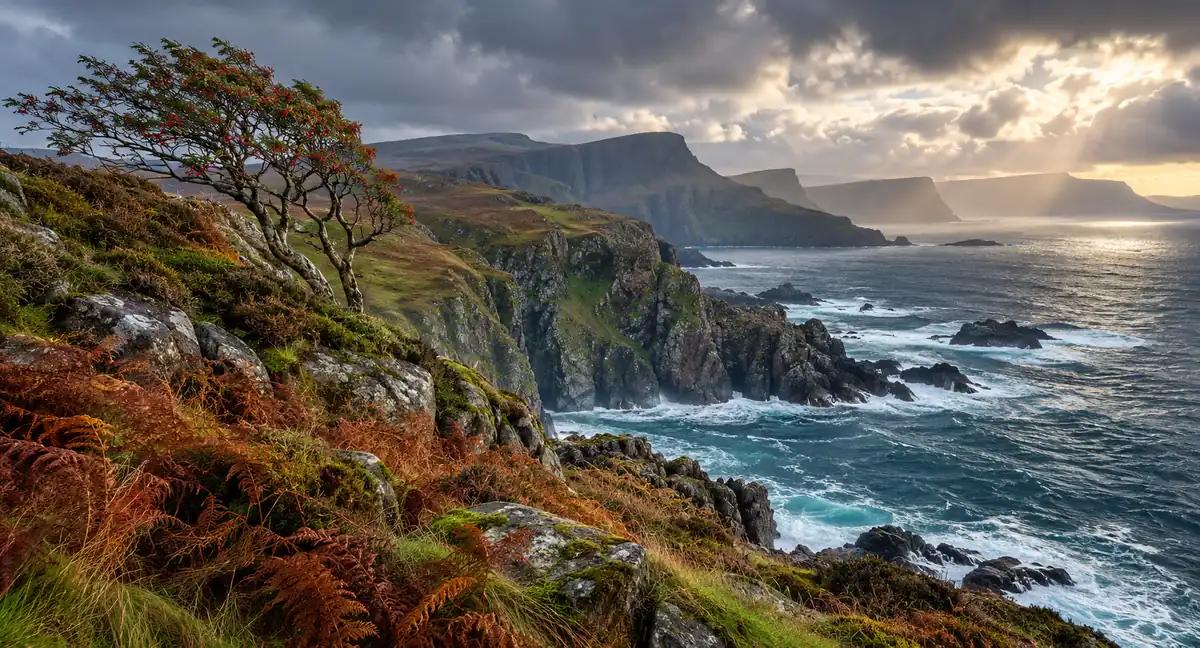
Rowan Kilmerran crouched beneath a rowan tree bent almost horizontal by Atlantic weather. The dead bird lay among wet bracken, one immense wing open. Beyond it, the sea flashed pewter between the headlands of Eilean Garbh.
“Ah, girl,” she said.
She recognised the crooked outer feather. This female had held the southern territory for eleven years. Last spring, Rowan had watched her steal a fish from her own mate and then demand another.
Now there was salmon skin beneath her talons, cut along a ruler-straight edge.
Rowan photographed everything before moving closer.
Three occupied territories had become two, then one, in seven weeks. Plenty of fish. Rabbits everywhere. No storms severe enough to explain the losses. The cliffs should have been noisy with young birds.
Instead, there was this.
She kept her gloves away from her face and called the mainland veterinary laboratory.
“I have another white-tailed eagle. This time there’s suspicious bait.”
While the duty vet gave instructions she already knew, a movement below caught her attention.
A man stood on the shore path with binoculars.
He was watching her, not the bird.
By four o’clock, the eagle and separate bait samples were sealed for collection, and Rowan had decided she disliked her visitor.
His booking said Morgan Cairnwick, thirty-nine, environmental consultant, here for a week’s birdwatching. He had excellent boots, an expensive waterproof patched at the shoulder, and binoculars adjusted so narrowly that they couldn’t possibly suit his eyes.
The reserve’s single guest cottage had seemed a reasonable way to cover a failing generator. She was reconsidering.
“White-tailed?” he asked as she approached.
“Yes.”
“Any indication what happened?”
“You’ll miss very little if you turn those binoculars round and actually look through them.”
He glanced down. They were facing the right way.
She waited.
Then, unexpectedly, he smiled.
“Fair.”
The smile complicated his face. Before it, he had looked like someone measuring a room for exits. Afterwards, he looked tired and almost approachable.
Rowan declined the invitation.
“You’re booked into the cottage. No drones, no fires, no approaching nests. The western causeway floods two hours before high water, whatever your map suggests.”
“Does it reopen two hours after?”
“Sometimes.”
“That sounds deliberately unhelpful.”
“The sea has never accepted feedback.”
He looked towards the sealed transport box beside her Land Rover.
“Can I carry that?”
“No.”
He stepped aside immediately.
That, at least, she liked.
At forty-two, Rowan had acquired a reputation for being difficult, largely by refusing to call preventable disasters unfortunate. She had worked in five countries, managed seven-figure conservation budgets, and once spent forty-six hours awake negotiating the release of a confiscated leopard.
Then she had cried because a hotel breakfast buffet contained sixteen kinds of bread.
Eilean Garbh offered one shop, no hotels, and bread on Tuesdays.
For four years, that had been enough.
Now something was killing her eagles, and a supposed birdwatcher had arrived with clean notebook pages and a habit of noticing approaching boats.
The first result came the following afternoon: exposure to a highly toxic pesticide, banned for ordinary use. Further testing would take longer.
Rowan stood outside the boathouse, listening to the vet.
“The salmon?”
“Also positive. Rowan, this needs police involvement.”
“I reported the first missing bird six weeks ago.”
“This is a carcass with evidence.”
“So was the buzzard on the mainland in March.”
A pause.
“I know.”
She ended the call and found Morgan by the slipway, looking at a pale scratch on the gate.
“What are you doing?”
“Wondering why someone cut your chain and fitted a new padlock.”
Rowan stopped.
The chain hung exactly as she had left it. The padlock was the same brand.
But hers had a yellow paint spot beneath the keyhole.
She walked past him into the boathouse. Nothing obvious was missing. Nets, fuel cans, sample coolers, the reserve’s aluminium workboat.
Her spare field camera was gone.
Morgan stayed at the threshold.
“Don’t touch anything else.”
It was not the sentence. It was the voice: quiet, immediate, accustomed to being obeyed.
Rowan turned.
“Who are you?”
He looked towards the headland before answering.
“Detective Sergeant Morgan Cairnwick. Police Scotland, working with a national wildlife crime operation.”
For several seconds, she heard only water slapping beneath the slipway.
Then she said, “Get out.”
“Rowan—”
“Out of my boathouse. Out of the cottage. Pick an out.”
He stepped back into the rain. She followed him.
“You let me think you were a tourist.”
“Yes.”
“You watched me bag that bird.”
“Yes.”
“How long have you known?”
“About suspected organised persecution here? Three weeks. About this eagle? Since yesterday.”
“And you thought I might be involved?”
“We hadn’t ruled out anyone with access.”
That was worse than an excuse. It was an answer she could not easily dismiss.
She folded her arms tightly.
He took out identification, then offered a verification number she could obtain independently through the police switchboard.
“Someone is being told when wildlife complaints reach the mainland,” he said. “Sites get cleared before officers arrive. We’re investigating a transport contractor connected to suspected poaching and several estates. We don’t yet know who is helping them.”
“So you came here and used my reserve as a blind.”
“I came here to watch their boats. I should have brought you in once you found the bait.”
“Why didn’t you?”
“Because anyone seen cooperating with us may be at risk. I thought keeping my identity from you bought you distance.”
She pointed at the cut chain.
“How’s that working?”
He looked at it.
“Badly.”
The admission took some of the force from her anger, which annoyed her further.
After verifying his identity, she made him wait outside while she photographed the lock.
Then she brought two mugs of tea to the boathouse steps.
“You don’t decide what risks I understand,” she said.
“Agreed.”
“If I ask a direct question, you don’t give me another cover story.”
“Agreed. There are things I won’t be able to tell you. I’ll say that.”
“And you do not touch my maps.”
He accepted the mug.
“May I look at them?”
“We’ll see.”
They spread the maps across her kitchen table that evening.
Rain tapped the window. A drying rack above the stove held socks, seaweed presses and one bra whose presence Rowan chose not to acknowledge.
Morgan did not look at it.
She respected that more than she intended to.
He had arranged for an evidence officer to collect the eagle and process the boathouse the next morning. His operational team would receive their findings through a restricted route, bypassing the reporting chain under suspicion.
“I need to establish where the bait is being placed,” Rowan said. “Before another bird takes it.”
“And I need to connect whoever places it to whoever pays.”
“Then keep up.”
He pulled his chair closer.
She marked the known territories, last sightings and carcass locations. Morgan added boat movements from his surveillance.
His suspect was Callum Ardren, owner of a refrigerated transport company serving fishing boats and sporting estates. His vehicles had appeared near two suspected deer-poaching sites. Payments linked him to people investigated for trafficking wild birds overseas.
“Suspected,” Rowan said.
“Yes.”
“You say that a lot.”
“I’d like to stop.”
She almost smiled.
The obvious source was the salmon farm north of the island. The eagle had carried farmed salmon; the colour and residual fat made that likely. Waste from processing might have entered the food chain.
Morgan regarded the map.
“The lab says pesticide. Why would a fish farm have that?”
“It shouldn’t. But we check the boring explanation before admiring the interesting one.”
They took the workboat north at first light.
Morgan handled the bowline correctly, without being asked. When a gust caught them leaving the jetty, he shifted his weight before Rowan needed to tell him.
“Boats?” she asked.
“Father repaired them in Mallaig.”
“And you?”
“Mostly held things at the wrong angle.”
At the farm, the manager looked appalled and gave them access to waste records, feed stores and mortality containers. Rowan checked seals and drainage. Morgan asked questions with an unhurried persistence that made evasions difficult without making cooperation unpleasant.
By noon, they had a disappointing answer.
The farm shipped whole fish away. It did no filleting. Its waste tanks were intact, and the pesticide had no plausible connection to its operations.
Back aboard, Rowan stared at the empty sample bag between her boots.
“A whole morning.”
“A route eliminated,” Morgan said.
“That’s what people say when they’ve lost a whole morning.”
He handed her a cheese sandwich.
She looked at it.
“You packed lunch?”
“You packed three kinds of forceps.”
“Two. The third is pliers.”
“My mistake.”
She ate the sandwich.
On the return journey, he pointed towards a rusting pier beneath a roofless packing shed.
“Ardren’s launch was there twice last week.”
“Old mussel station. Lease belongs to Strathcorran Estates.”
“Worth a look?”
“Not from the sea today.”
The narrow channel in front of the pier looked calm.
Morgan studied her face, then the water.
“Why?”
“See how the kelp’s lying flat while the surface is still?”
He nodded.
“Strong current underneath. It pushes you sideways into the piles.”
He looked again, properly this time.
“All right. How else?”
Rowan found herself wanting to show him.
They crossed to the mussel station on foot the next morning, using the western causeway while it was still a rib of dark stones above the tide.
Morgan carried a camera. Rowan carried a tide staff, sampling kit and the irritation of having someone match her walking pace without complaint.
The abandoned station smelled of salt, old rope and something sweetly rotten.
There was no bait.
No suspicious container. No ledger conveniently left open.
They could see through the broken packing-shed windows, but its locked inner store was beyond their lawful access. Morgan photographed tyre impressions on the public track and a recently installed security camera.
Rowan knelt by the drainage channel.
“What have you got?” he asked.
“A crab having a difficult morning.”
She moved it out of a plastic cup and back beneath a stone.
Morgan said nothing.
When she stood, he had turned away, but she caught the edge of a smile.
“What?”
“Nothing.”
“You’ve got a very loud nothing.”
“I’m revising an opinion.”
“Keep it to yourself.”
Outside the shed, she found scraps of salmon skin among gull droppings. She collected them, hopeful despite herself.
The laboratory later found no poison.
Another incomplete lead.
By then, the wind had risen and the causeway was narrowing. Morgan glanced at his watch.
“We have forty minutes.”
“We have twenty.”
“The published table—”
“Is for the mainland harbour. This channel fills early in a southwesterly.”
He hesitated, looking back at a stretch of shore they had not examined.
Rowan felt her temper stir.
“You can search the other side tomorrow. You can’t negotiate with this one.”
He put the camera away.
They were halfway across when water began threading over the lowest stones.
Morgan moved onto the seaward side without crowding her. Rowan tested each foothold with the staff. At the deepest section, they linked elbows by mutual instinct, bracing against the current.
His arm was warm through two layers of wet clothing.
On dry ground, he released her immediately.
“Twenty minutes,” he said.
“Eighteen.”
“Do you ever allow anyone the consolation of rounding?”
“Not near water.”
He laughed then, fully, and the sound startled a laugh out of her.
It felt like opening a window in a room she had forgotten was closed.
That evening, they found the reserve office unlocked.
Rowan knew before entering that something was wrong. She always left the desk chair tucked in. It stood facing the door.
Her paper nest records lay open.
Nothing had been stolen this time.
Across the current survey map, someone had drawn a heavy black line through the southern territory.
Morgan checked the building while she remained outside, furious at how difficult it was to stand still.
When he came back, his expression had lost every trace of humour.
“You can stay on the mainland tonight.”
“So can whoever did this.”
“True.”
“I’m not leaving the last pair unwatched.”
“All right. We need better locks, cameras covering the approaches, and someone besides us aware of your movements.”
She had expected an argument. His practical acceptance left her briefly without one.
“What about your cover?”
“It’s probably gone.”
“Because of me?”
“Because somebody cut a chain, stole a camera and came back to make sure you noticed. They’re acting under pressure. We need to find out why.”
An evidence technician came over with the evening supply boat. By dark, the office was secured and small cameras watched both land approaches. Morgan moved his working equipment into Rowan’s spare room because it had the only reliable upland radio signal.
He asked before bringing in his overnight bag.
She said yes, then spent an unreasonable amount of time moving old journals off the bed.
At eleven, they sat in her kitchen watching footage from the reserve’s surviving field cameras.
A pine marten. Rain. Three hundred images of grass.
“Riveting,” Morgan said.
“You should see the director’s cut.”
Then Rowan leaned forward.
A hooded crow stood on a rock with something pale in its beak.
She advanced the images.
The crow had come from the west. In its beak was a salmon strip, narrow and neatly cut.
Morgan looked at her.
“The station?”
“Maybe. But the samples there were clean.”
“Different batch?”
“Possibly.”
She rewound to a camera sequence from five days earlier. Another crow. Another strip.
Behind it, the wrack line lay high on the stones.
She stopped.
“What?” Morgan asked.
“Give me your boat times.”
He opened his notebook.
Ardren’s two visits had occurred shortly before exceptionally low tides.
Rowan pulled the missing-bird records towards her. The disappearances had followed spring tides too, separated by roughly a fortnight.
She had assumed the carcass locations represented where the birds had fed. But eagles could carry food kilometres. Crows carried smaller pieces. Gulls fed where scraps were accessible.
She went to the window, looking west into darkness.
“The station isn’t the bait site.”
Morgan joined her.
“Then where?”
“There’s a ledge below it. Seaward side. Most of the month, it’s underwater or being washed clean. Around low spring tides it dries out.”
“Accessible from a boat?”
“Or by steps from the station. Eagles use it to feed. Big flat rock, open approach, good view of anything coming.”
“And the crows carry scraps inland.”
“Yes. We searched above the tide line. The tide line was the problem.”
Morgan looked back at the map, then at her.
“That gives us a place and a window.”
For the first time in days, Rowan felt something besides dread.
It was sharpened by the way he watched her—not as though she had performed a trick, but as though he had been waiting for her to find the shape of something.
They reached the ledge before dawn.
A shore observation team had arrived discreetly overnight. Morgan’s supervisor had authorised the operation and arranged marine support, though the approaching weather could complicate any landing.
Rowan guided Morgan down a sheep track east of the station. They remained outside the fenced lease boundary, hidden by heather above the ledge.
Through the telescope, she saw three pieces of fish.
Too evenly spaced.
Too far above the current wash.
An eagle called somewhere beyond the mist.
Rowan’s stomach tightened.
“We remove them.”
“We photograph the placement first.”
“Quickly.”
Morgan worked fast. Then, with gloves and separate evidence bags, they approached each piece.
The fish was folded around a dark paste.
Rowan did not touch it.
Morgan photographed it where it lay, recorded its position and collected it. Beneath the overhang, they found a dead crow.
That mattered. A bait sample could be disputed in isolation. The crow placed a casualty at the suspected feeding site.
On the rock above them, Rowan found a narrow scrape through orange lichen.
Something heavy had been dragged towards the steps.
She followed the mark with her eyes.
A plastic fish box would fit.
The steps climbed into the station’s fenced yard.
Morgan photographed the scrape without crossing the boundary.
Then his phone vibrated.
He listened for a long time.
“What?” Rowan asked when he finished.
“The first toxicology comparison is back. Your eagle and a buzzard recovered near a Strathcorran estate last month show the same unusual formulation. The laboratory thinks the toxic material was prepared for baiting.”
“So this isn’t somebody tipping out an old bottle.”
“No.”
“And the estate?”
“There’s more. Ardren has been paid through a consultancy working for three landowners. The invoices say shoreline maintenance.”
Rowan looked up at the buildings.
There were plans for a private marina along this coast. She had submitted eagle activity records during the consultation. Without occupied territories, the ecological objection weakened considerably.
“Who signed off the survey?” she asked.
Morgan’s silence answered before he did.
“Alastair Keldrum. Regional environmental compliance director.”
Keldrum had personally assured her that the earlier reports were being examined.
She felt cold in a way the weather could not explain.
“He has my nest coordinates.”
“We’re obtaining the communications behind those decisions.”
“He has every coordinate I sent.”
Morgan closed his hand briefly over her sleeve.
“Then we change how we protect what’s left.”
She looked at his hand, then his face.
He let go, but the warmth remained.
They spent the afternoon securing the last occupied nest from a distant observation point, with volunteers rotated in under the reserve’s routine monitoring programme.
Rowan insisted that everyone receive a clear account of the risk.
Morgan agreed.
By evening, the eagle pair were still alive, the suspicious food was gone, and search warrants were being sought for the station and Ardren’s mainland premises.
Rowan should have felt relieved.
Instead, she stood in the kitchen unable to remember why she had opened a cupboard.
“Bowls,” Morgan said gently.
“Yes.”
He took two down and handed them to her.
They ate lentil soup while rain ticked against the glass.
“I used to be good at people,” she said.
Morgan waited.
“Or at managing them. There’s a difference.”
“What happened?”
“Too many things I couldn’t fix. Too many meetings about how we should describe them. I started hearing every reasonable request as another demand.”
She traced a chip in the bowl.
“I left before I began hating work I loved.”
“That sounds like a decision made in time.”
“It didn’t feel like it.”
“No. They rarely do.”
She looked at him.
“And you? How does a man who dislikes lying end up doing it professionally?”
“What makes you think I dislike it?”
“You’re much easier company when you’re telling the truth.”
He leaned back, considering that.
“My first long covert job, I got used to having an explanation for everything. After it ended, someone I cared about asked a simple question. I answered like I was still protecting an operation.”
“Were you?”
“No. Just myself.”
“Did you fix it?”
“We parted reasonably. Which was more generosity than I deserved.”
Outside, the wind lifted a loose edge of guttering.
Rowan said, “I understand why you didn’t announce yourself at the pier.”
“That doesn’t make the way I handled you right.”
“No.”
“I wanted whoever was watching to see a solitary reserve manager who knew nothing about me.”
“A role I had perfected.”
“You shouldn’t have had to perform it unknowingly.”
She liked him most, she was discovering, when he declined an easy pardon.
He reached for her empty bowl. Their fingers touched.
Neither moved immediately.
“This is inconvenient,” she said.
“Extremely.”
“Are you allowed to kiss people you’re investigating with?”
“There’d be a serious problem if you were a suspect, or someone I had authority over. You’re neither. But you’re also a witness, and I need to handle that properly.”
She drew her hand back.
“All right.”
“I’d rather ask you when this operation is over.”
Her disappointment was sharp enough to be funny.
“You assume I’ll still be interested.”
“No,” he said. “I’m hoping.”
She took the bowls to the sink, smiling where he couldn’t see.
At six the next morning, Ardren changed the plan.
Morgan’s surveillance colleague reported his refrigerated van leaving its mainland depot early, towing a small launch. A second vehicle followed towards the public slip.
Then the station’s security camera went offline.
“They’re clearing it,” Morgan said.
The warrants had been granted, but teams were still travelling. On the mainland, officers could stop the van. On the island, they needed to know whether someone was already inside the station.
Rowan checked the weather station.
Wind rising. Rain approaching in a thick band from the southwest. Low water at eleven twenty.
“If they’ve heard about the searches, they’ll use the morning tide.”
Morgan was on the phone, arranging coverage of the landing places.
She listened, then shook her head.
“They won’t come round the point.”
He muted the call.
“Why?”
“Too exposed with that launch loaded. They’ll use the north gut.”
“Your chart shows it drying.”
“It does. There’s a narrow run through the eelgrass. Mussel workers used it at half tide.”
“Can you mark it?”
She took his pencil.
For a moment, all she could hear was Keldrum’s voice from their last meeting: We must be proportionate, Rowan.
She drew the channel.
Morgan relayed the correction. The marine team could reach its outer entrance, but not before Ardren’s likely arrival.
“We observe,” he told her when the call ended. “We don’t try to arrest two men on our own.”
“Good. I’m terrible with paperwork.”
He did not smile.
“Rowan.”
“I heard you.”
They reached the observation hollow above the station at nine forty.
The second man was already there.
Through the telescope, Rowan saw him loading fish boxes onto a handcart. His hood fell back as he turned.
She recognised a keeper employed by Strathcorran Estates.
Morgan photographed him. Then a launch appeared between the skerries, travelling through the very channel Rowan had marked.
Ardren stepped ashore carrying a fuel can.
Morgan quietly relayed the update.
The keeper took the can into the store.
Rowan lowered the telescope.
“They’re going to burn it.”
“Support is coming.”
“How long?”
“Twenty minutes.”
The wind moved across the heather in dark sheets.
Below, Ardren carried something else from the launch: a covered wire crate.
It shifted.
Rowan put her eye back to the telescope.
A narrow wing struck the mesh.
“Live bird,” she said.
Morgan’s expression changed.
“What kind?”
“Can’t tell.”
Another crate followed. Then a third.
This wasn’t just poisoned bait. The station was a holding point.
Morgan spoke rapidly into his radio.
Below them, the keeper emerged from the store and reached for the nearest crate.
From inside came a sharp, repeated falcon call.
Rowan knew that sound. Young peregrine. Distressed.
The man carried the crate towards the open doorway.
“Whatever you decide,” she whispered, “decide now.”
Morgan studied the yard, the launch, the steep bank between them.
“Can we reach the landing without crossing their view?”
“By the drainage burn.”
“How far?”
“Four minutes.”
He updated his team, then looked at her.
“You stay behind the stone wall by the steps. If they run inland, let them. If you have to withdraw, go east.”
“And you?”
“I’ll give them something more urgent than a fire.”
It was a risk, openly named and imperfect.
Rowan nodded.
They moved.
The burn was swollen, its banks slick with peat. Rowan led on hands and feet beneath the gorse.
At the wall, Morgan paused long enough to touch her shoulder.
Then he stepped into the yard.
“Police. Put the can down.”
Ardren froze.
The keeper dropped the empty crate he was holding and ran inland.
Morgan let him go, exactly as he had said.
Ardren looked towards the launch.
“Don’t,” Morgan said.
For a moment, Rowan thought he would listen.
Then the wind slammed the store door against its frame.
Ardren bolted down the steps.
Morgan followed, but Ardren had the shorter path. He jumped into the launch and shoved away before Morgan reached the bottom.
Rowan rose behind the wall.
“Let him take the outer channel,” she called. “Your team’s there.”
Ardren heard her.
He looked up, recognised her, and swung the tiller the other way.
Towards the eelgrass.
Rowan felt the next few seconds arrange themselves.
The tide was lower now. The safe run was no longer where it had been on his arrival. Beyond its lip, shallow water covered a shelf of stone.
She pointed.
“He’ll ground at the bend.”
Morgan relayed the direction instead of attempting to jump aboard.
The launch surged forward, then stopped with a brutal scrape.
Ardren fell against the console.
The engine howled. Mud boiled behind the stern.
From the store came a thin curl of smoke.
Rowan turned and ran.
“Fire!” she shouted.
Morgan was already climbing back.
Inside the doorway, a small flame travelled along a wet shine on the floor. The fuel had been poured towards a stack of packaging, but most of it had not yet caught.
Three crates stood beyond it.
Rowan stopped herself at the threshold.
Entering would put the fire between her and the door.
“There’s a side hatch,” she said. “Fish delivery. North wall.”
They ran round together.
The hatch was secured with an exterior sliding bolt. Morgan hauled it open. Rowan leaned through into cold, smoky air.
The crates were within reach.
“First one.”
She pushed it across the sill. Morgan took the weight.
A peregrine beat against the mesh, frantic beneath its loose cover.
“Keep it dark.”
He set it down and pulled the cloth back into place.
They moved the second crate. Then the third, heavier, wedged against a plastic tub.
Rowan could see a goshawk’s yellow eye.
Smoke thickened beneath the roof.
“Rowan. Out.”
“One pull. Help me.”
Morgan reached beside her. Together they dragged the tub clear and lifted the crate through.
They backed away as flame climbed the packaging inside.
Rowan’s heart was hammering. Morgan had soot along his jaw and one hand still clenched around the crate handle.
“All three?” he asked.
“All three.”
He moved them uphill, away from the smoke, while she called the reserve vet and reported captive raptors, unknown condition.
Below the station, an engine approached.
Marine officers entered the channel from its outer end. Ardren abandoned his attempt to free the launch and stood in water up to his thighs, with nowhere useful to go.
The keeper did not get far either.
He took the western causeway, perhaps remembering its existence but not its hours. The observation team found him stranded on the station side, wet to the waist.
Rowan sat beside the covered crates and listened until the birds settled.
Morgan crouched opposite her.
“You knew he’d run aground.”
“I knew where the rock was.”
“That distinction will feature heavily in my report.”
She began to laugh, then found she was shaking.
He held out his hand.
She took it.
Neither pretended it was only because she needed help standing.
The fire damaged the packing shed, but the island’s retained fire crew contained it before it reached the inner store.
What survived there was useful. What officers recovered from Ardren’s grounded launch was better.
The launch held sealed bait containers, transport documents, two phones and a waterproof case of cash. Ardren had taken the things he valued most with him.
Searches on the mainland uncovered veterinary records used to disguise wild-caught birds as captive-bred, and correspondence connecting the transport business to illegal estate services.
The poisoning case took longer.
Laboratory work matched bait from the launch and ledge to the material recovered with Rowan’s eagle. Camera footage showed the keeper carrying a fish box towards the steps on an earlier low tide.
The money required accountants.
The messages required warrants and patient people in windowless rooms.
Keldrum had not merely ignored complaints. Investigators found payments through his partner’s consultancy, alongside messages warning estate representatives about inspections and advising them how to challenge Rowan’s territory records.
Three landowners faced investigation. Keldrum was arrested. The marina application was suspended pending a fresh ecological assessment, and restrictions were put in place around the remaining nesting territory.
None of that happened in one triumphant afternoon.
Rowan found this both reassuring and irritating.
“You’ve infected me with evidential standards,” she told Morgan.
He stood on her jetty twelve days after the fire, holding the bag he had brought ashore under a false name.
“A difficult condition. Usually chronic.”
He had withdrawn from taking her formal statements as soon as immediate events allowed, explaining the reason to his supervisor. Another officer handled her evidence now.
The rescued raptors were in specialist care. Two had been stolen from nests that spring; the third’s origins were still being traced.
The surviving eagle pair had returned to their usual feeding range.
Morgan’s work was moving back to the mainland.
Rowan had known this from the beginning.
It remained an unreasonable development.
“I’ll send the updated monitoring plan,” she said.
“To the case officer.”
“Yes.”
“And the tide observations. They asked particularly for those.”
“Yes.”
A ferry horn sounded beyond the point.
Morgan looked at her.
“That’s all the work things I can think of.”
“I could invent some.”
“I’d rather you didn’t.”
Wind lifted the hair from her cheek. He tucked his hands into his jacket pockets, waiting.
She stepped closer.
“Are you going to ask?”
His smile arrived slowly.
“Can I kiss you?”
“Yes.”
He set down the bag.
His hand settled at her waist; hers caught the damp collar of his coat. The first kiss was warm and careful for approximately two seconds.
Then she drew him closer.
He made a quiet sound against her mouth, and the reserve, the ferry, the entire inconvenient mainland receded.
When they parted, his forehead rested briefly against hers.
“I had a much more restrained version planned,” he said.
“Poor field conditions.”
He laughed, and she kissed him again.
Six weeks later, Rowan hired a seasonal assistant.
She chose a woman who asked intelligent questions, could repair an outboard and did not apologise when she disagreed.
It was a deliberate experiment in having help before she desperately needed it.
She also agreed to advise the wider investigation into poisoned food moving through coastal ecosystems. Two mainland days a month, properly funded, with somebody else responsible for organising the meetings.
Morgan did not ask her to leave the island.
She did not ask him to become somebody who could always stay.
Instead, they became unexpectedly good at calendars.
There were dinners in Mallaig, phone calls interrupted by poor reception, and one argument about his habit of saying he was fine when he meant he had worked sixteen hours. She began telling him when solitude had become loneliness. He began answering questions without first deciding what would worry her least.
On his third visit, he arrived carrying groceries and binoculars correctly adjusted for his eyes.
“Ambitious,” she said.
“I’ve been studying.”
They walked west in evening light, stopping well above the causeway. Sea pinks trembled in the cracks between stones. Out beyond the kelp beds, an otter surfaced with a crab and vanished again.
Then an eagle came over the ridge.
Broad wings. Pale head. A fish hanging silver beneath it.
Rowan lifted her binoculars.
Morgan waited beside her.
The bird climbed towards the surviving nest, strong and purposeful against the blue shoulder of the mountains.
“Well?” he asked.
“Whole fish.”
“Good.”
“Very.”
She lowered the binoculars and found his hand.
Below them, the causeway was disappearing beneath the tide. There would be no crossing now, no useful shortcut, nowhere they needed to hurry. Rowan turned towards home with Morgan beside her, and kept hold of his hand all the way.
Every ending is somewhere new.
Find your next story →