Beyond the Cameras
On holiday in southern Spain, media entrepreneur Margo Quenley becomes an unlikely getaway driver for a politician seeking quiet—and discovers a detour worth taking slowly.
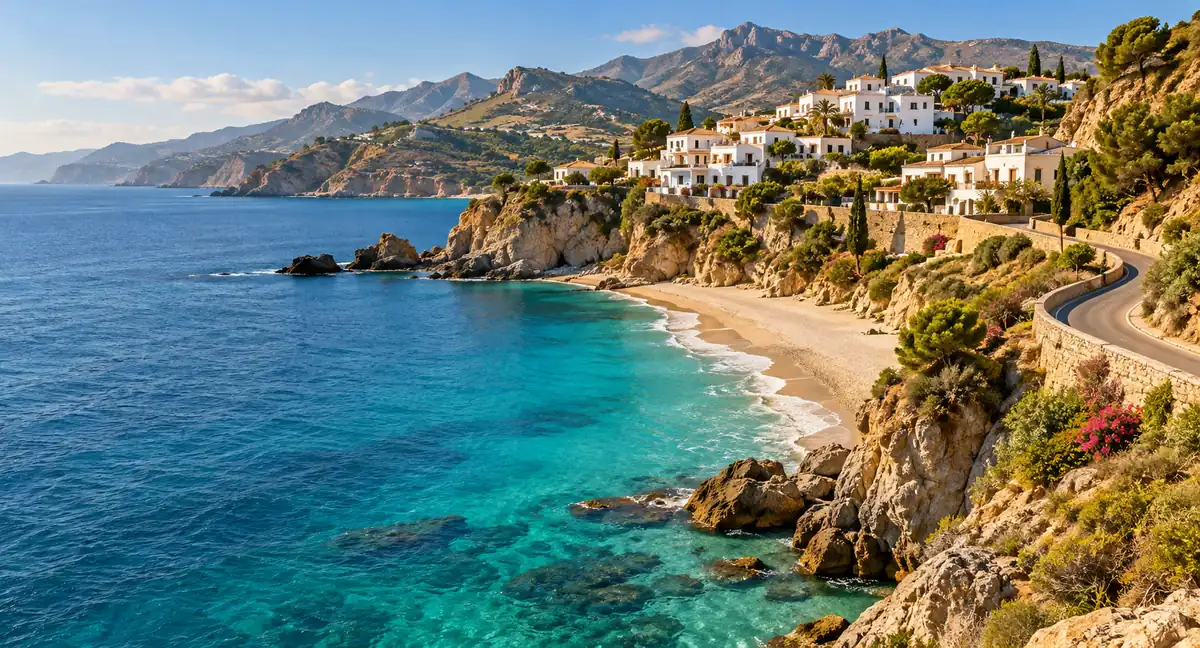
The man beside Margo Quenley’s beach towel asked whether she would mind pretending he had been boring her for twenty minutes.
“That depends,” she said. “Have you?”
“Not yet.”
“Ambitious opening.”
He stood barefoot in the sand, holding two paper cups of coffee. Dark hair, a faded blue shirt, perhaps forty. Attractive in a way that suggested he had forgotten to make arrangements about it.
Beyond him, the Mediterranean glittered hard enough to hurt.
Margo lowered her sunglasses.
“Why?”
“The man by the showers has a camera.”
“Several people have cameras. It’s Spain.”
“That one has been following me since breakfast.”
She looked without turning her head. A man in a grey cap stood beside the wooden beach walkway, a long lens resting against his thigh.
“Are you someone’s husband?”
“No.”
“Wanted by the police?”
“No.”
“Selling something?”
“Apparently my morning.”
She held out a hand for one of the coffees.
“Sit down. Don’t look grateful. It photographs badly.”
He settled on the sand a careful distance from her towel.
At thirty-six, Margo ran a media company in Nice employing nineteen people, all of whom knew she was unavailable for the next eleven days unless a building was on fire or someone had actually purchased it.
These were her two weeks. Her annual experiment in being a person with shoulders instead of deadlines.
She had eaten grilled sardines for lunch, drunk one cold glass of white wine over two hours, and watched a woman argue lovingly with an elderly dog about entering the sea.
It had been an excellent day.
Now there was a politician beside her.
She recognised him when he smiled.
“Oh,” she said. “You’re the coastal bill.”
He closed his eyes briefly.
“I used to have a name.”
“Tomás something.”
“Cendrales.”
Her company had produced an explainer about proposed protections for vulnerable sections of the Andalusian coast. She remembered reviewing subtitles late at night. He had been the man insisting that compensation for homeowners needed to appear in the actual budget, not merely in a minister’s encouraging remarks.
“You were less sunburned in our footage.”
“Your footage?”
“Quenley Media.”
His expression sharpened.
Margo lifted her coffee.
“Yes. This is awkward for both of us.”
“Are you working?”
“Absolutely not.”
“Then perhaps it isn’t.”
The photographer raised his camera.
Tomás looked down at the sand rather than at Margo. She appreciated that. He wasn’t trying to pull her into an intimate-looking conversation.
“How long has this been happening?”
“Three days. Our party leader is resigning. Someone decided my reluctance to answer questions means I’m preparing a leadership campaign.”
“Are you?”
“No.”
“Have you said that?”
“In three interviews, a written statement, and to a man who stopped me outside a pharmacy.”
“That last one was probably decisive.”
He laughed, and she found she liked the sound before she had decided whether she liked him.
His phone vibrated. He glanced at it, silenced it, and turned it facedown on his knee.
Margo watched a fishing boat move beyond the swimming buoys.
“Why this beach?”
“I came here as a boy. I thought that might make it a good place to stop thinking.”
“Terrible planning. Memories everywhere.”
“And you?”
“Somewhere nobody would ask me whether we could make a six-minute film feel more like twelve seconds.”
“Could you?”
“Get your own towel.”
Twenty minutes later, he had indeed become mildly boring about anchoring restrictions, although Margo suspected this was deliberate.
She learned that he was forty-one, had worked as a harbour pilot before entering regional politics, and was taking four days of leave before returning to Seville for committee meetings. His office knew where he was. He was travelling privately, without an official car.
She told him she had built her company from a borrowed camera and an inability to endure certain kinds of boss.
“Now you’re the boss,” he said.
“Yes. It’s been a difficult discovery.”
A second photographer arrived.
Tomás noticed him in the reflection of Margo’s sunglasses.
“I should go.”
“Where?”
“My hotel. Although they’ve found that too.”
Margo had intended to leave Nerja that afternoon anyway. Her small hired convertible waited in an underground car park, packed with a suitcase, three unread novels, and a straw hat already losing its structural integrity.
Farther east, beyond the busier resorts, she had booked four nights at a little guesthouse in a village called Cala Serena. Six rooms, no swimming pool, no entertainment schedule. Its website had apologised for the church bell.
She considered him.
Not the face from the video. The man who had shifted his coffee cup off her towel without being asked and had answered a call from his assistant with, “No, you take your lunch first.”
“I’m heading along the coast,” she said. “You could come as far as the next town and decide what to do there.”
His gaze returned to her.
“You don’t owe me an escape.”
“I know. I’m offering a lift, not asylum.”
“I would have to tell my assistant.”
“And I would have to tell a friend I’m driving away with a strange man.”
“Entirely reasonable.”
She sent his name and a photograph of him holding both coffee cups to her friend Léa.
The reply arrived almost immediately.
Better than the last rental car passenger. That one vomited.
“My friends approve conditionally,” Margo said.
He called his assistant, Inés, explained his change of plans, then handed Margo the phone when she asked to speak to her.
“Please make him eat something,” Inés said.
“I’m not adopting him.”
“Of course. My apologies.”
The photographer by the showers began walking towards them.
Margo stood, folded her towel, and shook sand onto Tomás’s foot.
“Time to be useful.”
He carried her beach bag.
They took the public steps up from the beach, neither running nor pretending to be invisible. At the top, a reporter called his name.
“Are you meeting supporters in Motril?”
“No,” Tomás answered.
“Will you rule out a leadership bid?”
“I have. My office can send you the statement.”
Margo unlocked the car.
One photographer hurried towards a scooter.
Tomás opened the passenger door and looked at her across the roof.
“Last chance.”
“You haven’t seen me parallel park.”
He got in.
They drove out at the speed limit with the roof firmly closed.
For the first kilometre, Margo felt wonderfully ridiculous.
Then a scooter appeared in her mirror.
“Don’t turn here,” Tomás said.
“Why?”
“The coast road narrows after the roundabout. If he stays behind us, there’s nowhere comfortable to stop.”
She continued straight.
“What would you suggest?”
“The service station ahead. Public, busy, plenty of room.”
“A very glamorous getaway.”
“I’m new to this.”
She parked beside the café rather than the pumps. The scooter stopped near the air machine.
Margo turned off the engine.
“We aren’t going to race him.”
“Agreed.”
“And I’m not taking a stranger somewhere isolated while a man with a lens follows us.”
“Also agreed.”
They bought water and two cheese rolls. Tomás insisted on paying; Margo allowed it because she was hungry and opposed to administrative delays.
Through the window, she saw the photographer studying his phone.
“He’s freelance,” she said.
“How can you tell?”
“The equipment labels. An agency would have its own inventory stickers. His lens has a hire-company barcode.”
“Does that help?”
“It tells us he’s paying to stand beside a tyre pump.”
She knew a picture editor at the agency whose logo appeared on his helmet. She also knew exactly how quickly a friendly call could turn her holiday into work.
Instead, she walked outside.
The photographer straightened.
“Hello,” she said. “Are you filing live?”
“Who are you?”
“The driver whose registration you’ve photographed. I’d appreciate you cropping it.”
He looked faintly embarrassed.
“I wasn’t after the car.”
“Good. Then that should be easy.”
His name was Rafa. He had sold a beach picture and was waiting for instructions from a desk in Madrid.
“They think he’s going to a meeting.”
“He has told you he isn’t.”
Rafa gave her the tired, practical look of someone paid for proof rather than assurances.
“Then a picture of him arriving somewhere ordinary settles it.”
“Or creates a story about everyone already there.”
That landed. Not decisively, but enough.
Behind her, Tomás came out carrying her water.
“I’ll stand over there for a photograph,” he said. “Alone. Then I’m asking you to leave us to our afternoon.”
Rafa glanced between them.
“No questions?”
“One,” Tomás said.
“Are you running?”
“No.”
The shutter clicked several times.
When they left, the scooter stayed where it was.
Margo waited until the next bend before breathing out.
“You negotiated that very neatly,” she said.
“He needed something he could sell.”
“You didn’t have to reward him.”
“No. But I could afford to give him a photograph.”
There was no bitterness in it.
She looked across at him.
“You’re more sensible than your profession suggests.”
“You’re kinder than yours suggests.”
“Careful. I have references.”
The road curved east between dry hills and bright water. White houses gathered in folds of land. On a terrace above a cove, washing snapped beside a satellite dish.
Margo lowered the roof.
Wind lifted his hair and stole the first thing he said.
“What?”
“I said, this is better.”
She could hardly argue.
By the time they reached La Herradura, Tomás had arranged a room at a small hotel outside town.
It seemed an adequate solution until they turned into its lane and found a television van beside the entrance.
Margo drove past.
Neither spoke for a moment.
Then Tomás said something quiet and emphatic in Spanish.
“I understood that.”
“I’m sorry.”
“Don’t apologise for the vocabulary. Explain the van.”
He called Inés.
Margo parked above the marina while they talked. Below, rigging tapped against masts with the delicate persistence of cutlery in a drawer.
The reservation had been made directly. Inés had told nobody outside the office. The hotel manager claimed nobody had called asking about him.
Tomás ended the call and sat looking at his phone.
“My assistant thinks someone at the hotel recognised the name.”
“Possible.”
“You don’t sound convinced.”
“I spent fifteen years learning how information moves. People usually blame the last person who touched it.”
He turned towards her.
“You said you weren’t working.”
“I’m not. I’m being inconvenienced intelligently.”
She searched his name.
The first photograph was already online: Tomás alone outside the service station, looking much more solemn than he had while eating a cheese roll.
The next result made her pause.
CENDRALES EXPECTED ON GRANADA COAST AS LEADERSHIP SPECULATION GROWS.
Published at eleven forty that morning.
Before they had met.
She opened it. Most of the piece was speculation built around an unnamed source and a reference to a “long-planned coastal visit.” There was no hotel name.
A second site repeated the same phrase.
Then a third.
“The hotel might be innocent,” she said.
“Three different reporters?”
“Maybe. Or one source copied three times.”
“How do we find out?”
She locked her phone.
“First, we eat something that isn’t wrapped in plastic. Then you ask Inés for every public event listing with your name on it this week.”
“And after that?”
“After that, I decide whether this is ruining my holiday.”
He nodded.
“That’s fair.”
She liked that he didn’t try to charm the decision out of her.
At a harbour restaurant, they ordered tomatoes, fried aubergine with honey, and grilled fish. Margo drank sparkling water because she was still driving. Tomás ordered the same without making a performance of solidarity.
His phone stayed beside his plate.
Hers remained in her bag.
For a while they talked about things nobody could reasonably turn into news: the dreadful carpet in his first flat, the way Margo’s father saved jars as if preparing to open a jar shop, whether sea urchins counted as food or a test of affection.
Then he said, “You can leave me here.”
“I know.”
“I don’t think I’ve said it clearly enough.”
“You have.”
He studied her.
She tore a piece of bread.
“I’m enjoying parts of this.”
“Which parts?”
“The aubergine is excellent.”
His smile arrived slowly.
She felt it somewhere inconvenient.
The events list came while they were drinking coffee.
There were seven entries. Two radio appearances already completed, three parliamentary commitments for the following week, a cancelled school visit, and a coastal access forum at the Hotel Mar de Almendra outside Motril.
Tomorrow morning.
“That was cancelled a month ago,” Tomás said.
“By whom?”
“The organisers. The venue flooded after a burst pipe.”
“Your office calendar says cancelled. What did the press receive?”
He called Inés again.
Margo watched him listen. He asked precise questions without making anyone on the other end feel small.
“No, don’t pull yourself back into the office,” he said. “Send what you can reach remotely. We’ll handle the rest tomorrow.”
When he hung up, she said, “You really do want the four days.”
“My father turned seventy last winter. I went to lunch and spent most of it in his stairwell taking calls.”
“Is he ill?”
“No. That’s what made it difficult to explain why it mattered.”
Margo looked towards the boats.
Her mother had recently begun saying, I know you’re busy, before telling her anything at all.
“I understand,” she said.
“The work matters. I still want to do it.” He rubbed a hand over the back of his neck. “I’d like occasionally to finish a meal.”
“That sounds dangerously moderate.”
“What about you?”
“I gave my operations director full authority before I left.”
“And?”
“I keep checking whether she needs to use it.”
“Does she?”
“No. It’s devastating.”
They laughed.
Then Margo showed him the guesthouse she had booked.
“I’ll ask whether they have another room. You pay for yours. You don’t give anyone the address except whoever actually needs it. And if reporters arrive, we deal with them without turning the village into a chase sequence.”
Tomás looked at the photograph: a whitewashed house above a narrow strip of beach, blue shutters, a fig tree leaning across the terrace.
“This is where you wanted to go.”
“Yes.”
“I don’t want to take that from you.”
“Then don’t.”
He held her gaze for a moment.
“All right.”
The owner, Pilar, had a room.
When Margo explained the circumstances, there was a silence.
Then Pilar said, “Does he snore?”
“I haven’t investigated.”
“The walls are good. Bring him.”
Cala Serena lay beyond a succession of greenhouses, an almond orchard, and a road that seemed to reconsider itself at every bend.
There was a bakery, a pharmacy, two bars, and a little landing place where fishing boats rested above the tideline on wheeled wooden cradles.
A hand-painted sign outside Pilar’s guesthouse read: DINNER AT NINE. PLEASE ARRIVE HUNGRY.
Margo felt her shoulders lower.
Pilar was in her sixties and wore reading glasses on a red cord.
“I don’t discuss guests,” she told Tomás. “But I won’t lie if you stand on the terrace waving.”
“I’ll try to resist.”
“Good. Room five.”
Margo had room two.
The distance between them seemed suddenly more specific than a set of numbers.
They went swimming before dinner. The beach was mostly pebbles, warm underfoot, and the water held the day’s heat.
Tomás entered carefully.
“Former harbour pilot,” Margo called, already waist-deep. “Afraid of the sea?”
“Respectful of sharp stones.”
She swam out towards the buoy. He followed without trying to catch her.
Farther offshore, the village lost its edges. White walls, terracotta roofs, the dark green of the fig tree. For the first time all day, there was no road to watch.
They floated several feet apart.
“You look different,” he said.
“Wet?”
“Less likely to dismiss someone.”
“That’s the salt. Temporary effect.”
He smiled.
A small wave carried her closer. She could see a pale scar near his chin and the first silver in his beard.
Neither closed the distance.
At dinner, Pilar served fish stew, potatoes with saffron, and a jug of wine with no label.
Tomás asked Margo about the first film her company had made.
“A portrait of a woman who repaired accordions.”
“Was it good?”
“It was forty-three minutes long.”
“That wasn’t the question.”
“No. But it’s the answer.”
He laughed so hard Pilar glanced over from the kitchen.
Later, they sat beneath the fig tree with the remaining wine. Somewhere down the lane, a television murmured through an open window.
Margo told him about almost losing the company six years earlier because she had confused being indispensable with being responsible.
“What changed?”
“One of my editors went home at six. I was furious. Then I realised she’d finished her work.”
Tomás rolled the stem of his glass between his fingers.
“I’m not sure I’ve learned that.”
“You did today. You let Inés stay home.”
He looked surprised.
“It counts,” she said.
His knee rested near hers beneath the table. Not touching. She was absurdly aware of the space.
When she went upstairs, he walked only as far as the foot of the steps.
“Breakfast?”
“Depends. Will you be boring?”
“I have strong views about breakwaters.”
“Eight thirty, then.”
At eight twelve, a television producer called Pilar asking to reserve every available room.
By eight twenty, a reporter had emailed Margo’s company seeking comment on her “private talks” with Tomás Cendrales.
Margo read the forwarded message in bed.
Then she sat up.
Her operations director had added one sentence.
I assume this is nonsense, but please confirm before I become professionally unpleasant.
Margo confirmed.
Downstairs, Tomás stood beside the terrace door, already dressed.
“I’m leaving,” he said.
“Good morning to you too.”
“They’ve connected you to me. I won’t have your company dragged into this.”
“You don’t get to decide what I can tolerate.”
His jaw tightened, then eased.
“No. But I can decide whether I stay.”
“Yes,” she said. “You can. First, have coffee and tell me what changed.”
He had spoken to Inés. The cancelled forum remained on an old press advisory distributed by a regional events service. Yesterday’s stories had all relied on that advisory, although none had linked to it.
That explained Motril.
It didn’t explain Cala Serena.
Margo opened the original email from the reporter. The question concerned a supposed discussion about communications contracts at the Hotel Mar de Almendra.
She read it twice.
“They don’t know we’re here.”
“Pilar had a booking call.”
“From someone casting a wide net. This asks about the hotel outside Motril.”
She pulled up the articles from yesterday.
One described the forum as a “closed coastal strategy session.”
Another mentioned “communications advisers.”
“Was there ever a closed session?”
“No.”
“Who was invited?”
“Councillors. Residents’ associations. Engineers. It was supposed to be streamed.”
Margo leaned back.
The story had gained a secret room and a conspiracy simply by passing through three desks.
She felt the old professional heat rise in her: not excitement exactly, but the need to put crooked things straight.
Tomás saw it.
“You’re working.”
“I’m protecting something I own.”
“Your company?”
“My morning.”
He sat opposite her.
They compared the archived advisory with the current listing. The cancellation appeared on the organisers’ website, but their press-service entry still showed the original event.
More usefully, it included the complete schedule.
Registration at nine. Public discussion at ten. Lunch at one.
Overnight accommodation recommended in La Herradura.
Margo turned the screen towards him.
“That’s why the television van was there. They weren’t following the reservation. They were following the old itinerary.”
Tomás exhaled.
“I owe a hotel manager an apology.”
“And possibly Inés deserves flowers.”
“She’d prefer another assistant.”
“Then start there.”
But the false suggestion of a private meeting now involved Margo’s business. Quietly slipping away would leave it unanswered.
Tomás wanted to record a statement immediately.
Margo disagreed.
“A video of you saying there’s no secret meeting becomes a video labelled ‘Cendrales denies secret meeting.’ We need the original organiser to correct the original source.”
“That could take all day.”
“Yes.”
“And meanwhile?”
“We answer factual questions. We don’t provide an exciting new scene.”
He walked to the terrace wall, looking down at the empty beach.
“I hate waiting while someone else describes what I’m doing.”
“So do I.”
“You make it sound easy.”
“No. I make it sound preferable.”
He turned back.
For a moment she thought he would argue.
Instead he said, “Show me where it began.”
It took most of the morning.
The forum coordinator was on a train. The events service needed written authorisation. The hotel had already spent weeks returning deposits and was furious to discover journalists expecting a conference.
Margo assembled a short timeline using documents rather than conclusions: the original announcement, the cancellation, the unchanged listing, the first story.
Tomás reached the coordinator and persuaded her to send the correction to everyone on the original distribution list.
He was good on the telephone. Patient without being soft, specific without bullying.
When the events service offered to update the page quietly, he said, “The old notice has created a public error. Please send the correction to the same subscribers.”
Margo looked up from her laptop.
He met her eyes and gave the smallest shrug.
At noon, the corrected notice went out.
By one, two outlets had updated their stories.
The third wanted an interview.
Tomás agreed to answer questions by telephone, on the record, while Margo walked to the bakery. When she returned with warm bread and apricots, he was ending the call.
“No,” he said. “She isn’t advising my campaign. There isn’t a campaign. She gave me a lift.”
A pause.
“Yes. People still do that.”
He put down the phone.
Margo set the bag between them.
“How was that?”
“I may have sounded annoyed.”
“Human. Terrible development.”
Pilar emerged from the kitchen.
“Now that the government is finished, would you like lunch?”
Afterward, they walked along the beach towards an abandoned watchtower.
The path climbed through rosemary and brittle grass. Below them, the sea shifted from turquoise to dark blue around submerged rocks.
Margo had left her phone charging in her room.
Tomás had left his beside it.
At the tower, they sat in a patch of shade barely wide enough for two.
“I’m sorry you lost the morning,” he said.
“I chose to spend it.”
“I know. I’m still sorry.”
She passed him an apricot.
“That’s acceptable.”
He split it with his thumbs.
“My ex used to say I was always available to someone who wasn’t in the room.”
Margo waited.
“She was right. We separated three years ago. There were other reasons, but that one was mine.”
“Have you changed?”
“Some days.”
She liked the absence of a polished answer.
“I once checked an audience report during a friend’s wedding speeches,” she said.
“Did she notice?”
“She was the one speaking.”
He winced.
“She still brings it up. Usually when I’m winning an argument.”
“That seems fair.”
“It is. Deeply irritating.”
A breeze moved over the ridge. Tomás’s sleeve brushed her arm.
He looked down at their hands on the stone between them.
Then at her.
“I’d like to kiss you,” he said.
Margo felt the words settle slowly.
“I’d like that too.”
He leaned in without hurry.
His mouth was warm, the kiss gentle enough that she could have stopped it easily. Instead she caught the front of his shirt and drew him closer.
The second kiss was less tentative.
He touched her jaw, then the back of her neck, and she forgot the tower, the road, the three unread books. There was only the scrape of his beard and the quiet, surprised sound he made when she kissed him again.
When they parted, she rested her forehead against his.
“That,” she said, “was a much better use of the afternoon.”
“I have several follow-up proposals.”
“Submit them after lunch.”
“We’ve had lunch.”
“Then your timing is excellent.”
The reporter arrived the following evening.
By then, Margo and Tomás had spent a day doing almost nothing: swimming, reading, walking to buy tomatoes they did not need. He had learned how she took her coffee. She had discovered he sang tunelessly while searching for things.
They had kissed in the guesthouse passage with Pilar audibly moving crockery ten feet away, which had made them laugh and stop and then begin again more quietly.
At seven, Margo came down dressed for dinner in a green linen dress.
A woman stood outside the gate holding a microphone.
Behind her, a camera operator adjusted his shoulder rig.
Tomás was on the terrace.
Margo saw him recognise the woman.
“Elena.”
“Five minutes,” she said. “Then we go.”
Pilar stood in the doorway, arms folded.
“No filming inside.”
“We’re on the public lane.”
“And my dining room is not.”
Two guests had retreated upstairs. A fisherman pushing a cart stopped because the camera blocked his way.
This was exactly what Margo had wanted to avoid.
Elena stepped aside to let him pass.
“Your office says you’re on private leave,” she told Tomás. “But yesterday you were correcting a story with the head of a media company.”
“Because the story involved her company.”
“Then explain that on camera.”
Margo could see the trap without assuming malice. Elena had driven a long way. Her editor needed footage. Refusal would become the only visible event.
Tomás came down the steps.
Margo touched his wrist.
“Not at the gate.”
He looked at her.
“The background,” she said quietly. “Every window. Every guest who walks through.”
Elena heard.
“We can frame tightly.”
“You can,” Margo said. “The next crew won’t.”
Tomás looked towards the landing place, then at the sky beyond the roofs.
Clouds had gathered over the hills. The air felt close and metallic.
“There’s a public promenade in Puerto Lumbre,” he said. “Ten minutes west. I’ll answer there at eight tomorrow morning.”
Elena shook her head.
“I have a live slot tonight.”
“That isn’t his appointment,” Margo said.
“I didn’t say it was.”
The woman’s voice was tired rather than hostile.
Margo understood that tiredness. She had sent people into it.
Tomás said, “You can have a recorded statement now by telephone, or questions tomorrow in town. You can’t have dinner here.”
Elena looked at him for a long moment.
Then she lowered the microphone.
“Eight. Don’t disappear again.”
“I went on holiday. I didn’t disappear.”
But as the crew moved away, another car slowed at the mouth of the lane.
A man leaned out to photograph the guesthouse.
Pilar watched him go.
“My guests pay to hear the sea,” she said.
Tomás nodded.
That night, they ate at the kitchen table.
He had decided to leave after the interview and travel back to Seville early.
Margo put down her fork.
“Because you want to?”
“Because this follows me.”
“It won’t follow you at this intensity forever.”
“It only needs to follow me until everyone else wishes I hadn’t come.”
His tone was level. That made it harder.
She understood the logic. She disliked where it led.
“You offered a scheduled interview,” she said. “That’s sensible. Going back to work because someone interrupts your leave teaches everyone that interruption works.”
“And staying here makes Pilar pay for my principle.”
“Yes,” Margo said. “That matters too.”
Rain began tapping the kitchen window.
They sat with the problem rather than trying to win it.
Then Pilar said, “My brother has a house beyond the eastern headland. He’s away until September. No road to the door, no neighbours to annoy. You walk in or come by boat.”
Tomás started to answer.
Pilar raised one finger.
“It costs money. This isn’t a rescue.”
Margo smiled despite herself.
“How far?”
“Forty minutes on foot. Longer with his suitcase.”
Outside, thunder moved among the hills.
Tomás looked at Margo.
“You booked a room here.”
“I did.”
“You don’t have to move.”
“I know.”
This time, she reached for his hand beneath the table.
“I’d like to see the house.”
In the morning, the coast road was closed.
Rain had brought stones down onto a bend west of the village. A municipal worker stood at the barrier telling drivers that clearance would take several hours.
The inland diversion would put Tomás in Puerto Lumbre well after eight.
His phone rang.
Elena.
He explained.
“We’re already here,” she said. “There are three crews now.”
Margo could hear enough to imagine it: the harbour railings, the cameras, the expectation hardening.
They could reschedule. But the crews would then have reason to return to Cala Serena, where everyone knew the guesthouse.
Tomás looked down towards the boats.
“The sea’s calmer than the road.”
Margo followed his gaze.
“You can hire a boat?”
“Possibly. If the landing is safe.”
They found Pilar’s brother-in-law, Andrés, preparing to check his moorings. He had a sturdy open launch with a small engine and the expression of a man who had not yet had enough coffee.
Tomás asked about swell beyond the headland, not simply whether he would take them.
Andrés studied him more attentively after that.
“Low from the south. Some wash at the harbour entrance.”
“Any debris from the runoff?”
“Likely.”
They agreed on a fare.
Margo returned for their bags while Tomás checked the harbour conditions by telephone. They would give the interview, buy supplies, and continue by boat to the little house if Andrés judged the eastern landing safe.
It was an actual getaway now, Margo thought, though slower than the sort generally shown in films.
Pilar packed them bread and a tortilla.
At the water’s edge, Tomás handed Margo a life jacket.
“Still want to come?”
She fastened it.
“I’m beginning to question your definition of a restful holiday.”
“So am I.”
The launch rose over a small wave and dropped with a solid slap.
Cala Serena receded behind them.
Rainwater had drawn brown fans into the blue sea. Andrés kept well outside them. Tomás stood beside him, watching for floating branches, one hand braced against the console.
Margo sat low, their bags secured beneath her feet.
Beyond the headland, the swell grew longer.
She had been on enough filming boats to recognise the change in Andrés’s posture before he said anything. A log lay half-submerged ahead.
Tomás pointed. Andrés eased the throttle and passed wide.
Nobody made a joke until they were clear.
Then Margo said, “I assume the interview won’t mention competent boat handling.”
“Not unless I get it wrong.”
At Puerto Lumbre, the harbour entrance funnelled the swell between two stone walls.
Tomás explained where she should step when they came alongside.
“Wait for Andrés to say. The gap changes.”
“I can see it.”
“I know. I’m telling you what I know.”
She looked at him, then nodded.
That was becoming the shape of them.
He didn’t need her to be helpless. She didn’t need to know everything.
Andrés brought them neatly against the landing.
Margo stepped ashore on his signal and took the bag Tomás passed up.
It was eight oh-three.
The interview lasted fourteen minutes.
Margo stayed beyond the cameras, under the striped awning of a closed ice-cream shop.
Tomás answered questions about the leadership, the coastal bill, and the cancelled forum. When asked whether Margo’s company sought a public contract, he said no and referred the reporter to its published client information.
Then Elena asked, “Is she your partner?”
He glanced towards Margo.
Not asking permission to possess her. Asking what she wanted made public.
She shook her head slightly.
He turned back.
“I’m here to answer questions about my work. My private relationships involve other people who haven’t volunteered for this.”
Elena held his gaze, then looked at her notes.
“When will the compensation figures be available?”
“Tuesday. Alongside the amendments.”
And just like that, the question changed.
There was no applause. No remarkable defeat of the press.
A camera operator checked his battery. Someone asked for the last answer again because a delivery van had reversed through it.
When it was over, Tomás approached Margo with his hands in his pockets.
“All right?”
“Yes.”
“I nearly looked at you again during the budget question.”
“Understandable. I’m fascinating on expenditure.”
Elena joined them.
“For what it’s worth,” she said, “the forum correction went into last night’s piece.”
“Thank you,” Margo said.
“The guesthouse tip came from a reader who recognised him on the beach.”
No sinister leak. No elaborate betrayal. Just a man swimming in a place where other people swam.
Margo nodded.
Elena glanced at their bags.
“I’m not asking.”
“Much appreciated,” Tomás said.
They bought tomatoes, peaches, coffee, and a bottle of wine from a shop opening near the harbour.
Margo called her operations director while Tomás carried the bags down to Andrés.
Everything at the company was fine.
A client had approved a difficult edit. Someone had fixed the air conditioning. Nobody required her opinion.
“Enjoy yourself,” her director said.
Margo watched Tomás stop to help Andrés coil a line.
“I am.”
She turned off email notifications.
Not her phone. Not her whole working life.
Just the part that kept knocking when it had nothing to say.
The house beyond the headland had pale yellow walls, a shaded terrace, and a refrigerator that complained for several seconds before deciding to work.
Andrés landed them at a small sheltered jetty and pointed out the walking path back to the village.
“Fresh water is in the tank. Don’t waste it. Boat on Sunday at ten unless the weather changes.”
Tomás checked the forecast with him.
Margo carried the wine inside.
There were two bedrooms.
She chose the one facing the sea and put her suitcase on the bed.
When she returned, Tomás was standing on the terrace with a handwritten note from Pilar’s brother explaining the stove.
“Any political implications?” she asked.
“Only if I burn lunch.”
They swam. They ate tomatoes with bread and olive oil. Tomás took one scheduled call from Inés while Margo read thirty-seven pages of a novel and fell asleep with it on her chest.
When she woke, there was a glass of water in the shade beside her.
In the late afternoon, they walked above the little cove.
The path smelled of warm thyme. Far out, a cargo ship moved along the horizon so slowly it seemed painted there.
“I go back on Monday,” he said.
“I know.”
“You have another week.”
“Yes.”
He stopped beside a low stone wall.
“I’d like to see you after this.”
Margo turned towards him.
“Somewhere with roads?”
“Preferably.”
“My life is in Nice.”
“Mine is mostly in Seville.”
“I’m not especially available.”
“Neither am I.”
It could have sounded like the beginning of a sensible goodbye.
Instead, he took out his phone.
“What does your September look like?”
She laughed.
“Is that your romantic approach? Calendar access?”
“I’m trying something new. Making an appointment and keeping it.”
She considered him in the slanting light: the capable hands, the patient mouth, the man who could answer a hard question and leave an easier one alone.
“The second weekend,” she said. “Nice. You book your own hotel.”
“All right.”
“I’ll choose dinner.”
“That seems wise.”
“And if a reporter calls?”
“I can call back on Monday.”
She kissed him then, with no tower or doorway to shelter them.
His hand settled at her waist. Hers slid into his hair. The sea moved below the wall, steady and unhurried, while the kiss deepened until she was smiling against his mouth.
They walked back holding hands.
That evening, they cooked badly together. The fish was good; the potatoes were stubborn. Tomás opened the wine while Margo found candles in a drawer.
Later, at her bedroom door, he asked, “Would you like company?”
“Yes,” she said, and drew him inside.
On Sunday morning, Margo drove him to the station after Andrés brought them back along the coast.
The road had reopened. The fallen stones were gone, though pale scars marked the slope above the bend.
They stopped for coffee at the same service station.
No scooter. No photographer.
Only a delivery driver eating toast and a child carefully feeding crumbs to a sparrow.
Tomás put two cups on the table.
“May I bore you for twenty minutes?”
“You have seventeen. I’m not making you miss your train.”
“Very strict.”
“You’ll adjust.”
At the station, he took his bag from the boot and kissed her beside the car. A proper kiss, neither hidden nor offered to anyone watching.
“September,” he said.
“Send the booking.”
“I will.”
She believed him.
Then he went through the doors, and Margo turned back towards the sea.
She still had six days. A room beneath a fig tree. Two and a half unread novels. Her own life, waiting without needing to consume every hour of it.
By the time she reached Cala Serena, a train confirmation had arrived on her phone.
Beneath it was a message.
No meetings. Friday to Monday.
Margo stood on the warm pebbles, smiling as the water reached her feet. She sent him a photograph of the empty space beside her towel, then set the phone down and went for a swim.
Every ending is somewhere new.
Find your next story →