Before the Saws Arrive
When a forest ecologist challenges a timber harvest in Washington’s Cascades, his fiercest professional opponent becomes an unexpected ally in uncovering fraud—and choosing what deserves to endure.
The tree scheduled to become a stump on Tuesday was older than the report said the entire forest was.
Dr. Kenji Hoshimori stood beneath it in the rain, studying a rectangle of blue paint on its bark.
Three paces away, his field technician lowered her hood.
“That’s a boundary mark,” Lila said.
“I know.”
“So they’re leaving it.”
“They’re leaving this one.”
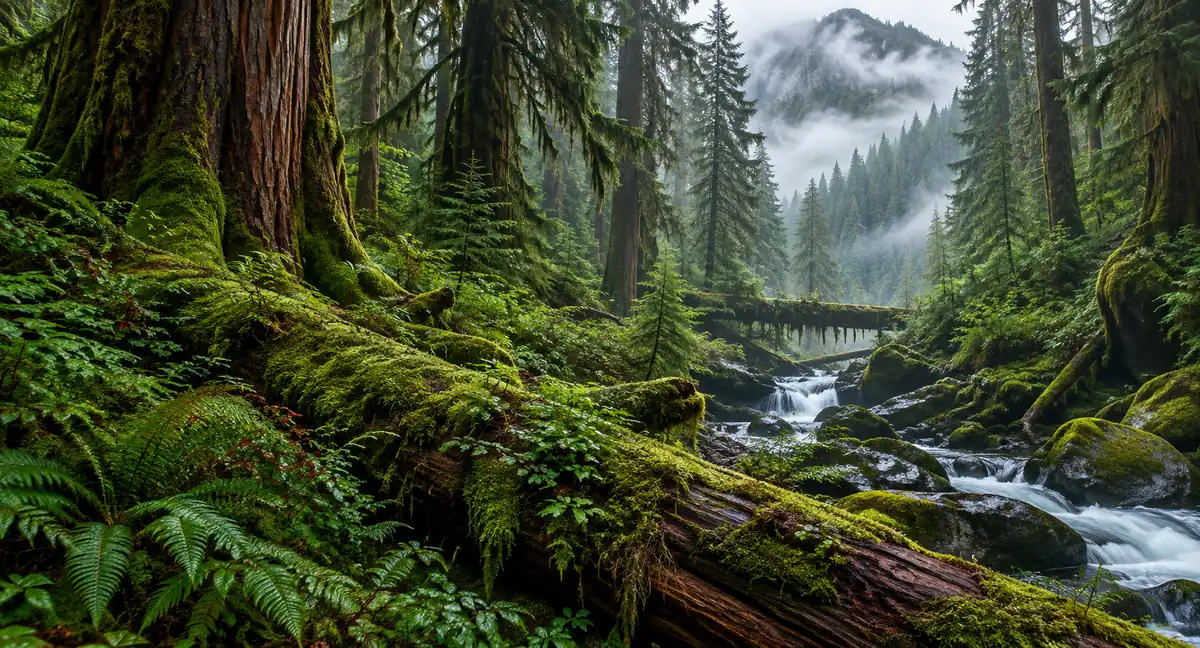
Beyond the painted trunk, orange ribbons disappeared uphill through western hemlock and silver fir. The marked harvest boundary enclosed a wet, shadowed basin threaded with fallen trees. Huckleberry grew from wood so thoroughly decayed it had become a second forest floor.
According to the environmental assessment, this was an even-aged stand established after a fire seventy-six years earlier.
Kenji had spent the morning finding things that couldn’t belong in one.
He knelt beside a windthrown cedar. Its roots had lifted a wall of stones and earth. Underneath lay another cedar, buried before the living tree had begun to grow.
He photographed the exposed layers with a scale.
At forty-one, after fourteen years with the Forest Service, he had become excellent at measuring things that people preferred not to know.
“Do we have enough?” Lila asked.
“For a discrepancy.”
“For stopping them?”
Rain clicked against his hard hat.
“That,” he said, “requires a different unit of measurement.”
At the district office, the unit proved to be meetings.
A regional restoration project had authorized commercial thinning in portions of the Alder Creek reserve: remove selected trees from younger, dense stands, improve forest structure, sell the timber to pay for the work.
Kenji supported that principle. He had published on it.
He did not support applying it to an old-growth basin because someone had called the basin young.
His supervisor, Mara Fenrick, spread his photographs across her desk.
“The contractor’s assessment includes increment cores.”
“From somewhere else.”
“You can establish that?”
“Not yet.”
“Then say ‘inconsistent with field observations.’”
“Those observations include a cedar older than the state.”
“And I need a finding that survives review.”
He looked toward the window. A log truck passed on the highway, its load dark with rain.
Mara leaned back.
“I’ve requested a voluntary hold through Monday. The purchaser agreed. We need the stand classification settled before Tuesday’s start.”
“And if the evidence shows deliberate misrepresentation?”
“Then we refer it for investigation.”
Kenji’s name appeared on page forty-eight of the assessment, beside a reference to an earlier paper. His research had been used to justify the prescription.
The paper concerned thinning plantations.
He touched the page once, then closed it.
Outside Mara’s office, a woman in mud-stained boots was examining the district’s wall map. She had a pencil tucked behind one ear and the stillness of someone who listened before spending words.
“Dr. Hoshimori?”
“Yes.”
“River Ashcombe. Northwest Working Forests Council.”
Of course, he thought.
The industry association had been copied on the hold.
“I’ve been assigned to review your objections,” she said.
“My findings.”
“All right. Your findings.”
She turned back to the map.
“Before we argue, why does the haul-road map put this crossing downstream of the tributary?”
Kenji stepped closer.
A small blue line joined Alder Creek beneath the proposed crossing. On the topographic base, it joined above.
“Different map revisions.”
“Possibly.”
She drew the pencil from behind her ear.
“Or somebody moved a line because it was inconvenient.”
He looked at her properly then.
She met his gaze.
“I dislike those people too.”
River was thirty-eight, a licensed forester, and had spent six years managing logging contracts before becoming someone who explained logging contracts to people who hated them.
“I don’t hate logging,” Kenji said.
They were in the conference room. Rain blurred the parking lot beyond the glass.
“I haven’t accused you of it.”
“You brought three charts about rural employment.”
“You brought a photograph of a very handsome tree.”
“The tree is relevant.”
“So are the people.”
He sat back.
River opened her laptop.
“Fourteen people on the harvesting crew. A mill that’s already cutting shifts. A restoration budget tied to timber receipts. None of that makes your data wrong. It makes checking it urgent.”
That was a better answer than he had prepared for.
He showed her the plot measurements he and Lila had taken: multiple canopy layers, large standing dead trees, deep accumulations of decaying wood. Old-growth structure wasn’t a matter of one ancient survivor. It was a pattern of living and dead things.
River listened, asking precise questions.
“How did you choose your plots?”
“Systematic grid with a random starting point.”
“Same grid as the assessment?”
“No. Independent.”
“Then you could both be measuring different portions of a mixed stand.”
“Yes.”
She glanced up.
“You agree?”
“It’s a valid objection.”
“That was almost painless.”
“Give me time.”
Her mouth moved at one corner.
They overlaid their maps.
The assessment showed twelve plots across the disputed basin. Kenji’s six occupied its northern half. An old fire perimeter crossed both.
River pointed at a narrow strip near the road.
“This burned hard. I’ve walked it.”
“So have I. It’s young.”
“And your basin may have been a fire refuge.”
“Exactly.”
“But until we locate their plots, we don’t know whether this is fraud or terrible sampling.”
Kenji disliked how much he wanted the word fraud to be correct. It would make his anger simpler.
He shut the photograph folder.
“Tomorrow morning?”
“Six-thirty.”
“You know where the gate is?”
“I have the key.”
River’s truck smelled of coffee, wet wool, and orange peel.
She handed him a thermos cup without ceremony.
“Black?”
“How did you know?”
“You look like a man who considers milk an uncontrolled variable.”
He took the cup.
Outside town, the highway followed a river the colour of bottle glass. Sawmill steam stood pale against the foothills. Farther up, clearcuts quilted the slopes, some raw, others furred with twenty years of green.
At the landing, a man in a yellow hard hat waited beside a parked processor.
“Gus,” River said. “This is Kenji.”
“I’ve read your email,” Gus told him.
“I imagine it wasn’t your favourite.”
“Depends whether you’re right.”
Gus was the logging contractor, paid to move machinery before he earned anything cutting trees. Three expensive machines stood idle behind him.
Kenji expected resentment. He got a question.
“Are we in the wrong stand?”
“Possibly.”
Gus rubbed his jaw.
“Well. Better before breakfast on Tuesday.”
River checked the weather briefing on her phone. Moderate rain through midday; a stronger front arriving Saturday night. They agreed on a turnaround time and radio check-ins with Lila.
Then they walked.
At the first reported plot coordinate, they found sword fern, a rotting snag, and no survey stake.
At the second, a shallow pond.
At the third, Kenji stopped talking.
The report listed seventeen Douglas firs in a measured radius. They found four, surrounded by hemlock. A documented forty-six-centimetre fir should have stood near the centre. In its place grew a cedar wider than River’s outstretched arms.
“GPS error?” she asked.
“Not enough.”
“Different datum?”
“We’ll check.”
They checked.
They searched expanding circles through salal that soaked their trousers to the thigh. River found an old beer can and a broken elk antler. Kenji found a metal research tag almost swallowed by bark.
He brushed away moss.
AC–17.
Below it, faintly stamped: 1978.
He photographed it.
“Yours?” River asked.
“Before my time.”
“That must be comforting.”
“Occasionally.”
By noon they had established that three plotted locations did not match their descriptions. They had not located the original field sites or proved anything about intent.
Back at the landing, Kenji showed River his screen.
“Enough to reject the assessment.”
“Enough to question this portion of it.”
He felt irritation rise.
“How many nonexistent firs would satisfy you?”
She took a moment before answering.
“I’m trying to work out whether one basin is misclassified or the whole project is compromised. Those are different decisions for everyone down this road.”
He looked past her at the parked machinery.
“All right,” he said.
It cost him less than he expected.
The old monitoring programme seemed promising until they found its records.
Most had gone to a university archive when the research station closed. The district retained a card catalogue, two mould-stained maps, and a box containing twenty-seven photographs of a retirement barbecue.
Kenji held up a slide.
“Remarkably consistent stand structure.”
River leaned over his shoulder.
“Those are men holding sausages.”
“Very little recruitment.”
She laughed, surprising him into looking at her.
It changed her whole face. He wished, inconveniently, to cause it again.
The archive could provide a finding aid on Monday. The inventory didn’t mention plot coordinates. One of the surviving maps had been eaten along its most useful edge.
By four, the research tag had become an interesting fact attached to a dead end.
Lila came in carrying printouts.
“The consultant sent the field sheets. Scans only. Their analyst says the original GPS files are in a retired system.”
Kenji knew the analyst. Owen Bracknell had once shared a research fellowship with him. Owen had reviewed the assessment for the district under contract, and his signature appeared below the conclusions.
“Did he say when they could recover them?”
“Next week.”
Tuesday was next week.
River spread the sheets across the table.
“What?”
She tapped a column.
“Tree numbers.”
Each field sheet listed numbered trees. Those numbers were not unusual. The sequence was.
“This crew numbers continuously along a cruise strip,” she said. “I’ve used them. They don’t restart at one for each plot.”
Kenji bent beside her.
Three supposedly distant plots contained consecutive tree numbers.
“They could have renumbered them afterward.”
“They could. Let’s ask.”
She called the field contractor on speaker. His office was closed; the number on the invoice reached voicemail.
River left a careful request for the original records.
No accusation. No suggestion of the answer they wanted.
Kenji liked her more for that than for laughing at his joke.
As she gathered the sheets, he noticed pencil marks showing through one scan. Figures from the reverse side.
“Wait.”
They enlarged the page.
The faint words were backwards. He flipped the image.
Road 62. Chainage 840.
River stood very still.
“That’s a distance along a road.”
“Not a location in the basin?”
“Not unless the road has moved several hundred metres uphill.”
They looked at each other.
For the first time, they had somewhere useful to go.
Dinner happened because the district building alarm would arm at eight and neither had eaten since a crushed granola bar at noon.
The only place still serving food was a diner beside the mill.
River ordered chowder and blackberry pie. Kenji ordered the same.
“Peer review?” she asked.
“Replication.”
Rain glittered in the dark windows. At the counter, two men in fluorescent work shirts argued gently over a football game no longer on the television.
River rolled her shoulders.
Kenji noticed a pale scar across one knuckle, the pressure mark her watch left at her wrist. He had begun noticing too much.
“Why advocacy?” he asked.
“Because I got tired of watching decisions made by people who’d never stood on a landing.”
“On either side?”
“Usually both.”
Her father had operated a yarder. Her mother had kept books for a mill. When the mill closed, River had been seventeen.
“Everyone had an explanation,” she said. “Trade. Automation. Timber supply. Environmental rules. Every explanation was partly true, which made them all useful for shouting.”
“What did you think?”
“I thought I wanted a profession where numbers settled things.”
He laughed once.
“Yes,” she said. “I was adorable.”
Kenji turned his spoon over.
“My parents thought research would suit me because I was patient.”
“Were you?”
“With insects. Not with my sister.”
His parents had been born in Tacoma, children of Japanese immigrants. His father repaired refrigeration systems and distrusted any diagnosis made without opening the machine. His mother taught community-college chemistry.
“They didn’t mind forestry?”
“They minded unstable employment. The federal benefits reassured them.”
“And you?”
“I wanted to understand why forests survived what they survived.”
He glanced at the black window.
“Then I wanted understanding to matter.”
River studied him.
“It does.”
“I have forty-three publications. Three get cited constantly by people proposing things those papers don’t support.”
“Do you want policy to follow evidence, or do you want it to follow you?”
He looked back at her.
“That’s an irritating question.”
“I’ve been saving it.”
After a moment, he said, “Evidence. But I’d enjoy an apology.”
She smiled into her coffee.
When they stepped outside, rain drummed on the diner awning.
River stood close enough that he could feel warmth through the damp evening.
“I don’t think you’re trying to stop all logging,” she said.
“I don’t think you’re trying to excuse this.”
“Good.”
Neither moved toward the parking lot.
Then her phone rang.
The field contractor had called back.
By nine on Saturday morning, the apparent contradiction had become a documented one.
The field contractor, a blunt woman named Beth, had sampled roadside stands to evaluate access and possible restoration work. Her contract had not called for a representative inventory of the basin.
She emailed the originals, including GPS tracks, photographs, and the invoice describing her scope.
Eight of the assessment’s twelve plots matched Beth’s roadside measurements exactly.
The coordinates did not.
In the final report, those plots had been redistributed across the basin.
The four remaining plots, genuinely inside it, had been labelled statistical outliers and excluded from the age analysis.
Kenji read the methodology twice.
River sat opposite him at his kitchen table, having arrived with breakfast and a second laptop. She had taken off her raincoat. Her sweater was the soft green of new larch needles.
He resented his brain for recording that alongside scientific misconduct.
“This isn’t poor sampling,” he said.
“No.”
“And it changes more than the stand age. Their stability assessment uses the roadside soils to represent the entire harvest area.”
River opened a photograph. Gravel and shallow roots beneath young firs.
Then Kenji opened his own: deep organic soil above a tight layer of glacial sediment, water moving sideways along the boundary.
The wrong stand data supported the harvest prescription. The wrong soils supported the claim that removing trees would not materially increase slope risk.
Together, the substitutions made the basin appear suitable for logging.
River called her director.
Kenji went to rinse cups, giving her what privacy a small kitchen allowed.
He heard her say, “No, I can’t describe it as a mapping anomaly.”
A pause.
“Because the excluded plots were the ones that contradicted the conclusion.”
Another pause, longer.
“I’ll send you exactly what I’m sending the agency.”
When she finished, she sat for a moment with her phone face down.
“Difficult?” he asked.
“He wants another consultant to review it before we take a position.”
“That’s reasonable.”
“He also wants me to stop corresponding with you.”
Kenji dried his hands.
“What will you do?”
“Send the evidence. Ask him to make any restriction in writing.”
He wanted to touch her shoulder. Instead he put fresh coffee beside her.
“Thank you.”
“Don’t thank me for reaching the same conclusion.”
“For making it expensive to ignore.”
She looked up then.
The kitchen seemed unexpectedly small.
His phone vibrated against the counter.
Owen.
“It was a preliminary spatial allocation,” Owen said.
Kenji put the call on speaker with his permission.
“A what?”
“The field locations weren’t intended to represent literal coordinates.”
“They appear on a map labelled ‘sample locations.’”
“The landscape model needed distribution.”
River leaned forward.
“Did Beth authorize that use of her measurements?”
“This is a technical discussion.”
“I’m a forester, Owen. We can have one.”
Silence.
Kenji kept his voice steady.
“Why were the interior plots excluded?”
“They were unrepresentative of the treatment area.”
“They were inside it.”
“Kenji, you’ve walked six plots. We’ve spent eighteen months on this project.”
“Then help me understand the discrepancy.”
For a moment, only the refrigerator hummed.
Owen sounded tired when he spoke again.
“The reserve needs work. There was no funding without a viable sale. We were trying to keep the project alive.”
“Who changed the locations?”
“I’m not discussing internal drafting on this call.”
“Then preserve it.”
The line went quiet.
Afterward, Kenji sat without moving.
He remembered Owen at twenty-eight, sleeping under a laboratory bench while waiting for samples to dry.
River closed her laptop.
“We don’t have to decide his motives.”
“No.”
“You sound disappointed.”
“I wanted a better answer from him.”
She reached across the table and rested her hand over his.
He turned his hand beneath hers.
Neither spoke for a while.
By midday, Mara had the source records and their comparison. She issued a written temporary suspension of operations in the disputed units and referred the altered records for investigation.
Tuesday’s cutting was stopped.
Kenji should have felt triumphant.
Instead he read Mara’s next message: an independent regional ecologist would arrive Sunday. Before deciding how much of the project required reassessment, the agency needed the boundary between the younger burned slopes and the surviving old forest verified.
Monday’s storm could close access for days.
River studied the weather. The heavier rain was still forecast after dark.
“We could establish the eastern boundary this afternoon,” she said. “The old road gets us close.”
“And the regional reviewer can check our methods tomorrow.”
“Joint field record. Photographs, coordinates, everything.”
He nodded.
They had stopped a bad decision. Now they needed enough sound information to make a better one.
They took the high road into a country of low cloud.
River drove. Kenji navigated from the old fire map, Beth’s tracks, and a slope model on his tablet.
At a bend above the creek, she slowed.
A rusted steel cable emerged from moss, ran beside the road, and disappeared beneath an embankment.
“Old railroad grade,” she said.
“How old?”
“Before trucks took over. See how evenly it climbs?”
He looked beyond the road. A narrow bench continued through the trees.
On the damaged research map, a pencilled line crossed the basin near the surviving plot symbol. He had assumed it marked a trail.
“Could crews have used that to reach the monitoring plots?”
“Easier than climbing from the creek.”
They parked at the agreed turnaround, checked in with Lila, and walked.
The first half-hour took them through straight young firs with little understory. Then the ground folded inward.
Suddenly they were among enormous trunks.
Mist caught in the high branches. A wren sang from a fallen tree with the furious confidence of something much larger.
They found two more metal tags beside the old grade.
AC–18. AC–19.
No archive was needed to explain everything those plots had recorded. They could measure what stood there now.
But the old route helped them find a continuous strip of surviving forest where the project map showed scattered remnants.
Kenji stopped at a blackened cedar.
Fire had hollowed one side. Living bark curled around the wound.
He unfolded the historical perimeter map.
“The line records where the fire travelled,” he said.
“Not what it killed.”
He nodded.
“The report treats everything inside it as replacement forest.”
River looked back along the slope.
“But it skipped through here.”
“And the railroad gave the old monitoring crew a way to follow the survivors.”
They had been looking for isolated old trees within a young stand. The fire map, research tags, and continuous cool basin told a different story.
This was a substantial old forest with a young, heavily burned edge.
They ran a measured transect across that transition, recording vegetation, tree structure, soil, and location. River managed the bearings and distances while Kenji assessed the plots. They exchanged instruments and checked one another’s work.
At the final station, she called out a measurement.
He wrote it down.
“Again?” he asked.
“You don’t trust me?”
“I’m hoping you’ll say it twice. I like your voice.”
She lowered the rangefinder.
For a second, rain seemed louder.
“That,” she said, “is a serious development in the methodology.”
“I’ll note it under limitations.”
She smiled slowly.
“Please do.”
They ate lunch beneath the roof of an abandoned maintenance shelter beside the grade.
The building leaned, but the roof held. Ferns grew through the floorboards at the far end. Someone had once painted KEEP DOOR SHUT on a wall without a door.
River gave him half an orange.
“You’ve gone quiet.”
“I’m thinking about Monday.”
“About Owen?”
“And you.”
She peeled a thread of pith from her thumb.
“My director called while you were measuring the last plot. They’re bringing in someone else to handle the public response.”
“I’m sorry.”
“I’m angry. That’s different.”
He nodded.
“I helped sell this project to the town,” she said. “I told people the safeguards meant something.”
“They can still mean something.”
“If people enforce them.”
“You are.”
She looked out into the dripping trees.
“My father will ask whether I’m sure.”
“What will you tell him?”
“That I checked.”
Kenji felt something settle in him, deeper than attraction and inseparable from it.
“My father would like that answer.”
River looked back.
“And you?”
“I like it very much.”
She moved closer along the bench.
“Kenji.”
“Yes?”
“I’d like to kiss you. I’d also like to keep disagreeing with you when necessary.”
“I have no objection to either.”
She touched his jaw first, giving him a moment to meet her.
He did.
The kiss began softly, almost questioning, then changed when she slid her hand behind his neck. He drew her closer, his palm warm at her waist. She tasted of orange, and her quiet laugh against his mouth undid the last of his restraint.
He kissed her again, more deeply.
For a little while there were no reports, no signatures, no arguments waiting beyond the trees. Only her fingers in his damp hair and the astonishing fact that she wanted to be there too.
When they separated, she kept her forehead against his.
“That was extremely distracting.”
“I’ve recorded a similar finding.”
Her radio crackled.
They both laughed, then listened.
Lila’s voice came thin through static.
“The front’s accelerated. Heavy rain already at the lower gauge. Time to come down.”
River checked her watch.
“Agreed. We’re heading back.”
They reached the truck before the rain became a solid grey curtain.
River transmitted their departure, then drove downhill in low gear.
Water streamed along the wheel ruts. At the second switchback, she stopped.
A muddy fan spread across the road ahead.
Kenji opened his door.
“Stay on this side,” River said. “Let’s look from here.”
He heard it then: stones clicking together somewhere uphill.
Across the blocked culvert, runoff had backed into a brown pool. Water pushed through the road fill below it, carrying fine soil. A small alder leaned outward as they watched.
River reversed to the broad turnout behind them.
The road slumped.
It happened without drama at first: a sag, a widening crack. Then several metres of gravel folded into the creek with a grinding roar.
Kenji’s breath stopped in his throat.
River had both hands on the wheel. Her knuckles had whitened.
After a moment, she switched off the engine.
“Well,” she said quietly.
They reported the washout. The signal broke twice, but Lila received their location and confirmed that Gus’s crew had closed the lower road.
The truck could not go forward. Behind them, the high road ended at an old landing.
They had shelter, food, emergency blankets. They could wait.
Then water began crossing the turnout’s uphill edge.
River studied the ditch from firm ground.
“The culvert failure has diverted the drainage. I don’t want the truck here.”
“Back to the landing?”
“Yes.”
At the landing, the slope above remained steep and densely wooded. They parked away from the edge and checked the map.
Kenji traced the old railroad grade westward.
It joined a spur road beyond the unstable drainage. River had identified the junction that morning.
“Could we walk this?”
“Possibly. There’s a trestle marked near the creek.”
They had passed its remains: moss-covered timbers hanging over empty space.
“No crossing there,” he said.
“Then we wait.”
A gust drove rain hard against the windshield.
Kenji brought up their field track. Beneath the trestle symbol, the terrain flattened briefly before pinching into the creek gorge.
He remembered what he had been too occupied to interpret.
“There’s another channel.”
River leaned over.
“Where?”
“Below plot eighteen. Dry when we crossed it. Alder on both sides, rounded gravel. I thought it was an old stream course.”
He compared the slope model with the field photographs.
The railroad had crossed a side channel. The main creek ran farther west.
“If we follow the grade only to here, then take this bench north, we stay on this side of both channels. It reaches the spur above its bridge.”
River worked through it herself.
“That’s two kilometres. More with the blowdown.”
“Better ground than the road fill.”
“If the bench connects.”
“The contour data says it does. We’ll verify as we go.”
She looked at him.
“We turn back if it doesn’t.”
“Yes.”
No argument. No promise that wanting a route would create one.
They gave Lila the proposed track. Gus could reach the spur from the other valley and wait at its end. If they found the route impassable, they would return to the truck.
River packed the emergency supplies.
Kenji secured the instruments and their duplicated field records inside waterproof bags.
Then they stepped into the rain.
The forest had become a room full of moving water.
It dripped from every needle, ran down bark, gathered in the cuffs of their gloves.
River led along the grade. She recognized places where the apparent path was only rotten decking beneath moss, guiding them onto solid ground beside it.
Kenji kept their position, checking the terrain against the map. At the abandoned channel, water now shone between stones.
They climbed away from it.
A fallen hemlock barred the bench.
River examined the uphill root plate.
“Not underneath.”
They worked around its crown, pushing through stiff branches that caught their packs. Kenji lost his footing in a hollow and went down on one knee.
River stopped.
“Hurt?”
“Dignity.”
“That heals slowly.”
He got up, laughing breathlessly.
Beyond the tree, the bench narrowed. Mud covered a short traverse above a steep drop into salal.
River tested the ground with her pole. The surface slipped.
“We go higher.”
“That takes us toward the seep.”
“I’d rather wet boots than sliding.”
Kenji shone his light through the rain. Several metres uphill, water issued beneath a mat of roots. Below it, the soil bulged.
“That’s saturated fill,” he said. “The grade was built out around this shoulder. Higher puts us on more of it.”
River studied the shape of the ground.
Then she nodded.
“Back thirty metres. We climb on the bedrock rib.”
They retreated.
The detour was slow, awkward work, hands on cold stone, boots finding shallow steps. Neither could have hurried the other without making things worse.
At the top, Kenji turned and offered a hand.
River took it for the last step, then kept hold of it.
For three breaths they stood together, rain running between their joined fingers.
Then her radio spoke.
“River? Gus. I’m on the spur.”
She closed her eyes briefly.
“Good to hear you.”
“Likewise. Got the heater on. Don’t make it a wasted gesture.”
Another twenty minutes brought them to gravel.
Headlights shone through the trees.
Gus stood beside his pickup with two blankets and an expression of profound disapproval.
River took one.
“Professional opinion?”
“Stay indoors more.”
In the back seat, Kenji’s hands shook as he tried to open a food wrapper.
River took it, tore it, and handed it back.
A minute later, she couldn’t manage the zipper on her coat.
He helped her.
Neither commented.
The regional ecologist arrived Sunday with dry equipment and a healthy suspicion of everybody.
Kenji liked her immediately.
Access to the basin would remain closed pending a road inspection, but their methods, geotagged photographs, original measurements, and Beth’s source files gave her enough to recommend extending the suspension. She requested a complete independent inventory before any revised proposal.
Kenji insisted that their joint field record include its limits.
“We haven’t surveyed the whole reserve.”
River nodded.
“And the younger roadside stands still need a separate assessment.”
Mara looked between them.
“That will annoy almost everyone.”
“Efficient,” River said.
The altered source locations went to investigators. Owen was removed from the review. Neither Kenji nor River called it a conviction.
The forest would not be cut on Tuesday.
That evening, Kenji drove River to the motel where she had booked a room rather than face the long wet drive home.
They sat with the engine off.
“I want to see you when there isn’t a disputed methodology between us,” he said.
River considered him.
“There will probably always be a disputed methodology.”
“Dinner, then. With a manageable one.”
“Yes.”
She leaned across the console and kissed him, warm and unhurried.
This time, nothing interrupted them.
Six weeks later, frost silvered the landing.
The independent survey had confirmed the old-growth basin’s extent. The district withdrew those units from the sale and opened the remaining restoration work for reassessment.
An audit recovered successive report drafts and instructions to replace the interior sample locations. The environmental consulting firm lost its contract. The formal investigation continued.
Kenji had wanted a clean ending with an apology.
Instead, he got something more useful: the agency committed to retaining source data and independently checking stand classifications before approving the revised work.
He volunteered to lead that process.
It meant fewer papers that winter, and more meetings than he liked. He made the choice anyway.
River remained with the council after a difficult board review. Some members disliked her report. Others, including contractors who had nearly committed crews to the wrong ground, wanted her involved in the next one.
On a cold Saturday, she met Kenji at the reopened road.
“No clipboard?” she asked.
“Day off.”
She glanced at the small notebook visible in his pocket.
“Your definition needs work.”
They walked into the basin carrying lunch.
They had managed four dinners, one argument about thinning prescriptions, and a Sunday morning in his kitchen during which she discovered he made excellent pancakes and owned no matching plates.
He had learned that she sang badly on long drives and went quiet when worried. She had learned that his silences often meant he was reconsidering, not withdrawing.
They were getting better at asking.
At the old maintenance shelter, River stopped.
“You know, there are places with actual doors.”
“I wanted to show you something.”
Beyond the shelter, sunlight fell through a break in the canopy. The hollow cedar stood bright along one edge, its charred interior black as ink.
Kenji set down the lunch bag.
“The road work funded here next month—new drainage, stable crossings. Gus got the contract.”
River smiled.
“He told me. He also said you asked him three questions about excavators.”
“I had three questions.”
“He was delighted.”
She slipped her hand into his coat pocket, finding his.
“I’m in town Thursday,” she said. “Through Sunday, if you’d like.”
“I would.”
“No emergency fieldwork?”
“I can’t speak for the forest.”
“Speak for yourself, then.”
He turned toward her.
“Stay.”
She kissed him beneath the cedar, her cold fingers closing around his warm ones. Above them, a breeze moved through the high branches, and sunlight travelled slowly across the moss. When they finally stepped apart, they kept hold of each other and walked back toward lunch.
Every ending is somewhere new.
Find your next story →