A Light Below the Water
On a stormbound Hebridean research island, a solitary marine biologist shelters an injured stranger whose secrets threaten the community—and the quiet life she thought she wanted.
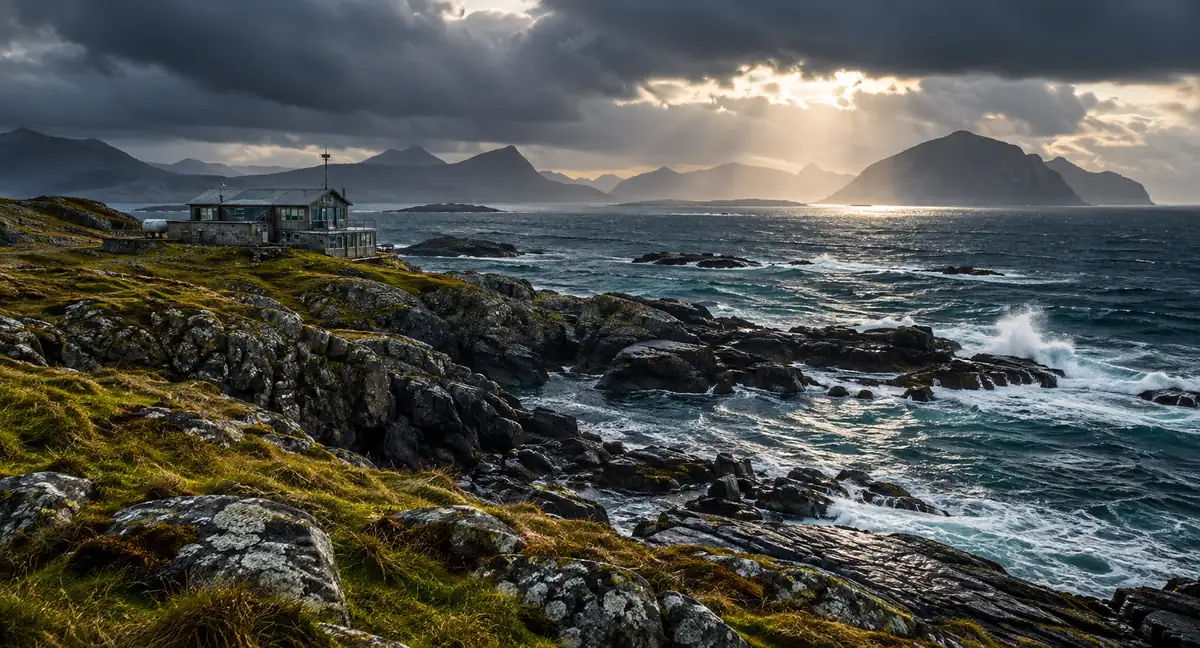
The first person Yuki had invited into her laboratory in eleven days arrived bleeding onto her seawater samples.
“Not that bench,” Yuki said.
The woman looked down at the row of glass vials beneath her elbow.
“Good to know where I rank.”
Then her knees folded.
Yuki caught her awkwardly, knocking a stool sideways. Outside, the storm struck the laboratory windows hard enough to make the black glass shudder.
“Sit. Here.”
“Excellent. More instructions.”
The woman lowered herself onto the stool. Blood ran from beneath her sleeve, bright against a yellow oilskin. Her face was grey with cold, her dark curls flattened against one cheek.
Yuki pressed a clean laboratory towel into her uninjured hand.
“Hold that firmly against the wound.”
The telephone was still off its cradle. From the receiver, the island nurse said, “Yuki? Have you got her?”
“Yes.”
“Is she conscious?”
“Argumentative.”
“Good enough. Keep her warm. I’ll be there when I can.”
Behind the nurse’s voice came shouting, then the crash of something metallic.
The fishing vessel Red Linn had grounded on the island’s southern reef forty minutes earlier. Six people had come ashore in the volunteer rescue boat. The clinic had two beds, one nurse, and a retired GP whose hands shook until someone gave him something useful to do.
Yuki had been summoned to carry blankets and record names. On her way out, she had found the stranger trying the laboratory door.
“What’s your name?” she asked.
The woman watched the open doorway.
“Isla.”
“Isla what?”
A pause.
“Is that necessary for the towel?”
Yuki looked at her.
She had chosen Eilean Darran because its winter population was twenty-three, its research station was almost empty, and most conversations could be concluded by referring to the weather. At thirty-six, she had built a life around work she loved and social obligations she could reliably avoid.
Now someone was bleeding into that arrangement.
“I need to tell the nurse who you are.”
“Isla Ardwyn.”
Yuki relayed it, then fetched the emergency blanket.
When she returned, Isla was staring at the whiteboard above the sample bench.
Beneath Yuki’s tide calculations, someone had written the station’s shipping schedule.
Isla pointed.
“Who handles those collections?”
“Gordon Dunsmere. Station logistics.”
“Does he have a key to this building?”
“Yes.”
Isla closed her eyes.
“Please don’t tell him I’m here.”
The cut required stitches. Isla’s left ankle required a support and, according to Maeve, several days of doing precisely what she was told.
“She won’t,” Yuki said.
“I’m sensing a hostile clinical environment,” Isla murmured.
Maeve secured the dressing around Isla’s upper arm. “You’re both welcome to dislike each other after I’ve dealt with a fractured pelvis.”
The coastguard helicopter had turned back. Another attempt would be made when the wind dropped. Until then, casualties were spread between the clinic and the station accommodation.
Yuki offered her spare room before considering the consequences.
It was closer than the bunkhouse. It had heating. Isla could manage its three steps.
All defensible reasons.
Maeve left antibiotics, instructions, and a look Yuki declined to interpret.
In the cottage kitchen, Isla sat beside the radiator while Yuki heated soup. Wind moaned through the chimney. Beyond the window, the harbour light appeared and disappeared behind sheets of rain.
“You asked me not to tell Gordon,” Yuki said. “You should explain.”
Isla turned a mug between her hands.
“How well do you know him?”
“He collects freight. He repaired my back step.”
“That isn’t what I asked.”
“No,” Yuki said. “It’s what I know.”
Something in Isla’s expression changed.
“I’m a marine electrical engineer. Thirty-eight. Until this morning, responsible for keeping a floating scrapyard supplied with electricity.”
“The Red Linn.”
“And two boats before her. Same operator.”
Yuki put the soup down.
“They recruit people for fishing work,” Isla continued. “Good wages, travel paid. Then there are debts. Fees nobody mentioned. Passports kept in the office. Men moved between boats so they can’t find their way home.”
“Forced labour.”
“Yes.”
“Were you being held?”
“Not at first.”
The radiator clicked.
“I went looking for a deckhand who’d disappeared from the payroll. Found enough to understand why. After that, leaving became complicated.”
She touched the edge of her bandage without seeming aware of it.
“There are four men somewhere on this island. They were landed three nights ago. The skipper said accommodation had been arranged until another boat collected them.”
“Have you told the police?”
“I called the number on a welfare leaflet in the wheelhouse. A port contact. Told him where we were due to dock.”
“What happened?”
“The skipper repeated my exact words to me that evening.”
Yuki sat opposite her.
“That doesn’t mean every authority is involved.”
“No. It means I don’t know which telephone number is safe.”
“Why come to the laboratory?”
“I saw the sign. University buildings usually have phones, first-aid kits, and people who ask awkward questions.”
“You dislike the questions.”
“I was hoping to skip that part.”
Despite herself, Yuki almost smiled.
Isla noticed. It made her look briefly younger.
“The storm wasn’t part of a plan,” she said. “I got off with everyone else. But when they were counting heads outside the clinic, I saw Gordon talking to our skipper.”
“Everyone talks to Gordon.”
“He called him by a name he doesn’t use on this island.”
Yuki thought of Gordon delivering oranges with her groceries last week. Of his large, careful hands fitting a new hinge to her door.
“Do you have evidence?”
“Some.”
“Then we preserve it. We find a reliable way to report this. I won’t promise to keep a crime secret.”
“I’m asking you to keep me out of Gordon’s hands.”
“That,” Yuki said, “is a different promise.”
She pushed the soup closer.
“I can make that one.”
By morning, the ferry was cancelled for a second day, the helicopter had taken the two most seriously injured men, and Gordon had knocked twice.
The first time, Yuki was helping at the clinic.
The second, Isla was in the cottage bathroom and Yuki stood in the doorway holding a jar of coffee.
“Heard you took in one of the crew,” Gordon said.
His beard was wet. Behind him, the island’s narrow concrete road climbed between black cottages toward the station.
“Maeve needed beds.”
“Skipper’s arranging somewhere for her.”
“She’s under medical care.”
“I could take her bags up.”
“She has none.”
For a moment his friendly expression rested, like a hand set down on a table.
“Best not get involved in boat business, Yuki.”
“I’m already involved in her dressing changes.”
He gave a small laugh.
“Well. Let me know when she’s moving.”
Yuki closed the door.
From the bathroom, Isla said, “That went badly.”
“He didn’t ask how you were.”
“No.”
Yuki put down the coffee jar. Her hands were shaking.
She found this irritating.
Isla came into the kitchen on the crutch Maeve had supplied.
“You can still tell me to leave.”
“Where would you go?”
“That’s my problem.”
“It would also become mine.”
They looked at each other.
Then Yuki said, “Show me your evidence.”
Isla’s phone had drowned. A memory card, sealed inside the lining of her oilskin, had survived.
At the laboratory, they opened its contents on an offline computer. Isla had copied wage sheets, fuel invoices, and freight documents while repairing a bridge terminal. There were photographs of passport pages and a handwritten list of deductions.
Some files were unreadable. Others proved very little without context.
“This says an advance was paid,” Yuki said.
“It wasn’t.”
“Can you establish that?”
“With testimony.”
“From people we haven’t found.”
“I’m aware.”
Yuki softened her voice.
“I’m trying to understand what will stand up.”
“So am I.”
They worked in silence for several minutes.
Then Yuki opened a freight declaration.
Her own name appeared at the bottom.
She leaned forward.
“What is it?” Isla asked.
“Apparently I shipped eight hundred litres of live research cultures last month.”
“Did you?”
“My entire collection would fit in a small bath.”
The declaration listed organisms, temperatures, handling requirements. At first glance, it looked authoritative.
At second glance, it was nonsense.
“This species needs pressure vessels,” Yuki said. “This one is a shallow-water organism. And these temperature instructions would kill both.”
“Could it be an administrative mistake?”
“Three mistakes and a forged signature.”
She opened two more declarations. Different dates. Similar volumes. The same signature.
Her signature.
“They’re using scientific freight,” Isla said.
“Or pretending to. Live cultures discourage casual inspection. People worry about contamination.”
Yuki checked the university’s shipment records against the copied files.
No corresponding consignments existed.
She saved the comparisons, recorded how she had made them, and copied everything twice.
Behind her, Isla watched with a stillness that felt different from suspicion.
“What?”
“Nothing.”
“That rarely means nothing.”
“You’re angry very neatly.”
Yuki looked back at the forged signature.
“I’ve had practice with peer review.”
Isla laughed, then winced at her arm.
Yuki found she wanted to hear the laugh again under better circumstances.
The declarations named the old quarantine annex as the collection point.
It stood half a mile beyond the station, where a low causeway crossed a channel between black rocks. Once, visiting researchers had kept imported shellfish there. Now it stored broken aquarium stands and equipment nobody had the budget to dispose of.
Gordon controlled the keys.
Yuki had a university master key.
Isla watched her take it from the drawer.
“You’re not bringing me?”
“Your ankle—”
“Will object. My eyes still work.”
Yuki considered the route: rough ground, but no climbing. The wind had dropped enough to walk safely.
“We turn back if it worsens.”
“Agreed.”
“And you tell me if you can’t manage.”
“I can manage being told things once.”
Outside, rain travelled sideways across the grass. Isla shortened the crutch and placed its tip carefully between stones.
Yuki adjusted her pace without commenting.
At the causeway, Isla stopped.
A cable ran from a junction box along the annex wall. She studied it, then the rusted ventilation fan above the door.
“No power.”
“It was disconnected years ago.”
“Then nobody’s been heating this.”
Inside, the air smelled of dust and old salt. Yuki opened cupboards. Isla checked for recent wiring, chargers, anything that suggested occupation.
There were no bedding rolls, food packets, or fresh marks in the dust.
The place had not held four people three nights earlier.
Yuki stood between empty tank frames, feeling foolishly disappointed.
“The paperwork could name a collection point without anything ever being here,” Isla said.
“I should have considered that.”
“We did. We came to eliminate it.”
On the way back, they sheltered behind the stone wall of an abandoned garden. Isla was breathing harder than she had admitted.
Yuki handed her a flask.
“Tea?”
“Ginger.”
“An adventurous answer.”
“My mother sends it from Sapporo. She believes Scotland is a prolonged medical emergency.”
“She’s seen the weather forecast.”
Yuki smiled into her own cup.
Beyond the wall, the sea shouldered against the rocks. For a few seconds, winter sunlight broke through and made every wet blade of grass shine.
“What brought you here?” Isla asked.
“A fellowship.”
“Very moving. Tell it again.”
Yuki looked at her.
Isla lifted one shoulder. “You don’t have to.”
Perhaps that was why Yuki answered.
“I like fieldwork. I like having time to think. In Edinburgh, every day involved teaching, meetings, being available.”
“You weren’t happy?”
“I was tired in a way that sleep didn’t improve.”
“So you came somewhere people might leave you alone.”
“Yes.”
“And got me.”
“You weren’t in the fellowship description.”
“I’d have improved it.”
Yuki laughed before she could decide not to.
Isla looked pleased, but mercifully did not mention it.
On the final stretch, she stumbled. Yuki offered her forearm.
Isla took it.
Neither pretended it meant more than balance.
Neither seemed in a hurry to reach the door.
That evening, Ewan Keldrie delivered groceries to the station.
He had ferried Yuki across from the mainland in October, explaining which harbour steps became slippery first and refusing payment for the extra luggage containing her equipment.
Now she watched from the laboratory window as he carried two sacks of potatoes into the stores.
Then he loaded a carton of food back onto his trailer.
“Could be for his house,” Isla said beside her.
“It could.”
Yuki hated how quickly suspicion had spread through familiar things.
Ewan drove toward the north of the island.
There were only three occupied buildings that way: his cottage, the lighthouse keeper’s house, and a small maintenance bothy.
Beyond them stood the disused hatchery.
Yuki turned toward the wall monitor.
The station’s electricity came from a shared wind-and-diesel microgrid. Each outlying building had a separate meter. For weeks, the hatchery circuit had been drawing power at odd hours.
Gordon had said frost protection.
She had accepted it.
“What?” Isla asked.
Yuki brought up the usage history.
“Would frost protection look like this?”
Isla pulled over a chair.
There were short, steep peaks, separated by low steady consumption.
“Not usually. That’s a motor starting. Something substantial.”
“A pump?”
“Could be. The base load could be heating, lighting, refrigeration. This alone doesn’t tell us.”
Yuki opened another dataset.
At the coastal sampling station below the hatchery, the water temperature had jumped several times over the past fortnight. She had flagged it as a possible sensor fault.
The jumps coincided with the electrical peaks.
“I sample this outfall,” she said. “There’s been an unexpected change in the light-producing bacterial population. I thought warmer water might explain it, but Gordon said the building was empty.”
Isla moved closer to see the graph.
Her shoulder brushed Yuki’s.
Neither moved away.
“Warm discharge from a cooling system?” Isla asked.
“Possibly. The hatchery has a seawater heat exchanger.”
“Then it’s being used.”
“Something in it is.”
They compared timestamps. Every temperature pulse followed a motor start by approximately four minutes.
The annex paperwork had sent them to a dead building. The station’s own instruments were pointing to a live one.
Isla rubbed her mouth.
“One of the men who came back aboard before the last transfer said he couldn’t sleep ashore. Said there was water running over his head.”
“The hatchery’s header tanks,” Yuki said.
“Or a bad roof.”
“Or a bad roof.”
They sat with it.
Then Yuki said, “We need to look.”
“From outside.”
“Yes.”
“And we need somebody else to have these files first.”
Yuki glanced at her.
Isla’s expression was steady.
“I’m frightened of the wrong person receiving them. I’m more frightened of nobody receiving them.”
The island’s internet connection had been down since the storm damaged the mast. The station possessed a portable satellite terminal for field expeditions, but it had failed its last test.
“Power problem,” Yuki said.
Isla raised an eyebrow.
“At last. A social occasion suited to my interests.”
The terminal had a corroded connector and a battery that no longer held charge.
Isla worked at the kitchen table, using Yuki’s electronics kit and refusing assistance until she needed someone to hold a light.
“You can say please,” Yuki observed.
“I was building suspense.”
Outside, dusk turned the windows blue. Yuki made rice, fried eggs, and the last of a cabbage.
Isla finished the repair before dinner.
They carried the terminal outside, clear of the cottage wall, and established a connection beneath a sky racing with cloud.
Yuki contacted the university’s emergency duty officer through the official staff directory. She explained the forged freight documents, the suspected forced labour, the injured witness, and their concern about a compromised local contact.
She asked for police and coastguard coordination through independently verified channels.
Nobody promised an immediate arrival.
Nobody dismissed her.
A detective spoke to Isla. A reference number was given. The files went through slowly, in batches.
The detective told them to avoid approaching suspected offenders, keep their location private, and report any sign of an imminent transfer.
By the time they came inside, the rice had cooled.
Isla sat down heavily.
Yuki reheated dinner without speaking.
“You’re not going to say I should have done that earlier?” Isla asked.
“No.”
“Why?”
“You know why.”
For a while, the only sound was cutlery.
Then Isla said, “I wired an alarm on the Red Linn. The skipper said men were going into the machinery space at night. I thought it was a safety problem.”
Yuki waited.
“It also told him when someone left the accommodation corridor.”
“Did you know that when you installed it?”
“No. But I knew later.”
“What did you do?”
“Made it unreliable.”
Yuki looked up.
“Intermittent faults are a terrible thing at sea,” Isla said.
There was no humour in her face now.
“I stayed too long trying to fix things from inside.”
“Perhaps. You also collected evidence.”
“It doesn’t make everything before it clean.”
“No,” Yuki said. “It doesn’t.”
Isla’s gaze held hers.
Yuki had the sense that an easier reassurance would have cost them something.
After dinner, she checked Isla’s dressing. The wound was clean. Isla sat very still while Yuki secured the tape.
“You’re concentrating quite hard,” Isla said.
“I’m a biologist. You’re unusually large.”
“And poorly labelled.”
“Extremely.”
Yuki’s fingers rested for a moment against the warm skin below the bandage.
She withdrew them.
Isla did not reach after her.
Instead she asked, “Would you sit here a while?”
Yuki sat.
They listened to the wind diminishing around the cottage.
For once, another person’s silence did not feel like a question she was failing to answer.
They saw the men through a gap in the hatchery’s boarded window the following morning.
Four adults in a room that had once held feed sacks. A heater. Mattresses. One man washing a shirt in a bucket.
The external door was secured with a padlock.
Yuki photographed it from behind the old concrete intake housing. Isla recorded the positions of the doors, the trailer tracks, the path to the landing.
A boat lay beyond the seawall.
Not the grounded Red Linn. A smaller workboat, with Ewan’s blue wheelhouse.
They retreated the way they had come.
At the cottage, the detective confirmed receipt of the images.
A mainland team was preparing to travel as soon as conditions permitted. Local responders had not been briefed broadly because the suspects’ connections were still unclear.
“Can you establish whether the vessel is preparing to leave?” the detective asked. “Only from a safe position.”
Yuki could see the north channel from the sampling hut.
She said so.
Then Gordon’s voice came from outside.
“Yuki?”
Isla moved first, closing the laptop.
Yuki’s pulse struck painfully in her throat.
“Take the terminal into the bedroom,” she whispered. “Keep the call connected.”
She opened the cottage door halfway.
Gordon stood on the step. Ewan waited by a trailer carrying two fuel drums.
“We need the station keys,” Gordon said.
“Why?”
“Fuel delivery. Some access changes.”
“You have keys.”
“Master set.”
Yuki kept one hand on the door.
“I’ll need an email from the station director.”
His eyes moved over her shoulder.
“You’ve been busy.”
“Yes.”
“Your guest’s putting you in a difficult position.”
“My guest is recovering from an injury.”
“She stole commercial records. Whatever story she’s told you, you should think about your own career.”
The mention of her career steadied Yuki.
There it was: something solid beneath the friendliness.
“You signed my name to freight declarations,” she said.
Gordon went still.
It was a mistake to reveal what she knew.
She saw that at once.
From the bedroom, a floorboard creaked.
Gordon pushed against the door.
Yuki braced it with her foot.
“Leave.”
“You don’t understand—”
“Leave.”
Ewan stepped forward, glanced toward the neighbouring cottage, and caught Gordon’s sleeve.
“Not here.”
For a moment nobody moved.
Then Gordon stepped back.
They drove away without the keys.
Yuki shut the door and turned the lock.
Isla emerged with the terminal tucked under her good arm.
“The detective heard.”
“I shouldn’t have told him.”
“No. But we work from here.”
Outside, an engine accelerated north.
The detective’s voice came thinly from the laptop.
“They may move the men. Stay inside. Assistance is being redirected.”
“How long?” Yuki asked.
A pause.
“Not soon enough to guarantee interception at the island.”
Isla looked at the window.
Yuki looked at the tide chart pinned above her desk.
High water was at eleven forty.
The hatchery landing could take Ewan’s boat for perhaps forty minutes either side.
“They have a departure window,” she said.
“So do we,” Isla answered quietly.
The detective was explicit: they were not to confront Gordon or Ewan.
Yuki agreed.
Then she explained that the locked room had a second entrance.
She knew because she had spent six wet mornings sampling the hatchery’s old seawater system. A maintenance gallery ran below the building from the intake house. It emerged behind the tanks, inside the perimeter fence.
The men could be brought out without going near the main door.
“If access is safe,” the detective said, “and you can do it without approaching the suspects, get them to shelter. Withdraw if circumstances change.”
Yuki contacted Maeve and gave her the reference number. The nurse would open the clinic’s rear entrance, ready blankets, and stay on the phone.
Then Yuki spread a plan of the hatchery across the kitchen table.
Isla pointed to the gallery.
“Is it dry?”
“At this state of tide. Water enters through a cracked sluice at high water.”
“How much?”
“Enough that we don’t remain there.”
“Yuki.”
“I measured it. This isn’t optimism.”
Isla examined the times written beside the plan.
“All right.”
They packed torches, bolt cutters from the station maintenance cupboard, warm clothing, and a first-aid kit. Isla added insulated tools.
Yuki caught the movement.
“No electrical heroics.”
“Only if I find something straightforward.”
“That is what people say before electrical heroics.”
Isla set the tools down and met her eyes.
“I won’t make you responsible for a risk you haven’t agreed to.”
The room went quiet.
Yuki nodded.
“Thank you.”
At the door, Isla stopped her with a light touch on her sleeve.
“You don’t have to become someone who likes danger.”
“I don’t.”
“Good.”
“I would also prefer a much easier beginning to whatever this is.”
Isla’s expression opened.
“Whatever this is?”
Yuki felt heat rise into her face. Inconveniently, there seemed to be no professional vocabulary available.
“I would like to find out.”
“So would I.”
Isla glanced at Yuki’s mouth, then back to her eyes.
“Later?”
“Definitely later.”
They went out into the cold.
The maintenance entrance lay beneath a slope of marram grass, invisible from the hatchery yard.
Yuki unlocked it.
Inside, their torch beams caught pipes furred with salt. Water dripped into a shallow channel along the floor. The air smelled of iron and seaweed.
Isla moved carefully, testing every step with her crutch.
Halfway through, Yuki stopped.
The channel beside them was flowing inward.
Too early.
She crouched, touched the water, and shone her light along the wall. A floating scrap of kelp travelled toward the hatchery.
“Surge,” she said.
The wind had fallen, but the sea outside was still piling against the northern shore. Her predicted safe window had shortened.
“How long?” Isla asked.
“I can’t give you a reliable number.”
“Then we don’t bring four people back through this.”
Yuki stared at the moving water.
Beyond the gallery door, four people were locked in a room.
Behind her was an exit she could still use.
She took one slow breath.
“We go forward. There’s a pedestrian gate above the western drain. The fence is chained, but we have cutters. The path beyond reaches the clinic.”
“Can they see it from the landing?”
“Part of it.”
Isla considered.
“Better than a flooding tunnel.”
They continued.
The inner door opened beneath a row of header tanks.
Warm air struck Yuki’s face.
Somewhere overhead a pump thudded into life—the same motor that had made the peaks on her screen, sending warm water past her instruments while she sat in the laboratory wondering why the bacteria had changed.
She had been looking at evidence for weeks.
She pushed the thought aside.
They found the storeroom door behind a stack of plastic crates.
Yuki knocked softly.
“We’re here to help.”
Silence.
Isla stepped close.
“Tomas? It’s Ardwyn. From the Red Linn.”
Movement inside.
A man spoke, too quietly for Yuki to hear.
“The engineer,” Isla said. “Yes. The one who fixed your radio.”
The cutters bit through the padlock shackle on the third attempt.
Four men watched them from the other side.
Yuki kept her hands visible.
“My name is Yuki. We’ve contacted police on the mainland. There’s a nurse expecting you. You can come with us.”
“Police here?” asked the oldest man.
“Coming.”
His expression tightened.
“Not yet,” Yuki said. “I won’t tell you otherwise.”
Tomas looked past her at Isla.
She nodded once.
He reached for his boots.
They were almost at the western exit when the main door rattled.
Voices.
Ewan said, “Get them down now.”
Gordon answered something Yuki couldn’t make out.
She guided the men behind an empty tank.
The hatchery’s outer door opened.
Isla pointed toward the pump controls, then toward the western passage. Yuki understood: machinery noise could cover their movement.
She nodded.
Isla pressed the labelled manual-run switch. The old transfer pump started with a metallic clatter.
Gordon swore.
Yuki led the men along the passage.
Behind her came the scrape of Isla’s crutch.
At the pedestrian gate, the chain was heavier than she remembered.
The cutters slipped.
She repositioned them.
From inside the hatchery: “They’re gone.”
Yuki pulled hard.
Nothing.
Tomas put his hands over the second handle.
“Together.”
They squeezed.
The chain snapped.
The men went through.
Isla was last, her face white with pain.
Then Gordon appeared at the end of the passage.
“Stop.”
Yuki pulled the gate closed.
There was no chain left to secure it.
Gordon ran toward them.
Isla shoved her crutch through the bars and across the frame. Gordon struck the gate hard enough to jar it against the improvised brace.
“Go,” Isla said.
Yuki put Isla’s arm across her shoulders.
They moved.
On the slope above the drain, the wind caught them fully. One of the men turned back and took Isla’s other side.
Behind them, metal clanged.
The gate would delay Gordon for seconds.
But the path ahead curved behind a low basalt ridge. Beyond it stood the sampling hut, and beyond that the first cottages.
Yuki knew every dip in this ground.
“Left here. Keep below the wall.”
They reached the ridge as Gordon forced the gate.
He shouted their names.
Nobody stopped.
At the sampling hut, Yuki pressed the station radio’s emergency button and gave their position on the agreed channel.
Maeve answered.
Then another voice: a coastguard team approaching from the southern landing, where the island’s sheltered steps had finally become usable.
“Continue toward the clinic,” the voice said. “We’re coming to meet you.”
Yuki looked back once.
Gordon had stopped beside the ridge.
He could hear the radio.
For the first time since he had knocked on her door, he seemed uncertain what to do with his hands.
The clinic smelled of wet wool and toast.
Maeve sat the four men near the heater and addressed each by name. Nobody was separated from anyone they wanted beside them.
Yuki found that small fact unexpectedly difficult to bear.
She went outside.
The wind had eased to a cold, persistent shove. Across the harbour, a police launch stood off the pier while its crew prepared to come alongside.
Ewan’s boat had not left.
Coastguard volunteers had found him at the north landing; after the escape, there had been nobody to load aboard.
Gordon was in the station office with a police officer.
More officers were coming. So were interpreters.
It was not finished, but it had become larger than two women and a collection of copied files.
The clinic door opened.
Isla came out using a borrowed walking stick.
“That’s a demotion,” Yuki said.
“My crutch died nobly.”
“You shouldn’t be standing.”
“Neither should you. Apparently we’ve both annoyed Maeve.”
Yuki tried to answer.
Instead, she began to shake.
Isla moved closer without touching her.
“May I?”
Yuki nodded.
Isla put her good arm around her. Yuki leaned carefully against her uninjured side.
For a minute, they stood like that beside the clinic wall.
“I was frightened,” Yuki said.
“I noticed.”
“I don’t mean slightly.”
“I know.”
Yuki closed her eyes.
Isla’s coat smelled of salt, warm machinery, and the ginger soap from Yuki’s bathroom.
Eventually Yuki drew back enough to look at her.
“Is later now?”
Isla’s face changed.
“It can be.”
“I’d like to kiss you.”
“Yes,” Isla said softly. “Please.”
The first kiss was tentative only because they were both trembling.
Then Isla’s hand settled at the back of Yuki’s neck, and Yuki stepped closer, and the cold seemed to fall away from the narrow space between them.
Isla kissed her slowly, then with a warmth that made Yuki grip the front of her coat.
There was no uncertainty in it now.
Only the careful pressure of their mouths, the faint catch of Isla’s breath, and the startling pleasure of wanting something she did not have to talk herself into.
When they parted, Isla rested her forehead against Yuki’s.
“I’m going to be inconvenient,” she said.
“You already are.”
“Statements. Lawyers. Possibly moving around for a while.”
“I understand.”
“You can think about it.”
Yuki brushed a curl away from Isla’s cheek.
“I intend to.”
Then she kissed her again.
Six weeks later, Yuki gave evidence from a quiet room in Glasgow.
The false research consignments had provided investigators with dates, vessels, and a route through records that had previously looked unrelated. The four men’s accounts gave those movements human meaning.
Gordon and Ewan had been charged. So had the skipper of the Red Linn and two men on the mainland.
The investigation continued beyond them.
Isla’s testimony would take longer. There were things she had witnessed, things she had wired, things she wished she had understood sooner. She had a solicitor, a named police contact, and work offered by an engineering firm that had checked her references rather than demanding she explain her whole life.
Yuki had offered no promises about making any of it simple.
She had offered Thursday.
They met outside a railway station under a sky the colour of unpolished steel.
Isla was no longer limping.
“You look disappointed,” she said.
“I’d prepared to walk very slowly.”
“We can still do that.”
They found a small restaurant where the windows steamed over and nobody knew either of them. Yuki ordered without rehearsing. Isla told a story about an apprentice who had labelled an entire fuse board “miscellaneous.”
Halfway through dinner, Yuki realised she had not once wondered when she could leave.
Later, in Isla’s temporary flat, she took off her own coat and hung it beside Isla’s.
That, somehow, felt more intimate than the kiss at the clinic.
Isla noticed her looking at the two coats.
“You can move it if the arrangement offends you.”
“It’s acceptable.”
“High praise.”
Yuki crossed the room and kissed her.
This time there was no injury to negotiate, no radio waiting to interrupt. Isla drew her close, paused long enough to let Yuki choose the remaining distance, and smiled against her mouth when she did.
Outside, buses hissed along the wet street.
Inside, the evening became theirs.
In March, Isla returned to Eilean Darran on a ferry that smelled of diesel and toasted sandwiches.
Her visit was for four days. The return ticket was in her pocket. Yuki liked knowing they were choosing something with edges they could see.
At the harbour, Maeve waved from her doorway.
Yuki waved back.
Isla watched this with interest.
“Careful. You’ll acquire acquaintances.”
“I have several. It’s becoming serious.”
The station had a new logistics contractor. The hatchery remained sealed while investigators finished their work. At the clinic, a postcard had arrived from Tomas, thanking Maeve and reporting, at some length, on the inadequacy of British soup.
Ordinary things were returning.
Different ordinary things.
Yuki took Isla to the laboratory after sunset.
On the bench stood a flask of dinoflagellates, cultured from local water for an outreach demonstration Yuki had reluctantly agreed to give.
“An audience?” Isla asked. “Should I alert someone?”
“Six people. Strictly limited.”
“And me?”
“You’re helping with the lights.”
Isla switched them off.
Darkness settled around the glass.
Yuki lifted the flask and gave it a gentle swirl.
Blue light spilled through the water, bright as a small galaxy turning in her hands.
Isla went quiet.
Yuki watched her face in the glow.
“For years,” she said, “this was the part I liked best. Being the only person here to see it.”
“And now?”
Yuki set the flask down and took Isla’s hand. With their joined hands, she stirred the water once more, and the blue light rose around them.
Every ending is somewhere new.
Find your next story →